

Mo
3K posts

Mo
@motypes
Enterprise & Institutional Privacy @ethereumfndn. Formerly @goldmansachs, serial founder and @techstars alum.
เข้าร่วม Mayıs 2010
1.6K กำลังติดตาม1.3K ผู้ติดตาม

Interesting.
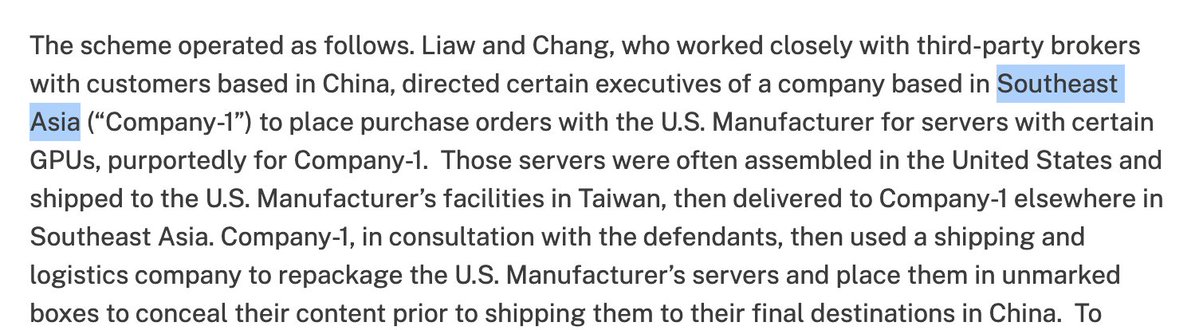
Do we know which country in South East Asia?
National Security Division, U.S. Dept of Justice@DOJNatSec
Three Charged with Conspiring to Unlawfully Divert Cutting Edge U.S. Artificial Intelligence Technology to China “The indictment unsealed today details alleged efforts to evade U.S. export laws through false documents, staged dummy servers to mislead inspectors, and convoluted transshipment schemes, in order to obfuscate the true destination of restricted AI technology—China,” said John A. Eisenberg, Assistant Attorney General for National Security. “These chips are the product of American ingenuity, and NSD will continue to enforce our export-control laws to protect that advantage.” 🔗: justice.gov/opa/pr/three-c…
English
The interesting thing about telco on-chain isn't the tech. It's the identity layer.
Exploring phone numbers as identity for agent-based transactions. Not wallets, not emails but phone numbers. The thing 5 billion people already have.
What if your phone number could sign transactions?
Most identity proposals start with crypto-native assumptions. This one starts with what people already use.

English
Private logic, public settlement. An elegant solution by @iptf_updates . PoC , write up and report. As always open source.
This team ships !
IPTF@iptf_updates
PRIVATE LOGIC ON PUBLIC RAILS We built a DIY validium where the business logic is ordinary Rust, proved in zero knowledge, and verified on Ethereum Simple idea: write the rule, prove it, verify it on-chain iptf.ethereum.org/diy-validium/
English
Mo รีทวีตแล้ว

Once @leanethereum is fully deployed, Ethereum will be the only major chain that simultaneously has (i) theoretically optimal security properties under synchrony [requires 51% of online validators honest], and (ii) strong economic finality under asynchrony. Most "semi-centralized fast chains" pick (ii) only, PoW chains pick (i) only, Ethereum gets both.
English
Mo รีทวีตแล้ว
I feel like at every level we've implicitly made this decision that running a node is this oh so scary devops task that it is ok to leave to professionals.
IT IS NOT.
We need to reverse this. Running your own Ethereum infrastructure should be the basic right of every individual and household.
"The hardware requirement is high, therefore it's okay for the devops skill and time requirements to also be high" is not an excuse. Even people who can afford high-end hardware, dedicated staking boxes, etc often do not have a lot of free time. Nodes should be easy.
English
A look at TEEs for cross chain atomic swaps
IPTF@iptf_updates
New post: Private Crosschain Atomic Swaps (Part 2 of 2) Part 1 built the shielded pool and stealth addresses. The missing piece was coordination. How do two institutions reveal secrets simultaneously without trusting each other? This post opens the black box.
English
Mo รีทวีตแล้ว


payments are obviously useful, but they are boring and mostly BD driven
the most interesting crypto fields that are viable alternatives to AI & robotics brain drain are:
- permissionless trading, mev, and microstructure (spot, perps and predictions)
- zk and privacy systems
English
Mo รีทวีตแล้ว
Crypto privacy is needed if you want to make API calls without compromising the information of your access patterns.
eg. even with a local AI agent, you can learn a lot about what someone is doing if you see all of their search engine calls
first-order solution to that is to make those calls through mixnet
but then (or in fact, even without the mixnet) the providers will get DoSed, and they will demand an anti-DoS mechanism, and realistically payment per call
by default that will be credit card or some corposlop "yeah we'll get to the privacy later" stablecoin thing
so we need crypto privacy
But yes, for privacy you have to think full stack. Local AI agent layer is very important.
It is like longevity: if there are 10 things damaging your body, curing one of them increases your longevity by 11%, curing two by 25%, and curing three by 42% (1 / (1 - 0.3) minus 100% base). Risks from data leakage are similar, and so mitigations similarly compound super-additively.
English
Mo รีทวีตแล้ว

A look at cross-chain private DvP using shielded pools & stealth addresses.
Private cross chain settlement is a hard problem.
Fantastic write up by @p1ge0nh8er and @yanis_mezn
IPTF@iptf_updates
Atomic settlement is a hard problem. Two parties, two assets, neither wants to move first. On a single chain, a smart contract enforces both sides at once. Cross-chain, that guarantee doesn't come for free.
English
Mo รีทวีตแล้ว

Today, Bitwise is donating $100,000 to support Ethereum open-source developers, who work tirelessly to secure and maintain the network.
When the Bitwise Ethereum ETF $ETHW launched in July 2024, we committed to giving 10% of ETHW’s gross profits back to the Ethereum ecosystem each year. Today, we’re excited to be making our second annual donation.
The funds will go to two non-profit initiatives—@ProtocolGuild and @PBS_Foundation—with critical missions: supporting Ethereum protocol research and development, and helping develop and maintain open-source Ethereum infrastructure.
To the investors who’ve chosen Bitwise and ETHW, thank you. We hope you’re as proud as we are to give back to the developers who make Ethereum better every day. We look forward to making more contributions as ETHW continues to grow.
We believe Ethereum is changing the world, and we will always strive to do our part to be a good steward of this incredible ecosystem alongside you.
From all of us at Bitwise, thank you.
GIF
English
Across almost all types of institutions, profit / non profit etc , Ethereum consistently surfaces as the preferred layer for tokenisation. The infrastructure edge is clear.
Joseph Chalom@joechalom
Just got back from an energizing trip to Hong Kong, South Korea, and Japan. The depth and vitality of ETH interest across these regions is real and accelerating. Here's what I saw, and why it matters. 🧵
English
Mo รีทวีตแล้ว
I think it's healthy for us in the Ethereum world to have a more bold and open mindset to many things, particularly on the application layer and on how we see ourselves in the world.
We should not compromise on core properties: censorship resistance, open source, privacy, security (CROPS). We should not have "open mindedness" of the type that leaves people with no confidence of what security properties the L1 will still have one year from now. We should not ask ourselves questions like "do we really need light clients to be able to trustlessly verify correctness of the chain?". But especially on the layer of applications and Ethereum's interface to the world, we should be more willing to radically rethink various concepts and step outside our comfort zone.
This includes issues of technological direction, eg. "what if AI basically means that wallets as browser extensions and mobile extensions are dead within a year?"
One example last year was the shift to thinking about privacy as a first-class consideration, something we value equally to the other types of security. This implies a radically different Ethereum application stack, because the entire stack so far has not been built around privacy. Great, let's build a radically different Ethereum application stack!
An example this year is the growing work on the networking side of privacy, both inside the EF and outside.
It includes application-layer issues, eg. "what if the rest of defi is basically just universal futures markets on top of a good decentralized oracle and letting users self-organize on top of that?", and "what if the ideal decentralized oracle is just a SNARK over M-of-N small LLMs over zk-TLSes of some major news sites?"
(BTW this is interrelated with the AI issue: one consequence of AI is that it moves "applications" away from being discrete categories of behavior with discrete UIs, and more toward being a continuous space, so "build fewer apps and rely on users to self-organize around them" should inevitably expand as a pattern)
One example this year is rethinking from zero the role of L2s, and what kind of L2s are actually most synergistic and additive to Ethereum.
It also includes culture. This is a big part of "the whole milady thing" for myself, @AyaMiyagotchi and others. Yes, it's a silly meme. Yes, I find the political takes of some milady partisans cringe and sometimes outright bootlickerish (though other milady partisans are quite the opposite). But the core underlying subtext, the message behind the message, is: rip off the suit and tie. If you have your suit and tie on, be willing to grab the nearest wine glass and spill it all over your suit and tie, so you have no choice but to rip it off and reclaim your body's full flexibility and freedom. Actually imagine yourself doing this the next time you get invited to a richpeopleslop formal gala dinner. Take the preconception that you are "respectable", write it down on a piece of paper, crumble it up and burn it. The psychological baptism of doing this leads to the intellectual baptism of unlocking greater creativity and expanding overton windows.
For too long, our algorithm in Ethereum has been: we have this existing ecosystem, what's the logical next step to make it one step better? Now, our algorithm should be: we have this L1 that is amazing and will become more amazing, we have a growing array of tools, both those built within our ecosystem and outside it, what are the most valuable things to build, knowing what we know now? If YOU had to write the section of the 2014 Ethereum whitepaper that talked about applications, and take a first-principles perspective of what makes sense in defi, decentralized social, identity, and elsewhere, what would you write? At least take the step of marking all path-dependence concerns down to zero, pretend for a brief moment that the Ethereum chain today has exactly zero usage and you're the one suggesting or building the first apps, and see what comes out. Do this even if you're the one building today's existing apps. This is how Ethereum can grow back stronger.
English
Mo รีทวีตแล้ว

Ben Horowitz on the infrastructure behind the AI economy:
"Crypto is the natural money for AI because it’s internet-native money."
"AI is global. Crypto is global."
"There needs to be not just a ledger of money, but probably a ledger of truth for AI to really fulfill its potential."
"I think people are probably underestimating how crypto and AI work together to form the AI economy."
"Networks and computers tend to grow together, and I think that AI is obviously a new kind of computer and crypto is a new kind of network."
@bhorowitz on Moonshots with @PeterDiamandis
English