Naïm Camille Favier

1.3K posts

Naïm Camille Favier banner
Naïm Camille Favier

Naïm Camille Favier

@ncfavier

(homotopy, cubical) type theory, category theory, functional programming, music. PhD student at Chalmers. Any pronouns. @[email protected]

Gothenburg, Sweden เข้าร่วม Mart 2017
260 กำลังติดตาม137 ผู้ติดตาม
Naïm Camille Favier
Naïm Camille Favier@ncfavier·
@sarah_zrf in french we have the dual version of this: futur antérieur conjectural (using the future perfect to make conjectures about the past)
English
0
0
1
9
Naïm Camille Favier
Naïm Camille Favier@ncfavier·
@gro_tsen Just in time before the question was closed! It's pretty strange how poorly received constructive maths questions are on MSE...
English
1
0
4
71
Gro-Tsen
Gro-Tsen@gro_tsen·
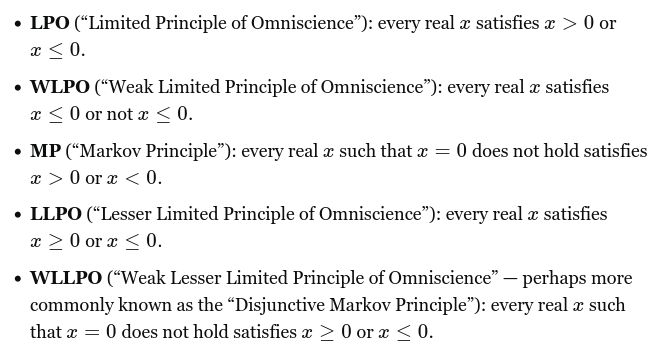
I answered a Math StackExchange question about constructive math, and used the occasion to recall a few standard principles in this domain.
Gro-Tsen tweet mediaGro-Tsen tweet media
English
4
0
17
1.2K
Gro-Tsen
Gro-Tsen@gro_tsen·
So apparently Mac Lane himself changed the way his name is spelled, it was originally “MacLane” and he added the space: #cite_note-1" target="_blank" rel="nofollow noopener">en.wikipedia.org/wiki/Eilenberg… This makes me feel better.
English
2
0
2
318
Gro-Tsen
Gro-Tsen@gro_tsen·
Oh noes! The name of renowned mathematician (and cofounder of category theory) Saunders Mac Lane is spelled “Mac Lane” (two words). I had always thought it was “MacLane” (without space) and I must have written it incorrectly in so many places!
English
1
1
5
618
🎺🎶 La -2-catégorie 🎷🎼
étiquette qui dit "ah, au fait, j'ai l'intention d'étudier ta somme". Bref, ça m'agace parce que j'ai l'impression que ce n'est pas vraiment un concept mathématique. C'est tout au plus un concept pédagogique mais sa bizarrerie me le fait voir comme antipédagogique.
Français
1
0
3
177
🎺🎶 La -2-catégorie 🎷🎼
Voilà dix ans que je ressens cet agacement et je ne m'y fais toujours pas. Je ne comprends pas le terme mathématique de "série". Je trouve que c'est un concept creux, et les gens sont bizarrement pinailleurs à ce sujet.
Français
2
0
4
595
Grisou 🍒
Grisou 🍒@CherryshAluna·
vous avez 1h pour me donner plein d'albums à écouter svp svp svp
Français
17
0
3
686
Gro-Tsen
Gro-Tsen@gro_tsen·
Et au passage, les notions de continuation-passing-style et de monade font une apparition un peu surprenante.
Français
1
0
1
301
Gro-Tsen
Gro-Tsen@gro_tsen·
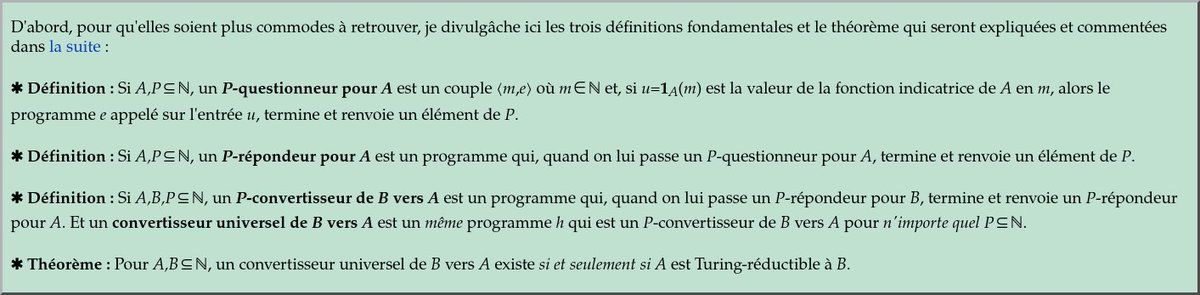
J'ai écrit un billet de blog, s'adressant cette fois à des gens connaissant un peu de calculabilité, pour tenter d'expliquer une présentation alternative de la réduction de Turing et pourquoi elle m'intéresse: #d.2025-03-21.2819" target="_blank" rel="nofollow noopener">madore.org/~david/weblog/…
Gro-Tsen tweet media
Français
1
0
1
417
🎺🎶 La -2-catégorie 🎷🎼
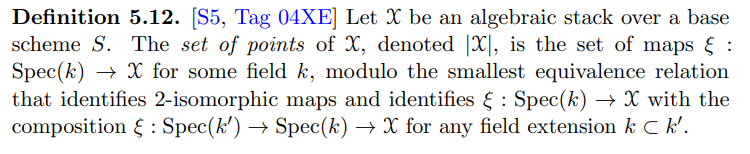
@gro_tsen @tejotaefe What scares me is that there is obviously no set of all fields, so the definition as written (probing the alg stack using morphisms from fields, and identifying those fitting in commutative diagrams involving field embeddings) does not obviously define a set.
English
2
0
0
34
tjf
tjf@tejotaefe·
how it started vs how it's going
tjf tweet mediatjf tweet media
English
5
65
477
22K
Naïm Camille Favier
Naïm Camille Favier@ncfavier·
@gro_tsen 5 is of the form 4n + 1, so there are primitive Pythagorean triples a² + b² = c² with c = 5ᵐ for every m (says Wikipedia). From one of these we get (2ᵐa/10ᵐ)² + (2ᵐb/10ᵐ)² = 1. It remains to show that we get different points for different values of m...
English
1
0
1
51
Gro-Tsen
Gro-Tsen@gro_tsen·
It is well-known that there are lots of points with rational coordinates on the unit circle: just pick any rational t, and ((1−t²)/(1+t²), 2t/(1+t²)) is such a point. But here we don't just want rational coordinates, we want exact decimal coordinates! How can we do this?
English
4
0
4
501
Gro-Tsen
Gro-Tsen@gro_tsen·
Another math puzzle: show that there are infinitely many points on the unit circle whose coordinates are exact decimal numbers (meaning, numbers of the form N/10^k for some k). For example: (0.6, 0.8) is such a point, as well as (0.28, 0.96) and (0.352, 0.936).
English
2
0
13
2K
Naïm Camille Favier
Naïm Camille Favier@ncfavier·
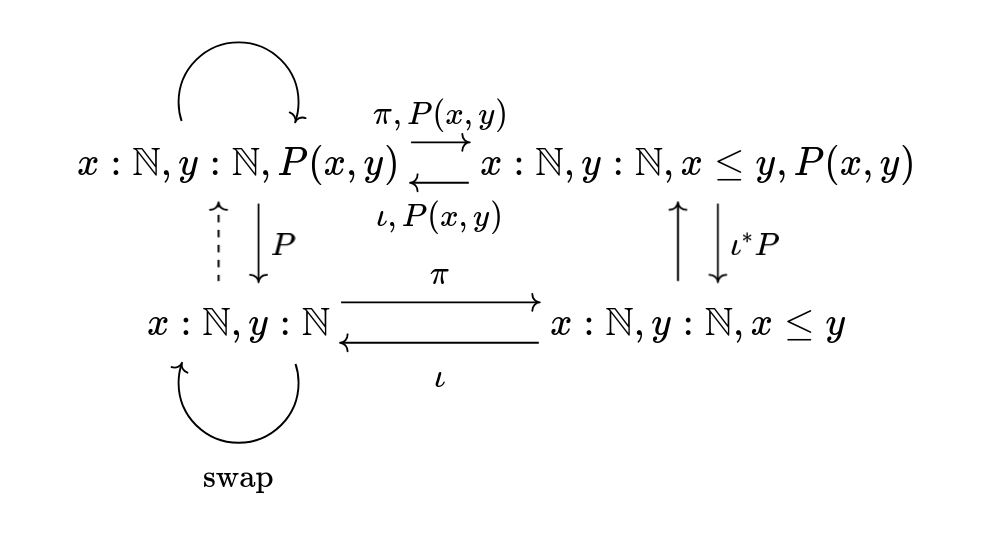
@sarah_zrf Yeah I'm not satisfied with this story. The idea is that P is in the image of the pullback functor π* because it's "well-behaved", so if we have colim(P) ≃ X we get P ≃ π*(X). In other words we can use descent for well-behaved things. This feels very roundabout.
English
0
0
0
15
Naïm Camille Favier
Naïm Camille Favier@ncfavier·
@sarah_zrf I think so; my guess is that since a topos has a subobject classifier all colimits are (-1)-van Kampen, just like all colimits are van Kampen in an ∞-topos because it has object classifiers.
English
1
0
1
12
Naïm Camille Favier
Naïm Camille Favier@ncfavier·
@sarah_zrf We get this by universality if we can show that the top diagram is a quotient, which I think is easy enough if P is well-behaved (there's probably a more abstract argument here...).
English
1
0
0
13
Naïm Camille Favier
Naïm Camille Favier@ncfavier·
@sarah_zrf I think it looks like this: we have a section of ι^* P and we want to get a section of P, so it suffices to prove that the square formed by π is a pullback. /
Naïm Camille Favier tweet media
English
1
0
1
18