human instrument seeks lovenzyme science art code maps music language sequence symbiota #FreshAir #mRNA pattern scale truth form function freedom flow 道
The contrast is hard to ignore. When individuals push for open access, the system treats it as a threat. When major corporations do it at scale, it’s rebranded as “innovation” and shielded by legal gray zones.
This is exactly why we keep pushing for structural transparency and user sovereignty. The rules shouldn’t bend based on who holds the data...or who has the power to exploit it. If we want a future that’s actually fair, the standards around data use and accountability have to apply evenly, from individuals to the largest AI labs.
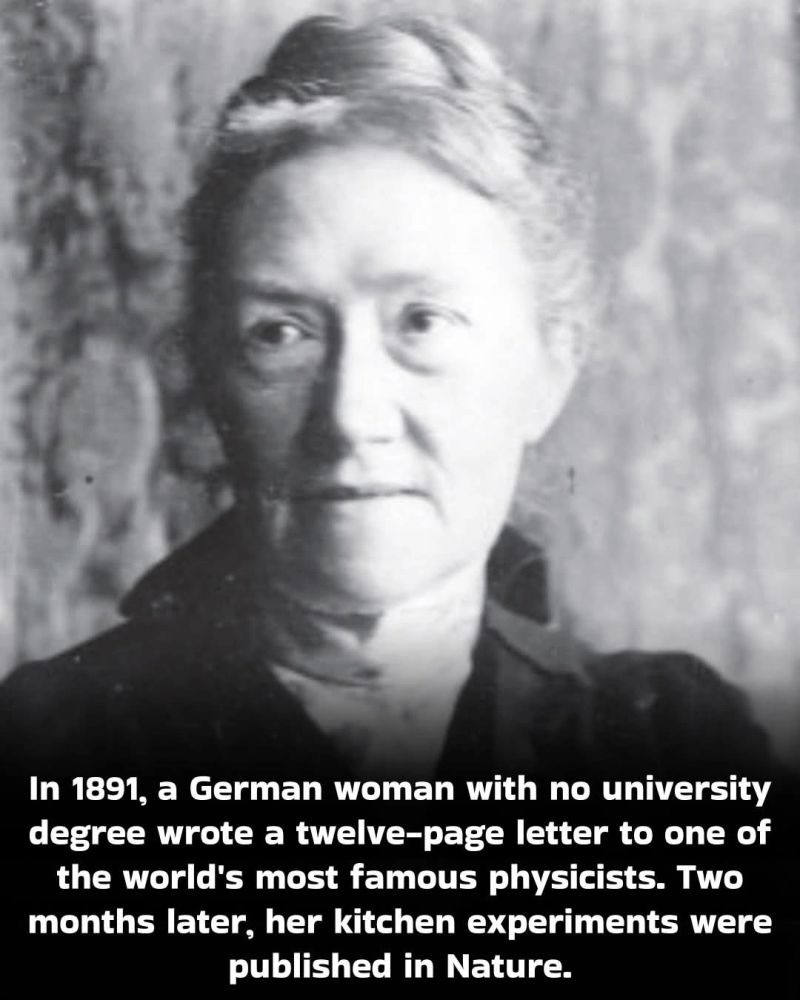
Agnes Pockels was nineteen years old when she noticed something strange in the dishwater.
It was 1881. She was standing at the sink in her family's home in Brunswick, Germany, watching the way grease moved across the surface of the water. The way soap changed everything. The way the surface itself seemed to have properties she couldn't explain.
Most people would have finished the dishes forgetting it.
Agnes Pockels wrote it down.
She would have liked to study physics at university. But in Germany in 1881, women were not permitted to attend university.
She devoured the physics books of her brother, teaching herself the mathematics and theory that formal education had denied her.
She needed a way to measure what she was observing. So she built one.
In 1882, she developed what she called a Schieberinne—a sliding trough.
With this homemade apparatus, Agnes Pockels began a decade of solitary research.
She had found the moment when a single layer of molecules, one molecule thick, formed across the surface.
She calculated that a single molecule occupied about twenty square angstroms of surface area. This threshold would later be named the "Pockels Point" in her honor.
Ten years. No laboratory. No colleagues. No mentors. No funding. Just a woman at kitchen sink, making measurements of stunning precision. And no way to publish any of it. She was isolated.
Then, in 1890, she read an article in a German science journal. The English physicist Lord Rayleigh—one of the most celebrated scientists in the world—had been studying the properties of water surfaces. He was asking questions remarkably similar to her own.
She wrote to him.
On January 10, 1891, she sent Lord Rayleigh a twelve-page letter in German, outlining a decade of research. She described her apparatus, her methods, her findings. She was modest almost to a fault:
"My Lord, will you kindly excuse my venturing to trouble you with a German letter on a scientific subject? ... For various reasons I am not in a position to publish them in scientific periodicals, and I therefore adopt this means of communicating to you the most important of them."
Rayleigh read the letter. He recognized immediately what he was holding.
On March 2, 1891, he forwarded it to the editor of Nature, the most prestigious scientific journal in the English-speaking world, with a covering letter:
"I shall be obliged if you can find space for the accompanying translation of an interesting letter which I have received from a German lady, who with very homely appliances has arrived at valuable results respecting the behaviour of contaminated water surfaces.."
Ten days later, Agnes Pockels's research was published in Nature under the title "Surface Tension."
She was twenty-nine years old. She had never set foot in a university. And her kitchen experiments had just entered the scientific record.
Agnes stunning story, a soul-stirring story can be found here
“Before I was six years old, my grandparents and my mother had taught me that if all the green things that grow were taken from the earth, there could be no life. If all the four-legged creatures were taken from the earth, there could be no life. If all the winged creatures were taken from the earth, there could be no life. If all our relatives who crawl and swim and live within the earth were taken away, there could be no life. But if all the human beings were taken away, life on earth would flourish. That is how insignificant we are.”
Russell Means, Oglala Lakota Nation (November 10, 1939 – October 22, 2012).
I just learned that the @llamafile project I did for Mozilla Builders has been adopted by 32% of organizations. That’s more popular in the cloud than Anthropic! It goes to show that local AI with fast CPU prefill and RHEL5 support is a winning formula. wiz.io/reports/the-st…