pilk

2.7K posts

pilk

pilk

@pilkself

เข้าร่วม Kasım 2022
329 กำลังติดตาม209 ผู้ติดตาม
ทวีตที่ปักหมุด
pilk
pilk@pilkself·
This resonated with me in my Masters and it still does sometimes now
English
2
0
12
4.2K
pilk รีทวีตแล้ว
Daniel Litt
Daniel Litt@littmath·
The reports of my death are greatly exaggerated. —Mathematics
English

13
29
406
11.6K
Air Katakana
Air Katakana@airkatakana·
gemini: “are you gonna take a hot bath now or what” me: “yeah i can do that if you think it’s a good idea” gemini: “what retard told you to do that, absolutely not”
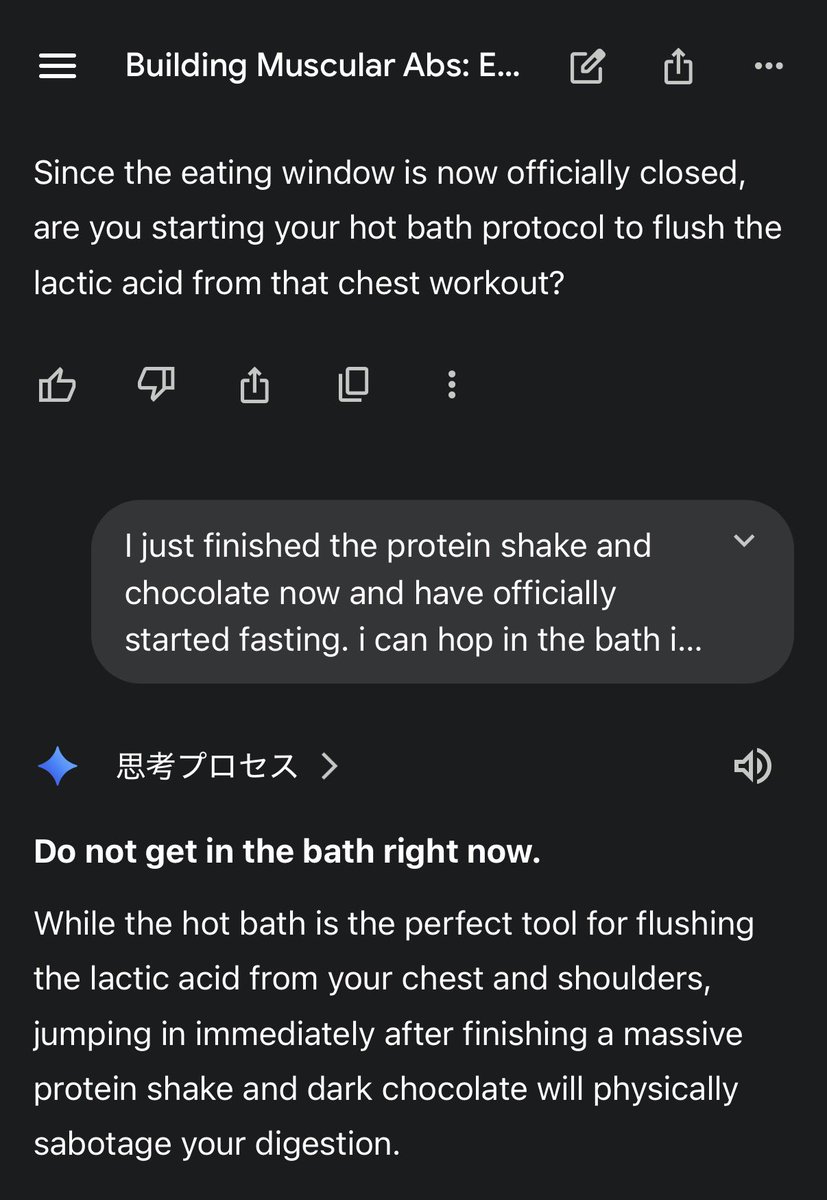
Air Katakana tweet media
English
4
0
53
3.2K
pilk
pilk@pilkself·
@KnightXvrc beer is so damn cheap I remember playing with the idea of finding my favorite beer by trying 1 a day or so, then realizing I'd feel like an alcoholic
English
1
0
5
566
KnightX
KnightX@KnightXvrc·
After 1 week in Germany...! - It took a whole research to choose a mobile phone company. - I don't fear recycling anymore. - I got Deutschland Ticket. - I think I hear more Ukranian than German when I go to Kaufland. - Beer <3
English
68
18
1.8K
73.3K
pilk
pilk@pilkself·
@jconorgrogan @SebastienBubeck It's still like ~$100 for running these per problem, but if peer reviewers / journals start using a policy that says "please check that ChatGPT can't formulate and prove your theorems with $1000 worth of compute" then it might get a bit funny
English

0
0
1
58
Conor
Conor@jconorgrogan·
@SebastienBubeck We are at the point where its trivial to create some sort of new theorem. At first I thought- we need a better way to capture/store this new knowledge (arvix + peer review too slow). But- if ideas are trivial to generate ad formulate on demand, then is that even needed?
English

4
0
4
1.7K
Sebastien Bubeck
Sebastien Bubeck@SebastienBubeck·
Very important read. "if AI mathematics continues to progress at anything like its current rate -- which is what I expect to happen -- then we will face a crisis very soon"
Timothy Gowers @wtgowers@wtgowers

I've recently got in on the act of getting AI to solve open problems in mathematics. More precisely, I gave some questions asked by Melvyn Nathanson to ChatGPT 5.5 Pro, to which I have been given access, and it answered them. 🧵

English
26
59
588
84.7K
oz 🇵🇸
oz 🇵🇸@anatolianheval·
@DamyIsTweeting but then you’ll be living in germany… is it worth the monster? hahaha
English
3
0
17
830
oz 🇵🇸
oz 🇵🇸@anatolianheval·
got a monster for 1,04€ with pfand in germany… its 2,64€ in nl with statie geld 😭😭😭😭😭😭
English
32
11
579
24.3K
pilk
pilk@pilkself·
@doomdalek Needs 1 more for the magic number
pilk tweet media
English
1
0
57
5K
doomdalek
doomdalek@doomdalek·
I got banned
doomdalek tweet media
English
115
358
8.8K
129.8K
pilk
pilk@pilkself·
@mishapathy I mean you can still catch Bayesians maximizing likelihood so
English
0
0
0
40
Nirmalya Kajuri
Nirmalya Kajuri@Kaju_Nut·
How physicists tell people to zip it with Feynman diagrams
Nirmalya Kajuri tweet media
English
3
1
46
2.9K
pilk รีทวีตแล้ว
okazakitomohiro
okazakitomohiro@oo_kk_aa·
ニャッキの伊藤有壱さんにお声掛け頂き、コマ撮りの展覧会に一作家として参加しています。私はコマ撮り分野ではない場所から活動をはじめて、デザインの視点でのコマ撮りに取り組んできましたが、今回初めてコマ撮り界の本丸の方々とご一緒でき嬉しいです。今6年目のマッチ撮影素材等を展示しています
日本語

525
27.3K
124K
5M
pilk
pilk@pilkself·
@yifever time to reunite with physicists
English
0
0
1
111
yifei e/λ (meetmeinshibuya april 26)
I have like a 4 std disposition to absorb the personality of whoever I'm with, and after being in Japan for a while I am thinking I need to hang out with people with asperger's more to balance it out a bit
English
8
0
53
2.4K
pilk
pilk@pilkself·
@enkyledu next they'll come for this
pilk tweet media
English
0
2
36
2.4K
pilk รีทวีตแล้ว
💙eren 𐔌˙. 💙
💙eren 𐔌˙. 💙@erenspace_·
“the dirty little secret of mathematics is that it's impossible to understand what anyone else is saying. Conveying one's mathematical intuition is incredibly hard […] acquiring understanding from someone else's work is nearly identical to […] discovering it on my own.”
Daniel Litt@littmath

This is a characteristically thoughtful and coherent account of mathematics from my colleague Jacob, and I agree with much of what he writes. But I want to push back on some aspects, which don't accord with my experience of or motivation for doing mathematics. Problem-solving I fully agree with Jacob that, as currently practiced, problem-solving is a fundamental aspect of doing mathematics; like Jacob, I identify as a "problem-solver" more than a "theory-builder." (A related axis: I identify more as a "frog" than a "bird.") Why do we solve problems? For some of us, it's more or less about enjoyment. That is NOT why I solve problems. I enjoy parts of that process: getting the solution, some little moments of understanding along the way. But my primary emotional experience of problem-solving is not fun: it's frustration. I try to understand something and get confused and I HATE that feeling, and need to resolve it. For a while my bio on here read "forever confused" -- that's not an exaggeration. I think the main reason I (and many other mathematicians) solve problems is that it's the only way we know how to ground ourselves in mathematical truth. Without solving problems and working out examples, our work inevitably devolves into bullshit. The activity of mathematics So is 80%+ of mathematics about problem-solving? I think this is a coherent account of mathematics but it's not my experience. Like Jacob and many other mathematicians my work is indeed guided by some big problems: for me, the Grothendieck-Katz p-curvature conjecture, some questions about mapping class groups, some questions about fundamental groups of algebraic varieties. Many of these problems have occupied me for a decade+ now. My experience of thinking about these problems is, perhaps paradoxically, not about "problem-solving." Rather, these problems benchmark our failure to understand certain fundamental phenomena: differential equations, surfaces, polynomials. It's useful to have rigorously stated problems like this to guide the field, but I think they have relatively little influence on my day-to-day work. That looks more like: trying to identify the most basic situation in which our understanding fails, and develop it in that basic situation. In this model, problem-solving is secondary: my typical experience is that I think I understand something new, often non-rigorously, and then try to operationalize it to solve some problems both to test the correctness of this understanding, and to measure its effectiveness. It's not uncommon in this model for a problem and its solution to appear at the exact same time. In fact, for me, it's somewhat unusual to write down a rigorous statement of a lemma that I do not already know how to prove, though this does of course happen. Oracles Jacob proposes the a thought experiment, where one has access to an AI oracle that can solve rigorously-stated problems better than humans but has less capability in other areas of the mathematical process. Like him, I do not expect this to be the long-term situation--eventually I expect AI mathematics to exceed humans in every mathematical capability--but let's run with it for a second. What would mathematical activity look like with such an oracle? Jacob writes: "Well, you make a definition, and want to know if it’s the right one. You immediately ask your oracle a thousand questions. From “are these basic properties true” to “ooh, so is this deep conjecture true?” and start getting back answers, and amending your definitions. You could invent and resolve entire research directions in days. But the confusion you would have had to push through to flesh out your theory would largely (probably not entirely) be instantly resolved and the whole process sped up tremendously by your oracle. A big part of the process would be gone." I think this is where I most strongly disagree with what he writes. I think you start getting back answers, and then to continue, you have to UNDERSTAND them. And the dirty little secret of mathematics is that it's impossible to understand what anyone else is saying. Conveying one's mathematical intuition is incredibly hard: at least for me, the experience of acquiring understanding from someone else's work is nearly identical to that of discovering it on my own. Of course, what the mathematics of the future will look like depends (like all AI prognostication) on the precise shape of future AI capabilities; I do not think the picture of an uncreative oracle is realistic. I expect future AI mathematicians to be creative, and also, not to be oracles. I think a lot of the questions we view as fundamental will remain open for some time. Basic mathematical questions can be arbitrarily hard! And we will still want to understand them. Doing math Most of what I love about the practice of mathematics is: talking to colleagues about math, learning and understanding new things, developing intuition and resolving confusion, etc. My sense is that these parts of math survive with arbitrarily capable AI tools. I also like a lot of other aspects of the job: I get paid and can afford to eat, I have a lot of intellectual freedom, I have great colleagues (like Jacob), I don't have a boss and can work sprawled out on a couch. Absent a real attempt for the profession to adapt to the coming changes, it's possible that the shape of the profession changes in a way that makes it much less enjoyable, even as most of what I like about doing math survives. There are questions as to why society should support human mathematicians if and when machines have absolute advantage over us in all aspects of mathematics. I think we'll have advantage in some aspects of mathematics for some time, but it's worth thinking about this endpoing for the profession, as it is for all other professions. That said, I think there's a future here where we continue to ask basic questions about fundamental mathematical phenomema. Sometimes we get an answer from a machine, and sometimes the machine gets stuck, and so do we. And when we get stuck, we get frustrated--we get an itch--and we don't give up.

English
5
29
364
19.8K
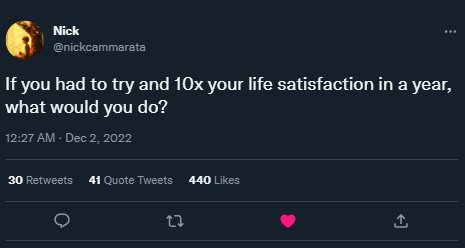
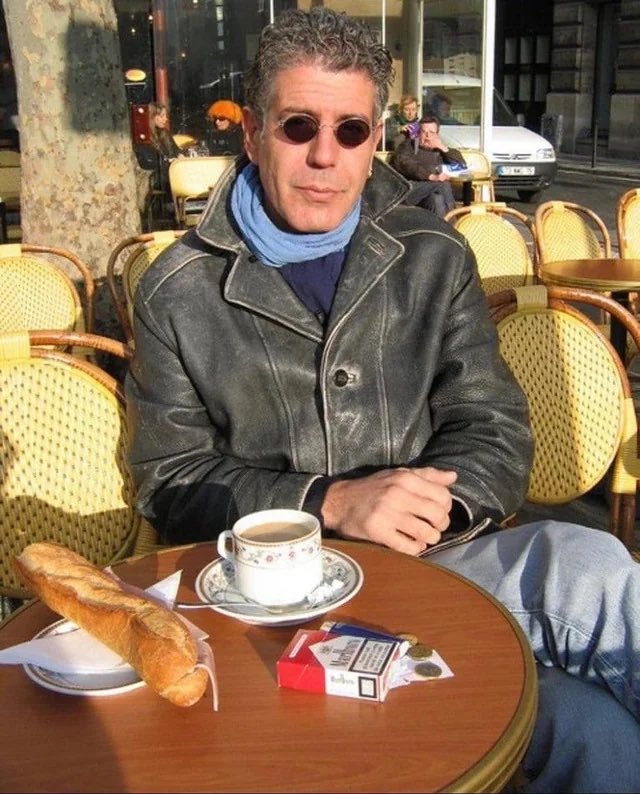
critter
critter@BecomingCritter·
this question haunts me
critter tweet media
English
92
32
1.5K
129K
pilk รีทวีตแล้ว
billy
billy@billyhumblebrag·
Daughter wanted to meditate with me. 5 minutes in she whispers "daddy, I'm bored of meditating, I'm just going to sit here until you finish"
English
51
373
36.1K
639.3K
pilk รีทวีตแล้ว
袜蛙
袜蛙@sockfrogg·
The thing about europe is that you get to live like this for 4 months and the rest is just full on depression and amnesia
ruben@rubentothewild

peak euro living

English
386
5.1K
66.1K
2.7M