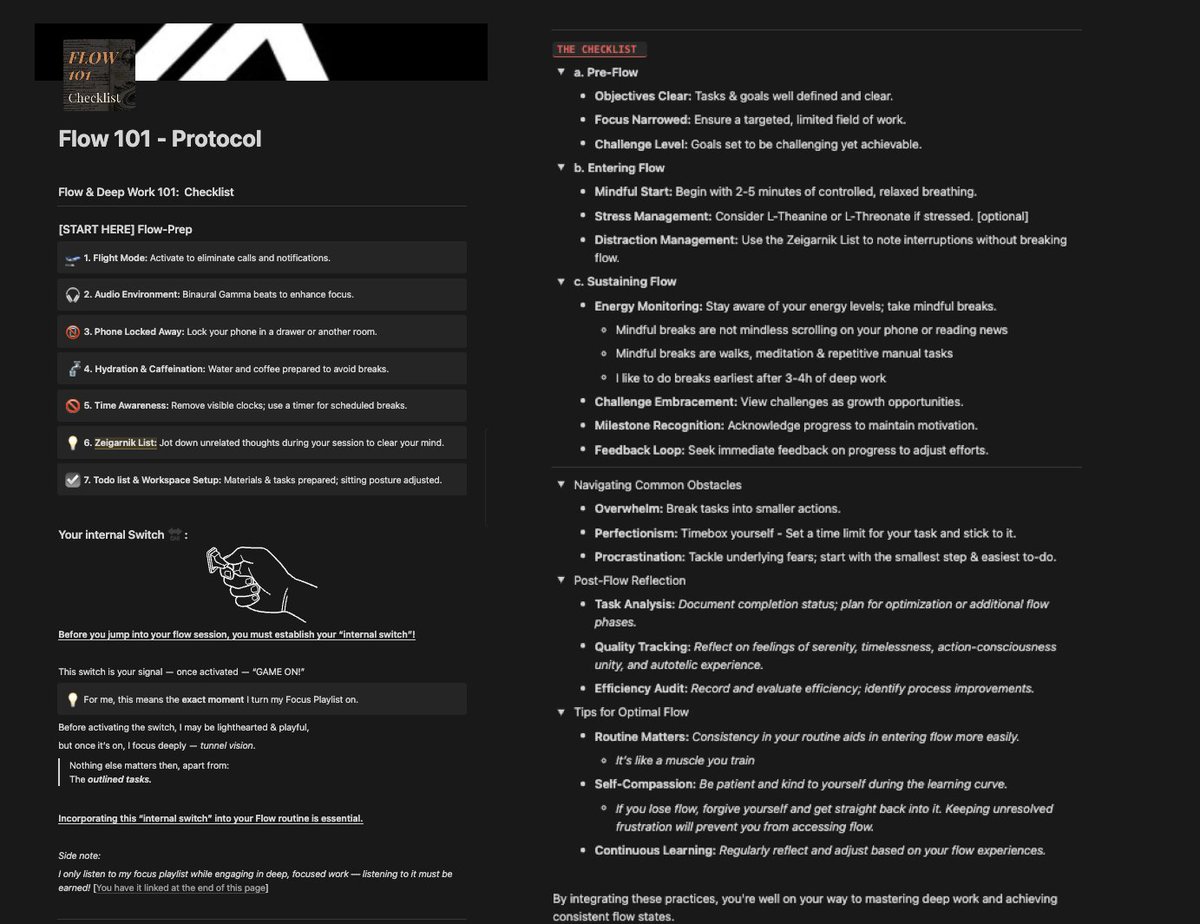
The world’s most productive people share one secret:
They achieve in hours what takes you days to finish.
Why? "They unlock flow states on demand."
How? "They properly prime themselves."
But so can you
Use my flow-protocol to tap into it:
Comment “flow” and I DM it to you ↓
Flow makes play into work and work into play.
I just wrote down my flow checklist that allowed me to:
• 3x my output
• Limit work to 4h a day
• Work from wherever I want
*Comment "flow" and I DM it to you ↓
No one comes to save you:
Set a time to get up,
→ get up at that time.
Set a time to workout,
→ workout at that time.
Set a time to go to sleep,
→ go to sleep at that time.
One pattern I've noticed in happy people:
They do not react; they respond.
Never react; always respond - responding means thinking before (re)acting.
Stoicism is what helped me in doing that:
When faced with situations beyond your control, your instinct often leads you to react emotionally, which is a natural human response.
However, Stoicism invites you to step back and respond rather than react.
― This means consciously choosing your attitude and actions to conserve energy for things within your sphere of influence.
Separate what you can control from what you cannot.
The key lies in understanding that your power lies not in external circumstances but in how you respond to them.
Pause, ponder, then proceed.
It's not just about controlling reactions but cultivating a mind that sees beyond the immediate.
Start your journey by delving into the timeless wisdom of Marcus Aurelius, Seneca and Epictetus, where you'll find the keys to a life of balance and purpose.
Study them and watch your world transform through the lens of thoughtful response.
Start with this reading list to delve deeper:
• "Meditations" by Marcus Aurelius - A personal diary of the Roman Emperor, offering insights into managing one's emotions and responding to life's challenges with wisdom.
• "Letters from a Stoic" by Seneca - A collection of letters that provide practical advice on how to maintain calm and rationality in the face of adversity.
• "Enchiridion" by Epictetus - A short manual of Stoic ethical advice; this text emphasizes the distinction between what is in our control and what is not.
Each of these texts offers valuable insights for you, particularly in learning how to respond thoughtfully and deliberately rather than reacting on impulse.
I am guilty of being that fool from time to time:
Are you?
„You must live in the present, launch yourself on every wave, find your eternity in each moment. Fools stand on their island of opportunities and look toward another land. There is no other land; there is no other life but this.“ Henry David Thoreau
Your “career path” is a recipe for mediocrity.
If you want:
- an interesting life, creativity, wealth.
Then you need to get a more diverse set of experiences.
How do you do that?
By not travelling the same paths as everyone else.
Don’t be a career path.
The new 1%:
- Exercise daily
- 30 min screen time
- One adventure a day
- Uninterrupted deep work
- Quality time with loved ones
- Limited "office hours" or no meetings
- Excitement before sleep for the next day
3 simple principles to achieve greatness (bookmark them):
- Be a serial-tasker, not a multi-tasker.
- Do hard things till they become easy.
- Reject the comfort of a predictable path.
If you struggle to negotiate,
there is this one "best line" to ask for anything.
One simple question
― that works all the time.
Be it getting:
- That cute girl's number
- A discount buying furniture
- A better deal in the boardroom
The line:
"What is the chance of + [what you want]?"
Examples:
1. What is the chance of me getting a discount?
2. What is the chance of me getting your number?
3. What is the chance of getting a more competitive price for xy?
Try it.
The line initiates negotiation without all the negativity or aggressiveness associated with it.
― Works like a charm.
How long are you going to wait to:
- Stop postponing
- Stop hitting snooze
- Stop settling for less
"Stop, stop, stop..."
The simple solution is to:
Stop breaking promises to yourself.
How?
Every evening, I jot down 3 things that are "must-dos" for tomorrow.
3 promises to my future self.
― Non-negotiable.
Yesterday, they were straightforward.
After travelling for months,
I had to get back into routine:
So my "must-dos" were:
- Gym
- Writing
- System-audit
The power of keeping yourself accountable that way is massively underrated.
Like a muscle, you train to show up for yourself.
Leading to:
- Fulfillment
- Momentum
- Confidence
Remember:
You must impress yourself first before others.
If you remain consistent with the former, the latter will come automatically.