Randall R. (@[email protected])

507 posts

Randall R. (@randallr@mastodon.gamedev.place)

Randall R. (@[email protected])

@raegnar

Qualcomm Graphics Research, Ex-meta, former Apple

Earth เข้าร่วม Haziran 2011
439 กำลังติดตาม1.3K ผู้ติดตาม
Randall R. (@[email protected]) รีทวีตแล้ว
Tim Soret
Tim Soret@timsoret·
For those who hesitate: install Codex or Claude Code. Have a literaly genie that can script anything on the fly in your terminal, work on your files, interpret pictures, understand your voice, code anything you want, use a browser to do stuff on your behalf, and connect to any app to carry entire tasks across them. All just by talking to it. And the $20/month starter is quite generous. That's it. Do it. Stop ruminating, stop waiting, stop hesitating, stop delaying, stop denying. Just do it. This is how computers are used by power users in 2026, and for everyone else in 2027.
English

33
10
189
25.6K
Randall R. (@[email protected]) รีทวีตแล้ว
Ignacio Castaño
Ignacio Castaño@castano·
I spent some time reverse-engineering Apple's Lossy texture format. It wasn't as simple as I originally thought, and some of the details surprised me. Check it out! ludicon.com/castano/blog/2…
English
0
27
190
11.2K
Randall R. (@[email protected]) รีทวีตแล้ว
Sebastian Aaltonen
Sebastian Aaltonen@SebAaltonen·
Got accepted to SIGGRAPH 2026! My talk is titled: Reducing graphics API complexity: A clean slate API design for modern hardware I am an ARM Ambassador nowadays. I am going to be talking in their track: developer.arm.com/community/arm-…
English
21
69
1.2K
40.5K
Randall R. (@[email protected]) รีทวีตแล้ว
λmélie Heinrich
λmélie Heinrich@Dispatch_Graph·
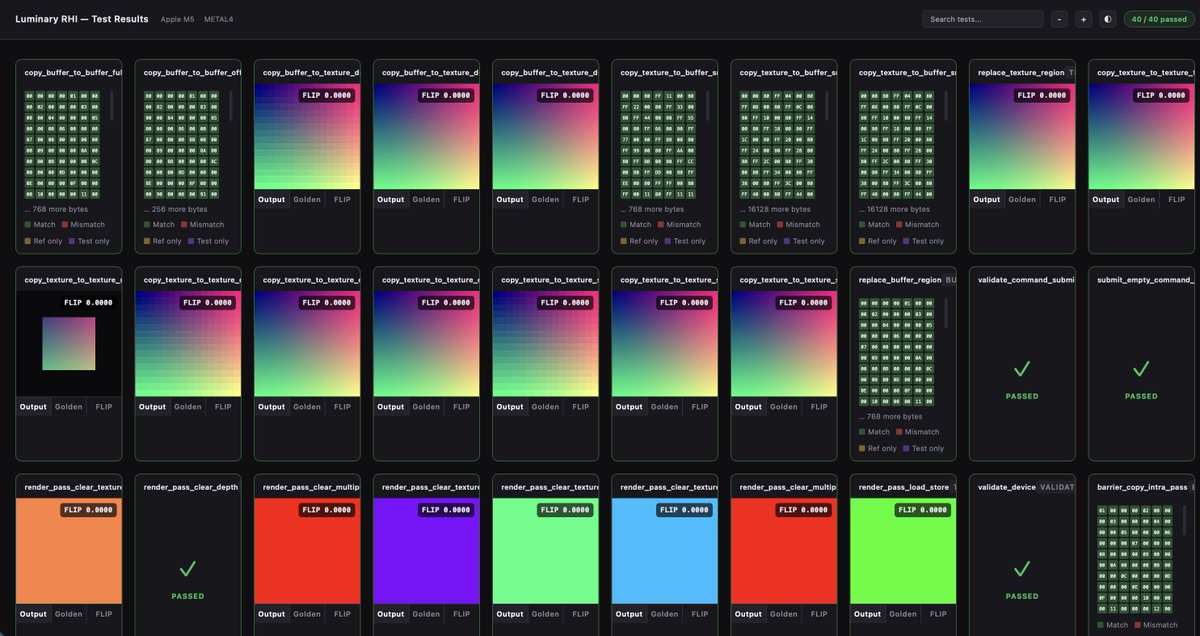
Implement tests for your RHI You won't regret it
λmélie Heinrich tweet media
English
5
7
109
7.7K
Randall R. (@[email protected]) รีทวีตแล้ว
mamoniem
mamoniem@_mamoniem·
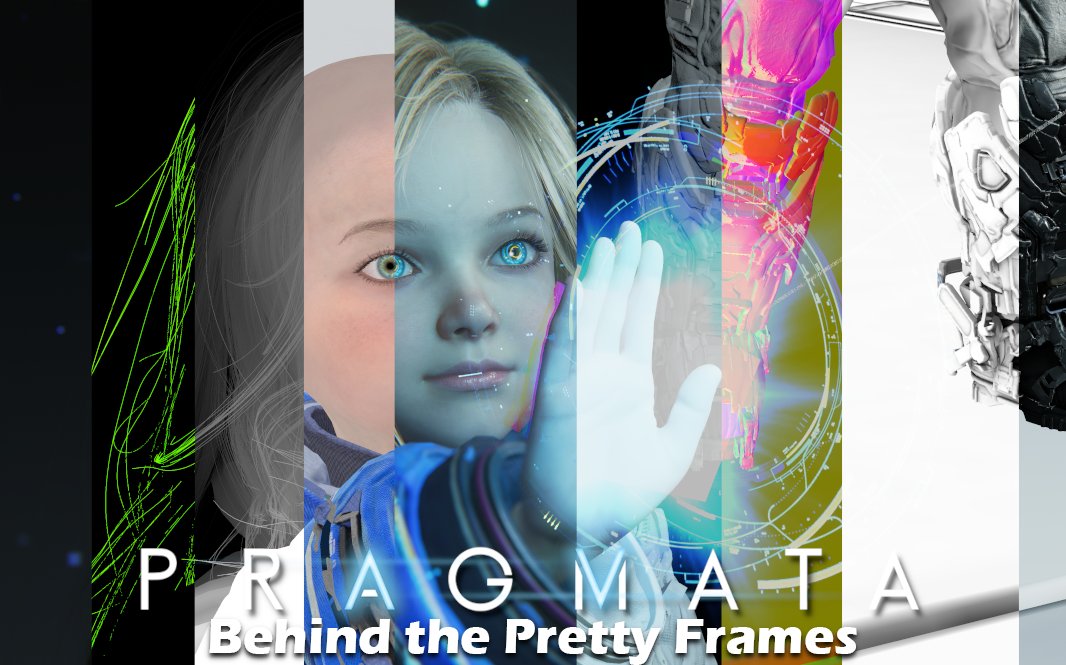
Behind the pretty frames of #PRAGMATA. Breaking down many tricks and hidden gems of the renderer behind @CAPCOM_RandD's RE Engine. i hope you enjoy & find this few months worth of freetime article useful... i had FUN playing the demo and digging every bit of it, & looking forward for the game official release next week!!!! mamoniem.com/behind-the-pre… @PRAGMATAgame @PRAGMATA_JP @CAPCOM_RandD
mamoniem tweet media
English
9
118
493
42.7K
Randall R. (@[email protected]) รีทวีตแล้ว
Gabriel Dechichi
Gabriel Dechichi@gdechichi·
in times when most people seem to only care about shortcuts, this is a nice thing to read
Gabriel Dechichi tweet media
English
19
127
1.2K
31.8K
Randall R. (@[email protected]) รีทวีตแล้ว
Patrick Heizer
Patrick Heizer@PatrickHeizer·
During college, I got a job in an immunology lab despite not majoring in a biological science. Asked my PI how I should go about learning immunology. He said, "Immunobiology by Charles Janeway." I bought & read it. Apparently, no previous undergrad hire had ever done this.
Paul Novosad@paulnovosad

From Ezra Klein, more true than ever. You would not believe how many shortcuts everyone else is taking. In many areas, you can get way ahead of everyone just by doing the work. More true than ever now, when more people are shirking and AI lets you do 10x if you try. 1/

English
7
122
2.8K
102.5K
Randall R. (@[email protected]) รีทวีตแล้ว
lcamtuf
lcamtuf@lcamtuf·
If you ask AI to rewrite the entirety of an open-source program, do you still need to abide by the original license? In philosophy, this problem is known as the Slop of Theseus
English
64
531
10.2K
261.2K
Randall R. (@[email protected]) รีทวีตแล้ว
Markus Schütz
Markus Schütz@m_schuetz·
I always thought Vulkan is the worst, needlessly overengineered graphics API, until I've been exposed to Vulkan-Hpp.
English
4
2
67
8.7K
Randall R. (@[email protected]) รีทวีตแล้ว
Nabeel S. Qureshi
Nabeel S. Qureshi@nabeelqu·
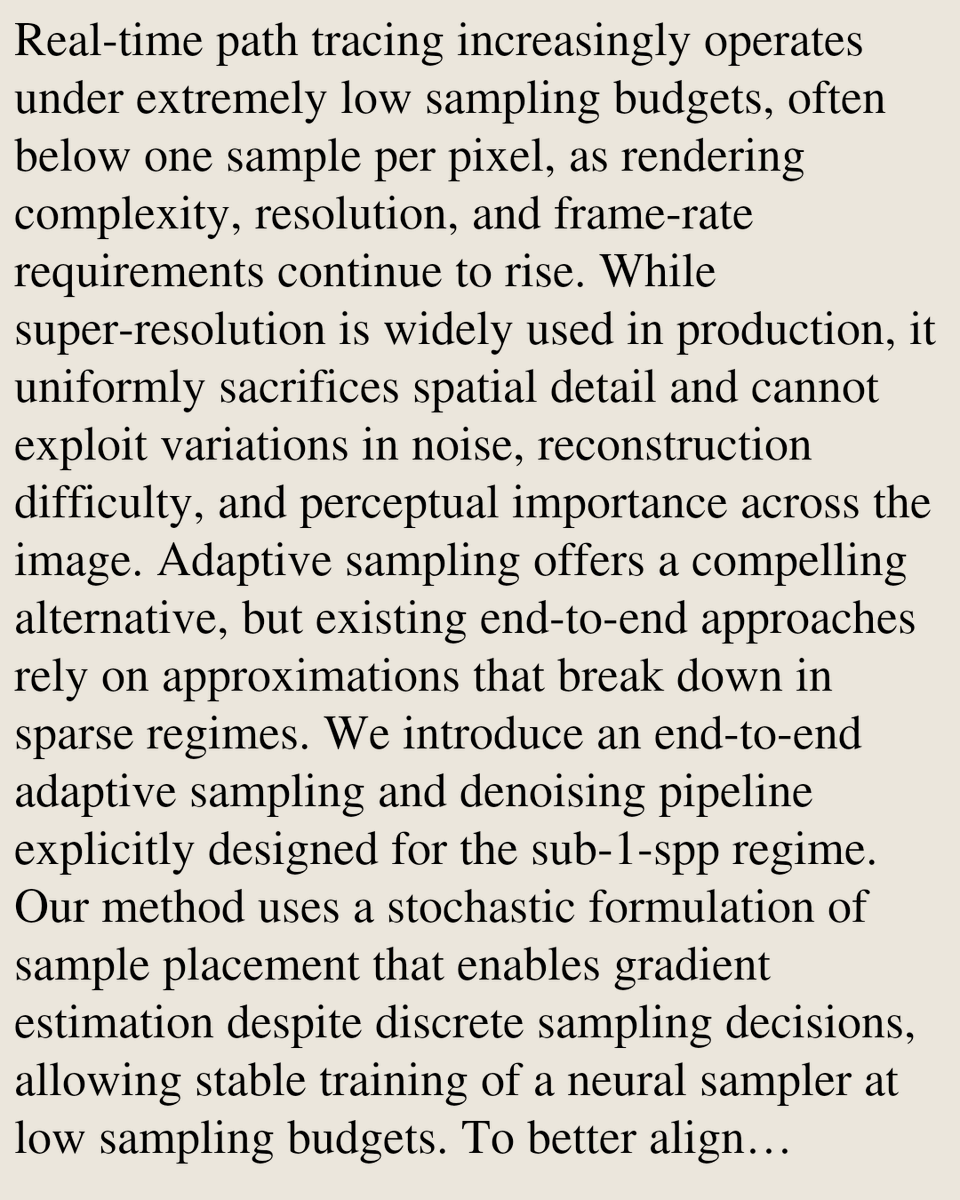
My LinkedIn is just the usual stream of company announcements and cringeposts, and then there's George Hotz poisoning the stream with these highly entertaining blackpills:
Nabeel S. Qureshi tweet media
English
40
100
2.3K
99.6K
Randall R. (@[email protected]) รีทวีตแล้ว
Hao Zhang
Hao Zhang@HaoZhang623·
As video world models become increasingly powerful, do we still need explicit 3D? A commonly misunderstood point is this: video world models are not “just 2D.” Their ability to maintain multi-view consistency, temporal stability, and realistic interaction necessarily implies that their latent knowledge encodes 3D world structure. Without some notion of 3D, consistency itself would not be possible. The real distinction, therefore, is not whether a model has 3D but whether that 3D exists implicitly or explicitly. Implicit 3D lives inside latent spaces and network weights. It supports generation, but it is difficult to localize, edit, constrain, or reason about. It allows the world to exist, but not to be used. Explicit 3D, in contrast, exists as structure and state: it is addressable, editable, composable, and transferable. Its purpose is not better visual fidelity, but operability to allow the world to be manipulated, controlled, and executed. From this perspective, video and 3D are not competing paradigms but a layered system: 2D/video is the interface to human perception; 3D is the interface to the physical world. They can reinforce each other, but neither forms a closed loop on its own. In practice, data not model architecture sets the upper bound of world models. Explicit 3D may not be the final user-facing representation, but it is likely the most effective pathway toward scalable, high-quality, and controllable data. Through explicit 3D/4D representations, worlds can be constructed systematically: interactions can be programmatically sampled, states and actions can be composed, rendered into images and videos, and fed back to train video world models. Seen this way, 3D is not the destination it is the starting point for scaling. What truly drives progress forward is never the model itself. Whether we capture the world or imagine new ones, whether data comes from observation or intent, whether we model what is or what should be the direction of the world is ultimately determined by human choice and purpose. Models may extend the world, but humans decide where it goes. #Genie3 #worldmodel
English
10
23
257
44.4K
Randall R. (@[email protected]) รีทวีตแล้ว
George Roush
George Roush@GeorgeRoush·
Raytheon has reached out repeatedly to me with job offers. Here's why I (a gen Z engineer) always say no: 1. Raytheon only offers 15 days off per year 2. Raytheon's health benefits are terrible 3. Raytheon's hiring practices are shady, and their hiring website directs you to talk with a chatbot 4. Raytheon's programs aren't all that much fun 5. I've noticed high turnover among lower level engineers 6. The pay SUCKS. No, prime defense contractor, I'm *not* going to take a 40% hit to my salary and benefits so I can have the pleasure of working for a company where I am just a number. Thanks for the offer though.
English
365
951
21K
1.9M
Randall R. (@[email protected]) รีทวีตแล้ว
Niklas Lundberg
Niklas Lundberg@datgame·
New company nickname #Microslop reflects the quality decline of Windows and their failed attempts at applying AI slop.
Niklas Lundberg tweet media
English
1
2
18
1.2K
Randall R. (@[email protected]) รีทวีตแล้ว
Casey Muratori
Casey Muratori@cmuratori·
If you ask, AI proponents will tell you that in the next decade or so we will have: ubiquitous transportation that drives itself with no human intervention; automated white-collar agentic services that program for us, make our spreadsheets, run our forecasts, and make better business decisions than we do; nuclear fusion reactors that cleanly power gigawatt decenters; autonomous humanoid robots that work in factories, do domestic work, and construct buildings; and centralized AGI that can self-improve and run civilization benevolently for the benefit of humanity. Despite all that, if you ask them if they could figure out a way to pay the people who made the training data they are using to make all those things possible, they will tell you that - and that alone - is simply impossible.
English
67
158
2K
66.8K
Randall R. (@[email protected]) รีทวีตแล้ว
Kecho
Kecho@kechogarcia·
@rfleury I'm 3 years in. It's the deepest and most meaningful thing in my life. Every day she levels up, there's new things. The baby phase is so short. Enjoy every second. When that personality comes out and you see yourself and your wife it will blow your mind. I love every second.
English
0
1
5
585
Randall R. (@[email protected]) รีทวีตแล้ว
Ryan Fleury
Ryan Fleury@rfleury·
Thoughts after a month of fatherhood: 1. This is difficult but doable so far 2. This is the most meaningful and important thing I’ve done in my life 3. The fact that many good people today are dissuaded or guilted out of parenthood is a profound tragedy
Ryan Fleury@rfleury

CreateThread();

English
73
34
1.3K
88K
Randall R. (@[email protected]) รีทวีตแล้ว
Lei Yang
Lei Yang@diyerxx·
Got burned by an Apple ICLR paper — it was withdrawn after my Public Comment. So here’s what happened. Earlier this month, a colleague shared an Apple paper on arXiv with me — it was also under review for ICLR 2026. The benchmark they proposed was perfectly aligned with a project we’re working on. I got excited after reading it. I immediately stopped my current tasks and started adapting our model to their benchmark. Pulled a whole weekend crunch session to finish the integration… only to find our model scoring absurdly low. I was really frustrated. I spent days debugging, checking everything — maybe I used it wrong, maybe there was a hidden bug. During this process, I actually found a critical bug in their official code: * When querying the VLM, it only passed in the image path string, not the image content itself. The most ridiculous part? After I fixed their bug, the model's scores got even lower! The results were so counterintuitive that I felt forced to do deeper validation. After multiple checks, the conclusion held: fixing the bug actually made the scores worse. At this point I decided to manually inspect the data. I sampled the first 20 questions our model got wrong, and I was shocked: * 6 out of 20 had clear GT errors. * The pattern suggested the “ground truth” was model-generated with extremely poor quality control, leading to tons of hallucinations. * Based on this quick sample, the GT error rate could be as high as 30%. I reported the data quality issue in a GitHub issue. After 6 days, the authors replied briefly and then immediately closed the issue. That annoyed me — I’d already wasted a ton of time, and I didn’t want others in the community to fall into the same trap — so I pushed back. Only then did they reopen the GitHub issue. Then I went back and checked the examples displayed in the paper itself. Even there, I found at least three clear GT errors. It’s hard to believe the authors were unaware of how bad the dataset quality was, especially when the paper claims all samples were reviewed by annotators. Yet even the examples printed in the paper contain blatant hallucinations and mistakes. When the ICLR reviews came out, I checked the five reviews for this paper. Not a single reviewer noticed the GT quality issues or the hallucinations in the paper's examples. So I started preparing a more detailed GT error analysis and wrote a Public Comment on OpenReview to inform the reviewers and the community about the data quality problems. The next day — the authors withdrew the paper and took down the GitHub repo. Fortunately, ICLR is an open conference with Public Comment. If this had been a closed-review venue, this kind of shoddy work would have been much harder to expose. So here’s a small call to the community: For any paper involving model-assisted dataset construction, reviewers should spend a few minutes checking a few samples manually. We need to prevent irresponsible work from slipping through and misleading everyone. Looking back, I should have suspected the dataset earlier based on two red flags: * The paper’s experiments claimed that GPT-5 has been surpassed by a bunch of small open-source models. * The original code, with a ridiculous bug, produced higher scores than the bug-fixed version. But because it was a paper from Big Tech, I subconsciously trusted the integrity and quality, which prevented me from spotting the problem sooner. This whole experience drained a lot of my time, energy, and emotion — especially because accusing others of bad data requires extra caution. I’m sharing this in hopes that the ML community remains vigilant and pushes back against this kind of sloppy, low-quality, and irresponsible behavior before it misleads people and wastes collective effort. #ICLR #ICLR2026 #NeurIPS #CVPR #openreview #MachineLearning #LLM #VLM
Lei Yang tweet media
English
52
211
2.5K
397.5K