James Winters

5.7K posts

James Winters banner
James Winters

James Winters

@replicatedtypo

Simulating sci-fi novels and calling it cultural evolution | Centre for Culture and Evolution | Brunel University London

London, UK เข้าร่วม Temmuz 2008
1.1K กำลังติดตาม1.4K ผู้ติดตาม
James Winters รีทวีตแล้ว
Alex Bentley
Alex Bentley@ralexbentley·
My new book with Mike O’Brien is out: Collaborators through Time (Bloomsbury). How humans have partnered—with each other, other species, and technology—across two million years, with AI as our latest collaborator. Amazon: amazon.com/gp/aw/d/B0FTFC…
Alex Bentley tweet media
English
2
2
6
258
James Winters รีทวีตแล้ว
Cody Moser
Cody Moser@LTF_01·
New pre-print with @psmaldino on an agent-based model of propaganda in online spaces. Using the voter model from physics, we simulate networks with stubborn agents (zealots) who do not change their opinions, asking about their optimal positioning for influencing the network.
Cody Moser tweet mediaCody Moser tweet media
English
1
2
8
511
James Winters รีทวีตแล้ว
Alberto Acerbi
Alberto Acerbi@acerbialberto·
Curious about what evolutionary psychology and cultural evolution say about digital media? Here’s the latest (final?) version of our chapter with @Arkyfish for the upcoming EHBEA textbook "Evolution, Culture and Human Behaviour". osf.io/preprints/psya…
English
0
8
20
2.2K
James Winters รีทวีตแล้ว
Charlotte Cavaille
Charlotte Cavaille@CharlotteCavai1·
It is the time of the year when I tell you about my favorite post-doc ever 👇 Unless you are allergic to the French, this one sits up there with the Nuffield and EUI postdocs (life style, productivity, interdisciplinary stimulation). Share widely! Apply! iast.fr/research-fello…
English
0
13
49
4.3K
James Winters รีทวีตแล้ว
Alberto Acerbi
Alberto Acerbi@acerbialberto·
We're back!
Alberto Acerbi tweet media
English
1
2
7
507
James Winters รีทวีตแล้ว
Fernando Leibovici
Fernando Leibovici@LeiboviciF·
"Solving the Longitude Puzzle: A Story of Clocks, Ships and Cities," fascinating new paper at the @JIntlEcon by Miotto and Pascali 🚢🕰️Study one of most transformative inventions of modern era—the marine chronometer—and its role in shaping global navigation and urban development
Fernando Leibovici tweet media
English
3
41
165
26K
James Winters
James Winters@replicatedtypo·
@BruceEdmonds And, in my personal experience and area of study, models are generally met with far more skepticism than correlational or experimental approaches. Admittedly, this is in an academic setting as opposed to a general audience one.
English
0
0
0
48
James Winters
James Winters@replicatedtypo·
@BruceEdmonds Still, similar issues exist in domains that try to deal with "real" world data, e.g., the dangers of spurious correlations (journals.plos.org/plosone/articl…) or the thoroughly documented replicability and reproducibility issues in experimental approaches.
English
1
0
0
48
James Winters
James Winters@replicatedtypo·
Broadly supportive of stating clearly that a study is a model. I did so myself recently: x.com/replicatedtypo…. BUT... I'm skeptical that adding "in a model" would have had any impact here. It's published in the Journal of Artificial Societies and Social Simulation 🤷‍♂️
Papers that should say "...in a model"@in_a_model

A classic example of language that does not distinguish between what is true in a model and in reality. This paper has had huge circulation among narrow nationalists (e.g. in Russia). The authors of this (otherwise fine) paper did not intend this. jasss.soc.surrey.ac.uk/16/3/7.html

English
1
0
0
139
James Winters รีทวีตแล้ว
Brunel Psychology
Brunel Psychology@BrunelPsy·
🧵 1/ 📢 New CCE pre-print on open-ended technological evolution by @replicatedtypo and @matcharbonneau1arxiv.org/pdf/2508.04828
James Winters@replicatedtypo

🚨🚨 New preprint 📜 with Mathieu Charbonneau (@matcharbonneau1): Modelling the emergence of open-ended technological evolution (arxiv.org/abs/2508.04828). Feedback welcomed! #Evolution #Technology #Culture #OpenEnded #TechnologicalEvolution #CulturalEvolution 🧵: 1/29

English
1
1
3
122
James Winters รีทวีตแล้ว
Christian Keil
Christian Keil@pronounced_kyle·
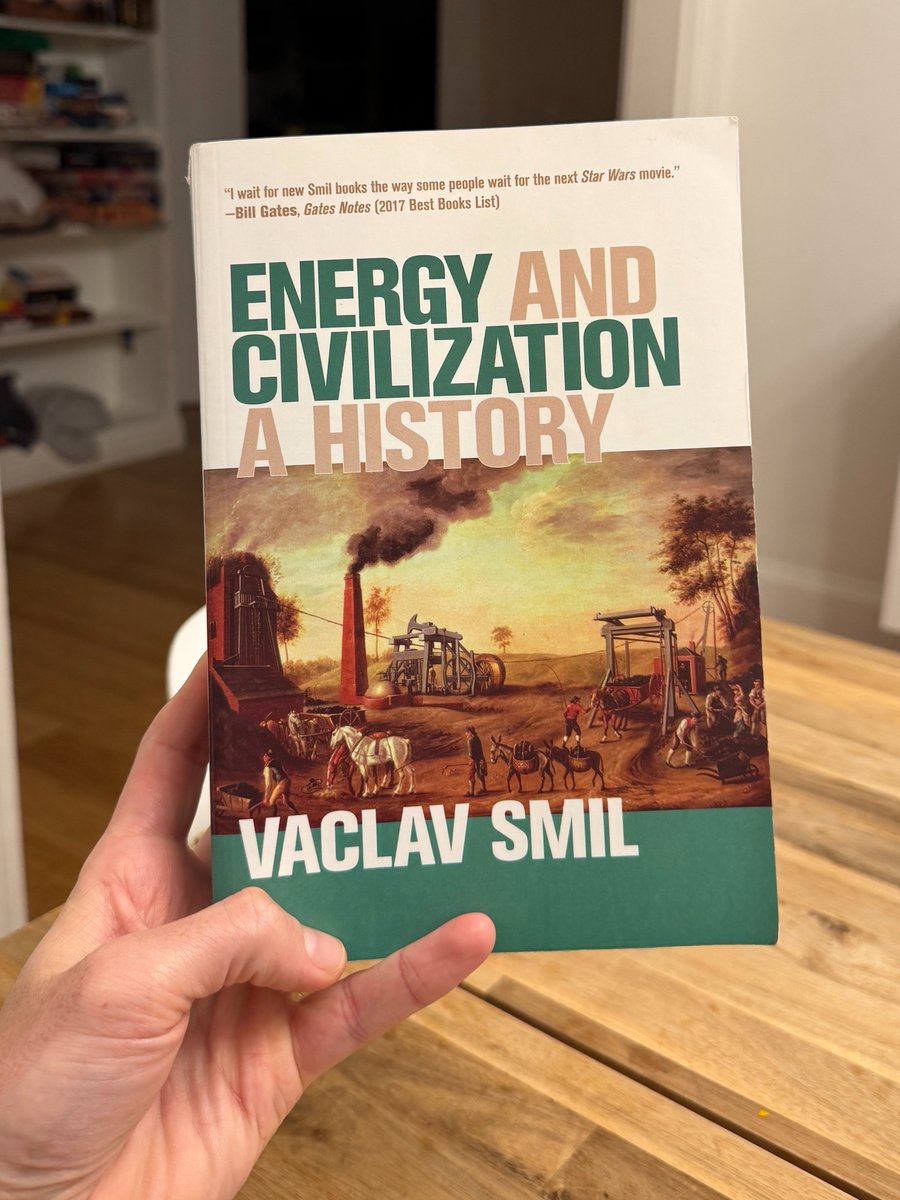
Just finished reading “Energy and Civilization” by Vaclav Smil. It lives up to the hype — it’s a truly comprehensive look at human history through the lens of energy. Here are my (messy) notes from the closest thing you’ll find to a “first principles of energy”: ‣ The average person consumes 8-11 MJ of food per day, and sustained power provided by a human is capped at around 100 W ‣ Lizot (1977) found two nearby Amazonian tribes, one normal and one whose lazy men who took drugs all day. The lazy tribe consumed less than half of the animal protein that its neighbors did. ‣ Traditional farming took an insane amount of labor, 94-98% of available labor in China (!) and 120% of available labor in India (!!) during peak summer months ‣ An ox-drawn plow reduces the time needed to prep a hectare of land from 100-200 hours to 30 hours ‣ Massive projects (e.g., aqueducts) took an objectively irrational amount of labor to complete, meaning no individual person who worked on it could expect to get more energy back than the extra energy they spent to build it. ‣ Horses are way better than oxen, generally: in the 1800s, ox-empowered farmers needed 150-170 hours to harvest wheat; in 1900, horses + other advances reduced that to just 9 hours. ‣ It was around the 1890s that human muscle power became effectively worthless (1:100 ratio in American farms of that time, human:animal power) ‣ Traditional agriculture couldn’t produce enough to eliminate malnutrition, limited by nitrogen recycling, there would be massive famines ‣ The original treadmills were literally like stairstepper machines that were installed in English prisons as punishment to power a mill. Tread mill. ‣ Different types of fuel (hardwood, charcoal, dung) had different energy content (MJ/kg) depending on their carbon and oxygen (etc.) content ‣ The average fuel consumption of an individual in the Roman empire was ~1.8kg of wood per day, or 1.5 GJ, which is about 1 tankful of gasoline (!) ‣ The rollout of the steam engine actually increased the deployment of horses, because it made people richer and increased overall shipment — once at the end of the route, you’d still need horses to get stuff from the tracks to your house/store ‣ Modern bikes were invented around the same time as cars ‣ The total potential energy of the Great Pyramid is 2.5 TJ ‣ Coal is goated, dominated Britain for 250 years — >75% of all energy from 1620 to about 1960 ‣ Chinese percussive drilling managed to create a 1 km deep borehole in 1835 ‣ Smil loves Edison, thinks his end-to-end innovation of the entire system made him deserve his notoriety ‣ First massive deployments of electricity were all for lighting ‣ The first-ever small DC electric motor in 1896 was invented by Tesla and intended to be mounted on a stylus to drive a stencil-making pen, to duplicate monuments (!) — shoutout to Monument Labs haha ‣ In 1800, the world consumed 20 EJ of energy, by 1900 it had doubled to 43 EJ, mostly from coal ‣ The goal of 99.9999% reliability for the US grid is ridiculous, it’s currently at 99.98% ‣ We are getting much more efficient in our use of fossil fuels over time, supply up 14x from 1900-2000, but useful energy up 30x ‣ Liebig’s law of the minimum: the nutrient in the shortest supply will determine the yield ‣ One furnace in South Korea produces 17,000 tons per day ‣ America’s GDP doubled from 1880 to 1900, thanks to fossil fuels ‣ China laid down 4.9 gigatons of concrete from 2008-2010, as much as America during the entire 20th century ‣ Infant morality falls off quickly with increasing per capita energy, up to about 110 GJ/capita, where it levels off ‣ The WW2 ramp in production was insane, from 300 planes in April 1917, then a $12 billion appropriation for 22,500 engines ‣ One week’s worth of energy use in the US is equivalent to 1 year of avg energy consumption in Nigeria and 2 years in Uganda
Christian Keil tweet mediaChristian Keil tweet mediaChristian Keil tweet media
English
113
573
4K
602.3K
James Winters
James Winters@replicatedtypo·
@matcharbonneau1 Understanding long-term technological evolution is therefore going to require a fully articulated theory of how technological systems and spaces co-evolve over time. 🧵: 28/29
English
1
1
3
105