

Rachel D., MD
1.6K posts
Rachel D., MD
@seeitRachelsWay
PGY-1 Anesthesiology resident | Interests: @VeteransHealth, addiction medicine, critical care.
United States เข้าร่วม Aralık 2014
573 กำลังติดตาม339 ผู้ติดตาม
Rachel D., MD รีทวีตแล้ว

Your doctor went to medical school for 12 years. The person denying your claim went through a two-week training module.
English
Intern just told an attending, “I’m not working today” and proceeded to walk away. I didn’t know we had that choice ? 🤔
English

Without naming your job tell me something you say 50x times per day🤦🏽♂️
English
@samgarzamd @briedavidson Sorry to hear this. Please accept my deepest condolences 🌺
English
Rachel D., MD รีทวีตแล้ว

It is with heavy hearts that we share the passing of Dr. Samantha Garza. In honor of Sam's life, we invite you to donate in her memory to fund brain tumor research. Thank you to everyone who supported Sam throughout her battle. We love you forever, Sam.
gofund.me/94b84c9b
English
Told the med student to go home. I’m officially a resident 😎
English

Me visiting my father in prison ➡️ My father watching my become a doctor

English

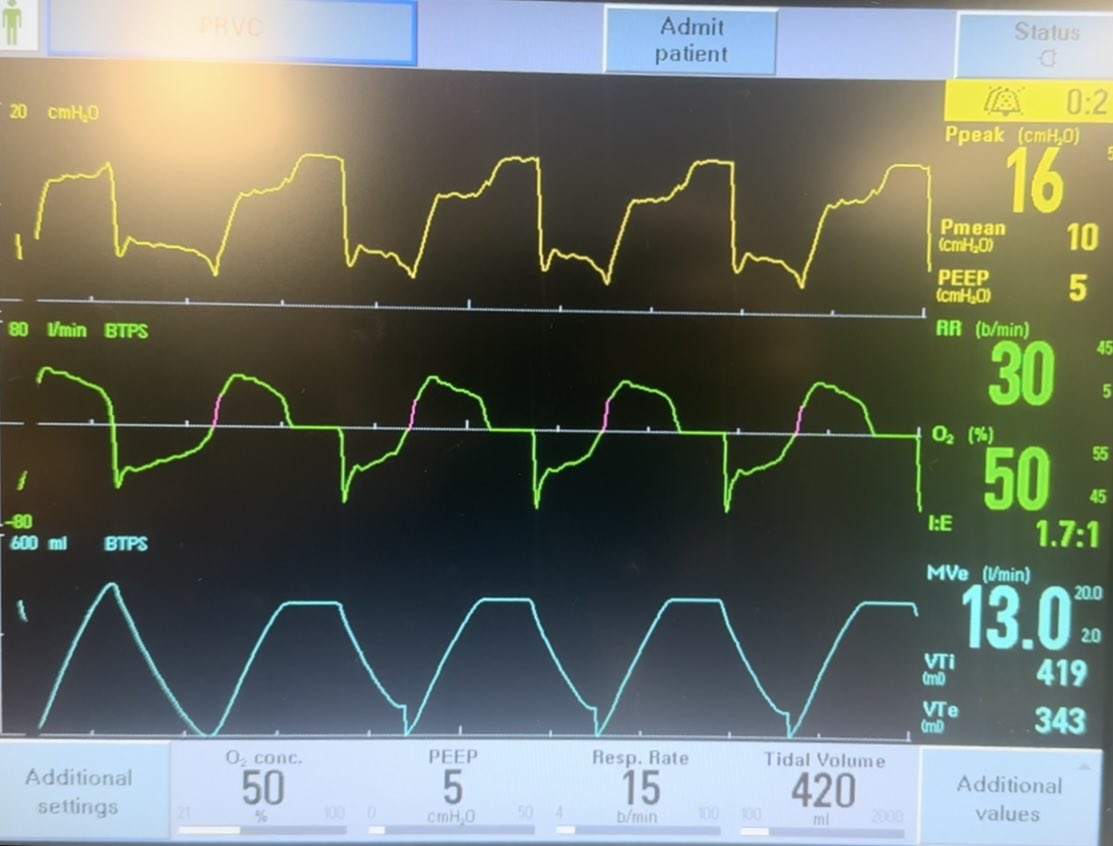
Here’s the ventilator graphic from a patient who was intubated for airway protection
What problems do you see?
English
Indonesia

I matched at my number one choice for residency: Stanford Anesthesiology!!! I am so excited to join the team! 😁👩🏽⚕️ @stanfordanes #Match2025 #anesthesia #anesthesiamatch

English


My dad was so proud of my journey in surgery. He passed away last week, on 3/11/25. I still haven’t figured out what I’m going to do without him.
I matched today- I’m going to be a surgeon! I know he was watching over me & I just hope to make him proud
#Match2025


English
@AlexisKThomas_ Proud of you too, Alexis!!! Congratulations 💕
English

A patient’s cardiac output decreases from 4 to 2 L/min after 15 cm H2O PEEP is initiated. Which of the following should the respiratory therapist recommend?
A. Perform an arterial blood gas analysis to check the patient’s oxygenation
B. Maintain the present settings, and check arterial blood gases in 1 hour
C. Decrease the respiratory rate to extend cardiac filling time
D. Decrease PEEP to 10 cm H2O and recheck the cardiac output
English

Rachel D., MD รีทวีตแล้ว

UW Madison recently and unexpectedly lost one of their students. Please consider donating to his family’s GoFundMe.
every bit of help makes a difference. gofund.me/b63077d8
English
@RespiratoryZone Likely A. Patient is probably air hungry. Increase the PEEP to overcome his flow demand since 10 isn’t sufficient.
English
A manometer is being used to monitor a continuous flow CPAP device set at 10 cm H2O. Each time the patient inhales, the pressure decreases to 2 cm H2O, then returns to 10 cm H2O on exhalation. Which of the following is the most likely cause of the problem?
A. The flow of gas to the patient system is insufficient
B. There is a leak in the patient system
C. The patient’s endotracheal tube is too small for the inspiratory flow
D. The CPAP pressure valve is too small for the patient’s size and weight
English
A patient is receiving noninvasive positive pressure therapy. Pulmonary compliance has decreased over the past 4 hours. To increase the patient’s tidal volume, it would be most appropriate to:
A. Suction the patient
B. Change the CPAP
C. Increase the low-pressure level
D. Increase the high-pressure level
English