Rafael Matias 🐼🕯️

412 posts

Rafael Matias 🐼🕯️ banner
Rafael Matias 🐼🕯️

Rafael Matias 🐼🕯️

@skylenet

Doing Ethereum stuff at the @Ethereum Foundation. @ethPandaOps

Switzerland เข้าร่วม Şubat 2009
859 กำลังติดตาม617 ผู้ติดตาม
Rafael Matias 🐼🕯️ รีทวีตแล้ว

carlbeek
carlbeek@CarlBeek·
the QuickSlots ⚡️🎰 website is live, and I'm very proud of the design! take a look! quickslots.info QuickSlots is the pragmatic way to get Ethereum to run much faster
English
11
31
121
28.9K
Rafael Matias 🐼🕯️ รีทวีตแล้ว
Fate meh
Fate meh@Fatalmeh·
I wish all those who spend so much critical thinking going after EF would give a tiny fraction of it to tweet about the 28days long comms shutdown in Iran, the war their countries are involved in or initiated, the fear and suffering and destruction of so many innocent lives
English
2
3
26
1.5K
Rafael Matias 🐼🕯️ รีทวีตแล้ว
Mario Havel
Mario Havel@TMIYChao·
One month, only 30 days, left in Bordel crowdloaning campaign to fund a DeFi mortgage for our new community space! loan.bordel.wtf We are building a space for independent creation, chaotic education and sustaining cypherpunk values. What is it and how does it work?!👇
English
14
38
130
26.8K
Rafael Matias 🐼🕯️ รีทวีตแล้ว
Justin Drake
Justin Drake@drakefjustin·
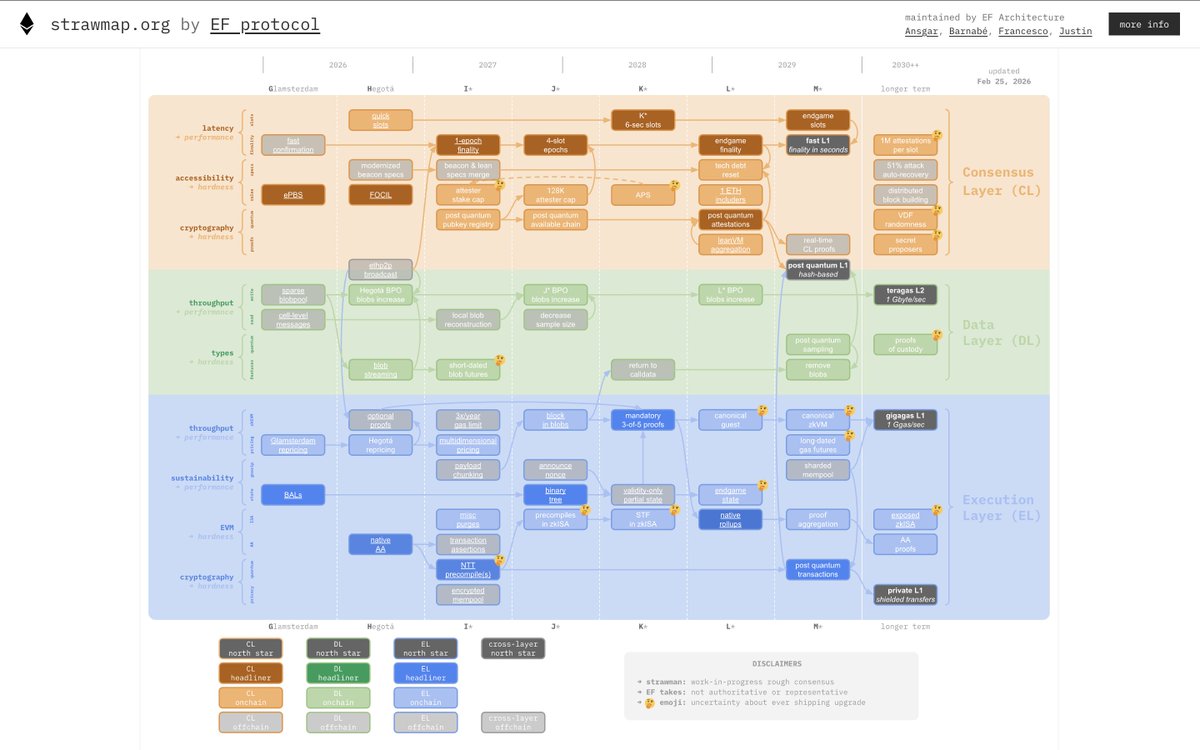
Introducing strawmap, a strawman roadmap by EF Protocol. Believe in something. Believe in an Ethereum strawmap. Who is this for? The document, available at strawmap[.]org, is intended for advanced readers. It is a dense and technical resource primarily for researchers, developers, and participants in Ethereum governance. Visit ethereum[.]org/roadmap for more introductory material. Accessible explainers unpacking the strawmap will follow soon™. What is the strawmap? The strawmap is an invitation to view L1 protocol upgrades through a holistic lens. By placing proposals on a single visual it provides a unified perspective on Ethereum L1 ambitions. The time horizon spans years, extending beyond the immediate focus of All Core Devs (ACD) and forkcast[.]org which typically cover only the next couple of forks. What are some of the highlights? The strawmap features five simple north stars, presented as black boxes on the right: → fast L1: fast UX, via short slots and finality in seconds → gigagas L1: 1 gigagas/sec (10K TPS), via zkEVMs and real-time proving → teragas L2: 1 gigabyte/sec (10M TPS), via data availability sampling → post quantum L1: durable cryptography, via hash-based schemes → private L1: first-class privacy, via shielded ETH transfers What is the origin story? The strawman roadmap originated as a discussion starter at an EF workshop in Jan 2026, partly motivated by a desire to integrate lean Ethereum with shorter-term initiatives. Upgrade dependencies and fork constraints became particularly effective at surfacing valuable discussion topics. The strawman is now shared publicly in a spirit of proactive transparency and accelerationism. Why the "strawmap" name? "Strawmap" is a portmanteau of "strawman" and "roadmap". The strawman qualifier is deliberate for two reasons: 1. It acknowledges the limits of drafting a roadmap in a highly decentralized ecosystem. An "official" roadmap reflecting all Ethereum stakeholders is effectively impossible. Rough consensus is fundamentally an emergent, continuous, and inherent uncertain process. 2. It underscores the document's status as a work-in-progress. Although it originated within the EF Protocol cluster, there are competing views held among its 100 members, not to mention a rich diversity of non-EFer views. The strawmap is not a prediction. It is an accelerationist coordination tool, sketching one reasonably coherent path among millions of possible outcomes. What is the strawmap time frame? The strawmap focuses on forks extending through the end of the decade. It outlines seven forks by 2029 based on a rough cadence of one fork every six months. While grounded in current expectations, these timelines should be treated with healthy skepticism. The current draft assumes human-first development. AI-driven development and formal verification could significantly compress schedules. What do the letters on top represent? The strawmap is organized as a timeline, with forks progressing from left to right. Consensus layer forks follow a star-based naming scheme with incrementing first letters: Altair, Bellatrix, Capella, Deneb, Electra, Fulu, etc. Upcoming forks such as Glamsterdam and Hegotá have finalized names. Other forks, like I* and J*, have placeholder names (with I* pronounced "I star"). What do the colors and arrows represent? Upgrades are grouped into three color-coded horizontal layers: consensus (CL), data (DL), execution (EL). Dark boxes denote headliners (see below), grey boxes indicate offchain upgrades, and black boxes represent north stars. An explanatory legend appears at the bottom. Within each layer, upgrades are further organized by theme and sub-theme. Arrows signal hard technical dependencies or natural upgrade progressions. Underlined text in boxes links to relevant EIPs and write-ups. What are headliners? Headliners are particularly prominent and ambitious upgrades. To maintain a fast fork cadence, the modern ACD process limits itself to one consensus and one execution headliner per fork. For example, in Glamsterdam, these headliners are ePBS and BALs, respectively. (L* is an exceptional fork, displaying two headliners tied to the bigger lean consensus fork. Lean consensus landing in L* would be a fateful coincidence.) Will the strawmap evolve? Yes, the strawmap is a living and malleable document. It will evolve alongside community feedback, R&D advancements, and governance. Expect at least quarterly updates, with the latest revision date noted on the document. Can I share feedback? Yes, feedback is actively encouraged. The EF Protocol strawmap is maintained by the EF Architecture team: @adietrichs, @barnabemonnot, @fradamt, @drakefjustin. Each has open DMs and can be reached at first.name@ethereum[.]org. General inquiries can be sent to strawmap@ethereum[.]org.
Justin Drake tweet media
English
206
411
1.6K
609.5K
Rafael Matias 🐼🕯️ รีทวีตแล้ว
ethPandaOps
ethPandaOps@ethPandaOps·
New in Xatu: Execution trace data. Per-opcode gas consumption for blocks/txs. 9 new tables covering call frames, opcode gas, and daily/hourly aggregations. Blog post + schema docs: ethpandaops.io/posts/evm-gas-…
English
6
5
33
2.2K
Rafael Matias 🐼🕯️ รีทวีตแล้ว
Go Ethereum
Go Ethereum@go_ethereum·
🚨 Geth v1.16.8 is out This is a security release addressing issues that can impact liveness. Geth node operators and downstream maintainers are strongly encouraged to upgrade promptly.
English
10
93
141
20.4K
Rafael Matias 🐼🕯️ รีทวีตแล้ว
ethPandaOps
ethPandaOps@ethPandaOps·
⏰ BPO2 lands on Mainnet on Wed 07/01/2026 at 01:01:11 GMT (in ~13 hours) - raising the max blob count to 21 No preparation or action is required, but we advise all node operators to monitor their infrastructure around fork time View the countdown: lab.ethpandaops.io/ethereum/forks…
English
2
5
12
1.4K
Rafael Matias 🐼🕯️ รีทวีตแล้ว
vitalik.eth
vitalik.eth@VitalikButerin·
Welcome to 2026! Milady is back. Ethereum did a lot in 2025: gas limits increased, blob count increased, node software quality improved, zkEVMs blasted through their performance milestones, and with zkEVMs and PeerDAS ethereum made its largest step toward being a fundamentally new and more powerful kind of blockchain (more on this later) But we have a challenge: Ethereum needs to do more to meet its own stated goals. Not the quest of "winning the next meta" regardless of whether it's tokenized dollars or political memecoins, not arbitrarily convincing people to help us fill up blockspace to make ETH ultrasound again, but the mission: To build the world computer that serves as a central infrastructure piece of a more free and open internet. We're building decentralized applications. Applications that run without fraud, censorship or third-party interference. Applications that pass the walkaway test: they keep running even if the original developers disappear. Applications where if you're a user, you don't even notice if Cloudflare goes down - or even if all of Cloudflare gets hacked by North Korea. Applications whose stability transcends the rise and fall of companies, ideologies and political parties. And applications that protect your privacy. All this - for finance, and also for identity, governance and whatever other civilizational infrastructure people want to build. These properties sound radical, but we must remember that a generation ago any wallet, kitchen appliance, book or car would fulfill every single one of them. Today, all of the above are by default becoming subscription services, consigning you to permanent dependence on some centralized overlord. Ethereum is the rebellion against this. To achieve this, it needs to be (i) usable, and usable at scale, and (ii) actually decentralized. This needs to happen at both (a) the blockchain layer, including the software we use to run and talk to the blockchain, and (b) the application layer. All of these pieces must be improved - they are already being improved, but they must be improved more. Fortunately, we have powerful tools on our side - but we need to apply them, and we will. Wishing everyone an exciting 2026. Milady.
English
2.9K
2K
13.1K
1.4M
Rafael Matias 🐼🕯️ รีทวีตแล้ว
Sam Calder-Mason
Sam Calder-Mason@samcmAU·
Heres some data from the last 24h of nodes that we connected to on Mainnet wrt. PeerDAS. - 17.6% of nodes are supernodes (4096+ ETH staked) - 46.1% custody 4 columns (the minimum) - 23.4% custody between 5-8 columns IMPORTANT: These are NODE counts. They are not directly stake weighted. More insights below 👇
Sam Calder-Mason tweet media
English
3
14
35
2.4K
Rafael Matias 🐼🕯️ รีทวีตแล้ว
binji
binji@binji_x·
not a fusaka explainer, but i hope you get a chance to read this.
binji@binji_x

the eth core devs don’t tweet a lot about just how hard the work that they do is so let’s talk about it: 1. every line of code they merge can move more money than most banks process in a quarter. there is no staging server for that. 2. they swap consensus logic for a 400B + dollar economy without scheduling downtime. ever. 3. they coordinate hundreds of researchers, auditors, and client teams across time zones, cultures, and philosophies, yet ship like a single mind. 4. they do it all in public, with every decision dissected by the loudest peanut gallery on the internet, and still keep the vibe collaborative. 5. they design for attackers who have nine figure incentives and infinite patience. then they sleep anyway. 6. they keep six independent clients in perfect sync so the same block lives at the same height for every node in the world. 7. they turn bleeding edge research into production code while preserving backwards compatibility for machines that went online before defi even had a name. 8. they debug issues that only happen once a year on a single archive node because someone somewhere will rely on that edge case. 9. they write cryptography that must stay unbroken for decades while the math itself evolves beneath their feet. 10.when the upgrade lands smooth the outside world shrugs. inside ethereum we know it was a minor miracle. every successful fork proves that decentralized coordination can outperform the world’s best hierarchies and shows that open internet capital markets are now the default. thank you, truly. we owe you everything.

English
20
9
159
15.5K
Rafael Matias 🐼🕯️ รีทวีตแล้ว
parithosh | 🐼👉👈🐼
parithosh | 🐼👉👈🐼@parithosh_j·
Don't forget that we managed 2x the forks in a year while shipping a bunch of other things and keeping the chain healthy! Client devs are beasts ❤️🐼
Nethermind@Nethermind

🚀 The @ethereum Fusaka Upgrade is now live on mainnet and running smoothly on the Nethermind Client. This marks a major step forward for the Ethereum protocol, unlocking powerful new capabilities for scalability and validator performance: - Gas limit raised to 60m - 4× blob capacity enabled by PeerDAS - 530 GB reduction in node sync overhead - 32-slot proposer lookahead Another seamless upgrade, another meaningful milestone for the entire ecosystem. Huge thanks to all client teams, researchers, and operators who collaborated to bring this upgrade across the finish line.

English
5
7
106
4.4K
Rafael Matias 🐼🕯️ รีทวีตแล้ว
ethPandaOps
ethPandaOps@ethPandaOps·
Fusaka is now live and finalized on Mainnet! We're busy looking at the data now and will update you on how the networking layer looks once we have enough samples! In the meantime, please report any bugs you see with your nearest friendly client dev!
ethPandaOps@ethPandaOps

Happy Fusaka week! 🦓 New Lab view going live shortly after Mainnet: live custody monitoring for PeerDAS. Are peers actually storing what they claim? Let's verify them in real-time. Built in collaboration with @ethereumfndn's P2P team🤝

English
5
22
174
15.7K
Rafael Matias 🐼🕯️ รีทวีตแล้ว
superphiz.eth
superphiz.eth@superphiz·
superphiz.eth tweet media
ZXX
1
7
165
2.6K
Rafael Matias 🐼🕯️ รีทวีตแล้ว
ethPandaOps
ethPandaOps@ethPandaOps·
Happy Fusaka week! 🦓 New Lab view going live shortly after Mainnet: live custody monitoring for PeerDAS. Are peers actually storing what they claim? Let's verify them in real-time. Built in collaboration with @ethereumfndn's P2P team🤝

ethPandaOps tweet media
English
8
21
104
19.2K
Rafael Matias 🐼🕯️ รีทวีตแล้ว
terence
terence@terencechain·
Happy 5th birthday to the beacon chain Crazy to look back at how far the network has come and how much has grown since genesis Huge thanks to everyone who’s pushed this thing forward over the years 🎉
English
13
51
140
31.1K
Rafael Matias 🐼🕯️
Rafael Matias 🐼🕯️@skylenet·
I still remember being on my first DevCon in Prague and reading this book. Ethereum was totally new for me back then. It helped me a lot. Can recommened🙏 Also shoutout to @nonsens3 for answering all my newb questions back then.
Blackie.hl@ManInBlackie

Mastering Ethereum: Second Edition is officially out for free on github. You can read it directly on github or on masteringethereum/./xyz if you prefer that UI. Enjoy the book and let us know if you like it.

English
0
0
2
600
Rafael Matias 🐼🕯️ รีทวีตแล้ว
Kaan
Kaan@kaanuzdogan·
What a week 🙌 and more importantly a moment of appreciation to @nethan_eth and the @EFDevcon team. They did it again 🫡 I'm mindblown by the scale and the quality this year again and how the team delivers even better every single year. Next year is India is going to be another level and the bar now even higher.
Kaan tweet mediaKaan tweet mediaKaan tweet media
English
4
1
50
2.6K
Rafael Matias 🐼🕯️
Rafael Matias 🐼🕯️@skylenet·
@SCBuergel Right. I see that Gnosis VPN can have a better pool of IP addresses then any centralized VPN provider. But the risk of IP reputation still exists. I guess that running your own VPN is the only way around that.
English
1
0
1
55
Sebastian Bürgel
Sebastian Bürgel@SCBuergel·
In context of the quoted tweet, Gnosis VPN will allow anyone with e.g. a Dappnode at home to run exit nodes. These residential IPs give you (as a user) access to much more "IP address reputation" than any legacy VPN. Yes, that's a risk for the exit node home nodler, but we will provide the tools to mitigate these risks as good as technically possible. And the rest should be decided by a supply and demand - and we provide the tools that you can use as a marketplace for that (but we do not operate it).
English
1
0
3
126
Sebastian Bürgel
Sebastian Bürgel@SCBuergel·
This is why people will use Gnosis VPN instead of NordVPN 👇
daniel@danielhangan_

Your $156/year VPN subscription is the reason your TikTok gets 200 views. I shadowbanned myself 4 times before I figured this out. Here's what consumer VPNs won't tell you: You share ONE IP address with 5,000+ other users. When you connect to NordVPN's "New York server," you're joining: > 2,847 dropshippers > 1,293 bot farmers > 891 banned account creators > You TikTok's fraud detection sees this IP and thinks: "5,000 accounts from one address? Spam network." Your content never had a chance. I tested this across 23 accounts over 4 months. test Group A: Consumer VPN (NordVPN, ExpressVPN) > Shadowbanned in 72 hours > Average views: 247 per video > US audience reach: 3% test Group b: private cloud VPS with Outline VPN (dansvpn) > Zero shadowbans in 4 months > Average views: 48,000 per video > US audience reach: 87% The difference? IP address reputation. Consumer VPNs = flagged by every platform Private VPS = looks like a real US user Here's the method that's working: Instead of NordVPN ($12.99/mo): Set up your own VPN Why this works: TikTok assigns a "trust score" to every IP. Shared VPN IPs: Trust score 2/10 (thousands of users) Home IP: Trust score 5/10 (residential, but wrong region) Private cloud IP: Trust score 9/10 (consistent, clean, dedicated) When you post from a 2/10 IP → 200 test viewers When you post from a 9/10 IP → 20,000 test viewers Same video. 100x different initial reach. One creator I advised switched from ExpressVPN to a private VPS. Week 1 (ExpressVPN): 14 videos, 2,347 total views Week 2 (Private VPS): 14 videos, 847,000 total views 361x difference. The only variable: IP address authenticity. The setup (high level): 1. Rent a VPS in your target region (US East Coast for TikTok) 2. Install Outline VPN (Docker one-click install) 3. Generate your private keys 4. Connect from your phone 5. Warm up your TikTok account properly (separate thread) Your competitors already figured this out. While you're troubleshooting why NordVPN "isn't working," they're hitting 1M+ views with $3.50/month infrastructure. Consumer VPNs are designed for privacy. Not for platform growth. Using the wrong tool for the wrong job.

English
15
1
33
4.6K