Zayyan@MCIAZayyan
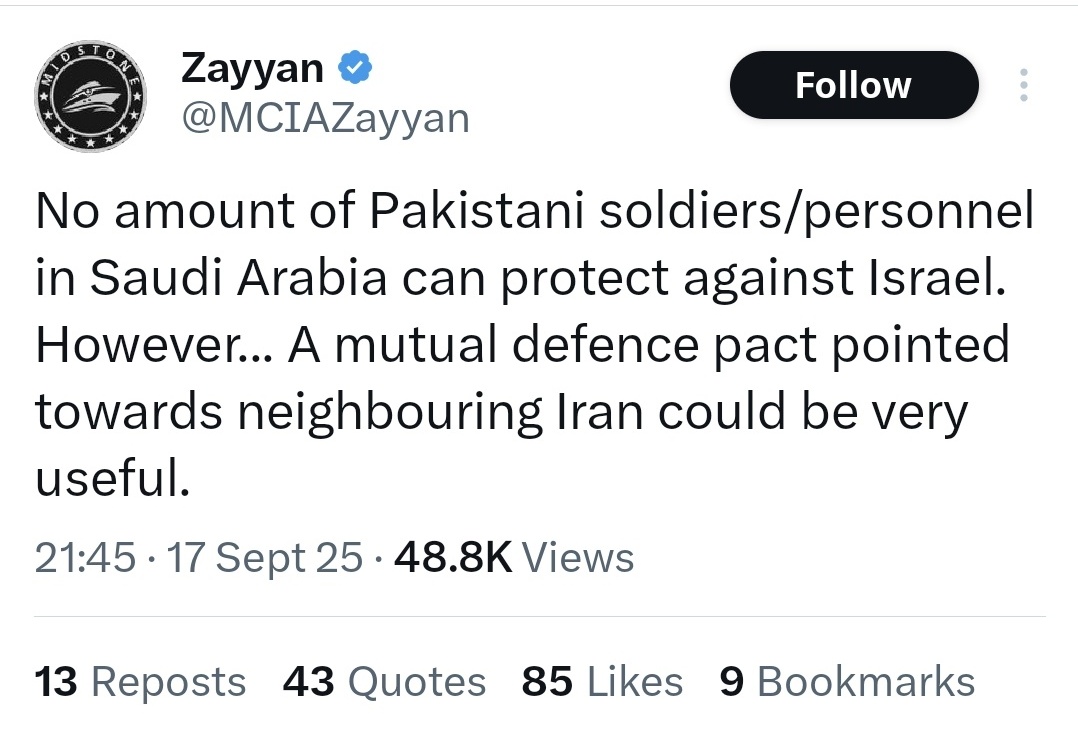
There's no mutual defence pact between Saudi Arabia and Pakistan.
In September 2025, the agreement was signed. The next month, Pakistan is fighting the Taliban. Saudi Arabia does not back Pakistan... not even politically, not even rhetorically. Then, in February 2026, Pakistan's war with the Taliban starts, and the Saudis still sit on the fence.
Pak had not been called to defend KSA when the clashes with the Taliban happened, but KSA already had opportunities to support Pak in what is a serious, long‑term security issue, & chose not to. That removes any moral basis for reciprocity.
So let’s be clear: this was never mutual. That's why you're seeing this "cash for muscle" discussion again.
So this idea in Saudi that Pak is now somehow obligated to step in for them under a “mutual defence pact” is nonsense. If there’s no mutuality in practice, the label is meaningless. In fact, it is used asymmetrically to make Pakistanis think they have some duty for people that don't even speak up for them... not on Afghanistan, not on India. In fact, look how good Saudi‑India relations are.
Call it what it is: a transactional arrangement. Cash for arms. Nothing more.
And even that isn’t simple.
If Pak were to intervene against Iran in any capacity, the domestic blowback would be significant. So any financial support should be seen as compensation for disruption, not a favour to help Pak manage an energy shock that originates in the Gulf. Bare minimum. This is a Middle Eastern war, & it's affecting everyone else, even those who have no role in it.
But even compensation isn’t enough.
Saudi didn’t support Pakistan in Afghanistan. It has taken positions favourable to India. Now it expects Pakistan to step in militarily?
The Saudis themselves aren't even defending themselves. That alone will have a catastrophic effect on their long‑term security. But why should Pak rush to defend a country, at its own risk, that doesn't even want to defend itself?
If Saudi wants anything resembling “mutual defence”, then it has to show it. That means actually stepping up against Iran long before invoking the pact, unbreakable promises of diplomatic backing on Pak’s core issues, including Afghanistan and, more difficult but still relevant, India. It means aligning politically, not just writing cheques, as if Pakistan were some desperate rent‑boy.
And beyond that, if the region is being reshaped, if everyone else is gaining something from this conflict, then Pakistan doesn’t just get paid... it gets a stake. A real one. Not crumbs, but a damn slice of the pie. If the Arabs would get theirs, then Pakistan is owed theirs if they were to intervene and it ends up going that far.
But right now, none of the required conditions are there.
There’s no moral obligation. There’s no direct threat to Pakistan. The domestic environment doesn’t support intervention. And strategically, Pakistan is not worse off seeing Iran weakened and the war ending.
So in the current situation, there is no basis for Pakistan to act.
It’d be perfect if something could be done about the nuclear issue, as a nuclear Iran would be a disaster, but Pakistan itself is not responsible for toppling the regime or taking the nuclear program out.
That doesn’t mean ignoring it. It means preparing properly: defining the conditions under which Pakistan would engage, what it expects in return, and where its red lines are.
Because what we’re seeing now is some in Saudi talking about invoking support while not even defending themselves.
However, there is a very big difference between fighting for Saudi Arabia against Iran, and fighting for Saudi Arabia as part of cleaning up the region. But that can only be done if you manage things correctly...
And that raises the obvious question:
Why should Pakistan step in militarily for states that won’t even fully defend themselves despite having the resources and backing to do so, while not even getting clear promises of something worthwhile in return?