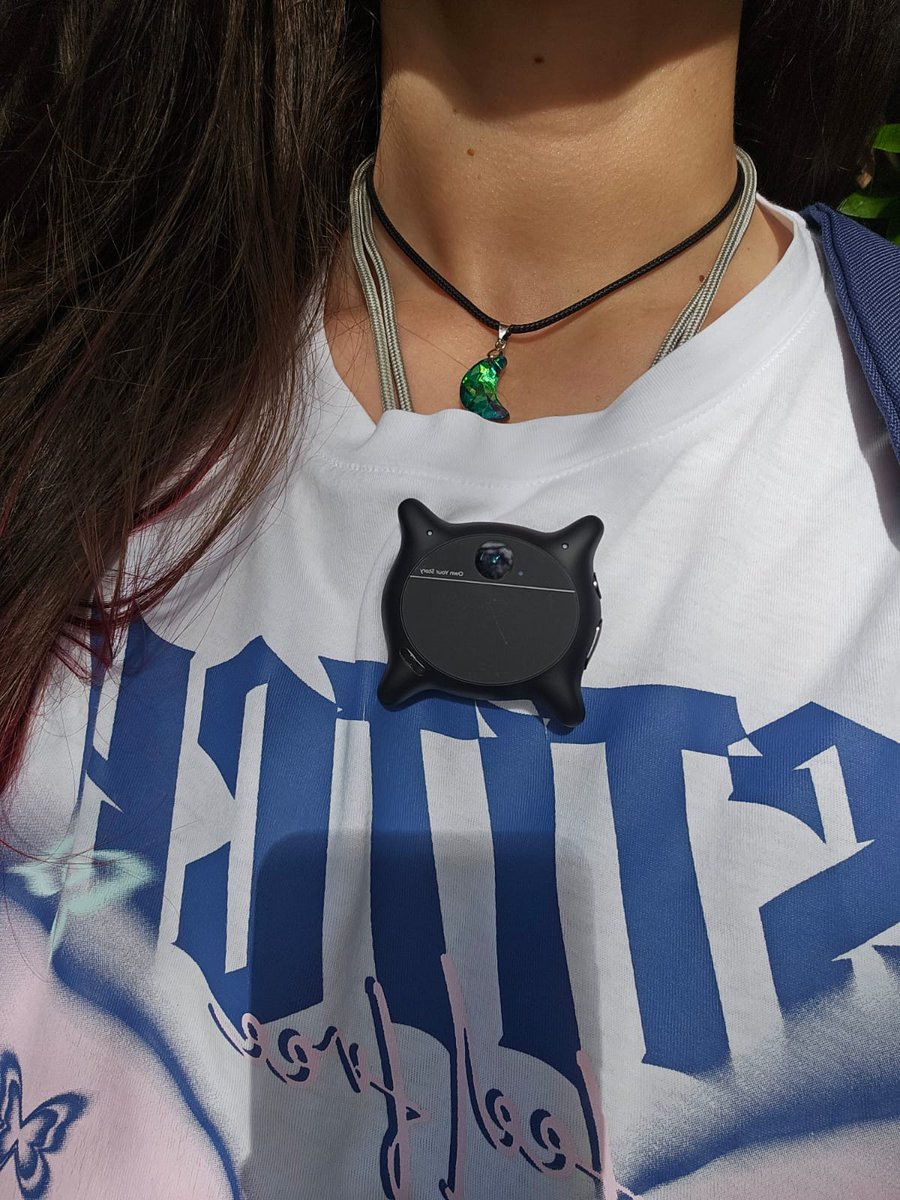
@AIinAmerica @Scobleizer @Looki_ai Not swappable at home, but hit us up if the battery ever gives out — we'll take care of it through official service. 🤙
English
Yang Sun
37 posts

@sunyangkobe
Cofounder and CEO @Looki_ai | UofT&CMU Alumni | xGoogler


Back in 1995 Microsoft had a research group in San Francisco that was wearing cameras all day long, discovering how an always-worn camera would change human life. I interviewed that team long ago. They called their camera “Sense Cam.” Today @Looki_ai came to my house to give me one. Here is founder/CEO Yang Sun telling me what it, and the assistant it empowers, does. And he takes on all the harsh criticism that will come its way. Privacy. Freaky factor. Security. I have wanted one for 20 years. And now I have it and am honored to be wearing it now.
Back in 1995 Microsoft had a research group in San Francisco that was wearing cameras all day long, discovering how an always-worn camera would change human life. I interviewed that team long ago. They called their camera “Sense Cam.” Today @Looki_ai came to my house to give me one. Here is founder/CEO Yang Sun telling me what it, and the assistant it empowers, does. And he takes on all the harsh criticism that will come its way. Privacy. Freaky factor. Security. I have wanted one for 20 years. And now I have it and am honored to be wearing it now.


AI is the most important technology of our lifetimes, and we shoved it in a text box. Today, most of us experience AI through a single interface: typing. But what would be the best way to interact with near omniscient, increasingly multi-modal intelligence we created? History says hardware is really hard. Naval calls it impossible. At Snap, I worked in consumer hardware – I viscerally know why people say this. It’s because it’s true. And yet, I keep meeting sharp, ambitious young founders building in it anyway and it’s simply too compelling to ignore. They’re working on glasses, pins, rings, lamps, microchips, and devices we haven’t imagined yet. All chasing the same goal: give AI a real presence in our lives. AI improves exponentially with richer context. Not just the words we type, but what we see, hear, and do. To gather that context, it can’t be trapped in a laptop. It has to move with us. Big tech should lead here, but won’t. The constraints are too tight. The leap will come from new founders who instinctively understand what people will wear, carry, and love and who will take risks incumbents can’t. Why this opportunity is hard to ignore, despite my experience: - Marginal cost of software creation is near zero - now what? - Context makes AI infinitely more useful + hardware collects it passively - Social norms evolve fast when the utility is undeniable We’re at the start of that shift. The form factor is still open. And I am very energized by the founders building in this space.