92 Johnson Solids
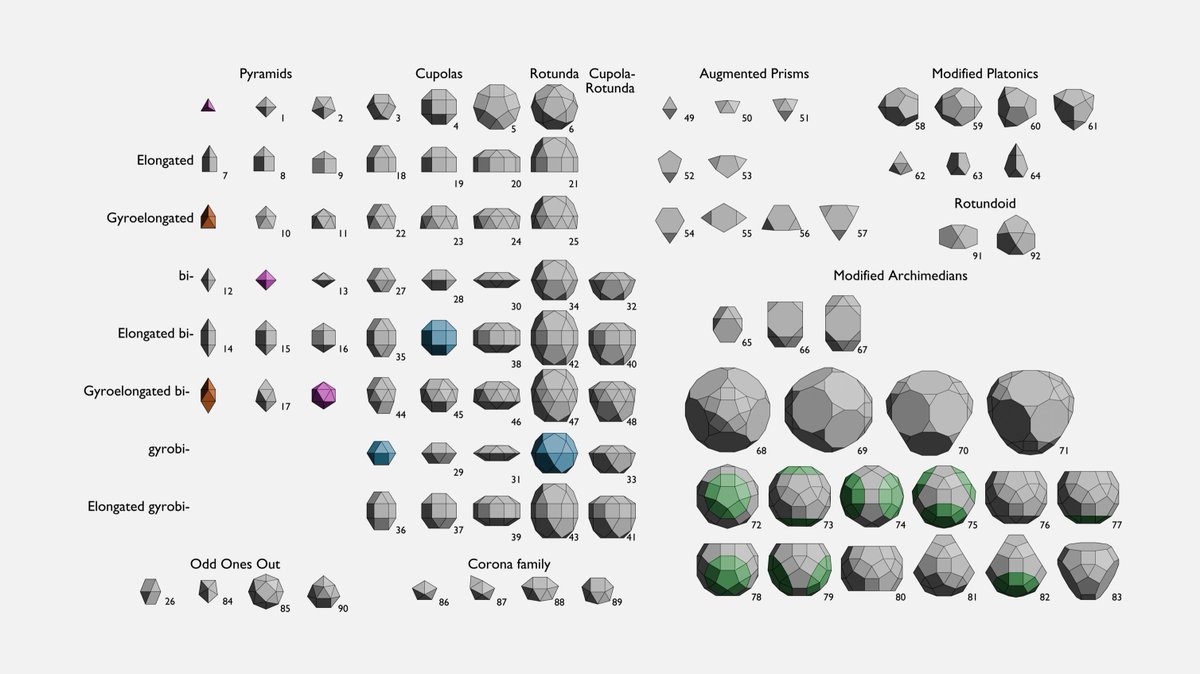
In 1966, Norman Johnson found 92 convex polyhedra made only of regular polygons that didn't belong to any known family. He guessed that was all of them.
In 1969, Victor Zalgaller proved that there are exactly 92.
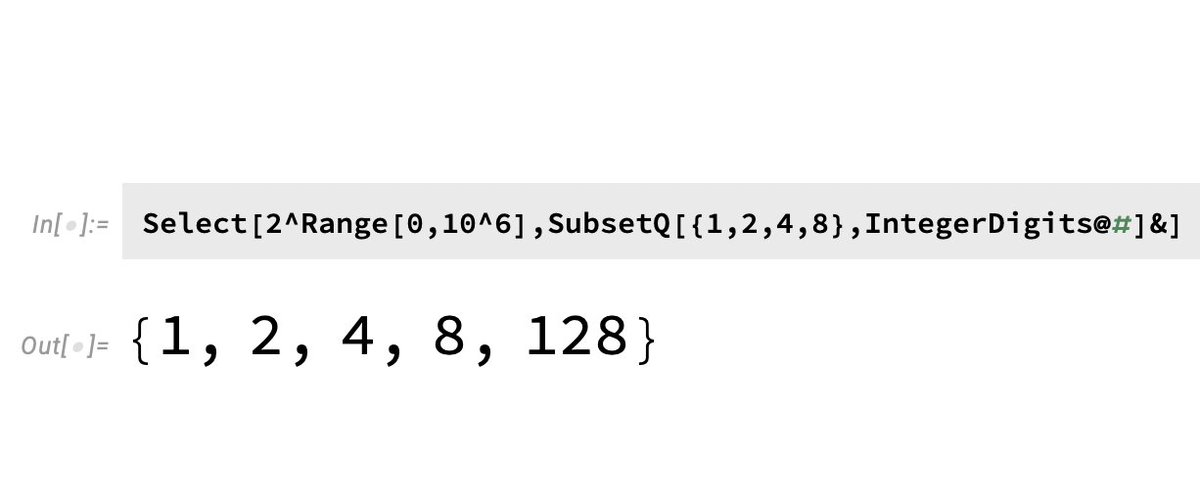
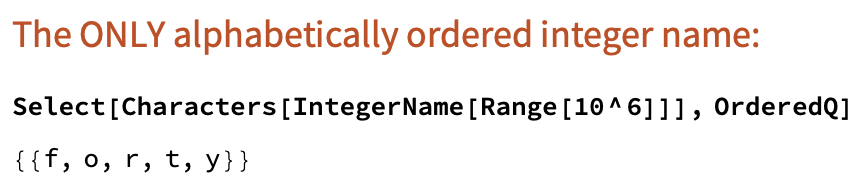
@fermatslibrary First 𝟏 𝐦𝐢𝐥𝐥𝐢𝐨𝐧 powers of 2 checked with an elegant Wolfram one-liner code. You can add Parallelize to thread of many CUP cores:
Select[2^Range[0,10^6],SubsetQ[{1,2,4,8},IntegerDigits@#]&]
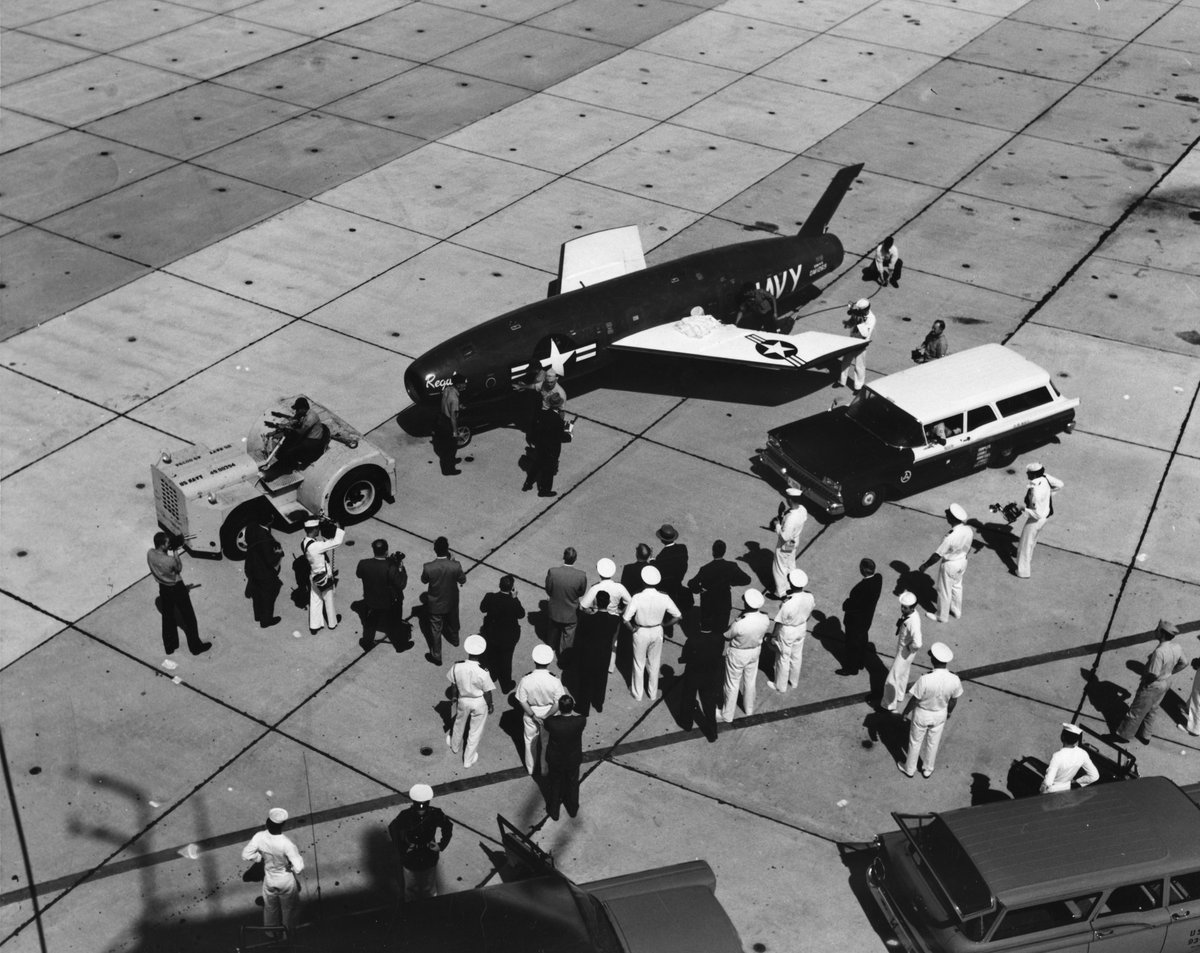
In 1959, the U.S. Postal Service tried delivering mail via cruise missile. They replaced the nuclear warhead with mailbags containing 3,000 letters and fired it from Virginia to Florida.
Flight time: 22 minutes
@fermatslibrary But did you know that e^π = (−1)^(-i) (as principal value) and is Gelfond's constant and is a transcendental number. But π^e is a mystery - right now, mathematicians do not even know if π^e is rational. And e^π > π^e :-)
Cover of prominent chemistry journal features a stunning structure made with Wolfram Language. When an unbound electron appears in the water a lot of things change around it. It is called a hydrated electron and it is in the center of its environment in the video.
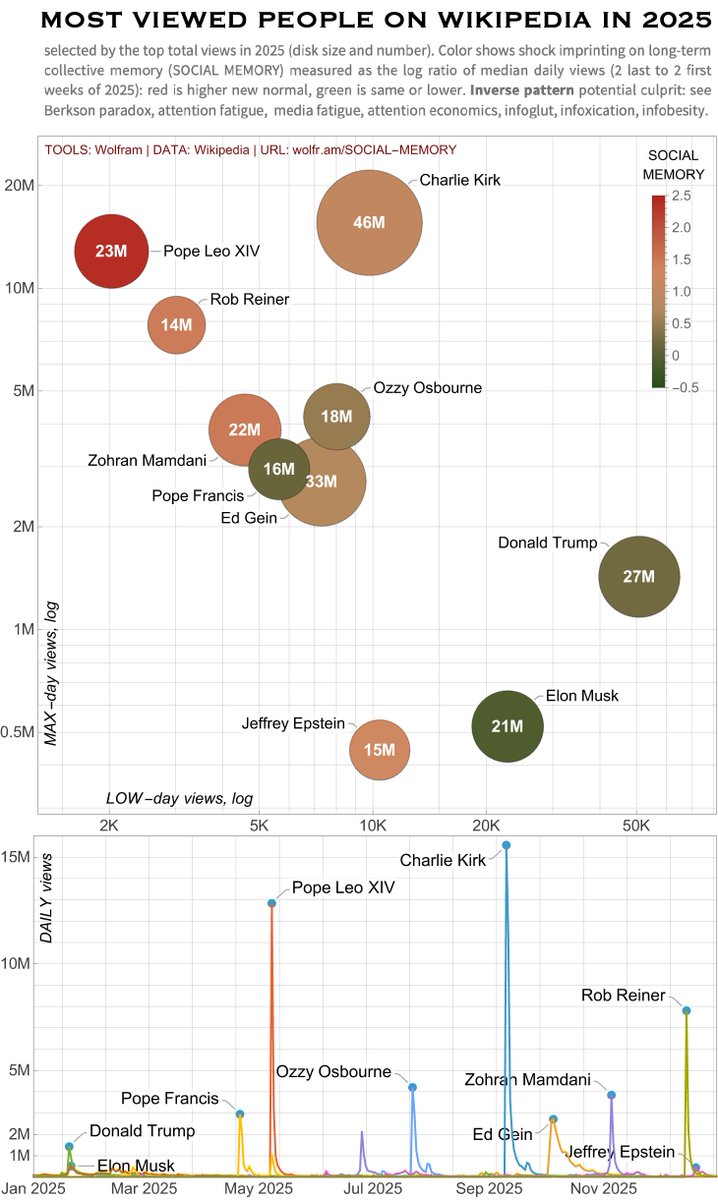
"Most-Viewed People on Wikipedia in 2025", my new article. Novel Social Memory wolfr.am/SOCIAL-MEMORY log ratio of post- to pre- catalyst event median Wikipedia pageviews, measuring how a catalyst event resets collective baseline attention. Comment If you know similar measures.
⚛️ In 𝐫𝐢𝐯𝐞𝐫 𝐦𝐨𝐝𝐞𝐥 of 𝐛𝐥𝐚𝐜𝐤 𝐡𝐨𝐥𝐞𝐬 space itself flows...
River of space falls into black hole at Newtonian escape velocity, hitting light speed at horizon. Newton particle-grid with Wolfram differential equations gives a qualitative proxy for the visual:
🔴 Wolfram code & article: lnkd.in/dp6gk2gK
ABSTRACT excerpt: "The river model of black holes":
"The river model is mathematically sound, yet simple enough that the basic picture can be understood by non-experts. In the river model, space itself flows like a river through a flat background, while objects move through the river according to the rules of special relativity. In a spherical black hole, the river of space falls into the black hole at the Newtonian escape velocity, hitting the speed of light at the horizon. Inside the horizon, the river flows inward faster than light, carrying everything with it."
How-to "see" 4th dimension in simple steps:
...using 𝐟𝐚𝐦𝐢𝐥𝐢𝐚𝐫 𝐨𝐛𝐣𝐞𝐜𝐭𝐬. 1️⃣ This 4D object = donut;
2️⃣ Cut typical 3D donut across its tube;
3️⃣ The shape of the cut is usual 2D circle;
4️⃣ Generalize by +1: cut 4D donut and get 3D shapes at the cut.
Which is similar to the red tubes in video. Those red tubes are shape of cuts when our familiar 3D space slices 4D donut. And they are similar to our typical 3D donuts!
What's your favorite application of higher dimensions?
TREFOIL KNOT & UNKNOT
Another stunning part in the video is gorgeous 𝐭𝐫𝐞𝐟𝐨𝐢𝐥 𝐤𝐧𝐨𝐭 falling apart into 2 separate rings and then reconnecting again into 𝐮𝐧𝐤𝐧𝐨𝐭 -- starting at t =12 seconds. I highly recommend to pause and slowly scroll through this structure. Its formation is analogical to how you twist 180° a paper band to make a Möbius strip. For details and code see:
🔴 Wolfram code & article: lnkd.in/eM5vES5x
APHANTASIA & ABSTRACT THINKING
𝐀𝐩𝐡𝐚𝐧𝐭𝐚𝐬𝐢𝐚 is the inability to visualize in the mind. Some people cannot form images in their thoughts, for example imagining an apple. Surprisingly people with aphantasia have ability to think of higher dimensions through the power of abstraction. Grasping very visual entities even with no ability to visualize. The mind is truly a mystery.
𝓜𝐚𝐧𝐝𝐞𝐥𝐛𝐫𝐨𝐭 fractal encodes 𝓙𝐮𝐥𝐢𝐚 fractals.
Video: 𝐰𝐡𝐢𝐭𝐞 𝐝𝐨𝐭 in 𝓜 defines connectivity of 𝓙.
Both 𝓜 and 𝓙 fractals are defined as 𝐙 ↦ 𝐙²+ 𝐂
The difference? 𝓜 plots 𝐂, and 𝓙 plots 𝐙.
The white dot (parameter 𝐂) travels in 𝓜 set (corners) and the corresponding 𝓙 set is plotted in the center.
Thus: 𝓜𝐚𝐧𝐝𝐞𝐥𝐛𝐫𝐨𝐭 is an atlas for 𝓙𝐮𝐥𝐢𝐚.
It means each point 𝐂 (white dot) in 𝓜 set tells you the structure of the corresponding 𝓙 set. If white dot inside 𝓜 then 𝓙(𝐂) is one connected whole. If white dot outside 𝓜 then 𝓙(𝐂) shatters into dust. So the Mandelbrot works like a map: by scanning parameter space 𝐂, you can classify every possible Julia set for connectivity.
In Wolfram Language simplest code can plot these fractals. For example, functions below helped to make this video. Plot Mandelbrot:
MandelbrotSetPlot[]
or even create interactive apps for Julia:
Manipulate[JuliaSetPlot[Complex @@ p, PlotRange->1.5], {p, Locator}]
Despite few-symbol definition 𝐙 ↦ 𝐙²+𝐂 no finite computation exhausts an infinite fractal. Any algorithm gives only approximations. When facing infinitely intricate, infinitely explorable universes, the power of mathematical abstraction is to encode infinite in finite symbolic form. A few fun facts:
𝐓𝐨𝐤𝐲𝐨 𝐬𝐮𝐛𝐰𝐚𝐲 is 99% on-time, world's best. But how lines can be shaped by 𝐄𝐝𝐨 𝐏𝐞𝐫𝐢𝐨𝐝 (1603–1868)?
Try to guess before reading further 👇 Each dot is a train (real data) ramping up to one of the world highest peak frequencies. Goes ~40m deep.
Tokyo's subway structure is quite complex. Japan has a law that land ownership extends to surface and underground. So land fee is due for subway construction. Unless... subway runs under the roads owned by the state or municipality, then underground is free for public interest. But the roads in Tokyo are made by filling the roads and waterways remaining from Edo period. They curve and run radially fitting the old Edo Castle. And that's how 1603–1868 shape modern subway.
𝘞𝘖𝘓𝘍𝘙𝘈𝘔 𝘢𝘳𝘵𝘪𝘤𝘭𝘦: community.wolfram.com/groups/-/m/t/2…
The whole data mining and visualization pipeline is done in Wolfram. Code base is quite small (see link above) due to large ~10K Wolfram function vocabulary and some packing neat algorithms like FindShortestTour used here.
🟥 or 🟦 floats above the other?
This stereo illusion (𝐜𝐡𝐫𝐨𝐦𝐨𝐬𝐭𝐞𝐫𝐞𝐨𝐬𝐢𝐬) needs both eyes: close one and illusion is gone. 𝐁𝐨𝐢𝐝𝐬 or 𝐬𝐰𝐚𝐫𝐦 𝐢𝐧𝐭𝐞𝐥𝐥𝐢𝐠𝐞𝐧𝐜𝐞 type algorithm used in simulation - expand for tiny code👇
Wolfram Mathematica code (do you get what it does?):
n=3000;f:=(#/(.01+Sqrt[# . #]))&/@(x[[#]]-x)&;
x=Table[{Sin[a],-Cos[a]},{a,0.,2\[Pi],2\[Pi]/(n-1)}];
p=Table[Mod[i+1,n]+1,{i,n}];q=RandomInteger[{1,n},n];
Graphics[{Dynamic[Point[x=0.995 x+0.02 f[p]-0.01 f[q]]]}]
𝐊𝐞𝐦𝐩𝐞'𝐬 𝐮𝐧𝐢𝐯𝐞𝐫𝐬𝐚𝐥𝐢𝐭𝐲 𝐭𝐡𝐞𝐨𝐫𝐞𝐦: There is a 𝐥𝐢𝐧𝐤𝐚𝐠𝐞 that signs your name. Proves a linkage exists to draw any algebraic planar curve. But to prove is NOT to design elegantly. Novel elegant method: community.wolfram.com/groups/-/m/t/2…
In the video this recursion is applied many times to a 3D table of values, shown as 3D image. 𝐒𝐭𝐚𝐛𝐥𝐞 𝐬𝐩𝐢𝐫𝐚𝐥𝐬 𝐞𝐦𝐞𝐫𝐠𝐞. Video runs evolution backwards to the initial random values, and then forward in time with slightly different visualization technique.