Dinesh Kumar

406 posts

Dinesh Kumar banner
Dinesh Kumar

Dinesh Kumar

@thedktalks

எண்ணம் போல் வாழ்கை | Carpe Diem | Software Engineer | Decoding modern life through Psychology, Tech, AGI & Systems Thinking.

Chennai, India เข้าร่วม Şubat 2026
0 กำลังติดตาม38 ผู้ติดตาม
ทวีตที่ปักหมุด
Dinesh Kumar
Dinesh Kumar@thedktalks·
I’m passionate about learning and sharing knowledge — always free and accessible to everyone. I believe high-quality education shouldn’t have a price tag. Over the years, I’ve self-learned across diverse subjects — History, Politics, Psychology, Economics, Science, Investing, Productivity, Fitness, Biohacking, and Nutrition. Much of this came from necessity: limited resources, but unlimited curiosity. Now, I share what I’ve learned to make the path easier for others walking the same journey. The DK Talks is a channel for people who still think.
English
0
0
3
626
Srajan
Srajan@_Creation22·
Mass layoff comming soon ????
Srajan tweet media
English
36
44
990
167K
Dinesh Kumar
Dinesh Kumar@thedktalks·
Nvidia is trading at a premium of approximately 50-60 times its PE ratio. It is riding the AI boom strongly. I have not been following the stock market in India lately, but I am sure not all our listed companies follow a similar premium pattern as NVIDIA. I am not an expert. Just sharing my two cents. Your point of view is welcome.
English
1
1
4
518
Harsh Goenka
Harsh Goenka@hvgoenka·
India vs Nvidia. A $3.5 trillion economy… yet its listed companies together are still valued less than a single chipmaker. Nvidia: $5.2T India: $4.97T The real question: are we underpriced… or underperforming where it matters most?
English
460
160
1.6K
121.5K
Dinesh Kumar
Dinesh Kumar@thedktalks·
But how the evening and night feels outside? You experience will help me to understand it better. Lately I am studying about this particular topic. I check room temperature, humidity, wall temperature of different rooms, terrace, etc. I do self experiments like room temperature before and after cross ventilation. Your response might help me to understand it better.
English
1
0
0
5
Dinesh Kumar
Dinesh Kumar@thedktalks·
We can’t control the climate like heat waves or temperature. Period. But we should try to improve green cover and create and maintain ponds. I have read that in Karnataka they converted around 97 acres of dry land into a forest and greatly improved the groundwater level. If this happens throughout the Indian subcontinent wherever possible, we will still feel the heat but it will feel less intense.
English
1
0
0
12
Dinesh Kumar
Dinesh Kumar@thedktalks·
Our system is slow, which I totally agree with. But we will get there eventually. At least we should make sure that newer expansions of the cities have proper planning. Keep some space for trees. It should be part of the side walls and space belonging to the government. Because real estate costs are too high and people expect better ROI for the money they paid. It is a bit complicated. 😊
English
0
0
1
95
Dinesh Kumar รีทวีตแล้ว
Nithin Kamath
Nithin Kamath@Nithin0dha·
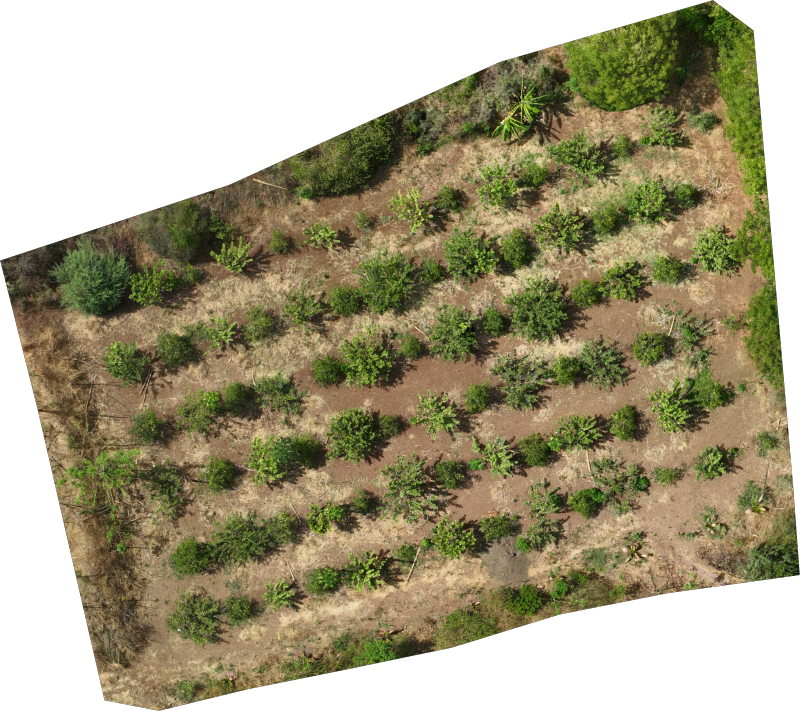
The heat has been brutal this past week. Temperatures hit 45° in Nagpur, 44° in Ahmedabad, 43° in Prayagraj, 42° in Delhi. Even Bengaluru hit 37°. And we're still in April 😬 A big contributing factor behind rising temperatures is the loss of forest cover, and India has lost a lot of it. Back in 2020, we met the team behind Farmers for Forests (F4F). Their idea was to do agroforestry at scale. The challenge is that farmers can't afford to wait years for trees to pay off, and most tree-planting projects don't survive the first monsoon. The idea was ambitious, and we at @RainmatterOrg backed them early. Most tree-planting in India is monoculture, just rows of one species. But a plantation isn't a forest. F4F plants multi-layer agroforests with fruit, timber, shrubs, intercrops, and native species, trying to mimic what an actual forest does. Six years later, they've gone from 50 acres to 5,000 acres and have just secured funding to reach 40,000 over the next three years. Compared to traditional crop farming, per acre, they're seeing ~4x carbon sequestration, ~3x farmer income, and meaningful improvement in biodiversity and soil health. Still early days, but promising. Those numbers needed to be verifiable. So F4F built TreeLens, an open-source tree-tracking system that uses drone imagery to measure carbon sequestration, tree height, and biodiversity across thousands of small farms. 15 other organisations now use it. The hardest problem in agroforestry is time. Fruit trees take 5 to 7 years to pay off, and most small farmers simply can't wait that long. So F4F is now working with the government and the larger ecosystem to design financial instruments like carbon bonds and first-loss guarantees that protect farmers while the trees grow. Really glad we backed Arti, Aditya, and Krutika early.
Nithin Kamath tweet mediaNithin Kamath tweet mediaNithin Kamath tweet media
English
243
403
4K
389.5K
Dinesh Kumar
Dinesh Kumar@thedktalks·
That’s a good thought process. It won’t reduce the heat wave or the heat of the summer. Just thinking out loud logically, The shade can reduce direct sunlight hitting the ground, which can reduce the concrete or ground storing and releasing heat. Once the sun goes down, there will be less heat to emit. I recently did a similar experiment on my terrace. White painting can reflect 80% of direct sunlight hitting the terrace. I pour water on the terrace to cool the upper layer. Inside the home, I open windows across in the late evening to improve cross ventilation. As the outer air is colder than the internal air, it cools the internal air. Heat emitted from the concrete, which used to last till midnight, dropped a few hours earlier. Internal temperature reduced by around 2 degrees Celsius approximately. This is a small study. On a larger scale, something similar might happen. Heat emitted in the evening will reduce, which can cause a feeling of less heat in the evening. During the day we will have shade and less absorption of heat from sunlight, which can make the temperature feel lower. There might be gaps here. Need to study more to come to proper conclusion.
English
0
0
0
7
Dinesh Kumar
Dinesh Kumar@thedktalks·
Good work, brother. Keep it up. I have lately been studying lateral and latent heating as part of understanding the absorption and release of heat over time. Understanding global warming is my latest interest. I am doing small experiments around air circulation and cooling. It might take some time to understand the bigger picture. Once I find time, I will research and write a detailed article about heat waves and whether there is any feasibility to make the environment more tolerable.
English
1
0
3
1.1K
Darshit Trivedi
Darshit Trivedi@Darshit1109·
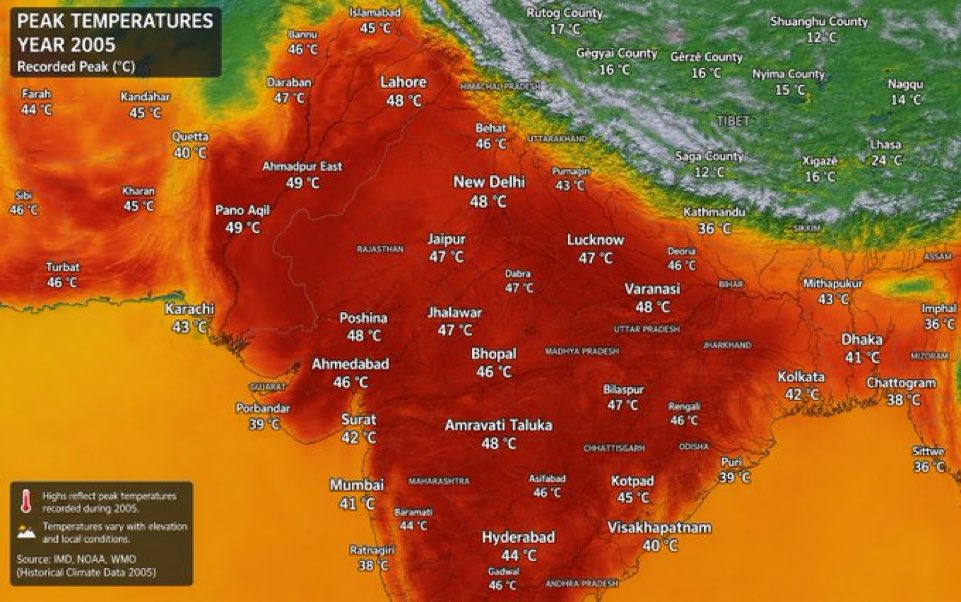
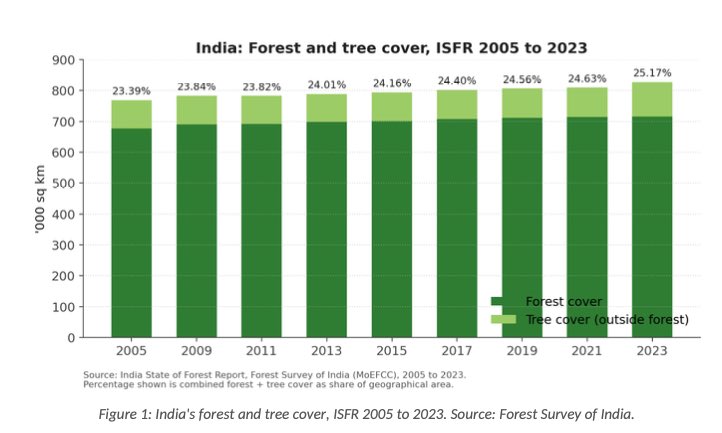
@theepicmap B’coz India was always hot. And here is the image of forest cover. India has increased. So hope it clear the doubt
Darshit Trivedi tweet mediaDarshit Trivedi tweet media
English
30
19
166
49.5K
Darshit Trivedi
Darshit Trivedi@Darshit1109·
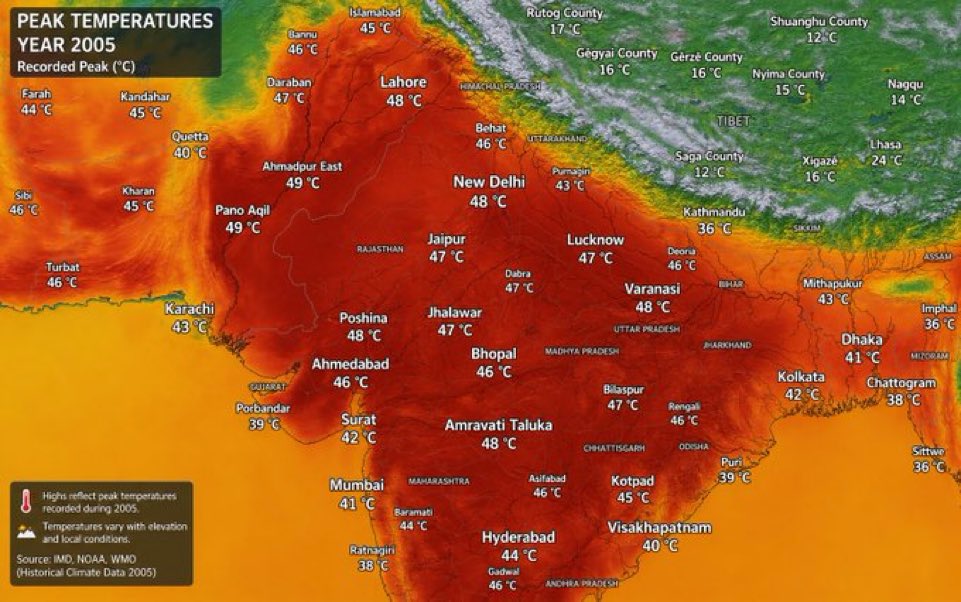
@thedktalks @theepicmap Sir India was always hot. Image of 2005 heat wave. And 2nd image is forest land cover. India has increased its forest land cover.
Darshit Trivedi tweet mediaDarshit Trivedi tweet media
English
2
0
1
307
Dinesh Kumar
Dinesh Kumar@thedktalks·
Seriously dude! I typed everything from scratch and articulated it to explain my point. Instead of trying to understand each other's point of view, you can only come up with the comment "stop using AI." 🤣 Some people read and write constantly over the years, which makes their thought processing coherent in a way that resembles AI but is not.
English
1
0
0
14
Dinesh Kumar
Dinesh Kumar@thedktalks·
Finally! Some relief from the heat waves.
Weatherman Navdeep Dahiya@navdeepdahiya55

Much-awaited relief from the heatwave ahead as summer storms are set to take over #India early next week Meteorological Context • A spell of heatwave usually triggers summer storms in India. These are WD/LWD-led patterns supported by moisture-laden winds from the Arabian Sea and the Bay of Bengal, forming inland cyclonic circulations. This setup triggers strong dust storms, thundershowers, and gusty winds during the evening to night hours while moving from west to east. What to Expect in This Spell • Strong dust storms (40–80 km/h wind gusts), followed by short spells of moderate to heavy intensity rain and thundershowers, usually lasting 15–45 minutes. Some areas may observe sustained drizzle for 2–3 hours after the passage of a storm. • Thunderstorms will carry lightning strikes and rumbling thunder. The risk of hailstorms remains on the lower side, but isolated events cannot be ruled out. • Most activity will occur between 2 PM and 10 PM each day. Some storms may spill over into the next day, but with limited geographical coverage. Date-wise Impact • 27th April: Rajasthan, Haryana, Delhi NCR (30–50% coverage) • 28th–30th April (Peak): Punjab, Haryana, Rajasthan, Delhi NCR, Uttar Pradesh, Bihar, Jharkhand, Odisha, Chhattisgarh, Karnataka, Telangana, Kerala (50–75% coverage) Madhya Pradesh, Maharashtra, Andhra Pradesh (10–30% coverage) Impact on Temperature • Heatwave conditions will continue on Monday. Temperatures are expected to fall from Tuesday evening in rain-affected regions. • Maximum temperatures are likely to drop to the range of 36–41°C across most areas from Wednesday onwards, compared to the current 42–46°C. • This indicates that the heatwave will abate, but hot afternoons will persist with slight humidity due to changing wind patterns. • Evenings and nights in rain-affected cities will become relatively pleasant. Safety Concerns • These summer storms, especially during the evening hours, can be intense—particularly in terms of wind speeds, which may occasionally reach up to 100 km/h. • If you observe dark clouds approaching from the west and hear thunder, it is strongly advisable to stay indoors until the storm passes. • After the initial dust/wind front, rainfall with lightning typically follows—wait for this phase to pass before stepping outdoors. Large parts of Gujarat, Madhya Pradesh, and Maharashtra are unlikely to experience significant relief and will continue to witness #heatwave conditions next week. This is a pan-India outlook; day-wise impacts and timings will vary by region. As the WDs arrive and development begins, it is best to track nowcasts based on cloud movement to assess when your area may be impacted. Updates for major cities will be shared as activity begins from tomorrow onwards—better to stay prepared than be caught off guard.

English
0
0
0
49
Dinesh Kumar
Dinesh Kumar@thedktalks·
We can’t control the global climate, but we can control the ecosystem to improve local conditions.
English
0
0
0
21
Dinesh Kumar
Dinesh Kumar@thedktalks·
When you’re feeling good or understood, post a tweet or respond to a tweet! You will soon learn how quickly the table can turn and how feeling good can become feeling bad in a few seconds.
English
0
0
0
24
Dinesh Kumar
Dinesh Kumar@thedktalks·
If someone can articulate enough to cascade their information in a logical way, they are considered AI these days. :) Not everything is AI. Some people develop skills over years to share their opinions in a better way.
English
0
0
0
19
Dinesh Kumar
Dinesh Kumar@thedktalks·
Temperature increase is part of the climate cycle. The mountains are blocking the cool winds from west to east, as per the picture. So the hot air is trapped here. If the wind direction changes, it will start to cool down. I am not an expert. 70% green cover cannot reduce temperature, but you will feel better in places with green cover than in places without green cover.
English
2
1
6
2.1K
Saffron Chargers
Saffron Chargers@SaffronChargers·
People are saying that temperatures are rising in India and a heatwave is happening due to deforestation and decreasing green cover. I live in a district with about 70% green cover, but the temperature is still 42°C. If temperatures rise due to decreasing green cover and deforestation, then why is it still so high in my district even with 70% green cover?
Saffron Chargers tweet media
English
162
52
341
57.7K