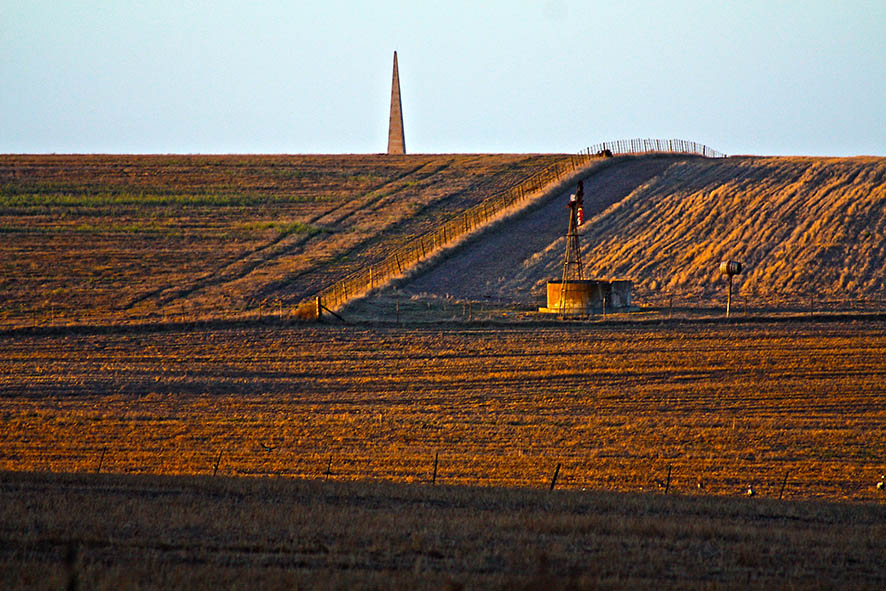
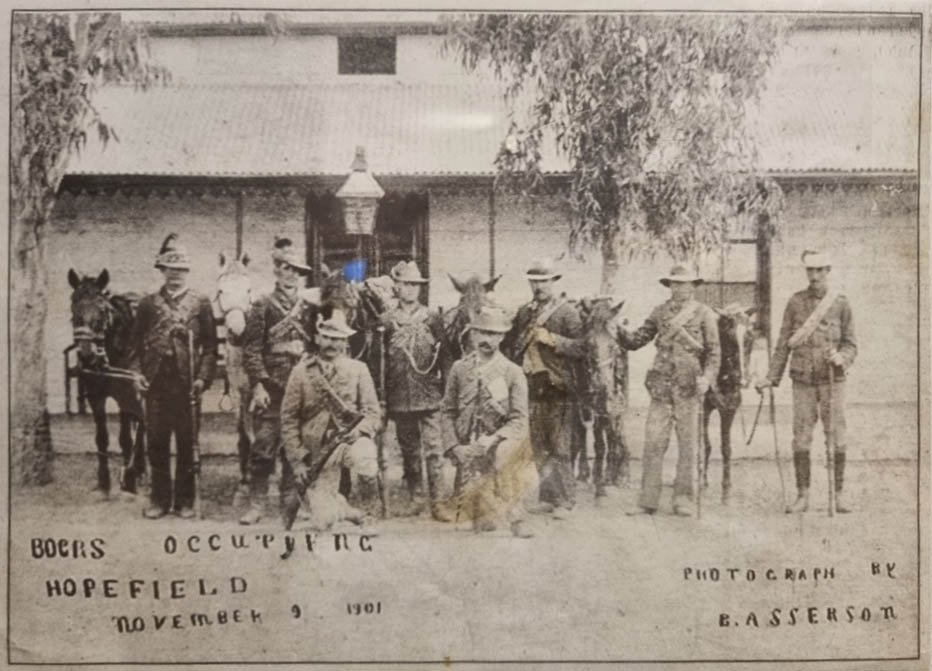
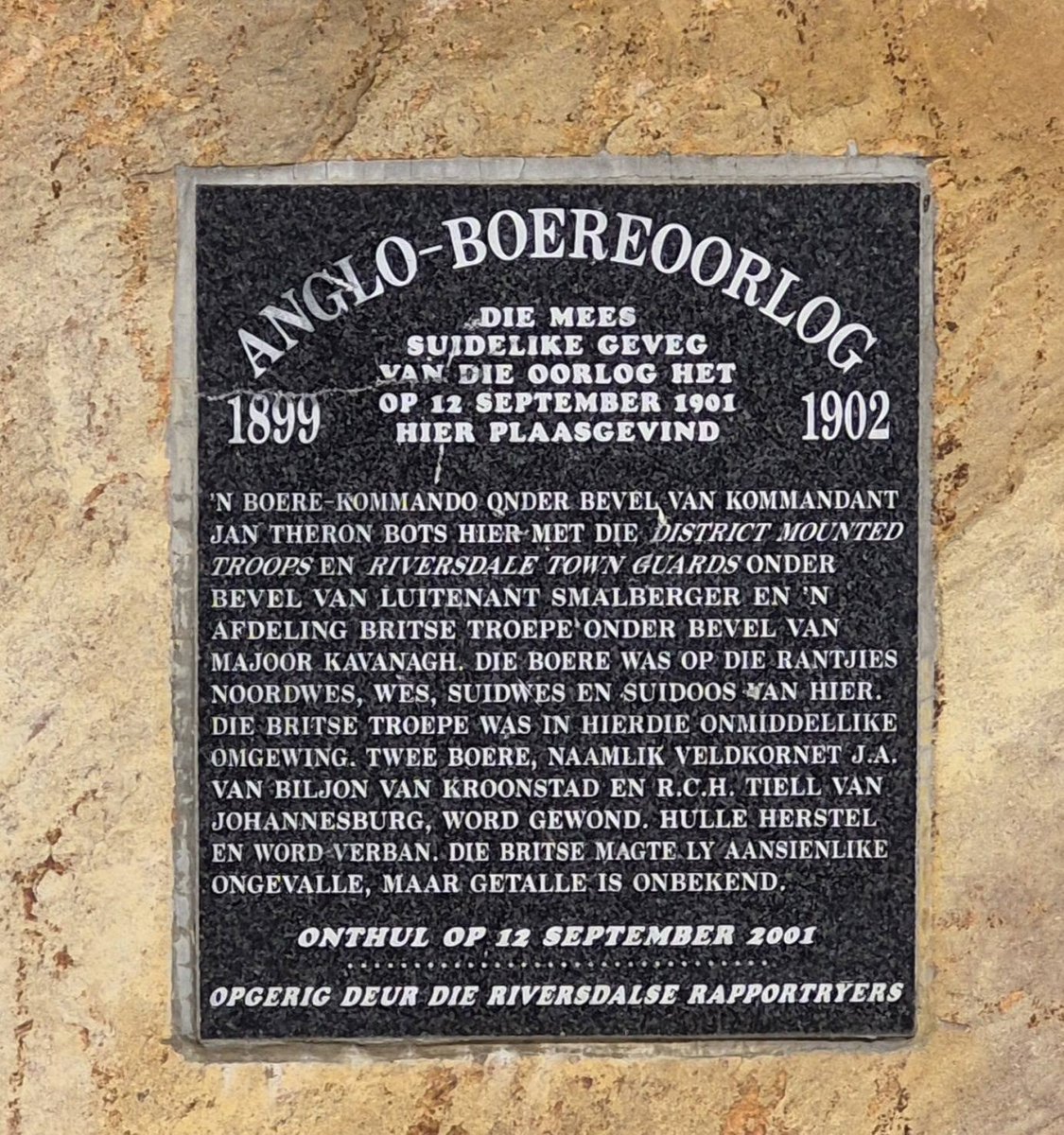
During the South African War Boer forces made their way south, and in 1901 reached Hopefield, before progressing to Darling, which they also took until British forces arrived and they retreated.
In a skirmish Veldkornet Hildebrand was killed and buried on site. Later he was reinterred and a memorial erected in 1940 to commemorate him
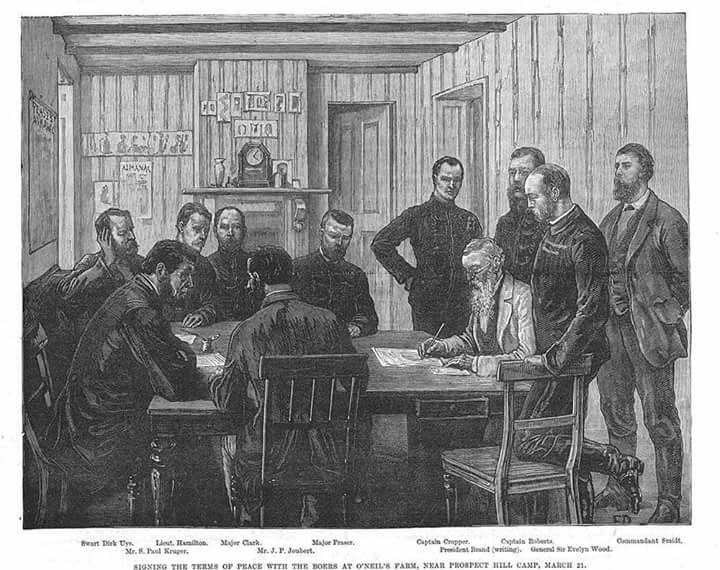
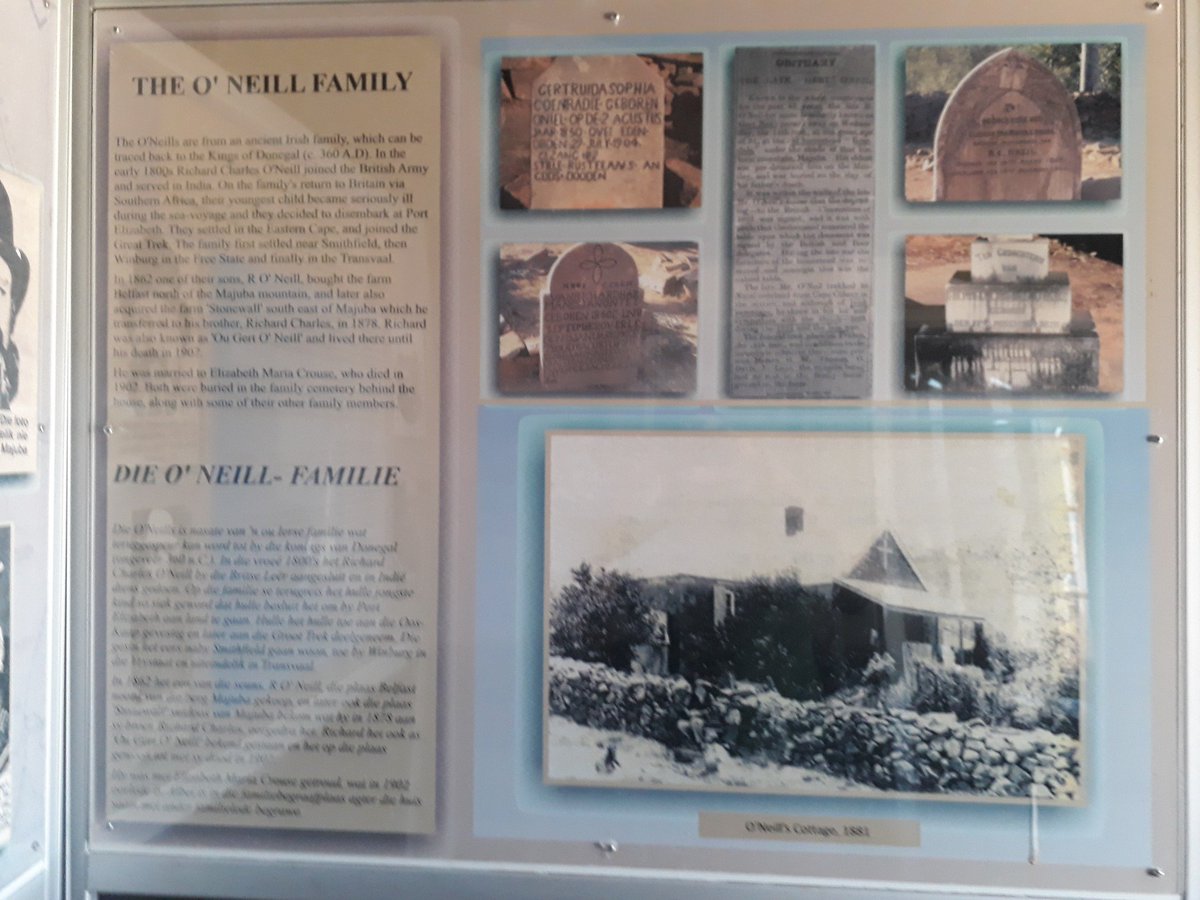
21st March 1881, 145 years ago, the peace treaty to end the first Boer War (Transvaal War of Independence) was signed at O’Neill’s Cottage which is half way up Laing’s Nek pass on the N11 between Newcastle and Volksrust. Now a National Monument, it was the home of Eugene O’Neill, which lay in “no mans land” between the British and Boer forces and had become a makeshift hospital for British soldiers after their defeat at Majuba. There are graves on the site. The peace treaty ending the war was negotiated here. It had seated in its parlour Paul Kruger, President Brand, Marthinus Pretorius, Commandant Piet Joubert, Sir Evelyn Wood, Col. R. Buller, Major Clarke, Capt Roberts and others.
The British government, under Prime Minister William Gladstone realised that any further action would require substantial troop reinforcements, and it was likely that the war would be costly, messy and protracted. British troops had been defeated at Bronkhorstspruit (25Kms east of Pretoria), Laing’s Nek, Ingogo (Skuinshoogte) and finally at Majuba. Diamonds had been discovered but gold was only to be found in 1886.
O’Neil’s Cottage was built in 1870 by its previous owner Peter A. Hayward de Barry (of Irish origin). De Barry’s wife Bessy named the cottage ‘Rosedale’ in a typically British-fashion. It is constructed of local stone from the small quarry that is situated on the southern slopes of Majuba. Graham McCallum - “The inconvenience must have been enormous for Mrs. O’Neil, and she no doubt was kept busy making cups of coffee and tea. Born “Crouse” to a Cape Dutch family, there is little speculation as to where her heart’s loyalties lay.
However, married to an English-speaking man from the British Isles, and her being a citizen of the Colony of Natal and the British Crown – she would have been aware that the demonising of the British by generations of Boers did not bode well. She and her husband embody all the ambivalence, internal conflict and contradiction so characteristic of South Africans.
FOR THEM THE LAST POST HAS SOUNDED
On this day 21 March 2026, let us pause to remember these young men from our Generation who answered the Sunset call. May they rest in eternal peace.
21 March 1966: Two members from Central Flying School Dunnottar were killed when their AT-6 Harvard, Serial No. 7685, crashed near Eendrag during a routine general flying training sortie. At some point during the exercise, the aircraft entered a spin from which the Pilot was unable to recover. They casualties were:
01516718E Lieutenant (Pilot Instructor) Johannes Nicolaas Taljaard. He was 22.
05576574R Candidate Officer (Pupil Pilot) Ian Ashton Fraser. He was 19.
21 Mar 1975: Two members from 17 Squadron and a civilian Government Employee were killed when their Alouette III Helicopter, Serial Number 23 struck power lines 7 km North of Windhoek. Both crew members and the civilian passenger were killed during the subsequent emergency landing. The Crew and passenger were:
64076110E Lieutenant (Pilot) Geoffrey Herbert Clark. He was 28.
05523584E Sergeant (Flight Engineer) Christiaan Hermanus Pretorius. He was 29.
Mr Charles Rion (Civilian Passenger). He was 25.
21 Mar 1976: 05518907PE Warrant Officer Class II Keith Hugh Hamilton from 250 Air Defence Artillery Group, South African Air Force died in 1 Military Hospital after developing blood clots on his lungs. He was 30.
21 Mar 1979: 72234123PR Lance Corporal Johannes Gerhardus Olivier from 1 Reconnaissance Regiment was Killed in Action during a contact with SWAPO/PLAN insurgents in South Eastern Angola near the Kavangoland Border. He was 22.
21 Mar 1979: 71387286KT Rifleman John Henry van Drutten from the Lydenburg Commando collapsed and died from heat exhaustion during a Route March at Phalaborwa. He was 23.
21 Mar 1980: 78912896SP Corporal Carlos da Conceição da Trindade from 32 Battalion Died of Wounds in the Grootfontein Hospital. He was grievously wounded on 13 March 1980 during Operation Makalani in Southern Angola when the 32 Battalion Golf Company platoon were sent to the scene of an earlier SWAPO/PLAN contact at Dombondola. The Patrol found a dead SWAPO/PLAN insurgent and the spoor of four others which they began to follow up. At 18:50 that evening, the SWAPO/PLAN insurgents were spotted and fired upon by the platoon's 60mm mortars. Unfortunately, one of the mortar bombs fell short due to the propellant charge being wet and landed among the pursuing 32 Battalion soldiers. 2/Lieutenant A.W. Kruger, Corporal Carlos da Trinidade, Riflemen R.E. Evaristo and Rifleman P. Frans were all wounded by shrapnel but unfortunately, Corporal Da Trinidade succumbed to his wounds on 21 March 1980. He was 20.
21 March 1981: 69324135PE Major Carel Arnold Briers from 101 Battalion SWATF Romeo Mike Team visited the Miershoop training base just south of Okatope on a Saturday morning to chat to his troops. Because it had been raining the previous evening, he was bare foot and wearing rugby shorts while carrying his young daughter on his shoulders. While he was moving through the camp, greeting and talking to the troops, he accidentally stood on an exposed electric cable that was running into one of the tents and was electrocuted. He collapsed unconscious and although first aid was administered almost immediately by medical personnel, he failed to regain consciousness and died. He was 27. He had only just recently been promoted to the rank of Major in January 1981 while serving with 54 Battalion.
21 March 1984: 80385537BG Rifleman Eugene Cedric Terblanche from 6 SAI arrived for Basic training very much overweight but showed exceptional vasbyt and never gave up. He pushed through his military training and lost all the extra weight and even though the going for him was always tough, he always had a joke to tell and lift everyone’s spirits. Four months before the end of his two-year National Service period, he contracted malaria while serving in the Operational Area and was admitted to the Grahamstown Provincial Hospital on returning to his Unit. He sadly succumbed to the disease on 21 March 1984. He was 19.
† Their names and sacrifices have not been forgotten †
All posts Credit Lt Col (rt) Graham du Toit
SA Naval Heritage Day-by-Day.
21 March:
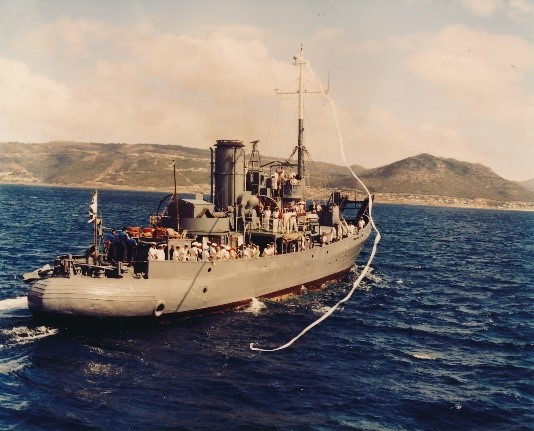
1986 The Boom Defence Vessel SAS Somerset (Cdr R.A. Hind), makes her final cruise in False Bay after 44 years of service. (Photos).
PHOTOs.
SAS Somerset longest paying off pennant in SA Naval history (at that time)
21 March 2026
Today in History
1653
From the diary of Jan van Riebeeck
The weather is not discussed for the day.
The deserters who had been sentenced on 19 March received their punishment on this day.
1654
From the diary of Jan van Riebeeck
The south-south-easter had started blowing the previous afternoon toward dusk and continued uninterrupted through daybreak.
No incidents are mentioned.
Sunday, 21 March 1655
From the diary of Jan van Riebeeck
Daybreak is described as exceptionally warm, dry, and sunny.
1656
From the diary of Jan van Riebeeck
Morning broke beautifully at the Cape.
The wind was little more than a breeze from the south-south-east.
The Nachtglas sailed to Robben Island to fetch another 50 sheep for the returning fleet.
Several ships of the returning fleet—including the Dolphijn, Hercules, Achilles, Maerssen, and Brouwershaven—departed for Batavia.
A fairly strong wind blew during the night.
1657
From the diary of Jan van Riebeeck
The weather is described as the same as the previous day, with only a light breeze.
Commissioner Van Goens and Van Riebeeck had a busy day.
Van Goens sent 200 sailors to assist about 40 woodcutters in cutting as many beams as possible so that the jetty could be completed
A number of men (likely soldiers from the fleet) were ordered to prepare for an extended expedition
The mission included:
Surveying and mapping the coastline and bays up to False Bay
Exploring and mapping the interior and existing developments
Van Goens had a mandate to inspect all activities, evaluate what had been achieved, and make recommendations for the benefit of the Company.
1658
From the diary of Jan van Riebeeck
Daybreak is described as pleasant, with a north-westerly wind.
An expedition led by Jan van Harwarden, which had left the fort on 26 February 1658 to trade, returned around midnight.
Van Harwarden kept a detailed journal of their journey. Van Riebeeck received them warmly despite the late hour and listened to their experiences.
They had traveled as far as a massive mountain range, beyond which they found a vast dry plain.
Two members of the expedition died
Another was nearly killed by a lion, which Van Harwarden shot while it was attacking the man
Lions were said to be common, though this one was particularly large. Its skin was carefully preserved and presented to Van Riebeeck.
The interior was described as a paradise, full of wildlife (including what were likely zebras, described as wild horses).
However, the primary goal—trading for cattle—was largely unsuccessful, and they returned with very little livestock.
1659
From the diary of Jan van Riebeeck
The weather is described simply as pleasant.
The ship seen the previous day near Robben Island docked in the morning. It was the Ulisses, which had left the Netherlands on 3 December 1658.
Crew: 95 men
One sailor fell overboard and drowned
The crew was otherwise healthy
A second vessel, the Loenen, docked shortly afterward:
Departed: 22 October
Crew: 71 men
One death at sea
Several cases of scurvy
The long voyage was attributed to persistent crosswinds
A third ship, the Hector, docked around 5 p.m. No further details are given.
Van Riebeeck promptly sent refreshments and supplies aboard.
Tuesday, 21 March 1837
From the diary of Louis Tregardt
Louis writes that the day dawned clear and bright.
Carolus and Pieta worked on their hartebeest huts.
Rossetoe sent a message via Sekoer asking Louis to come to him.
Louis did not fully trust the situation and took his muzzle-loader, accompanied by Adonis, Hans Strijdom, and his son Izaak.
Their fears proved unfounded. Rossetoe merely wanted them to meet his brother’s wives—twenty in total, including the chief wife.
Still uneasy, Louis asked to inspect some chests he had seen. Rossetoe agreed.
They contained only wheat and flour. A small room shown to Louis contained only fabric (sisal cloth).
Rossetoe gifted cloth to both Louis and Hannes. Louis received patterned material—striped on one side and floral on the other.
Back at camp, Carolus was upset that he had not gone along, as he also wanted such gifts.
Louis was about to get angry, but his wife Martha intervened, reminding Carolus that he had already received the most gifts from Rossetoe.
Carolus’s mother told him he should be ashamed. He fell silent and eventually went home.
Wednesday, 21 March 1838
From the diary of Louis Tregardt
The day was not without its usual share of drama.
Before departure, one of Carolus’s young oxen went missing. Workers searched for it without success.
The group traveled to the Wunssaan River.
While watering the sheep, a man from the Magwamba people grabbed one.
Willem saw it, but before he could react, others shouted for him to shoot the man. The man escaped quickly.
Louis and Pieta then rode upriver and each shot a hippo, as previously promised to a local captain.
1837
No entry for this day appears in the diary of Reverend Erasmus Smit.
Wednesday, 21 March 1838
From the diary of Reverend Erasmus Smit
The Voortrekker C. Liebenberg arrived at Doornkop, bringing news that Zulu forces had crossed the river.
This message had been relayed from Maritz’s camp at the Tugela River.
Hans Dons de Lange and three men immediately rode out to investigate.
It is noted that Zulu signal fires had been seen the previous day.
Smit writes that De Lange crossed the river with difficulty.
Men from Piet Uys’s camp also shot two hippos that day—everything was used, nothing wasted.
Later, five Zulus were seen near the camp at Doornkop. Some believed they were women, others suspected they were men disguised as women.
1844
General Ignatius Stephanus Ferreira was born in the Uitenhage district.
He later:
fought at Modder River
was promoted to general on 10 December 1899
commanded Free State forces
led operations during the siege of Kimberley
He was killed on 19 February 1900 at Paardeberg, reportedly shot by a startled sentry.
He is remembered as a brave and resolute man.
1881
After the Battle of Majuba (27 February 1881) ended the First Anglo-Boer War, a truce followed.
On 21 March 1881, an agreement was signed at the house of R. C. O’Neil:
The so-called Triumvirate—Paul Kruger, Piet Joubert, and M. W. Pretorius—agreed to accept British suzerainty.
This was followed by the Pretoria Convention (3 August 1881):
Transvaal received self-government, but under British suzerainty
The name South African Republic (ZAR) was officially restored only after the London Convention (24 February 1884).
1887
Boksburg was established—second only to Johannesburg as one of the oldest towns on the Witwatersrand.
It developed due to gold and coal and was laid out on the farm Vogelfontein.
Named after W. E. Bok, State Secretary of the ZAR.
1890
The Dutch Reformed Church Women’s Missionary Union was founded in Wellington.
Wednesday, 21 March 1900
Anglo-Boer War — Day 162
General French ordered that the Newberry’s Leeuw River mill near Tweespruit be occupied and guarded.
Thursday, 21 March 1901
Anglo-Boer War — Day 527
Acting President of the ZAR, S. W. Burgers, wrote to President M. T. Steyn:
He warned that no foreign assistance would come
Questioned whether the war might already be lost
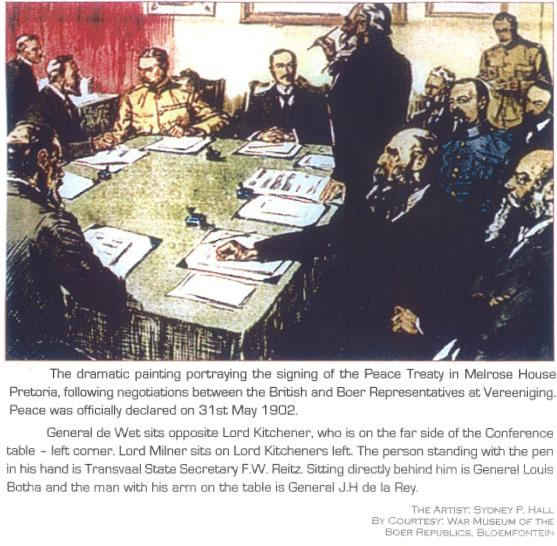
Friday, 21 March 1902
Anglo-Boer War — Day 892
The ZAR government requested safe passage to the Free State to hold a war council and discuss the possibility of peace
General Beyers continued his siege of Fort Edward
Colonel H. C. Denny’s attempt to relieve the fort failed
Lieutenant-Colonel J. W. Colenbrander was en route from Krugersdorp to assist
1990
South West Africa (Namibia) gained independence from the Republic of South Africa.
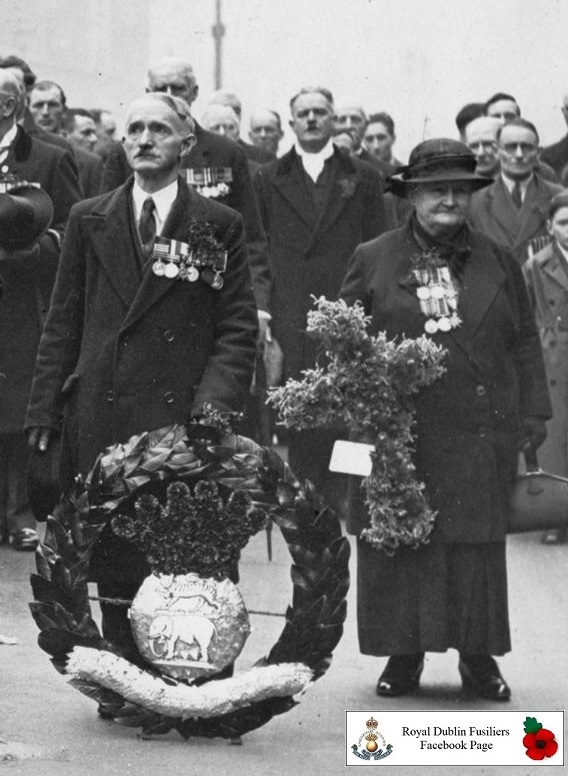
St. Patrick's Day, Dublin, 1920. A Royal Dublin Fusilier veteran of the 2nd Anglo - Boer War and Great War and Mrs. Branigan, she's wearing the medals of her son and brother.
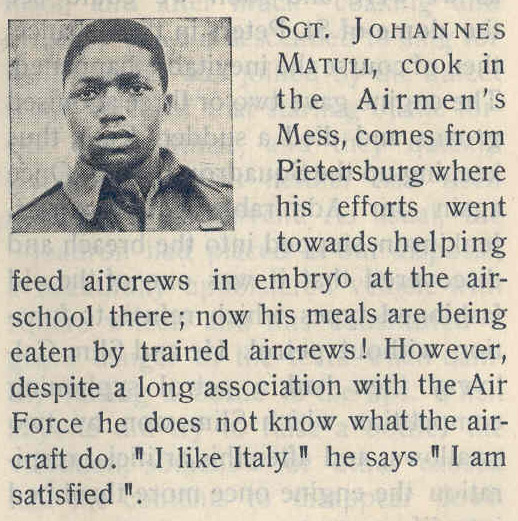
Sergeant Johannes Matuli from the Native Military Corps was attached to 30 Squadron SAAF while serving in Italy as a Senior Cook in the Squadron Airmen's Mess.
Today, March 20:
“This day in our shipwreck and aeronautical wreck history”
1859: Oste, this sailing vessel wrecked in a south easterly gale near Blaauwberg Beach in Table Bay in the Western Cape.
1860: Oaklands, this wooden sailing barque wrecked near the Coega River Mouth in Algoa Bay in the Eastern Cape.
1898: Clan Lindsay, this British steel steam-powered cargo ship was en route from Clyde in Scotland to Mauritius with a general cargo when it was wrecked on the eponymous Clan Lindsay Rocks in Mazeppa Bay in the Eastern Cape.
1934: Nautilus, this steel steam-powered dredger was scuttled off the Durban coast in KwaZulu-Natal.