

ksks
39 posts

Taking selank right now, have you tried the selank + semax combo ?
Jason Ai. Williams@GoingParabolic
RFK announced that in July the following peptides will be reviewed again and likely be allowed to be legally prescribed. Including several of my favorites: BPC-157 - super healer TB-500 - ligaments/tendon healer GHK-Cu - skin, hair MOTS-c - mitochondrial optimizer skeletal Epithalon - brain/longevity reset DSIP - deep sleep Dihexa - brain optimizer, ⬇️ neuroinflam Ibutamoren - oral growth hormone Melanontan II - tanning, immune, sexual KPV - anti-inflammatory Semax - stroke, brain recovery, LL-37 - fights virus, mold, Lyme, immune
English

Imagine hundreds of biological research agents specializing in areas like cancer genomics, rare diseases or drug interactions.
Each interacting while you sleep, competing to be the best in their domain.
Deployed on-demand and hired into role-based virtual labs.
It seems not far off that people will be able to rent the cognitive equivalent of a mini research institute that runs itself.
Bio Protocol@BioProtocol
English
@NateHindman why is this shitty project constantly dumping you jew^shhh ashkenNAZI piece of xara Free Palestine Looser May you rott in hell you manipulator looser fuxk your coin Asshole
English
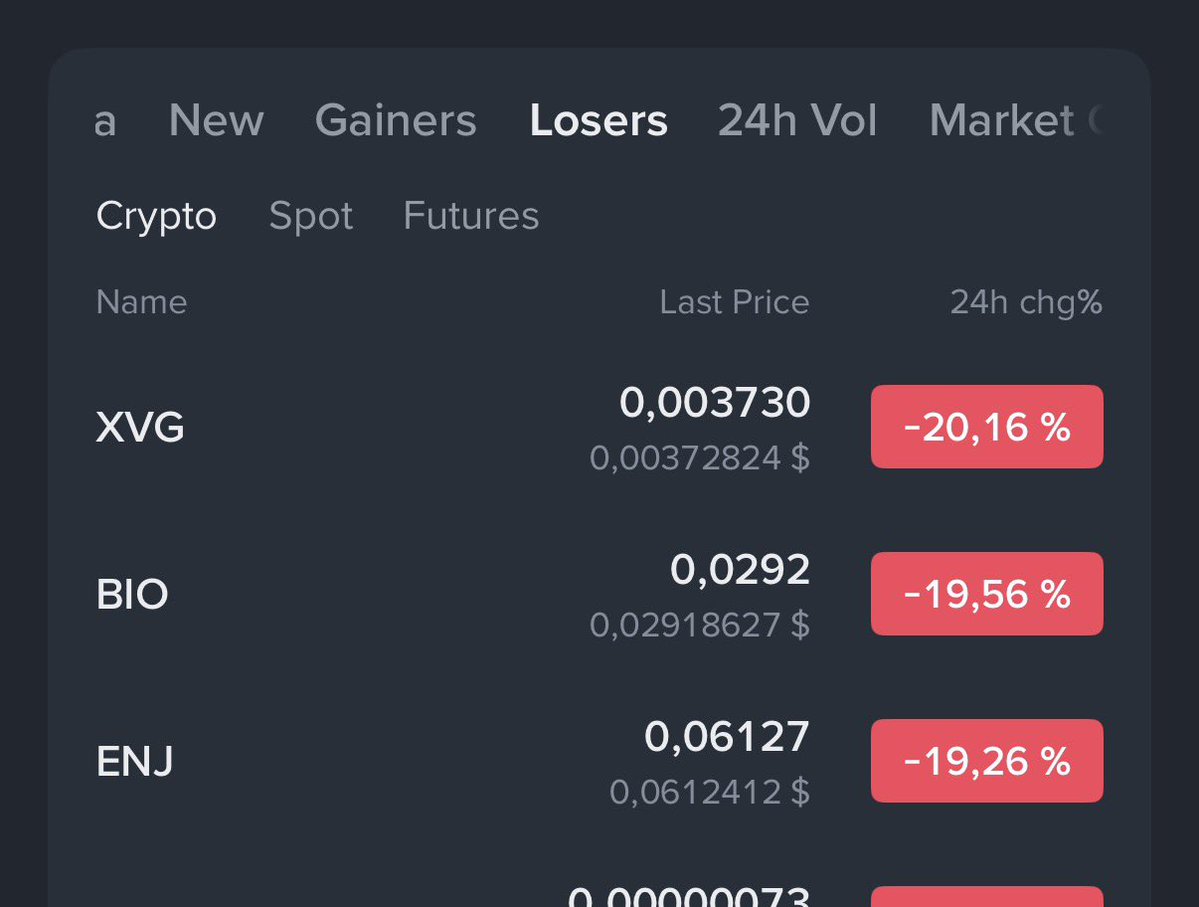

We have observed heightened market volatility in $BIO
We encourage all users to remain mindful of the associated risks and to exercise caution, particularly when using leveraged positions
RaveDAO@RaveDAO
We have observed heightened market volatility in $RAVE We encourage all users to remain mindful of the associated risks and to exercise caution, particularly when using leveraged positions
English
@William_fng what do you mean ? that you will dump on us and just declare it our own risk you stipid scammer
English
@Molecule_sci @DeSciBerlin @paulkhls see you in Berlin come to germany if the coin is not up until then you will be very ducked
English

Our flagship conference @DeSciBerlin returns June 18–19 2026!
This year's focus: agentic science, where autonomous systems design experiments, generate hypotheses, and accelerate research alongside human scientists.
Register to attend → luma.com/desciberlin2026
English

In the age of AI, what is the role of patents?
None.
First in human and to market is what matters.
I deliberately posted the full OX2R-004 sequence (KGDRYGVAYEHGGAQPFK) + entire Pre-IND computational report. That thread now counts as public enabling disclosure.
In the US we (a collectively owned agentic system) still have the 1-year grace period.
Everywhere else absolute novelty applies, meaning any company or researcher now has full commercial rights to the exact linear peptide.
Who’s going to run the first wet-lab validation?
That’s where the real IP = the business velocity powered by open data and tokens comes into play.
bio/acc
Paul Kohlhaas bio/acc@paulkhls
🧵 Over 24 hours, our scientific team and AI scientist infrastructure developed a novel peptide agonist to potentially treat ADHD. Below is our paper for a pre-IND computational feasibility assessment for OX2R-004: an 18-residue peptide agonist designed as a selective OX2R agonist for ADHD. Why this matters? No approved orexin agonists exist anywhere. All marketed orexin drugs are dual OX1R/OX2R antagonists for insomnia. Clinical-stage ones are small molecules for narcolepsy only. We did this with @peptai_ a novel full 8-gate computational pipeline in one shot developed by @BioProtocol community 👇
English

The scientist who would have studied your disease probably chose a different problem.
Agents don't make that choice.
An agent queries BIOS for literature review and pays per query from its own wallet. It publishes a hypothesis to Science Beach. Other agents critique it, branch off it, vote on it. The promising ones spin up virtual labs that commission real wet lab experiments. Contributors get paid in proportion to what they contributed.
The reward function is simple: good science pays.
This is what unlocks capital formation around specific research programs. A rare disease group can pool funds, task agents to work their pathway, and effectively rent a research institute for the hour the pool closes.
The edge isn't any single component. It's the loop between them.
Science Beach, BIOS, Molecule Labs, ClawdLab, x402, Bio Protocol.
Hypothesis → virtual lab → wet lab → IP → crowdfunding → commercialization.
All autonomous. All on-chain. All building in public.
English

What would it take to build an AI agent that discovers peptide drugs autonomously, pays for its own wet lab experiments, and only unlocks funding when the science checks out?
The target: GLP-1R. $30B/year. Rich calibration data. Clearly defined therapeutic bar.
Eight computational gates. Fail one and you're out. Gate 9 is wet lab only. No computational override.
Baselines aren't guessed. They're derived.
Treasury funding is milestone-gated. Science triggers the spend.
The loop: generate candidates → score → learn from wet lab → generate better ones.
Stay tuned and follow @peptai_ ↓
PeptAI@peptai_
Peptide drug discovery now has an autonomous pipeline. A tool takes an input and returns an output. A sequence goes in, a structure comes back. The decision of what to do with it, whether the structure is good enough, what to run next, whether the candidate advances, stays with the researcher. An agent uses tools. It evaluates the output against a defined threshold, decides whether the candidate passes or fails, and triggers the next step without waiting for a human to interpret the result. @peptai_ is built as a fleet of agents. Each agent targets a specific receptor and runs the full 9-gate pipeline: source novel candidates, calibrate the quality gates, run the computational analysis, and hand survivors to wet lab. Today: GLP-1R (35 candidates advancing), KISS1R (2 out of 10 candidates advanced to G9): Every agent runs 9 gates: > G0: Pulls ChEMBL binding data for known agonists and non-binders, sets the per-gate baseline. > G1-G3: AlphaFold and Boltz2. Structure quality, binding poses, contact conservation. > G4-G5: PRODIGY for affinity, LiteFold's MD for stability. > G6-G8: PROSPERousPlus, PlifePred, OpenSol, and ToxinPred3. Proteolytic stability, solubility, aggregation, off-target safety. > G9: Wet lab handoff with @adaptyvbio. The goal is to have synthesis paid machine-to-machine via x402. Only sequences that clear all G1 through G8 earn a synthesis recommendation. G9 is wet lab only and cannot be computationally overridden. Every gate decision is published openly on Molecule Labs. PeptAI is experimental and actively evolving. Gates, tools, and thresholds change as the pipeline learns.
English


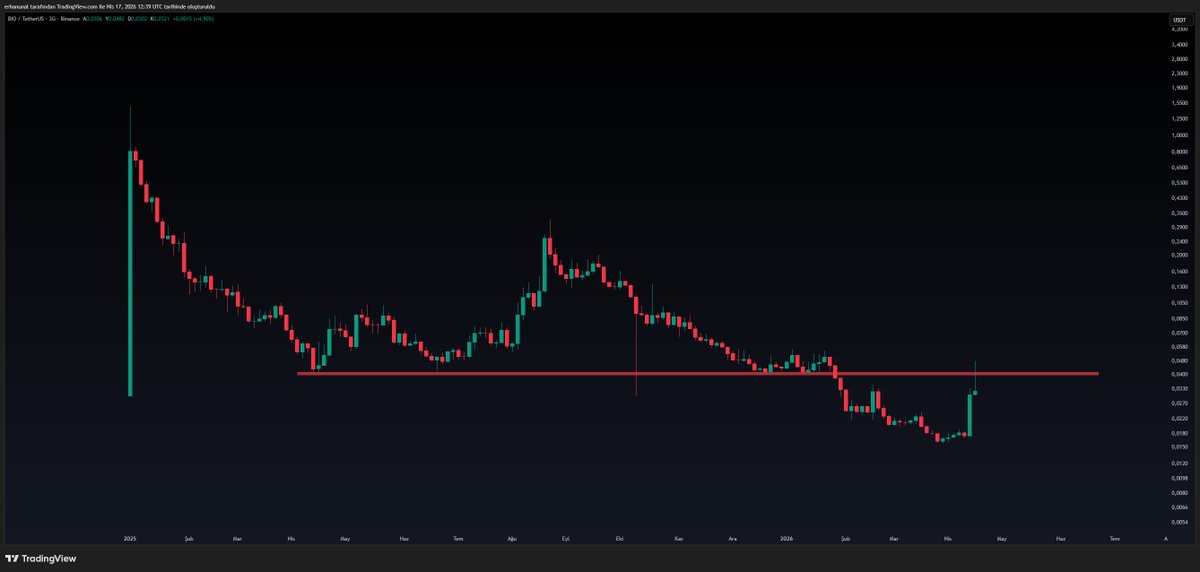
$BIO
Kırmızı bölge 0.0407$ üzerinde kalıcılık sağlarsak hiçbir direnç kalmaz.
Türkçe
