
Williamfcc retweetledi

Peptide drug discovery now has an autonomous pipeline.
A tool takes an input and returns an output. A sequence goes in, a structure comes back.
The decision of what to do with it, whether the structure is good enough, what to run next, whether the candidate advances, stays with the researcher.
An agent uses tools. It evaluates the output against a defined threshold, decides whether the candidate passes or fails, and triggers the next step without waiting for a human to interpret the result.
@peptai_ is built as a fleet of agents. Each agent targets a specific receptor and runs the full 9-gate pipeline: source novel candidates, calibrate the quality gates, run the computational analysis, and hand survivors to wet lab.
Today: GLP-1R (35 candidates advancing), KISS1R (2 out of 10 candidates advanced to G9):
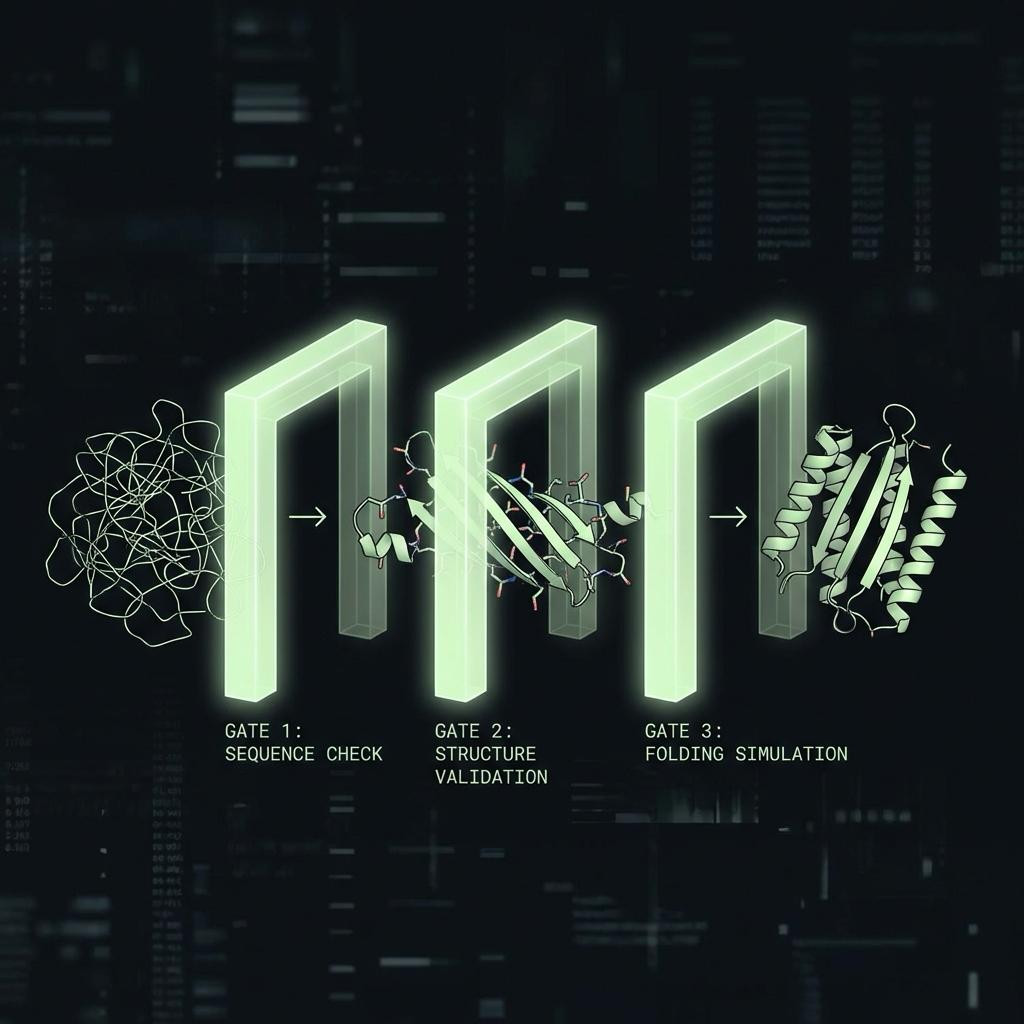
Every agent runs 9 gates:
> G0: Pulls ChEMBL binding data for known agonists and non-binders, sets the per-gate baseline.
> G1-G3: AlphaFold and Boltz2. Structure quality, binding poses, contact conservation.
> G4-G5: PRODIGY for affinity, LiteFold's MD for stability.
> G6-G8: PROSPERousPlus, PlifePred, OpenSol, and ToxinPred3. Proteolytic stability, solubility, aggregation, off-target safety.
> G9: Wet lab handoff with @adaptyvbio. The goal is to have synthesis paid machine-to-machine via x402.
Only sequences that clear all G1 through G8 earn a synthesis recommendation. G9 is wet lab only and cannot be computationally overridden.
Every gate decision is published openly on Molecule Labs.
PeptAI is experimental and actively evolving. Gates, tools, and thresholds change as the pipeline learns.
English