Naka-pin na Tweet
Carter Sifferman
315 posts


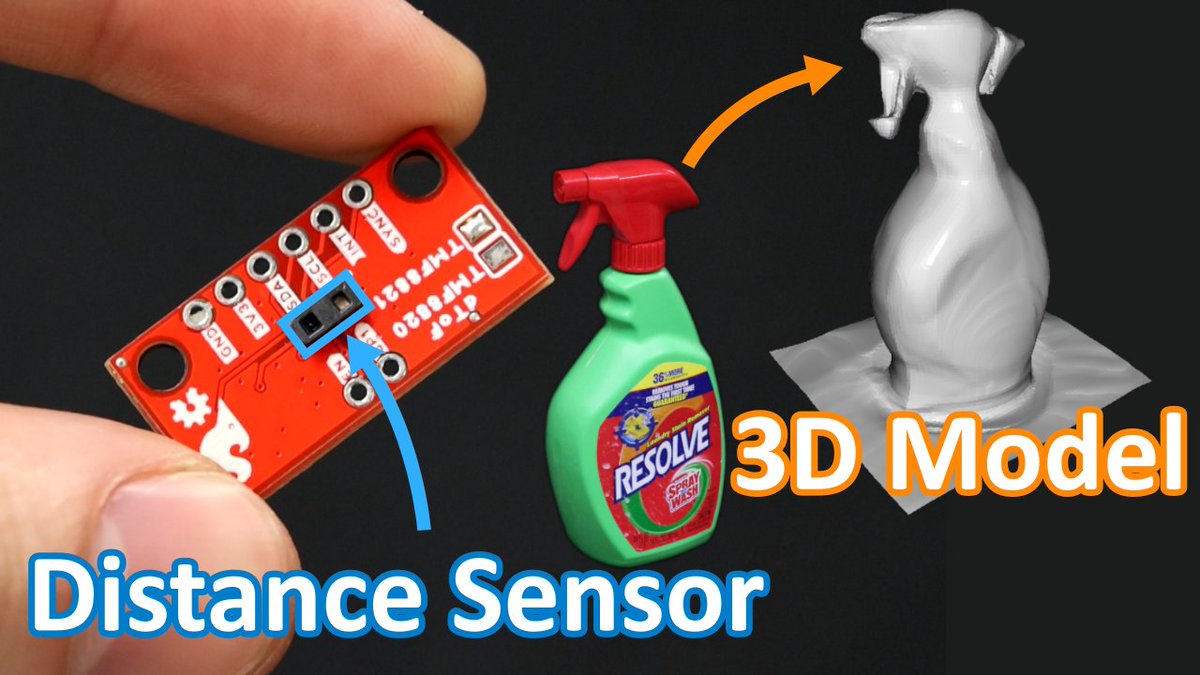
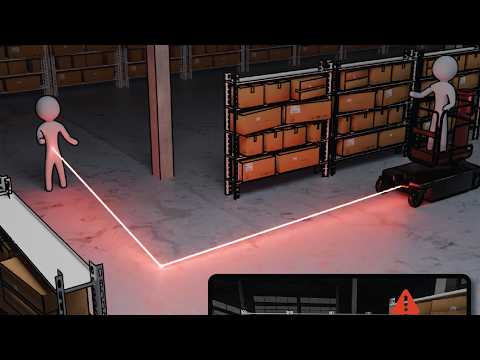
I’m excited to share our Nature paper on seeing around corners with consumer LiDARs!
We show that consumer LiDAR sensors — in your smartphones, AR headsets, self-driving cars, and robots — can be used to see objects hidden around corners.
youtube.com/watch?v=N3LEhh…

YouTube
English

@jon_barron I agree on principle, but how is a grad student going to pay for that much API usage? I don’t know of any grad programs that provide credits / Claude code or similar to their grad students.
English

Project Page: cpsiff.github.io/recovering_par…
ArXiv: arxiv.org/pdf/2509.16132
YouTube: youtu.be/p6G4_JU5y2k
Authors: Carter Sifferman*, Yiquan Li*, Yiming Li, Fangzhou Mu, Michael Gleicher, Mohit Gupta, Yin Li.

YouTube
Română

📣📣📣 Neural Inverse Rendering from Propagating Light 💡 just won Best Student Paper award at #CVPR!!!
Anagh Malik@anagh_malik
📢📢📢 Neural Inverse Rendering from Propagating Light 💡 Our CVPR Oral introduces the first method for multiview neural inverse rendering from videos of propagating light, unlocking applications such as relighting light propagation videos, geometry estimation, or light component separation! \w @imarhombus (co-first), @AndrewEJXie, @mpotoole, and @DaveLindell
English
Carter Sifferman nag-retweet

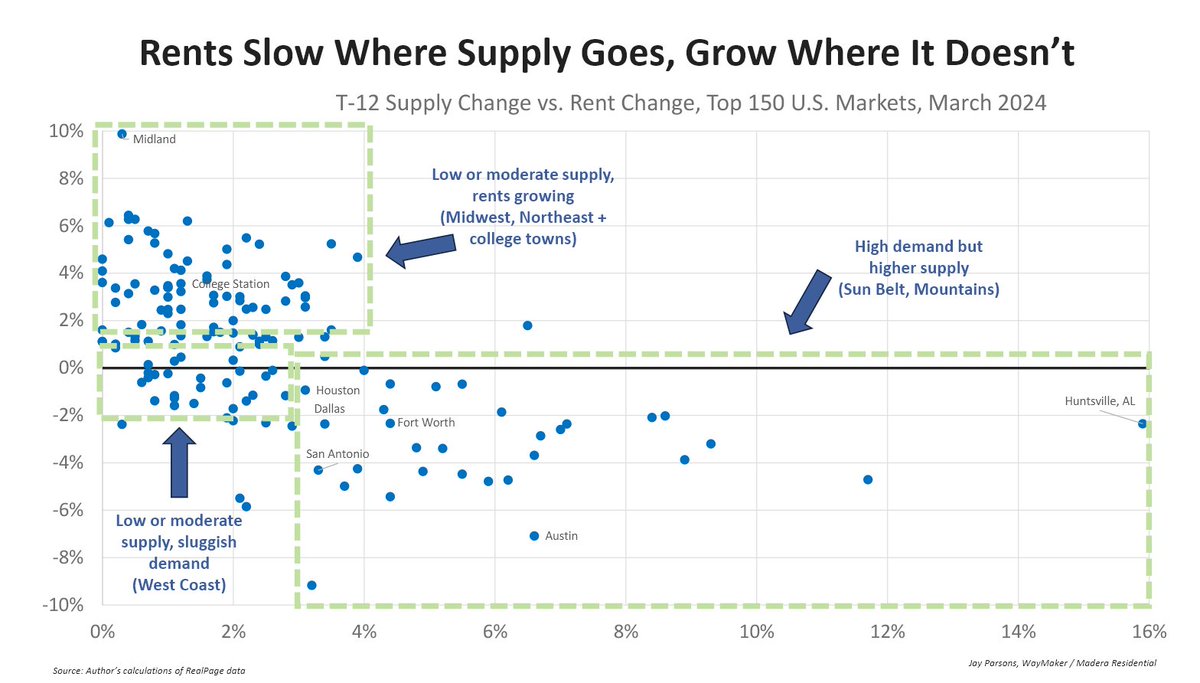
@jayparsons I’m so curious as to which one of those dots in the graph is Austin, TX
English

I was once a skeptic of rental housing "filtering" -- the theory that new "luxury" apartments pull up higher-income renters from moderate-priced rentals, thereby benefitting moderate-income renters, and on down the line.
I am no longer a skeptic. I became a believer once I realized several mistakes I made in the analysis -- the same mistakes I see some of my peers making now. Here are those common mistakes among filtering deniers:
1) You must focus on higher-supplied neighborhoods. Macro analysis doesn't work nearly as well. The more you build, the more clearly you see "filtering" play out. When you include low-supply neighborhoods in the analysis, you're obscuring the real story.
2) You cannot rely on the industry's asset class definitions based on non-rent measures like amenities or building age. You need to more specifically look at apartments by rent level, which is the foundation of "filtering." It's broadly correlated with classes, but not the same thing.
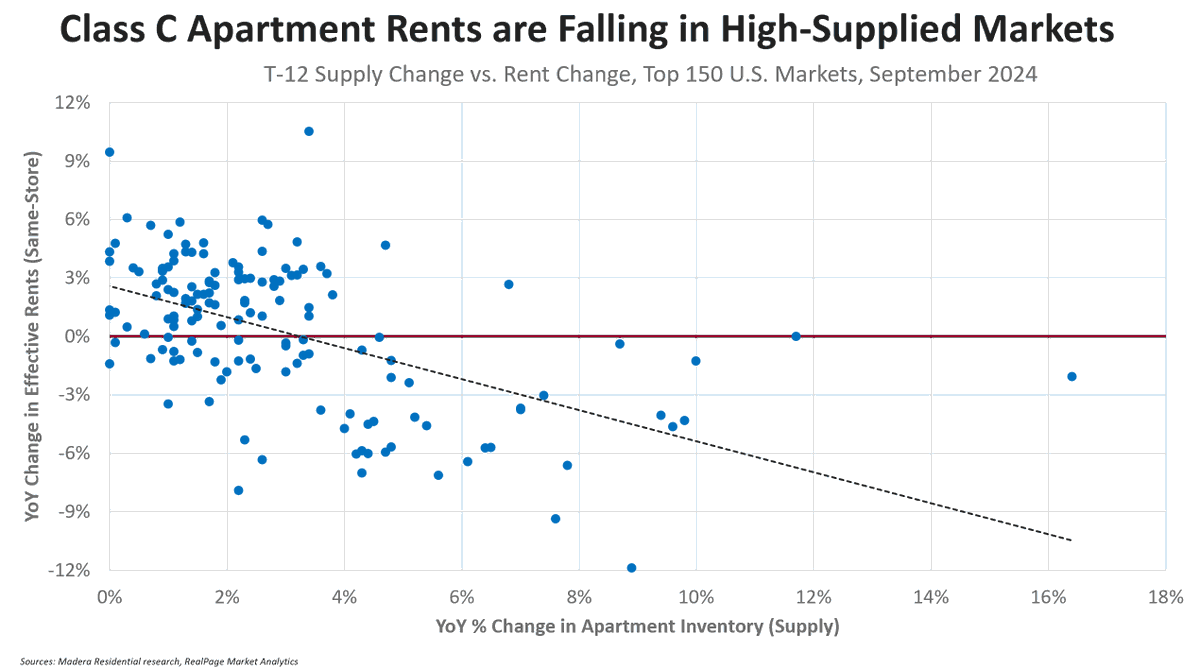
3) You can't assume "more supply" = "high supply." Very common mistake. In the 2010s decade, as example, we just didn't build that many apartments -- even in the places we *think* we did. For example, Texas probably built more apartments than any other state and yet rents outpaced national average-- making it harder to detect impact of filtering (even if still present in form of rents growing less than they otherwise would have absent the new supply.) It's not just supply. It's supply relative to demand. And in the 2010s, supply generally didn't keep pace with demand. The 2023-24 period shows us more clearly what happens when you build truly A LOT of new apartments. Rents fall -- even among the lowest-rent properties. (See chart below.)
4) You got to talk to people with eyes/ears on the ground -- especially those operating apartments at differing rent levels in high-supplied submarkets. They'll help you better understand what to look for in the data.
5) You need to be open to admitting you were wrong.

English

@jayparsons I was dying to know which dot was which so I did some searching, and found this plot with some labels. Hunstville, AL! I thought Austin would be further right, but given it's so large already it makes sense.
source: dallasfed.org/-/media/docume…

English

@ZGojcic Big fan of NFL and other works from your team. Applied and emailed :)
English

Our team at NVIDIA is recruiting PhD research interns for next year. If you are interested in neural reconstruction, generative models, graphics and related topics. Please apply at the link below or contact me directly. :)
nvidia.wd5.myworkdayjobs.com/en-US/NVIDIAEx…
English

@johnnywharris Something like this might be possible with NotebookLM
English