

Deepnote
1.3K posts

Deepnote
@DeepnoteHQ
Data workspace where agents and humans work together.
🌎 Sumali Ağustos 2019
74 Sinusundan5.2K Mga Tagasunod
Bad data is easy to spot. Root cause is the hard part.
@statsig’s data team runs two kinds of investigations:
- customer-level deep dives to reproduce issues by company and experiment
- internal analyses that support marketing, sales, and core product decisions.
As they scaled, the bottleneck wasn’t SQL. It was finding prior work, reusing it, and collaborating without losing context.
So, they built these workflows in @Deepnote. What changed:
1) From alert to investigation in one run
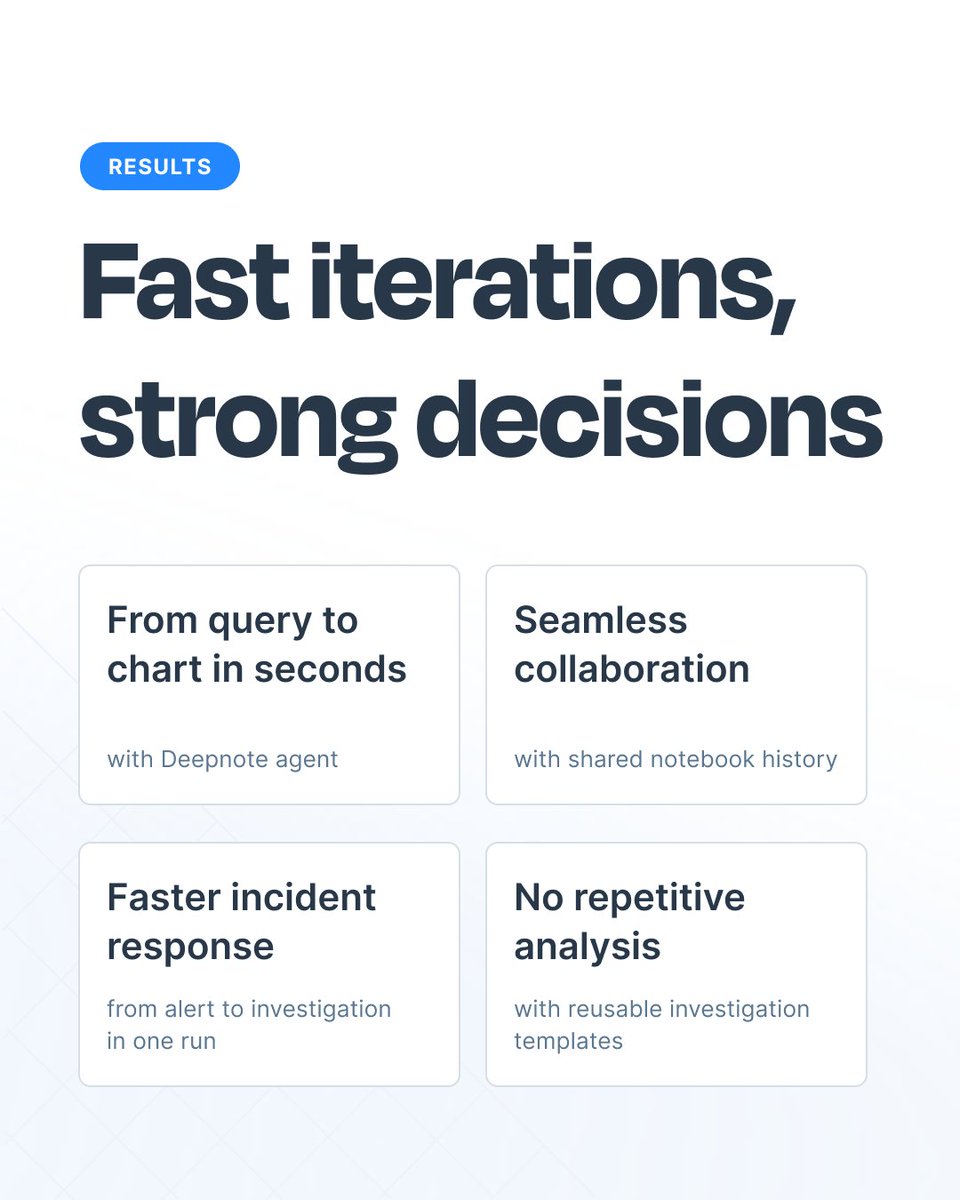
They turned data-quality alerts into a repeatable notebook workflow: paste the alert, hit Run, reproduce the issue, and start the root-cause analysis immediately.
2) Reusable investigation templates
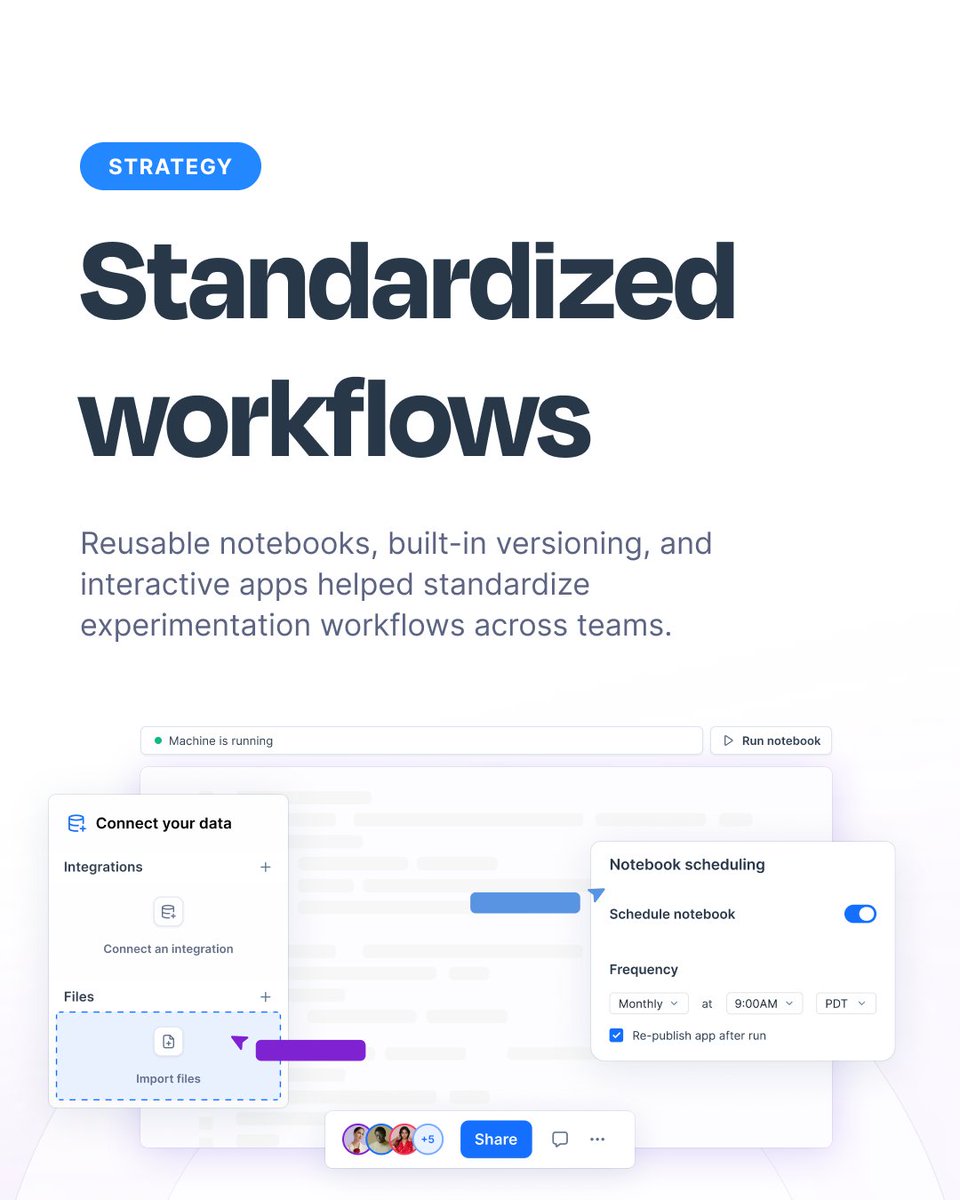
Customer investigations became parameterized notebooks. Change one parameter, rerun, and you’re back in a familiar flow instead of rewriting boilerplate.
3) Collaboration that actually works for investigations
Shared notebook history, multiplayer editing, and a searchable workspace made handoffs painless.
Huge thanks to Timothy Chan and the Statsig team for trusting us with critical workflows.
Check out Deepnote: vist.ly/4u9ei

English
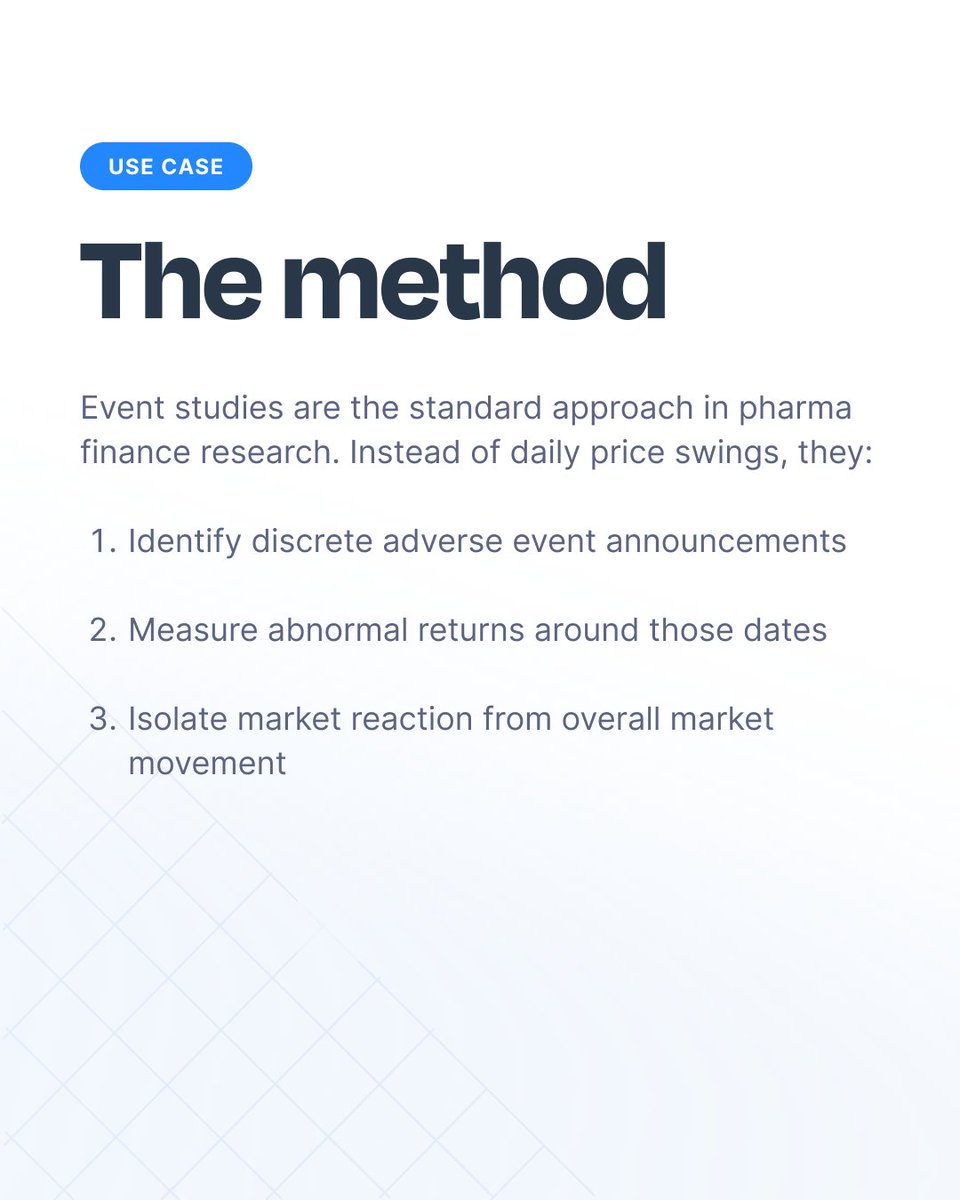
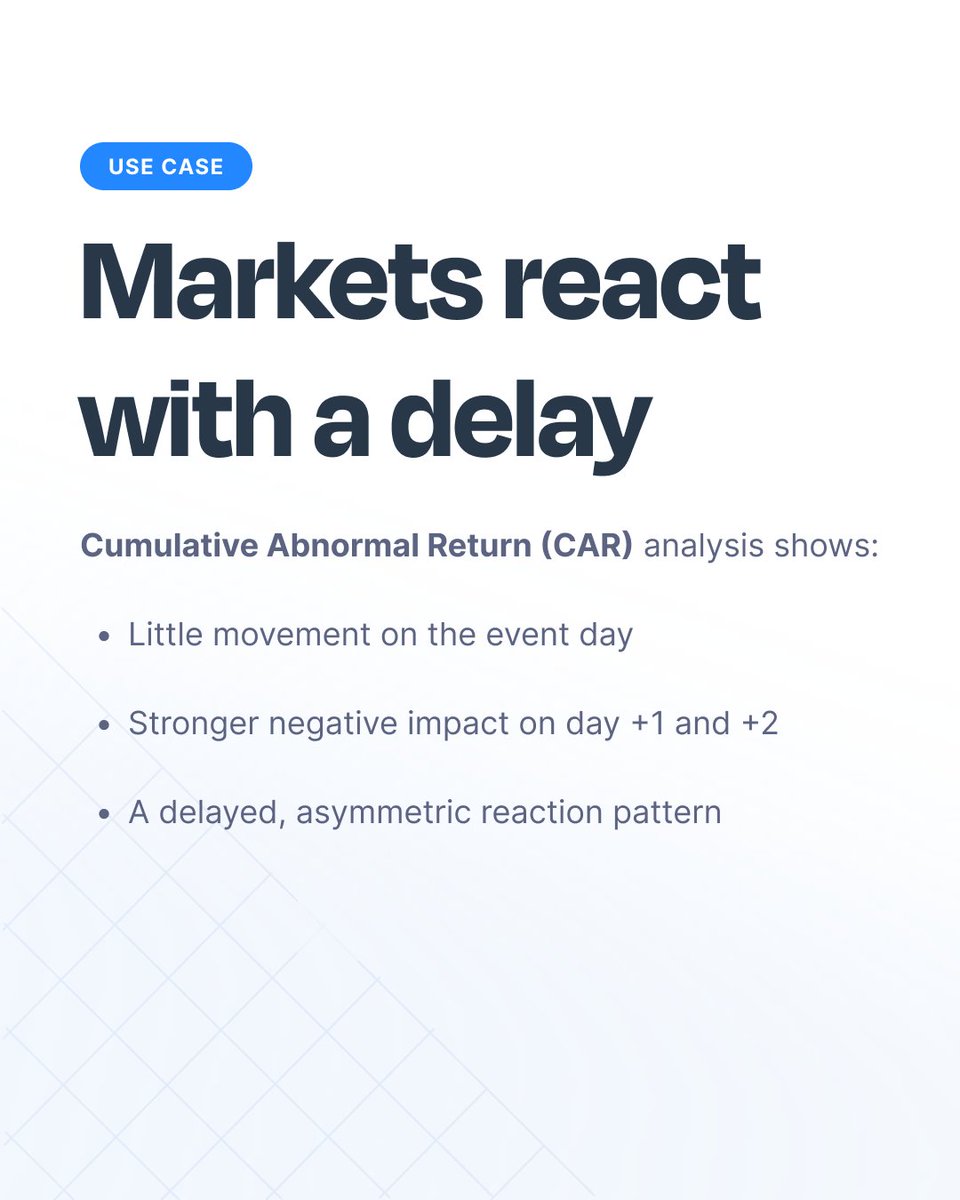
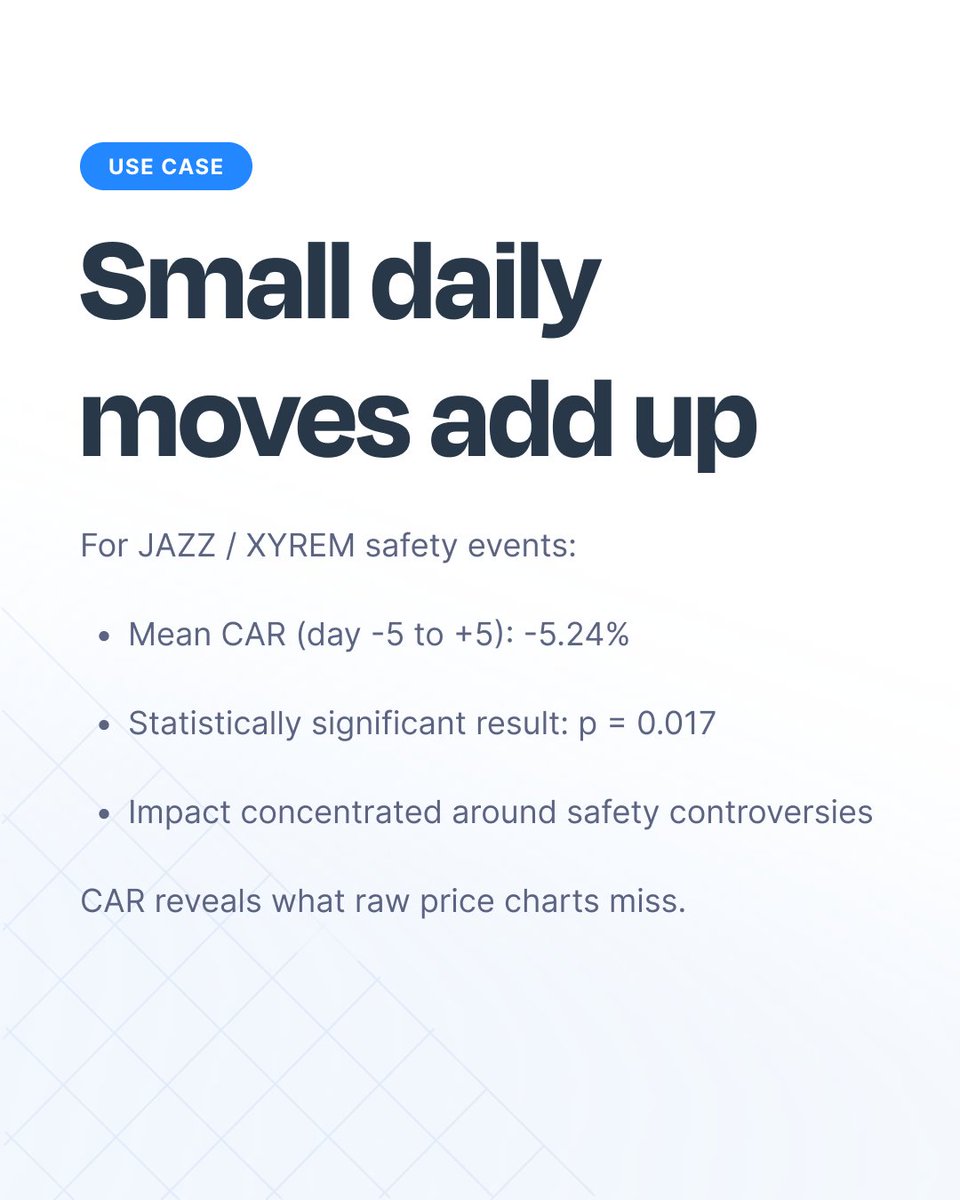
A single adverse event can wipe billions off a biotech’s market cap.
We built an event-study workflow that fuses stock prices with FDA adverse-event signals to measure how pharma stocks react around safety disclosures.
It’s a reusable methodology template, so you can swap in any ticker or drug and run the same analysis in minutes.
Link to the notebook in the comments.

English
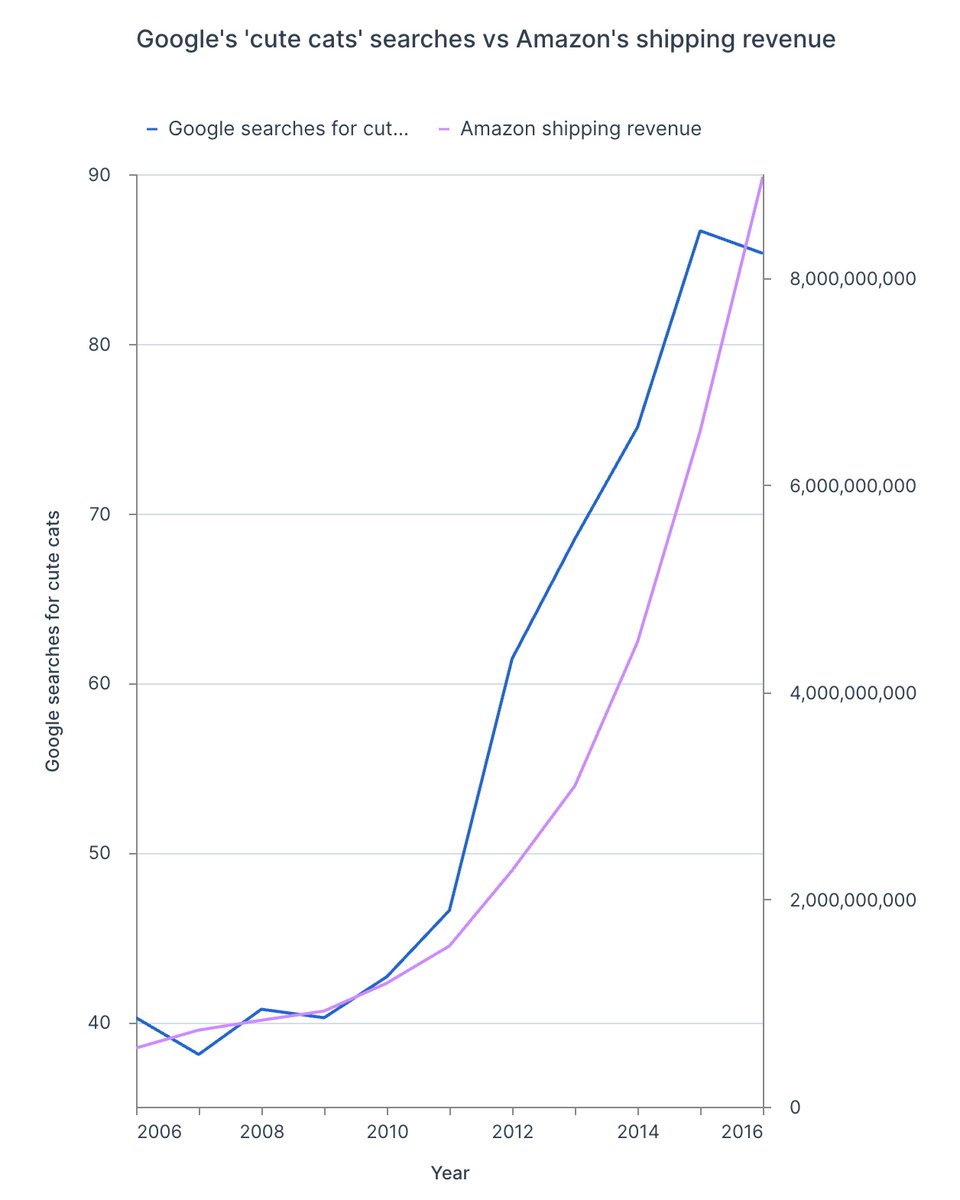
Apparently, the more we search for cute cats… the more packages Amazon ships.
Coincidence? Or is Jeff Bezos hiding a cat army?
Data via tylervigen.com, recreated in Deepnote.
English
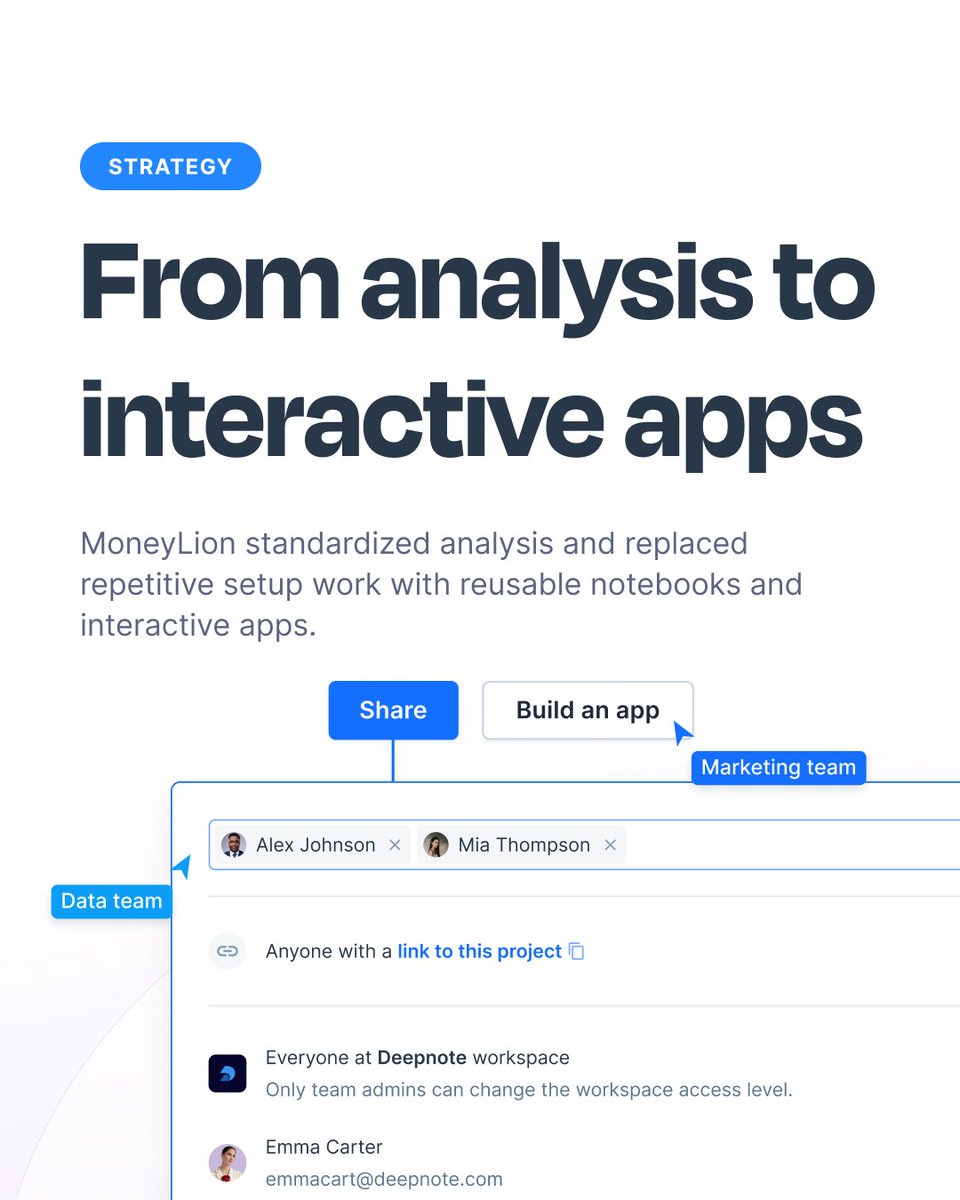
@MoneyLion (part of @GenDigitalInc, a F500 company) now saves 2 hours per week per analyst and 8 hours per month per headcount, and so can you.
How?
Before Deepnote, their MLOps team was spending too much time maintaining JupyterHub, dealing with unstable sessions, and stitching integrations together. The data scientists felt it too, rerunning charts, losing context, and sharing results as slides instead of live analysis.
So, the team switched to @Deepnote. Here's what happened after the plug-and-play upgrade:
1) AI-native notebooks. Zero babysitting.
JupyterHub maintenance and infra drag were gone. Stable sessions, native Snowflake integration, built-in collaboration, and AI assistance out of the box meant the MLOps team could focus on enabling the business, not keeping notebooks alive.
2) A better data UX.
Data scientists now move from SQL to charts in seconds with natural language, share live analyses instead of screenshots, and turn notebooks into dashboard-style apps that stakeholders can actually use. Less time rerunning notebooks, more time answering real business questions.
Interested in upgrading your data infra just like MoneyLion? Get in touch and we'll get you set up.


English
Deepnote nag-retweet

@MoneyLion (part of @GenDigitalInc, a F500 company) now saves 2 hours per week per analyst and 8 hours per month per headcount, and so can you.
How?
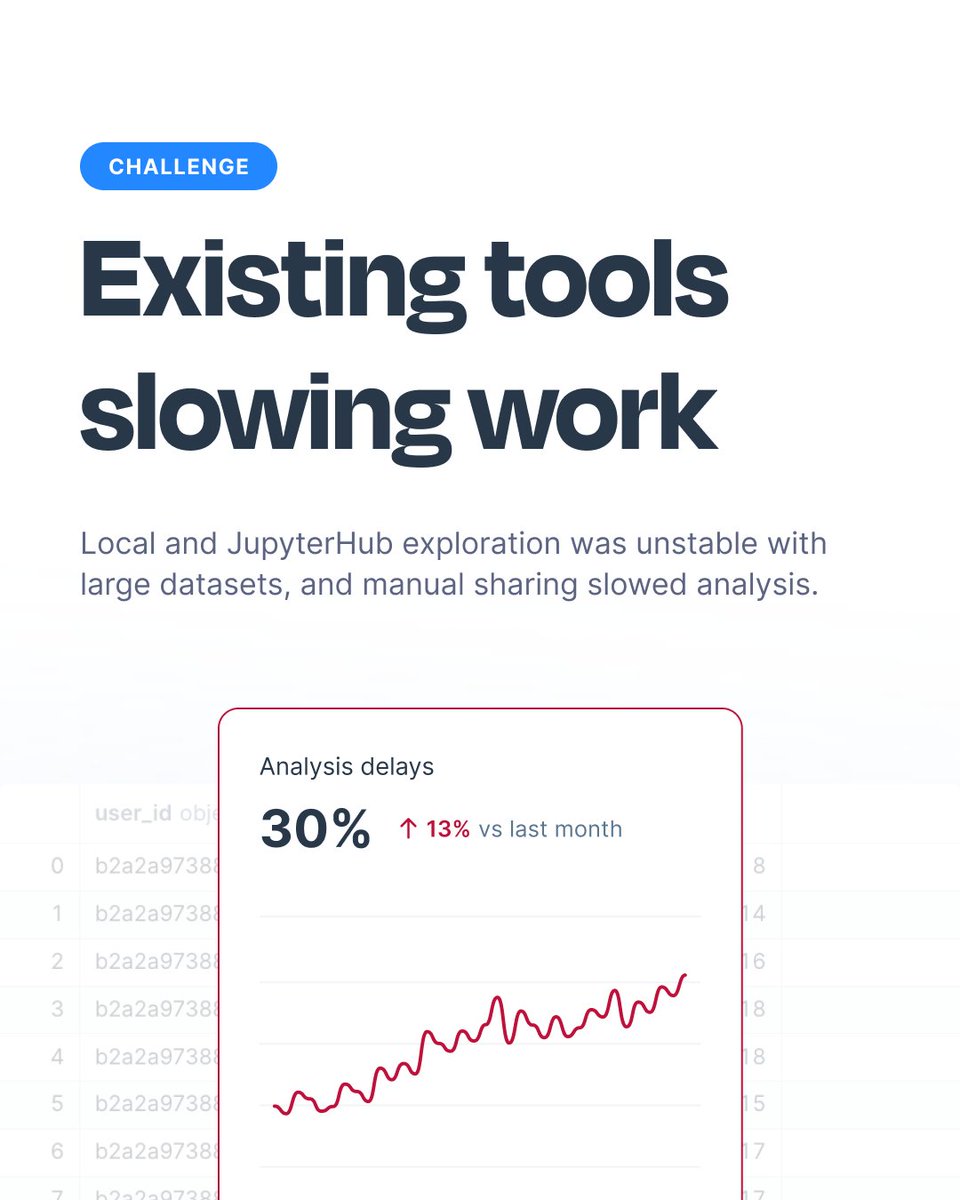
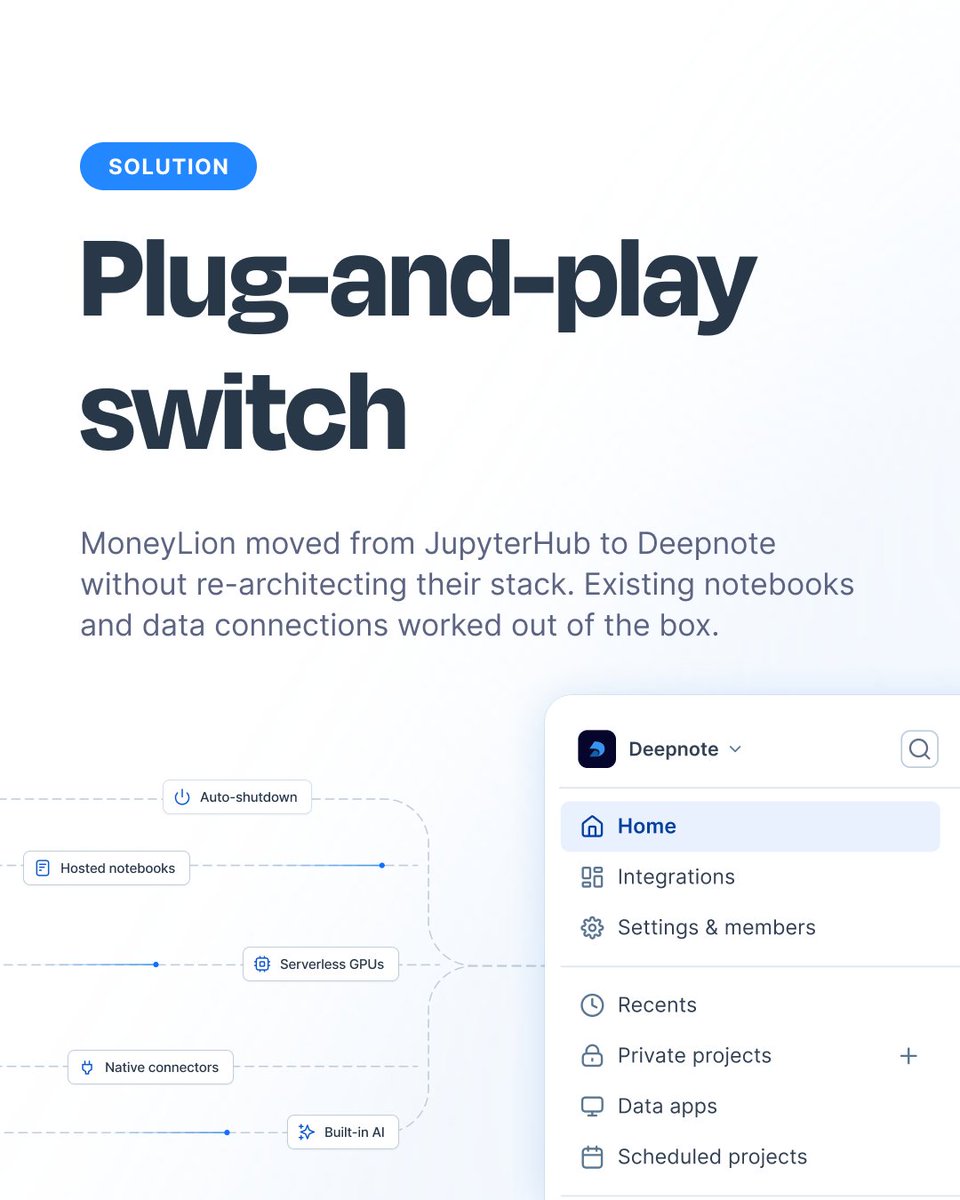
Before Deepnote, their MLOps team was spending too much time maintaining JupyterHub, dealing with unstable sessions, and stitching integrations together. The data scientists felt it too, rerunning charts, losing context, and sharing results as slides instead of live analysis.
So, the team switched to @Deepnote. Here's what happened after the plug-and-play upgrade:
1) AI-native notebooks. Zero babysitting.
JupyterHub maintenance and infra drag were gone. Stable sessions, native Snowflake integration, built-in collaboration, and AI assistance out of the box meant the MLOps team could focus on enabling the business, not keeping notebooks alive.
2) A better data UX.
Data scientists now move from SQL to charts in seconds with natural language, share live analyses instead of screenshots, and turn notebooks into dashboard-style apps that stakeholders can actually use. Less time rerunning notebooks, more time answering real business questions.
Huge thanks to Melvin Low and the entire MoneyLion team for trusting us with critical workflows.
Interested in upgrading your data infra just like MoneyLion? Feel free to dm me, and we'll get you set up.


English
Deepnote nag-retweet
Hello New York! I'm in town today & tomorrow.
If you’re around and want to catch up, DM me and we’ll find a time.

English
Deepnote nag-retweet
@Google just defied gravity. And it's… wicked.
Can @cursor_ai keep up?
I’ve spent a few days with @antigravity, and I have to say, well done, Google.
I was skeptical at first because how good can yet another VS Code fork be? Turns out, very good.
I was in a constant state of flow:
- Fair-use limits reset before momentum dies
- Autonomous browser for live tests
- Async agents tackle parallel tasks
I was vibe-shipping so hard I forgot about my Cursor subscription and tried to upgrade. Then, I realized it’s free.
I was surprised I couldn't pay for this, because the experience was that good. And my personal favorite: it supports @DeepnoteHQ's open-source notebooks out of the box!
We’ve seen big tech clones of successful GenAI products (e.g., Kiro from @amazon, a @Lovable alternative), but Antigravity just hits different.
Will no one mourn Cursor?

English
Deepnote nag-retweet

Massive breakthrough here!
Someone fixed every major flaw in Jupyter Notebooks.
The .ipynb format is stuck in 2014. It was built for a different era - no cloud collaboration, no AI agents, no team workflows.
Change one cell, and you get 50+ lines of JSON metadata in your git diff. Code reviews become a nightmare.
Want to share a database connection across notebooks? Configure it separately in each one. Need comments or permissions? Too bad.
Jupyter works for solo analysis but breaks for teams building production AI systems.
Deepnote just open-sourced the solution (Apache 2.0 license)
They've built a new notebook standard that actually fits modern workflows:
↳ Human-readable YAML - Git diffs show actual code changes, not JSON noise. Code reviews finally work.
↳ Project-based structure - Multiple notebooks share integrations, secrets, and environment settings. Configure once, use everywhere.
↳ 23 new block - SQL, interactive inputs, charts, and KPIs as first-class citizens. Build data apps, not just analytics notebooks.
↳ Multi-language support - Python and SQL in one notebook. Modern data work isn't single-language anymore.
↳ Full backward and forward compatibility: convert any Jupyter notebook to Deepnote and vice versa with one command.
npx @ deepnote/convert notebook.ipynb
Then open it in VS Code, Cursor, WindSurf, or Antigravity. Your existing notebooks migrate instantly.
Their cloud version adds real-time collaboration with comments, permissions, and live editing.
I've shared the GitHub repo link in the replies!
It's 100% open-source.
English
Deepnote nag-retweet

@DataChaz @DeepnoteHQ Wow this is actually massive. Deepnote going open-source is a big win for the data community. Jupyter really set the foundation, but this feels like the next evolution, collaborative, reactive, and AI-ready. Can’t wait to try it out!
English
Deepnote nag-retweet

This is BIG.
Deepnote, a company I’ve followed and used since its creation, just OPEN-SOURCED their modern notebook framework 🔥
And honestly, this could be the final chapter for Jupyter.
After 7 years of development, @DeepnoteHQ has built something that redefines the notebook experience: reactive, collaborative, AI-ready, and open by default.
Core capabilities
→ Supports Python, SQL, and R
→ Interactive blocks, charts, and tables
→ Reactive execution: cells update automatically (no more "Run All")
Integrations and compatibility
→ 60+ native data integrations
→ Fully .ipynb compatible with no lock-in
→ Runs locally or inside VS Code, Cursor, Windsurf, and JupyterLab
Scalability
→ Move to Deepnote Cloud with a single command
It’s everything we loved about Jupyter, rebuilt for 2025, a genuine open successor 🫶
OSS repo + utilities in thread

English
Deepnote nag-retweet
From big news on day 1 of #JupyterCon to the hot seat on day 2, @jakubjurovych of @DeepnoteHQ is with @ha_joslyn. Deepnote has had quite the journey and we're getting a peak behind the curtain, from early challenges to going open source.

English
Deepnote nag-retweet


Deepnote nag-retweet
A collaborative analytics and data science platform makes the move "so the community has a standard that is purpose-built for AI," says @DeepnoteHQ CEO @jakubjurovych thenewstack.io/deepnote-a-suc…
English
Deepnote nag-retweet


English
We've spent 7 years building the data notebook for AI era. Today, we're open sourcing it.
Deepnote Open Source is successor to the Jupyter notebook. It acts as a drop-in replacement for Jupyter with an AI-first design, sleek UI, new blocks, and native data integrations. Use Python, R, and SQL locally in your favorite IDE, then scale to Deepnote cloud for real-time collaboration, Deepnote agent, and deployable data apps.
Single-player notebooks were great in 2013.
2025 needs reactive, collaborative, AI-ready projects that integrate into your existing stack seamlessly.
That's why we're making Deepnote open source - to offer the community an open standard for AI-native data notebooks and data apps.
We're standing on the shoulders of Jupyter — it changed how the world explores data. But at team scale, the papercuts stack up: brittle reproducibility, no native data connectors, weak collaboration, and bolted-on AI features.
In the enterprise context, this gets very tough to manage - and we're seeing an increasing demand from large companies to move away from Jupyter.
What’s new:
- Reactive execution (downstream block auto-update)
- Powerful blocks beyond code: SQL, interactive inputs, charts, KPIs, buttons
- 100+ data integrations
- Code in your favorite IDE: Cursor, Windsurf, or VS Code
- No lock‑in: open standard; export to `.ipynb` whenever you need
Once you're ready to scale in your team, transfer to Deepnote Cloud with one command for beefier compute, powerful data apps from notebooks and agentic data science.
Ty it now:
Repo ➔ vist.ly/4ctcq
Deepnote in VS Code ➔vist.ly/4ctcm
Docs -> vist.ly/4ctcf
CLI ➔ `npx @deepnote/convert notebook.ipynb`
P.S. This only works as an open standard. Tell us what’s missing, file issues, send PRs.
Help define the data notebook for the AI era!
English