Rajasekar Maruthasalam

5.7K posts

Rajasekar Maruthasalam banner
Rajasekar Maruthasalam

Rajasekar Maruthasalam

@FunTechAcademy

Full time investor | 10+ years in stocks | 13x Zerodha Challenge winner | NSE courses on TA, FA & Portfolio Design | Trained 200+ investors

Tamilnadu Sumali Temmuz 2013
7 Sinusundan10.1K Mga Tagasunod
Naka-pin na Tweet
Rajasekar Maruthasalam
Rajasekar Maruthasalam@FunTechAcademy·
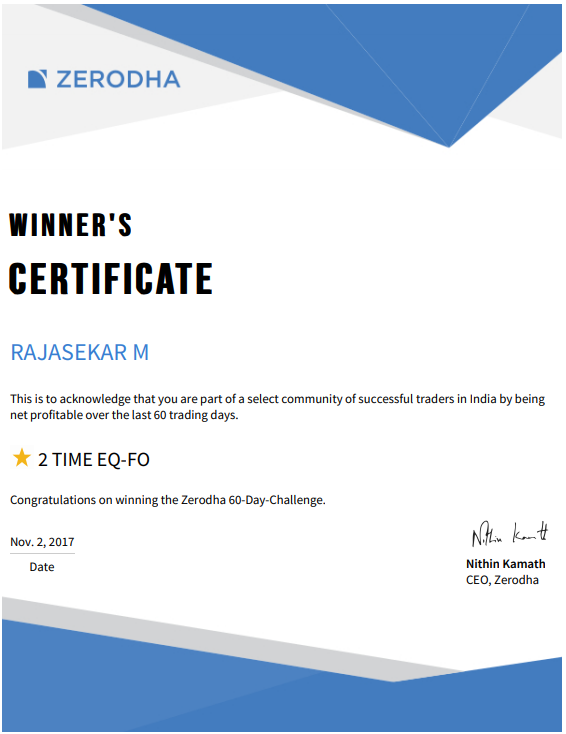
13 times. That is how many times I won Zerodha's 60-Day Profitable Trading Challenge. Most traders cannot survive 60 days profitably even once. I did it 13 times straight. Here is what I learned. 🧵
Rajasekar Maruthasalam tweet mediaRajasekar Maruthasalam tweet mediaRajasekar Maruthasalam tweet mediaRajasekar Maruthasalam tweet media
English
9
9
97
31.6K
Rajasekar Maruthasalam
Rajasekar Maruthasalam@FunTechAcademy·
@Akshat_World Bubble or not — the real risk is having no strategy at all. Optimism without allocation limits is dangerous. So is pessimism that keeps you in cash forever.
English
0
0
0
152
Akshat Shrivastava
Akshat Shrivastava@Akshat_World·
Many are assuming that AI bubble is going to burst like the 2000 dotcom bubble. Here are some points you need to think about:- - AI might/might not be a bubble. - If there is a bubble. And, if it pops: markets will drop 80%+ like in 2000. - This theory is not new. This has been going on for at least 2 years. In that phase: people lose 40%+ run up already. Optimism has "bubble-risk". Pessimism has "missing the run-up risk". You are betting either way. So build your strategy. Or see the world go by.
Akshat Shrivastava@Akshat_World

In 2000 dot com bubble. The market corrected by 83%. Someone invested 100 at peak. That money became 17. But, here is the interesting fact that almost no one is talking:- If you invested 100 before crash. Went through the entire bubble burst. Stayed put. You are now at 7.9X. This is roughly 8.3% CAGR in $ terms over the last 26 years. Massive gains? No. But, this is assuming you invested all your money at absolute peak. And, never downward averaged anything. A more realistic return estimate would be 12-13% CAGR in US$ terms. Point being: if you invest in things where value is migrating towards, you're likely to win. There is a reason why top firms like Google, Meta are staking all their cash, reputation and assets on the line for participating in the AI built out. If you step back and zoom long-term: this is one of the cleanest phases where these firms are deploying large capital with a lot of conviction. While the short-term noise of 5%, 10% fall will always be there. If you deploy capital patiently: there is good money to be made. I did a podcast with actual investors who are putting money on AI investments, do check out there views.... (these are real folks, putting real money on the line)
English
34
1
106
24.2K
Rajasekar Maruthasalam
Rajasekar Maruthasalam@FunTechAcademy·
@Akshat_World This is exactly the kind of accountability the investing world needs. Skin in the game isn't just a phrase — it's a standard. The fact that your community can track every trade and the full history speaks volumes. Results over rhetoric, always.
English
0
0
0
169
Akshat Shrivastava
Akshat Shrivastava@Akshat_World·
The thing about trust is, that it is earned. To do this: I actually invest my own money and show results. My community can see every single trade that I take. And, track the performance. In fact they can go on my portfolio. And, track the entire history of trades, since the day of starting my portfolios. > If I perform, trust grows. > The day I stop performing, the trust will shrink. This is a simple merit based investment model. **** In this entire story:- Trolls show up from time to time. After missing 40% rallies. Post smack. Call out bubbles. And, think they are eroding trust. This doesn't hurt me. It actually increases my reach. Thanks, go ahead do it more 😂 All I gotta do is: work hard, study hard, generate results. And, I will try my best to keep doing that.
Akshat Shrivastava tweet media
bmbharath@barathhbm

@Akshat_World No one trusts you anymore!!

English
18
1
50
8.9K
Rajasekar Maruthasalam
Rajasekar Maruthasalam@FunTechAcademy·
Most people lose money in stocks — not because they're careless. Because nobody taught them simply. I fixed that. 📘 My handwritten stock market book covers everything a beginner needs. 🎁 Launch offer: ₹199 (was ₹499) ⏳ Only till 8 June 2026 Link in Bio and Comment
English
1
0
3
686
Rajasekar Maruthasalam
Rajasekar Maruthasalam@FunTechAcademy·
India just made a silent move that could bring ₹2+ lakh crore back into the country. Most people haven't noticed it yet. But if you have money in FDs, mutual funds, or stocks — this affects you directly. Here's what happened and what it means for your money 🧵
English
39
33
289
230.5K
Rajasekar Maruthasalam
Rajasekar Maruthasalam@FunTechAcademy·
@IamManishArora Multiple times even effective yield was lower than this foreign investors invested in Gsec. Kindly Google it from your end. If you don’t find answer then I will provide.
English
1
0
0
3K
Manish Arora
Manish Arora@IamManishArora·
@FunTechAcademy Great analysis but it just covers one side of the coin. US bond Yields are at ~5%, G secs in India gives rate of 6-7%, factor in the currency depreciation and effective Yield which FII will earn comes below 5%. So why FIIs will leave US bond market and invest in Indian G secs?
English
1
0
1
3.5K
Rajasekar Maruthasalam
Rajasekar Maruthasalam@FunTechAcademy·
How long-term investors actually think A pension fund or sovereign wealth fund is not running a one-year currency-adjusted return model. They are asking one question: which economy will be significantly larger 20 years from now? India is one of three or four answers globally. S&P upgraded India's sovereign rating for the first time in 18 years, projecting 6.8% GDP growth over the next three years. Real GDP growth averaged 8.8% between FY22 and FY24 — highest in Asia-Pacific. Even with 3.5% annual rupee depreciation, India's GDP in USD terms still compounds at 7–8% per year. The bond is a ticket to that platform — not just a coupon. What the tax exemption actually unlocks Previously, FPIs paid 20% withholding tax on interest income plus 12.5% capital gains tax on G-Secs. Removing this addresses the single biggest friction point for sovereign wealth funds, pension funds, and insurance companies. Deloitte estimates this increases FPI returns from Indian G-Secs by 15–20%. And now with 15, 30, and 40-year FAR bonds made accessible, patient capital finally has the right instrument — a 30-year bond is not a trade, it is a conviction bet on India's trajectory. What history confirms Since August 2020, overall FPI equity assets grew ▲139.5%, but sovereign wealth fund investments grew ▲155.2% — they were the most consistent accumulators even during years when short-term traders were selling. That pattern will now repeat in the bond market. The tax exemption plus long-tenor FAR access is the structural trigger.
English
0
0
0
993
Tweetractatus
Tweetractatus@rosharma08·
@FunTechAcademy Why would they buy if yields have fallen and the benefits of those tax breaks neutralised?
English
1
0
0
906
Enlightened Oaf
Enlightened Oaf@EnlightenedOaf·
@FunTechAcademy What a toolkit sirji... Pls do explain why wld somebody buy a gsec in India when you r getting 4.6% in The US treasury n 5% plus on a 30 yr treasury Why would I take a forward cover premium risk of 3% n invest in a 7% paper Your math is not mathing
English
1
0
0
46
Rajasekar Maruthasalam
Rajasekar Maruthasalam@FunTechAcademy·
@rkputcha I posted today. Bookmark and come back after 3 months. Don’t comment before you see the result. As of now you also don’t have evidence for you stand.
English
1
0
9
915
Ajit Murur
Ajit Murur@AjitVMurur·
@FunTechAcademy There are few other changes to attract Foreign Currency Deposits from NRIs, ECBs made more attractive for PSUs. All of them also add up. We shd see INR gaining strength now
English
1
0
2
5.4K
Rajasekar Maruthasalam
Rajasekar Maruthasalam@FunTechAcademy·
@rkputcha How long you want to talk about past? If you have better knowledge to resolve then post it.
English
2
0
11
7.5K
Ravi 🇮🇳 🇸🇬🏏⛳ 🏎
@FunTechAcademy This is a delusional take. India's stock market is amongst the worst performing right now. The state of the economy suggests growth is a distance away. Removing LTCG tax will likely cause more selling.
English
3
0
20
8.7K
Chindi Chor
Chindi Chor@chindichor·
@FunTechAcademy Removing tax is never a solution for capital flow. Because RBI can always decrease interest rates for government to borrow more so if fiscal is going to increase the problem doesn't go away.
English
1
0
0
62
Rajasekar Maruthasalam
Rajasekar Maruthasalam@FunTechAcademy·
@___message___ I can’t comment on political party. I always go with data. My data or my analysis sometimes fail also. You can consider well experienced analyst and take decision. Thank you
English
1
1
14
5.4K
It’sAllOne 🟨🟥
It’sAllOne 🟨🟥@___message___·
@FunTechAcademy You act like govt figured out g-spot of economy. Nothing changes. More mehtas and modis will keep cheating the nations with scams. More FIIs flee, trust in our economy is failing as we speak. Domestic investors are thrown to the market wolves to be torn apart.
English
2
1
21
7.1K
RAHIL
RAHIL@nprahil·
@FunTechAcademy Bhaisaab. Aaj bhi fii 8k cr bech kar gaye hai.
हिन्दी
1
0
5
4.9K
Rajasekar Maruthasalam
Rajasekar Maruthasalam@FunTechAcademy·
India G-Sec yield: 7% US Treasury yield: 4.46% Gap: +2.54% in India’s favour Before today → US funds paid 20% tax on interest + 12.5% LTCG. That gap vanished on paper. After today → Zero tax. That 2.54% spread is now fully pocketable. Yes, rupee risk is real. But pension funds play a 10-year game, not a 1-year game.
English
0
1
6
1.4K
Akshat Shrivastava
Akshat Shrivastava@Akshat_World·
FIIs have been granted tax exemption on G-sec. If you are an Indian stock investor, you need to know this:- First, you need to understand how much benefits FIIs will get:- FII invests ₹100 crore in Indian G-Secs Assume: G-Sec yield: 7% per year So interest earned: ₹7 crore Held for 2 years, then sold at a profit of ₹5 crore BEFORE (old regime): Tax on interest income (20%): ₹1.4 crore Tax on capital gains (12.5% long-term): ₹0.625 crore Total tax paid: ~₹2 crore Net take-home: ~₹10 crore on ₹12 crore earned AFTER (new ordinance): Tax on interest: ₹0 Tax on capital gains: ₹0 Total tax paid: ₹0 Net take-home: full ₹12 crore That's a ~17% improvement in post-tax returns on G-Secs. Now comes the interesting part:- Historical INR depreciation: ~3-4% per year on average. So real USD return = 7% - 4% = ~3% in dollar terms. US Treasuries yield 4.3% So this is still likely to be a net negative trade. Let's assume if this is wrong: and there is some money to be made for FIIs. In the short term, this pulls capital toward bonds, not stocks. What's your take?
English
100
44
601
110.6K