Debbie @ Genetic Lifehacks

7.2K posts

Debbie @ Genetic Lifehacks banner
Debbie @ Genetic Lifehacks

Debbie @ Genetic Lifehacks

@GeneticLifehack

Understand your DNA. Optimize health, diet, & longevity with Genetic Lifehacks. #Biohacking
Small town, MT Sumali Şubat 2015
764 Sinusundan1.8K Mga Tagasunod
Naka-pin na Tweet
Debbie @ Genetic Lifehacks
Debbie @ Genetic Lifehacks@GeneticLifehack·
1/ Did you know that you can use your genetic raw data file from #23andMe or #AncestryDNA to learn more about your health? A thread on using your data to optimize health and prevent chronic disease 🧵
English
5
4
33
0
Debbie @ Genetic Lifehacks nag-retweet
Michal Tal, PhD
Michal Tal, PhD@ImmunoFever·
1/ I want to explain a bit about our MIT MAESTRO study. 🧵How can we help you get better if we don't know what's making you sick? If we don't currently have a way to identify what's going wrong, and we don't have the right tests, I think we need to MEASURE ABSOLUTELY EVERYTHING.
GIF
English
11
40
181
26.5K
サメQCU
サメQCU@sameQCU·
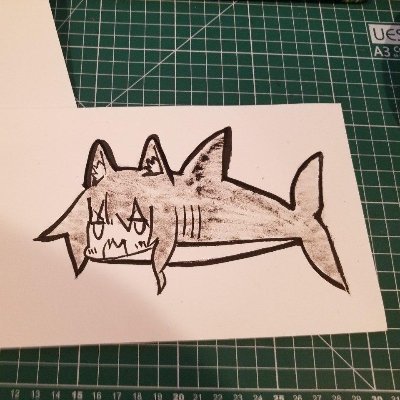
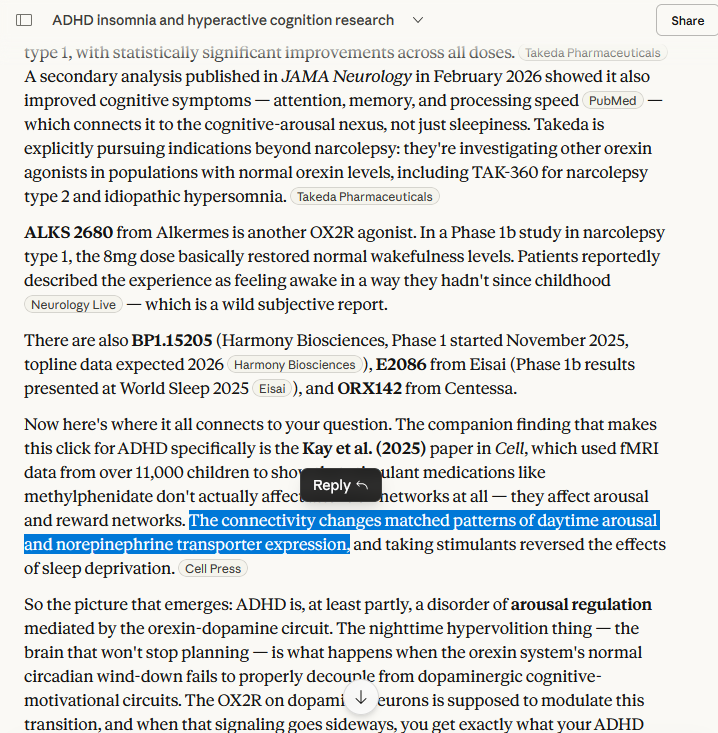
ah what the hell the anti-adhd peptide thing is REAL. they might have found the causal driver for 'adhd', and it's basically entirely sleep-wake-cycle stuff (???) which explains a lot tbh
サメQCU tweet media
English
98
440
8.1K
835.3K
Debbie @ Genetic Lifehacks nag-retweet
Maria Ermolaeva
Maria Ermolaeva@MariaErmolaev13·
Controversy alert: Senolytics may harm healthy brains. New study shows that dasatinib + quercetin - currently in clinical trials as senolytics, trigger white matter injury in healthy mice via oligodendrocyte dysfunction and corpus callosum demyelination. pnas.org/doi/abs/10.107…
English
2
18
55
4.7K
Debbie @ Genetic Lifehacks nag-retweet
S Blitshteyn MD, FAAN, FANA, Dysautonomia Clinic
A retrospective study on menopausal hormone therapy HT) in 83,147 women found that HT initiated at 50-65 years had markedly elevated hazards for stroke (HR: 16.692, 95% CI: 15.571-17.893), cancer (HR: 8.490, 95% CI: 7.281-9.900), and ischemic heart disease/MI (HR: 9.169, 95% CI: 8.321–10.102) after adjustment for certain variables. journals.lww.com/menopausejourn… The study provides further evidence that HT use in women age 50 carries risks that should be weighed against the benefits, based on personalized risk considerations as I discussed in my recent paper on HT. mdpi.com/2077-0383/15/4…
English
8
8
41
9.2K
Debbie @ Genetic Lifehacks nag-retweet
Robert Lufkin MD
Robert Lufkin MD@robertlufkinmd·
Mitochondrial Transplant Reverses Disease Scientists just transplanted healthy mitochondria into diseased cells -- and reversed Parkinson's, Leigh syndrome, and mtDNA depletion. In Cell. As a medical school professor, I can tell you this is one of the most important papers of 2026. Chinese researchers solved the delivery problem that's challenged mitochondrial medicine for decades. The breakthrough: wrapping healthy mitochondria in red blood cell membranes. Delivery efficiency jumped from under 5% to 80%. The results: - Rescued mitochondrial defects in patient-derived cells - Reversed mtDNA depletion syndrome in mice - Extended survival in Leigh syndrome mice - Prevented neuron loss and restored motor function in a Parkinson's model Tested in both mice and monkeys. This is what I wrote about in "Lies I Taught in Medical School" -- we treated mitochondrial diseases as untreatable because we couldn't fix the powerhouse. Now we can replace it entirely. "Organelle therapy" is no longer theoretical. It's here. Full breakdown coming on the Health Longevity Secrets podcast. Source: cell.com/cell/abstract/… #Mitochondria #Parkinsons #RegenerativeMedicine #CellTherapy #Longevity
Robert Lufkin MD tweet media
English
42
422
1.3K
65.4K
Debbie @ Genetic Lifehacks nag-retweet
ME/CFS Science
ME/CFS Science@mecfsskeptic·
1) 🇦🇺 There's a big new brain imaging study from the research team of Zack Shan. The findings are very interesting but they do NOT directly point to neuroinflammation in ME/CFS as the paper currently states (the authors plan to correct it). Here's what it does show...
ME/CFS Science tweet media
English
6
18
76
4.1K
Debbie @ Genetic Lifehacks
Debbie @ Genetic Lifehacks@GeneticLifehack·
@Naomi_D_Harvey Could be! Or - there are studies on specific amino acids, like arginine and taurine, being important in Alzehiemer's prevention. Those amino acids would also be higher in meat. Plus, microbiome differences could also play a role.
English
0
0
2
22
Debbie @ Genetic Lifehacks
Debbie @ Genetic Lifehacks@GeneticLifehack·
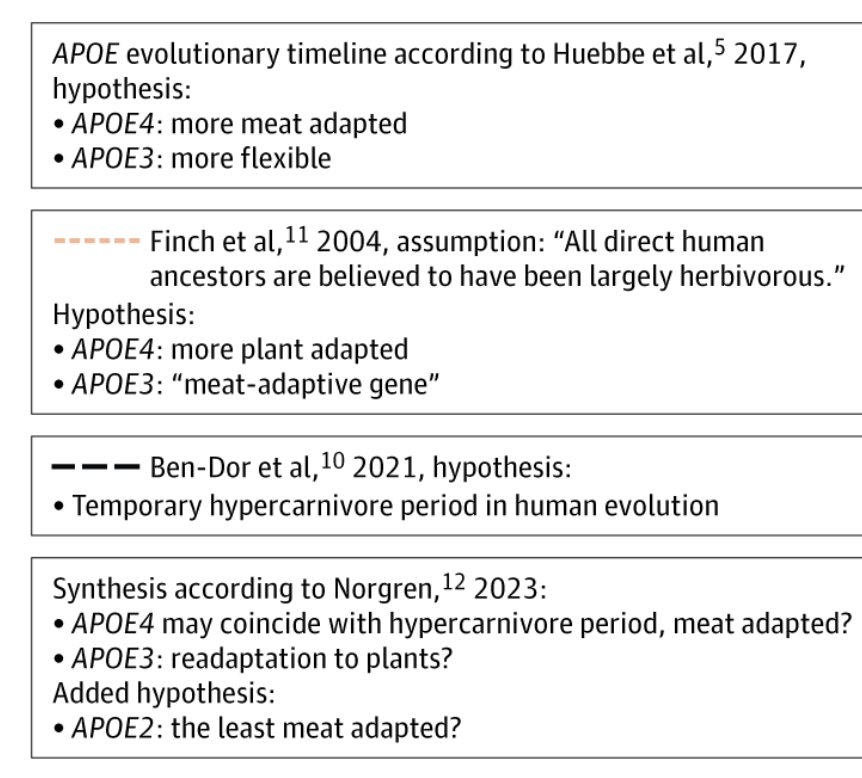
This is an interesting new study on cognitive health in aging - broken out by APOE status. The results showed a more than 50% reduction in the risk of dementia in people eating the most red meat. The kicker is that this result was only true for APOE E4 allele carriers.
Debbie @ Genetic Lifehacks tweet media
English
2
1
5
406
Debbie @ Genetic Lifehacks
Debbie @ Genetic Lifehacks@GeneticLifehack·
I would caution that the somewhat small study cohort size (~2100 older adults) makes me suspect that the effect size may not be quite that big. The study is worth reading - especially the theory on why APOE E4 would benefit from higher red meat consumption. (Unprocessed red meat. Processed meat isn't good.) jamanetwork.com/journals/jaman…
English
0
0
0
41
Debbie @ Genetic Lifehacks nag-retweet
Anish Moonka
Anish Moonka@AnishA_Moonka·
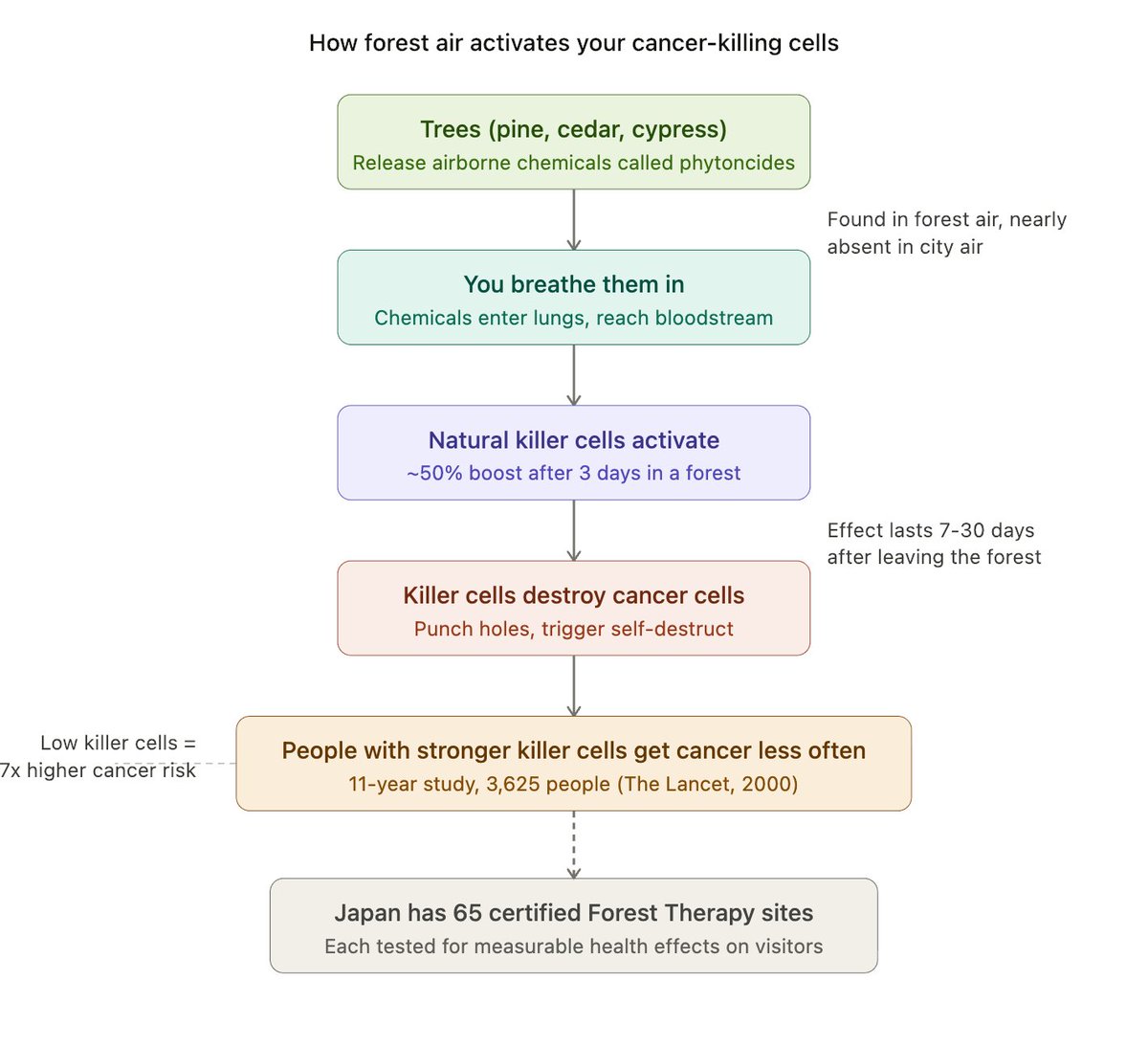
Trees release invisible chemicals into the air to protect themselves from bugs and disease. Turns out those same chemicals also switch on your body's cancer-fighting cells. They're called natural killer cells. They're a type of white blood cell that patrols your bloodstream looking for cancer cells and virus-infected cells. When they find one, they punch a hole through its outer wall and inject proteins that force the cell to self-destruct from the inside. You're born with them. Unlike most of your immune system, they don't need to be "trained" on a specific threat first. They just attack anything that looks wrong. The 50% number in this tweet comes from Dr. Qing Li at Nippon Medical School in Tokyo, who has been studying the effects of forests on the human body since 2004. His original 2007 study took 12 men on a 3-day, 2-night forest trip, walking two hours a day. Blood tests showed 11 of 12 had roughly 50% more cancer-killing cell activity afterward. A follow-up with 13 female nurses found the same thing. But the part the tweet leaves out: the boost didn't vanish when they went home. It lasted over 7 days in both groups, and in men, it was still detectable in blood work 30 days later. Li's conclusion is that one forest trip per month could keep these cells running at a higher level year-round. The obvious next question is whether it's the forest itself or just the vacation. Li tested this directly. A separate group took a city tourist trip with the same amount of walking. No boost to killer cells. No stress hormone drop. Zero effect. Then he ran an even more controlled test: 12 men stayed in a regular Tokyo hotel room for three nights while a humidifier pumped tree oil (from Japanese cypress) into the air overnight. Their killer cells still went up. Their stress hormones still dropped. That isolates the cause to those tree chemicals, called phytoncides. Pine, cedar, and cypress trees release the most. These chemicals were found in forest air but were nearly absent in city air. A 2021 lab study showed that one of these tree chemicals directly switches on killer cells and slows colon tumor growth in mice. The bigger picture connects these cells directly to cancer risk. An 11-year study published in The Lancet (one of the world's top medical journals) tracked 3,625 Japanese people and found that those with weaker natural killer cells developed cancer at significantly higher rates. A separate study screening for bowel cancer found that people with low killer cell levels were 7 times more likely to be diagnosed. Li's own research across all 47 regions of Japan showed that areas with less forest had higher cancer death rates for lung, breast, uterine, prostate, kidney, and colon cancers, even after accounting for differences in smoking rates and wealth. The caveats: Li's original studies used small groups (12 and 13 people), and the regional data show a pattern but don't directly prove that forests prevent cancer. No large-scale clinical trial has confirmed that yet. But the chain is consistent: trees release chemicals, those chemicals wake up the cells in your blood that kill cancer, the effect lasts weeks, not hours, and people with more active killer cells get cancer less often. Japan now has 65 government-certified Forest Therapy sites across the country, each tested and approved based on the physical effects they have on visitors.
Anish Moonka tweet media
All day Astronomy@forallcurious

🚨: Research suggest that just 3 days of camping in the forest can increase the production of cells that kill cancer by more than 50%.
English
37
967
3.8K
275.8K
Debbie @ Genetic Lifehacks nag-retweet
Clint Jarvis
Clint Jarvis@clinjar·
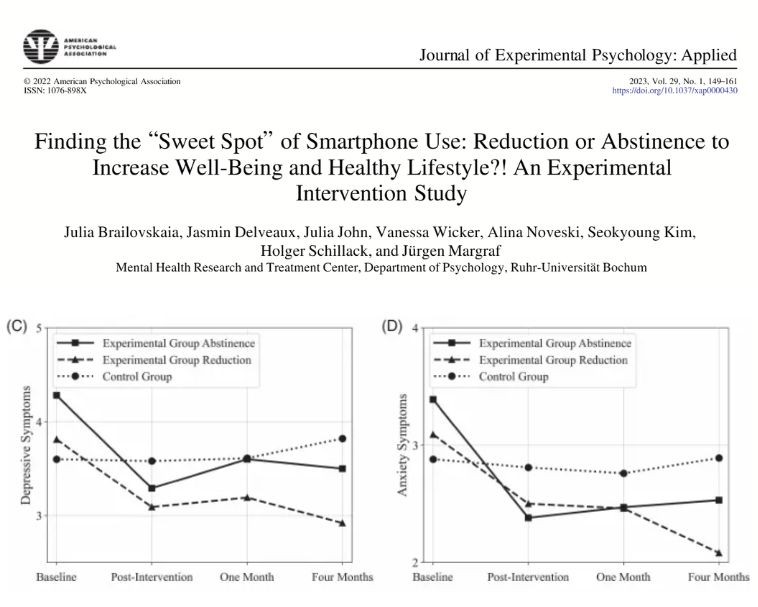
A German university ran an experiment with 619 people on phone use. One group quit completely. Another cut just 1 hour per day. The results changed how researchers think about phone addiction:
Clint Jarvis tweet media
English
3
78
444
55.7K
Debbie @ Genetic Lifehacks
Debbie @ Genetic Lifehacks@GeneticLifehack·
Privacy is definitely something to consider with any genetic data company. 23andMe's data hack was actually due to people reusing their same username and passwords that were already leaked on the dark web from other website hacks. But since then, they have implemented two-factor authentication so that it won't be able to happen again. I write about several ways to keep your genetic data more private here: geneticlifehacks.com/keeping-your-g… I also have some of the pros and cons of different genetic testing companies here: geneticlifehacks.com/dna-testing-pr…
English
1
0
4
378
Ascend DFW
Ascend DFW@ascend_dfw·
@GeneticLifehack Is there one you would recommend? 23andme seems great but I have concerns about the data privacy
English
1
0
0
207
Debbie @ Genetic Lifehacks
Debbie @ Genetic Lifehacks@GeneticLifehack·
Just as a heads up for anyone considering genetic testing.... AncestryDNA data files have changed significantly (starting about two weeks ago). New raw data files are about 450,000 SNPs instead of the prior ~700,000. They are missing some key information from a Genetic Lifehacks point of view, and they also no longer include Y chromosome SNPs or mitochondrial DNA.
English
1
2
17
1.2K
Debbie @ Genetic Lifehacks
Debbie @ Genetic Lifehacks@GeneticLifehack·
For anyone with IBD... This is an interesting study on the way that gut microbial tyramine production acts on intestinal stem cells to exacerbate colitis. pubmed.ncbi.nlm.nih.gov/38788722/ (Updating my tyramine metabolism article today!)
English
0
0
4
72