Melvin

212 posts

Melvin banner
Melvin

Melvin

@MelvinInvests

AI Analyst @MilkRoadAI | Co-Founder @_Investinq + @optionality_ | Finding opportunities across AI, photonics, defense, space, and tech.

Sumali Haziran 2026
75 Sinusundan3.5K Mga Tagasunod
Naka-pin na Tweet
Melvin
Melvin@MelvinInvests·
I just took a position in CCXI, Churchill Capital Corp XI and here's why (Save this). CCXI is a SPAC that on June 24 announced a definitive merger with Agility Robotics valuing the company at $2.5 billion pre money with over $620 million in gross proceeds to fund scale. When the deal closes, shareholder vote expected the week of August 19, CCXI becomes AGLT, the first and only US listed pure play humanoid robotics company with active commercial deployments. Every other humanoid company worth owning is either private, Figure AI, Physical Intelligence, 1X or buried inside a conglomerate where humanoid robots are a footnote. When the whole retail world wants a trade and there is exactly one liquid way to express it, scarcity alone is a thesis but Agility is the real thing. Digit has logged more than 65,000 hours of actual work across nine customer sites, with over $300 million in multi-year orders already signed for Digit v5. Paying customers include GXO, Schaeffler, Toyota Manufacturing Canada, and Mercado Libre with Amazon actively testing. The job Agility picked matters too, Digit was built for one boring, monetizable task moving things around warehouses. Figure AI, at a roughly $39 billion private mark, is chasing general-purpose everything with no paying customers yet while Agility earns money first and needs a miracle second. Nvidia named Agility the launch partner for its Halos physical-AI safety system, the same level of designation Jensen gave Nebius in the neocloud world that means preferential chip access, co-development resources, and a direct seat at the table for whatever physical AI looks like next. Now look at where this market is going. Goldman Sachs projects 1.4 million units shipped annually by 2035, Morgan Stanley puts the total ecosystem at $5 trillion by 2050 and Citigroup sees 648 million deployed humanoids by mid-century. The image above shows 30+ named robot makers spanning China, the US, Germany, and beyond but almost none of them are publicly investable as clean pure-plays. CCXI gives you that clean pure-play today, at a $2.5 billion valuation, for a company already generating commercial revenue, already deployed in live industrial settings, and about to receive $620 million in fresh capital to scale production. CCXI is the only place where the entire humanoid map collapses into a single liquid ticker and where buying the maker pulls every supplier on that map up with it. The shareholder vote closes by August 19. The S-4 drops in July with full financials and the window is narrow and that is exactly why I took the position now. Make sure to follow me @MelvinInvests for more overlooked opportunities in robotics and AI. Want my full breakdown of CCXI and every humanoid supply chain play we're tracking in the Milk Road portfolio? You can come join Milk road Pro for just a dollar using the link below!
Melvin tweet media
English
8
10
42
7.7K
Melvin
Melvin@MelvinInvests·
I just took a position in CCXI, Churchill Capital Corp XI and here's why (Save this). CCXI is a SPAC that on June 24 announced a definitive merger with Agility Robotics valuing the company at $2.5 billion pre money with over $620 million in gross proceeds to fund scale. When the deal closes, shareholder vote expected the week of August 19, CCXI becomes AGLT, the first and only US listed pure play humanoid robotics company with active commercial deployments. Every other humanoid company worth owning is either private, Figure AI, Physical Intelligence, 1X or buried inside a conglomerate where humanoid robots are a footnote. When the whole retail world wants a trade and there is exactly one liquid way to express it, scarcity alone is a thesis but Agility is the real thing. Digit has logged more than 65,000 hours of actual work across nine customer sites, with over $300 million in multi-year orders already signed for Digit v5. Paying customers include GXO, Schaeffler, Toyota Manufacturing Canada, and Mercado Libre with Amazon actively testing. The job Agility picked matters too, Digit was built for one boring, monetizable task moving things around warehouses. Figure AI, at a roughly $39 billion private mark, is chasing general-purpose everything with no paying customers yet while Agility earns money first and needs a miracle second. Nvidia named Agility the launch partner for its Halos physical-AI safety system, the same level of designation Jensen gave Nebius in the neocloud world that means preferential chip access, co-development resources, and a direct seat at the table for whatever physical AI looks like next. Now look at where this market is going. Goldman Sachs projects 1.4 million units shipped annually by 2035, Morgan Stanley puts the total ecosystem at $5 trillion by 2050 and Citigroup sees 648 million deployed humanoids by mid-century. The image above shows 30+ named robot makers spanning China, the US, Germany, and beyond but almost none of them are publicly investable as clean pure-plays. CCXI gives you that clean pure-play today, at a $2.5 billion valuation, for a company already generating commercial revenue, already deployed in live industrial settings, and about to receive $620 million in fresh capital to scale production. CCXI is the only place where the entire humanoid map collapses into a single liquid ticker and where buying the maker pulls every supplier on that map up with it. The shareholder vote closes by August 19. The S-4 drops in July with full financials and the window is narrow and that is exactly why I took the position now. Make sure to follow me @MelvinInvests for more overlooked opportunities in robotics and AI. Want my full breakdown of CCXI and every humanoid supply chain play we're tracking in the Milk Road portfolio? You can come join Milk road Pro for just a dollar using the link below!
Melvin tweet media
English
8
10
42
7.7K
DW
DW@Danwils97604894·
@MelvinInvests Huge value add. Thank you for sharing
English
1
0
0
120
Melvin
Melvin@MelvinInvests·
I’m an analyst at Milk Road, and my job is to find underrated gems before the market catches on. We called names like MU, CRDO, NBIS, and BE over the last 3 months. Join me and my team for just $1. #1" target="_blank" rel="nofollow noopener">milkroad.com/pro/?utm_mediu…
Melvin tweet media
English
0
0
2
360
Melvin
Melvin@MelvinInvests·
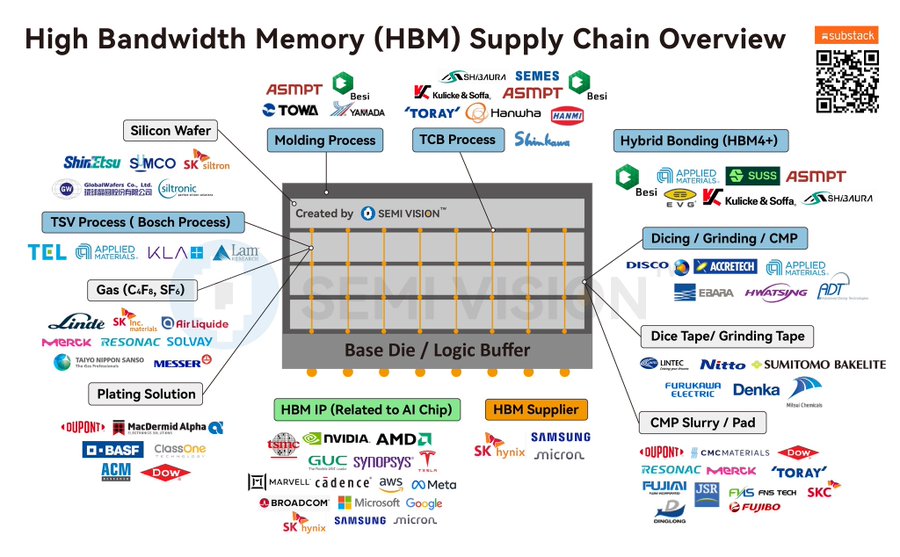
Total wafer fab equipment spending is projected to reach $145 billion in 2026, $200 billion in 2027 and $250 billion in 2028, a near doubling in three years driven almost entirely by HBM and advanced logic demand (Save this). And this image above shows exactly who collects a toll on every single chip that gets built. Before any HBM chip can exist, you need an ultra pure silicon wafer to build it on. Shin-Etsu Chemical and Siltronic are the dominant global silicon wafer suppliers, with Shin-Etsu controlling roughly 30% of global supply, one of the quietest monopolies in all of semiconductors. The most technically complex step is the TSV process drilling microscopic vertical holes through each silicon die so electrical signals can travel between stacked layers. Tokyo Electron (TEL), Applied Materials (AMAT), KLA Corporation (KLAC), and Lam Research (LRCX) dominate this step,and all four beat earnings, raised guidance, and reported sold out capacity simultaneously in the most recent cycle, an extraordinarily rare alignment that signals just how tight the HBM supply chain truly is. Applied Materials leads in deposition tools, Lam Research controls roughly 50% of the global etch market, and KLA holds a near monopoly at 55% share in process control and inspection, every wafer must pass through KLA's equipment to confirm chip integrity before moving forward. The TSV etching process also requires specialized industrial gases, C4F8 and SF6 that create the precise chemical reactions needed to carve through silicon without damaging surrounding material. Linde, Air Liquide, SK Materials, and Merck supply these gases and none of them are substitutable within current production timelines making them some of the most overlooked AI infrastructure plays in the market. Once the dies are prepared, they need to be stacked and bonded together, currently via Thermal Compression Bonding, but the industry is shifting toward Hybrid Bonding for HBM4 and beyond. Besi, ASMPT, Hanmi Semiconductor, and Kulicke & Soffa dominate the bonding equipment market, and the hybrid bonder market alone is projected to reach nearly $2 billion by 2028 as every memory maker upgrades to the next-generation process. After stacking, chips need to be thinned, cut and polished through grinding, dicing, and CMP processes where DISCO Corporation holds near-monopoly control in precision dicing equipment, with DuPont, Dow, CMC Materials, and Resonac supplying the CMP slurry chemicals needed to polish chips to atomic smoothness. All of this feeds into just three companies that actually build and sell HBM, SK Hynix with over 50% global market share, Micron ramping HBM4 for Nvidia's Rubin platform and Samsung fighting to regain ground after falling behind on qualification timelines. And at the very bottom of the supply chain sits the demand engine, every hyperscaler and chip designer whose AI accelerators require HBM to function, Nvidia, AMD, Broadcom, Google, Microsoft, Meta, AWS, Marvell, and Tesla. Every company in this supply chain is a toll booth and the traffic is only getting heavier. Make sure to follow me @MelvinInvests for more semiconductor opportunities.
Melvin tweet media
English
5
22
104
8.3K
Cooper
Cooper@coooooooopppppp·
@MelvinInvests @_Investinq Love these write ups. The only problem is I go down a 3 hour research hole after each one before realizing the time 🙃
English
1
0
0
56
Melvin
Melvin@MelvinInvests·
I’m an analyst at Milk Road, and my job is to find underrated gems before the market catches on. We called names like MU, CRDO, NBIS, and BE over the last 3 months. Join me and my team for just $1. #1" target="_blank" rel="nofollow noopener">milkroad.com/pro/?utm_mediu…
Melvin tweet media
English
0
0
1
417
Melvin
Melvin@MelvinInvests·
Nebius will be the first Neocloud to hit $1 trillion and the data makes that case better than any hype ever could (Save this). US data center power demand is on a trajectory to go from 31 GW in 2025 to 66 GW by 2027 more than doubling in just two years. Goldman estimates that only 50–60% of planned capacity will actually come online on time due to power grid bottlenecks, labor shortages, transformer supply constraints and permitting delays. And even after discounting half the entire buildout, demand still massively outstrips supply. Data centers are on track to consume 8.5% of peak US summer electricity by 2027, up from just 4.1% today. The real story is that the grid, the labor force, and the supply chain physically cannot build fast enough to satisfy it and that structural gap is widening every single quarter. This is the single most important tailwind Nebius has and it is not going away. In a world where Microsoft, Meta and Amazon are collectively spending over $700 billion on AI infrastructure in 2026 alone but cannot build fast enough themselves, they are being forced to sign decade long contracts with purpose-built AI cloud providers who have already done the hard work of securing land, power interconnects, and GPU supply. Nebius has secured $27 billion in contracted capacity with Meta Platforms and $19.4 billion with Microsoft over $46 billion in total contracted backlog meaning its revenue for the next five years is essentially pre-sold before a single new customer signs up. The financial results confirm that this, Nebius reported $399 million in revenue in Q1 2026, up 684% year over year, with AI cloud revenue specifically up 841% in a single quarter. Full-year 2026 guidance calls for $3.0–$3.4 billion in revenue, with an annualized run rate of $7–$9 billion by year-end. The company has now contracted over 3.5 GW of power capacity across seven sites each over 100 MW including a 1.2 GW AI factory campus in Pennsylvania and a £1.7 billion expansion across three UK sites, targeting 4 GW by end of 2026. And critically, Nebius is not just a landlord renting GPU racks to the highest bidder. But rather building a full-stack AI platform, proprietary inference solutions, agentic deployment tools, and developer APIs that converts one-time infrastructure contracts into recurring high-margin software subscriptions over time, compressing the multiple the market should apply to its revenue as those software layers scale. The Goldman chart is essentially a map of Nebius's total addressable market and every quarter that supply falls further behind demand, that market gets bigger. Long Nebius and make sure to follow me @MelvinInvests for more long duration AI winners.
Melvin tweet media
English
5
13
47
8K
Melvin
Melvin@MelvinInvests·
We just have different analysts within our Pro, as you probably already know. We all have different views. I don’t want to speak for Martin but I think demand for compute is at an all time high and will continue to go up, even as free open weight models catch up. Just look at Anthropic’s and OpenAI’s revenue. That will continue to accelerate, which means they are all going to need more compute. Google just limited Meta’s compute because they clearly don’t have enough capacity, even after signing a deal with SpaceX. I think some of the biggest beneficiaries of this will be neocloud providers like Nebius and CoreWeave.
English
0
0
2
124
Felix Heimberger
Felix Heimberger@FelixHburger·
@MelvinInvests @milkroaddaily Didn’t milk road recently analyzed that token cost has come down rapidly because improving free ai models? I’m super bullish data centers but that recent article from milk road was a bearish read for me. Could you please help me connect the dots?
English
1
0
1
126
Melvin
Melvin@MelvinInvests·
I’m an analyst at Milk Road, and my job is to find underrated gems before the market catches on. We called names like MU, CRDO, NBIS, and BE over the last 3 months. Join me and my team for just $1. #1" target="_blank" rel="nofollow noopener">milkroad.com/pro/?utm_mediu…
Melvin tweet media
English
0
2
3
513
Melvin
Melvin@MelvinInvests·
The humanoid robot market is projected to reach $7 trillion by 2050 with some forecasts going as high as $9 trillion when software and services are included (Save this). Every major bank covering this space agrees on one thing, this will eventually dwarf the entire global auto industry but the real money is not in the companies assembling the robots. Tesla, Hyundai and Xiaomi will compete brutally for share, compress each other's margins, and fight wars of attrition for the next 20 years just like every auto manufacturer before them. The companies that print money regardless of who wins that war are the ones supplying the components every single robot on earth must have, no matter which assembler's logo is on the chest. Here is how that plays out across each layer of the value chain shown above. The brain is the safest and most liquid layer to own. Nvidia (NVDA) is the backbone, its Isaac platform is becoming the default operating system for training and deploying physical AI meaning every humanoid robot essentially runs on Nvidia infrastructure before it ever takes a step. TSMC (TSM) manufactures the chips inside every competitive robot brain regardless of whose design wins, making it the toll booth of the entire sector. Arm (ARM) and Broadcom (AVGO) sit deeper in the stack as the architecture and connectivity layer that nobody talks about but everyone depends on. The body is where the highest conviction asymmetric plays live. Harmonic Drive Systems makes the precision gearboxes that give robot joints their accuracy, there is currently no viable substitute and every serious humanoid maker uses them, making this the closest thing to a monopoly in the entire value chain. Mobileye (MBLY) and Hesai supply the vision and LiDAR systems that let robots perceive the world, the same sensors that cracked autonomous vehicles are now being re-deployed into humanoid perception stacks. Monolithic Power Systems (MPWR) and Navitas supply the power management chips that determine how long a robot can operate, a silent but critical bottleneck as robots move from factory floors to field deployment. The bottleneck Layer is the most overlooked and potentially the most important. ASML (ASML) and Lam Research (LRCX) are the picks and shovels of semiconductor manufacturing, you cannot build robot chips at scale without their equipment, full stop. SK Hynix and Micron (MU) supply the memory that robot brains need to process real-time sensory data, the same HBM supercycle driving AI data centers will eventually power mobile robot intelligence. Amphenol (APH) and TE Connectivity (TEL) make the connectors and cables inside every robot, unglamorous, high margin, and impossible to disintermediate. MP Materials (MP) mines the rare earth magnets that go inside every actuator motor with China controlling most of the world's rare earth supply, MP is the only US-listed pure-play on this critical material. The applications layer, Intuitive Surgical, Symbotic, and Serve Robotics shows you what monetized robotics looks like right now, before humanoids go mass market. These companies are already generating real revenue from robotic systems in surgery, warehousing, and food delivery, and they de-risk the investment case because they don't require you to wait until 2035 for the thesis to pay off. For the lazy route, the chart lists KOID, BOTZ, ROBO, and ROBT as ETF vehicles that spread exposure across the full value chain. The framework is simple, bet on the toll roads, not the car companies. Make sure to follow me @MelvinInvests for more overlooked opportunities in AI and robotics.
Melvin tweet media
English
24
61
368
32.4K