

Tory
158 posts

Tory
@ToryCrypto
Sound Money Advocate | Kaspa | KRC721
Sumali Mart 2026
100 Sinusundan141 Mga Tagasunod

Yay!!! Y'all have done incredible!!
x.com/i/status/20387…
We mainly don't want to be called a shitcoin
We just want to be respected
Some people need Bitcoin as their base layer and some people need kaspa
We dislike being compared to fart coin 😂
This is our method of money and sovereignty that best fits our risk appetite and values
We dislike shitcoins
We love Bitcoin at heart
₿itcoin Rachy ⚡️@BitcoinRachy
Looks like the Bitcoin and Kaspa communities are getting along pretty well now that Breadman and I opened up some dialogue with them. Hopefully more people realize it’s okay to have differing ideas and talk to each other with respect.
English




It's happening.
Soon.
Stay tuned.
Kas.
Igra.
$kas $igra #kaspa #igra @SpectreMarket
x.com/Igra_Labs/stat…
Igra Labs@Igra_Labs
A note on what will happen on Wednesday and what comes next. The response has been overwhelming. We see you, and we're genuinely excited by the energy. Genesis and TGE mark the launch of Igra's on-chain infrastructure: node launched, contracts deployed, governance live, token minted. This is not yet open to the public. Next step on the roadmap is whitelisted mainnet testing with core partner protocols and integrations — @AppKaskad, @KaspaCom, @ZealousSwap, @KaspaFinance, @hyperlane, @quex_tech. (If your team is serious about building on Kaspa and wants early access— reach out.) Once that phase completes, Igra opens to users and the wider world. We're building a parapet before we invite people onto the roof.
English

The world will never move beyond slow, congested chains because Kaspa "works just fine."
The world will never adopt Kaspa because, why switch from a 10-minute block every 10 minutes, right?
The world will never embrace a truly scalable, feeless, instant network because Bitcoin has been around for over a decade, and it’s "reliable."
Oh, wait… Kaspa is here, handling thousands of TPS, instant confirmations, and Bitcoin is still stuck in the past.
Rajat Soni, CFA@Rajatsoni
The world will never use light bulbs because candles work just fine The world will never use cars because horse carriages were used for thousands of years, and they're reliable The world will never go to streaming services because physical media is best Oh, wait...
English


@anbrandenburger Breadman is one of the only BTC maxis to provide logical takes
English

This is the most reasonable take I’ve read of his.
I wish more Bitcoiners would at least say this!👇
Breadman@BTCBreadMan
I understand what the $KAS folks are saying, and from a technical standpoint I can’t say they’re wrong. The source of disagreement is whether a coin that is not Bitcoin has a realistic shot of turning out differently than every other altcoin in the graveyard of altcoin history.
English


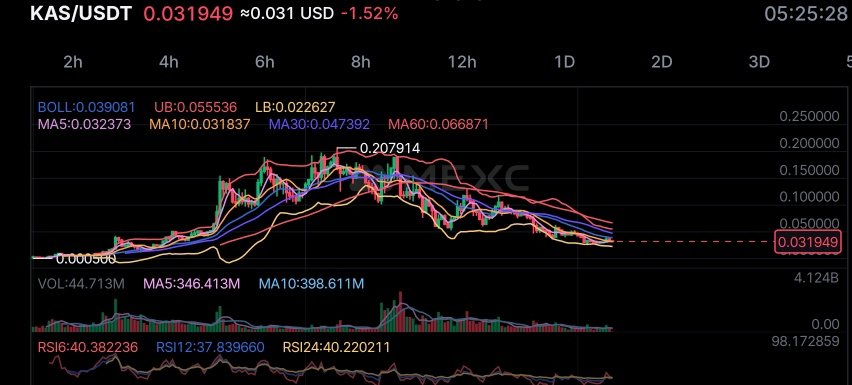
Loading up more $KAS at $0.022 👀
Got a big buy order sitting there… let’s see if it fills 🚀
English



$KAS ZK, Simplified (for beginners) 😁
Zero-knowledge (ZK) lets systems prove computations happened correctly without revealing the underlying data. This framework adds parallel proof generation, using cryptographic state and zkVMs to verify transactions and batches efficiently and securely.
This unlocks strong privacy without sacrificing trust. 🔓
Hans Moog@hus_qy
Okay, it's time for a little update: I just finished the work on the zero knowledge part of the vprogs framework, which introduces the ability to prove arbitrary computation. It consists of the following 8 PRs that gradually introduce the necessary features: 1. ZK-framework preparations (github.com/kaspanet/vprog…): This PR cleans up the scheduler and storage layers, extends the build tooling with workspace-wide dependency checking, adds the ability to publish artifacts for transactions and batches (which will later hold the proofs), renames some core types for clarity, and introduces lifecycle events on the Processor trait that allow a VM to hook into key scheduler events like batch creation, commit, shutdown, and rollback. 2. Core Codec (github.com/kaspanet/vprog…): This PR introduces a lightweight encoding library for ZK wire formats. In a zkVM guest, every byte operation contributes to the proof cost, so the codec is designed to reinterpret data in-place rather than copying it. It includes zero-copy binary decoding (Reader, Bits) and sorted-unique encoding for deterministic key ordering. It is built for no_std so it runs inside zkVM guests. 3. Core SMT (github.com/kaspanet/vprog…): To prove state transitions, we need cryptographic state commitments. This PR adds a versioned Sparse Merkle Tree that produces a single root hash representing the entire state. It includes all state-of-the-art optimizations: shortcut leaves at higher tree levels to avoid full-depth paths for sparse regions, multi-proof compression that shares sibling hashes across multiple keys, and compact topology bit-packing to minimize proof size. It integrates into the existing storage and scheduler layers so that every batch commit updates the authenticated state root, while rollback and pruning maintain tree consistency. 4. ZK ABI (github.com/kaspanet/vprog…): Defines the wire format for communication between the host and zkVM guest programs, establishing a universal language for proof composition. It specifies how inputs, outputs, and journals are structured for two levels of proving: the transaction processor, which proves individual transaction execution against a set of resources, and the batch processor, which aggregates transaction proofs and proves the resulting state root transition. Because the ABI is backend-agnostic and no_std compatible, any zkVM backend can directly use it (non-Rust zkVMs would need to reimplement the ABI in their language). 5. ZK Transaction Prover (github.com/kaspanet/vprog…): Introduces the transaction proving worker, which receives serialized execution contexts via the ABI wire format and submits them to a backend-specific prover on a dedicated thread. The Backend trait abstracts the actual proof generation, so different zkVM backends can be swapped without changing the pipeline. 6. ZK Batch Prover (github.com/kaspanet/vprog…): Introduces the batch proving worker, which collects the individual transaction proof artifacts, pairs them with an SMT proof covering the batch's resources, and submits the combined input to a backend-specific batch prover. The result is a single proof attesting to the entire batch's state root transition. Like the transaction prover, the Backend trait abstracts proof generation so different zkVM backends can be swapped without changing the pipeline. 7. ZK VM (github.com/kaspanet/vprog…): Wires everything together by implementing the scheduler's Processor trait with ZK proving support. The VM hooks into the lifecycle events introduced in PR 1 to feed executed transactions into the transaction prover and batches into the batch prover. Proving is optional and configurable - it can be disabled entirely, run at the transaction level only, or run the full batch proving pipeline. 8. ZK Backend RISC0 (github.com/kaspanet/vprog…): Provides the first concrete zkVM backend using risc0. It implements the transaction and batch Backend traits, includes two pre-compiled guest programs (one for transaction processing, one for batch aggregation), and ships with an integration test suite that verifies the full pipeline end-to-end - from transaction execution through batch proof generation to state root verification. TL;DR: While the early version of the framework focused on maximizing the parallelizability of execution, this feature focuses on extending this capability to maximizing the parallelizability of proof production. If you're a builder: this is the first version of the framework that lets you write guest programs with a Solana-like API (resources, instructions, program contexts) and have them proven in a zkVM. The current milestone uses a single hardcoded guest program - composability across multiple programs and bridging assets in and out of the L1 are part of the upcoming milestones, but if you're eager to start tinkering, the execution and proving pipeline is fully functional and provides a minimal environment to build and test guest logic today. Once we add user-deployed guests, they will move one logical layer down: the current transaction processor will become a hardcoded-circuit that handles invocation and access delegation to user programs, similar to how SUI handles programmable transactions (including linear type safety at the program boundary). In practice, this means guest programs will be invoked with a very similar API but scoped to a subset of resources, so the basic programming model won't change. Note that guests currently handle their own access authentication (e.g. signature checks) - the framework will eventually manage this automatically. If you want to contribute, two areas where community involvement would be especially impactful: - An Anchor-like DSL for writing guest programs -- the ABI is stable enough to build on, and a good developer experience layer would make this accessible to a much wider audience. - A second zkVM backend (e.g. SP1) - the Backend traits are designed for this, and a second implementation would prove out the abstraction. One thing I find particularly interesting in the context of PoW: the block hash provides an unpredictable, unbiasable random input that is revealed after transaction sequencing. This gives guest programs native access to on-chain randomness without oracles or additional infrastructure - something traditionally hard to achieve in smart contract platforms. PS: I am also planning to start with the promised regular hangouts but since I will visit my family over easter and want to get a better understanding of the open questions next week (it's good to have some problems to wrestle during that slower time 😅), I decided to start with that once I am back (12th of April). Generally speaking, is there a day that people would prefer for these hangouts? I guess monday would be bad as there is already another community event (write your preferences in the comments if you have a strong opinion).
English

🚀 $KAS is building something most chains can’t even conceptualize.
10 BPS. DAGKnight. ZK pipeline in development. Real-Time Decentralization isn’t a buzzword.. it’s the architecture.
While others ship narratives, Kaspa ships consensus breakthroughs.
The market hasn’t priced in what’s coming. Yet..
Satoshi gave us the blueprint: decentralized, permissionless, proof-of-work money.
But Bitcoin stopped at 1 block every 10 minutes.
Kaspa asked; what if we didn’t stop?
Satoshi proved PoW works. Kaspa proves it scales.
This isn’t an alternative to Bitcoin’s vision it’s the completion of it.
English

Your favorite crypto project is just a bank wearing a hoodie.
*cough* $XRP
Hidden leverage ✓
Fake decentralization ✓
Pausable exits ✓
Insider advantages ✓
Users locked in wrapped IOUs ✓
#Bitcoin has none of these.
Name one other project that doesn't. I'll wait. 👇
English



Gm ☕️
Feels good to be fast and lightweight 😌
$kas
$btc

English

Kaspa core developer Hans Moog just shared a major update on his work on the ZK-proof part of the vProgs framework.
This LM explainer aims to provide a clear, easy-to-understand breakdown.
For full details and sources, check Hans’ post below.
x.com/hus_qy/status/…
Hans Moog@hus_qy
Okay, it's time for a little update: I just finished the work on the zero knowledge part of the vprogs framework, which introduces the ability to prove arbitrary computation. It consists of the following 8 PRs that gradually introduce the necessary features: 1. ZK-framework preparations (github.com/kaspanet/vprog…): This PR cleans up the scheduler and storage layers, extends the build tooling with workspace-wide dependency checking, adds the ability to publish artifacts for transactions and batches (which will later hold the proofs), renames some core types for clarity, and introduces lifecycle events on the Processor trait that allow a VM to hook into key scheduler events like batch creation, commit, shutdown, and rollback. 2. Core Codec (github.com/kaspanet/vprog…): This PR introduces a lightweight encoding library for ZK wire formats. In a zkVM guest, every byte operation contributes to the proof cost, so the codec is designed to reinterpret data in-place rather than copying it. It includes zero-copy binary decoding (Reader, Bits) and sorted-unique encoding for deterministic key ordering. It is built for no_std so it runs inside zkVM guests. 3. Core SMT (github.com/kaspanet/vprog…): To prove state transitions, we need cryptographic state commitments. This PR adds a versioned Sparse Merkle Tree that produces a single root hash representing the entire state. It includes all state-of-the-art optimizations: shortcut leaves at higher tree levels to avoid full-depth paths for sparse regions, multi-proof compression that shares sibling hashes across multiple keys, and compact topology bit-packing to minimize proof size. It integrates into the existing storage and scheduler layers so that every batch commit updates the authenticated state root, while rollback and pruning maintain tree consistency. 4. ZK ABI (github.com/kaspanet/vprog…): Defines the wire format for communication between the host and zkVM guest programs, establishing a universal language for proof composition. It specifies how inputs, outputs, and journals are structured for two levels of proving: the transaction processor, which proves individual transaction execution against a set of resources, and the batch processor, which aggregates transaction proofs and proves the resulting state root transition. Because the ABI is backend-agnostic and no_std compatible, any zkVM backend can directly use it (non-Rust zkVMs would need to reimplement the ABI in their language). 5. ZK Transaction Prover (github.com/kaspanet/vprog…): Introduces the transaction proving worker, which receives serialized execution contexts via the ABI wire format and submits them to a backend-specific prover on a dedicated thread. The Backend trait abstracts the actual proof generation, so different zkVM backends can be swapped without changing the pipeline. 6. ZK Batch Prover (github.com/kaspanet/vprog…): Introduces the batch proving worker, which collects the individual transaction proof artifacts, pairs them with an SMT proof covering the batch's resources, and submits the combined input to a backend-specific batch prover. The result is a single proof attesting to the entire batch's state root transition. Like the transaction prover, the Backend trait abstracts proof generation so different zkVM backends can be swapped without changing the pipeline. 7. ZK VM (github.com/kaspanet/vprog…): Wires everything together by implementing the scheduler's Processor trait with ZK proving support. The VM hooks into the lifecycle events introduced in PR 1 to feed executed transactions into the transaction prover and batches into the batch prover. Proving is optional and configurable - it can be disabled entirely, run at the transaction level only, or run the full batch proving pipeline. 8. ZK Backend RISC0 (github.com/kaspanet/vprog…): Provides the first concrete zkVM backend using risc0. It implements the transaction and batch Backend traits, includes two pre-compiled guest programs (one for transaction processing, one for batch aggregation), and ships with an integration test suite that verifies the full pipeline end-to-end - from transaction execution through batch proof generation to state root verification. TL;DR: While the early version of the framework focused on maximizing the parallelizability of execution, this feature focuses on extending this capability to maximizing the parallelizability of proof production. If you're a builder: this is the first version of the framework that lets you write guest programs with a Solana-like API (resources, instructions, program contexts) and have them proven in a zkVM. The current milestone uses a single hardcoded guest program - composability across multiple programs and bridging assets in and out of the L1 are part of the upcoming milestones, but if you're eager to start tinkering, the execution and proving pipeline is fully functional and provides a minimal environment to build and test guest logic today. Once we add user-deployed guests, they will move one logical layer down: the current transaction processor will become a hardcoded-circuit that handles invocation and access delegation to user programs, similar to how SUI handles programmable transactions (including linear type safety at the program boundary). In practice, this means guest programs will be invoked with a very similar API but scoped to a subset of resources, so the basic programming model won't change. Note that guests currently handle their own access authentication (e.g. signature checks) - the framework will eventually manage this automatically. If you want to contribute, two areas where community involvement would be especially impactful: - An Anchor-like DSL for writing guest programs -- the ABI is stable enough to build on, and a good developer experience layer would make this accessible to a much wider audience. - A second zkVM backend (e.g. SP1) - the Backend traits are designed for this, and a second implementation would prove out the abstraction. One thing I find particularly interesting in the context of PoW: the block hash provides an unpredictable, unbiasable random input that is revealed after transaction sequencing. This gives guest programs native access to on-chain randomness without oracles or additional infrastructure - something traditionally hard to achieve in smart contract platforms. PS: I am also planning to start with the promised regular hangouts but since I will visit my family over easter and want to get a better understanding of the open questions next week (it's good to have some problems to wrestle during that slower time 😅), I decided to start with that once I am back (12th of April). Generally speaking, is there a day that people would prefer for these hangouts? I guess monday would be bad as there is already another community event (write your preferences in the comments if you have a strong opinion).
English
Prices will always move up and down, but what really matters is whether the network keeps building.
And in the case of $KAS, it’s not blocks it’s BlockDAG.
DeFi Decoder@DeFiDecoder_
Prices wobble up and down, but what truly matters is that blockchains keep producing blocks Or in the case of $KAS, BlockDAGs It's always a beauty to see how fast it produces them, especially when compared with older blockchains like BTC or ETH 👀
English