Nicholas Ho

110 posts

Nicholas Ho

Nicholas Ho

@eigenNick

ML for Bio PhD Student @SCSatCMU advised by @ericxing and @jmuiuc

#1 in Innovation Sumali Haziran 2021
730 Sinusundan143 Mga Tagasunod
Nicholas Ho nag-retweet
Garyk Brixi
Garyk Brixi@garykbrixi·
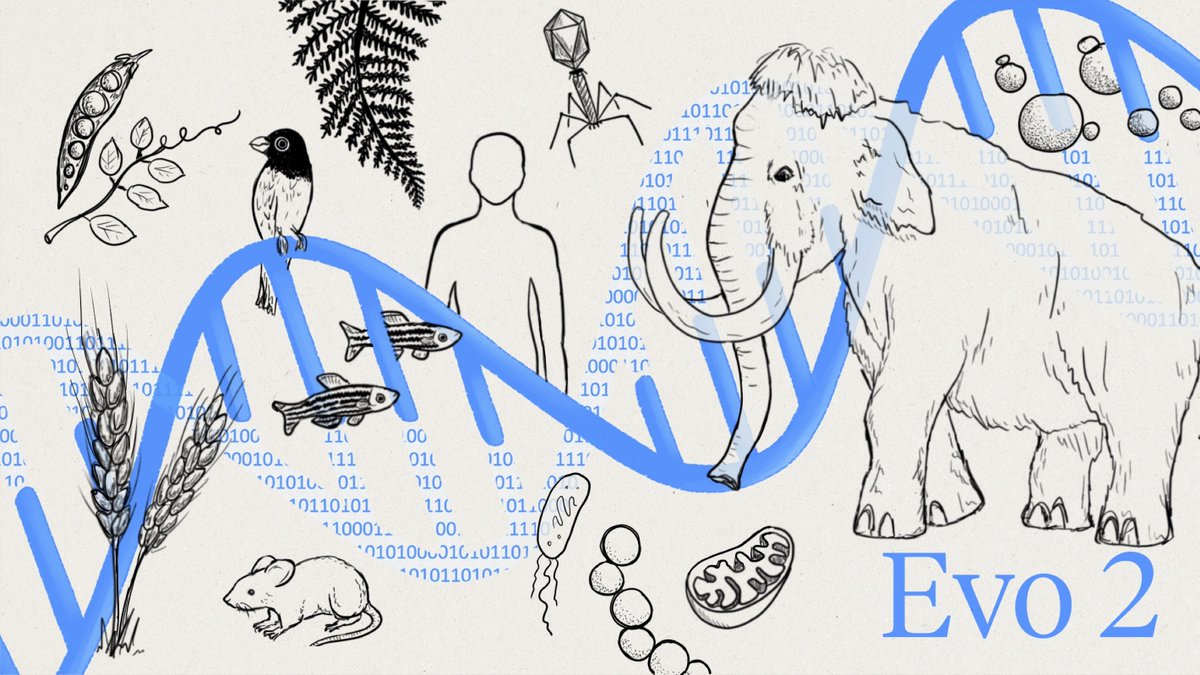
Evo 2 is out in Nature today, showing that genome language models can predict and design across the full complexity of life, from phages to eukaryotes. A few surprises from the project, including how ignoring trillions of nucleotides was key to getting a good model. 🧵
Garyk Brixi tweet media
English
13
207
1K
100.1K
Nicholas Ho nag-retweet
Hongyi Wang
Hongyi Wang@HongyiWang10·
Super excited to see that @genbioai was highlighted in Dr. @LisaSu's keynote talk. Thank you so much, @AMD — we look forward to what we will achieve together in 2026!
Hongyi Wang tweet media
GenBio AI@genbioai

Chair and Chief Executive Officer at AMD, Dr. @LisaSu, highlighted our partnership during her CES 2026 keynote. At #CES2026 in Las Vegas, GenBio AI joined @AMD to share a vision for advancing biology with AI. Together, we are building the foundation for personalized treatments made just for you. Learn more and stay tuned → x.genbio.ai/amd-genbio-ces…

English
0
6
13
942
Nicholas Ho nag-retweet
Ronghui (Ron) Zhu
Ronghui (Ron) Zhu@RonZhu2015·
Together with Emma Dann, we are thrilled to present a massive new Perturb-seq atlas of 22M primary CD4+ T cells, from 4 donors, across 3 timepoints – the result of a decade-long collaboration between the Marson (@MarsonLab) and Pritchard (@jkpritch) labs. 🧵👇
Ronghui (Ron) Zhu tweet media
English
4
52
239
38.7K
Nicholas Ho nag-retweet
Artificial Analysis
Artificial Analysis@ArtificialAnlys·
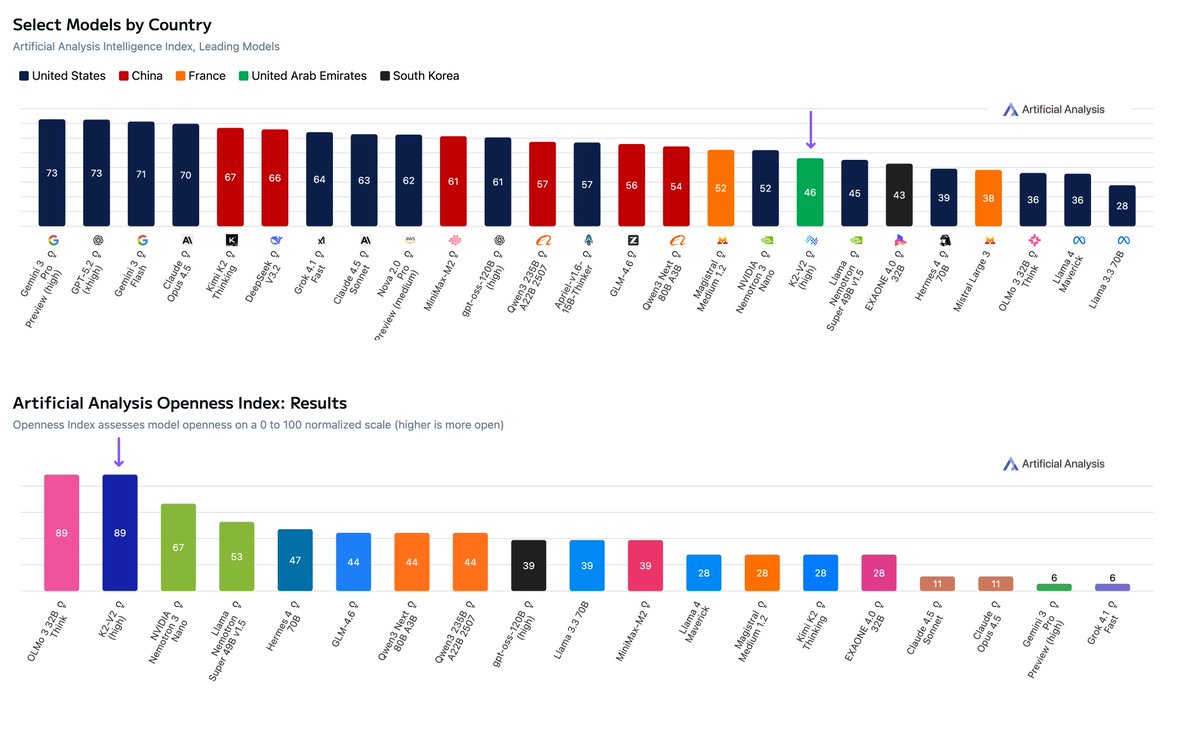
MBZUAI’s Institute of Foundation Models has released K2-V2, a 70B reasoning model that is tied for #1 in our Openness Index, and is the first model on our leaderboards from the UAE 📖 Tied leader in Openness: K2-V2 joins OLMo 3 32B Think at the top of the Artificial Analysis Openness Index - our newly released, standardized, independently assessed measure of AI model openness across availability and transparency. MBZUAI went beyond open access and licensing of the model weights - they provide full access to pre- and post-training data. They also publish training methodology and code with a permissive Apache license allowing free use for any purpose. This makes K2-V2 a valuable contribution to the open source community and allows more effective fine-tuning. See links below! 🧠 Strong medium-sized (40-150B) open weights model: At 70B, K2-V2 scores 46 on our Intelligence Index with its High reasoning mode. This puts it above Llama Nemotron Super 49B v1.5 but below Qwen3 Next 80B A3B. The model has a relative strength in instruction following with a score of 60% in IFBench 🇦🇪 First UAE entrant on our leaderboards: In a sea of largely US and Chinese models, K2-V2 stands out as the first representation of the UAE in our leaderboards, and the second entrant from the Middle East after Israel’s AI21 labs. K2-V2 is the first MBZUAI model we have benchmarked, but the lab has previously released models with a particular focus on language representation including Egyptian Arabic and Hindi 📊 Lower reasoning modes reduce token use & hallucination: K2-V2 has 3 reasoning modes, with the High reasoning mode using a substantial ~130M tokens to complete our Intelligence Index. However, the Medium mode reduces token usage by ~6x with only a 6pt drop in our Intelligence Index. Interestingly, lower reasoning modes score better in our knowledge and hallucination index, AA-Omniscience, due to a reduced tendency to hallucinate
Artificial Analysis tweet media
English
3
37
180
49.2K
Nicholas Ho nag-retweet
Itai Yanai
Itai Yanai@ItaiYanai·
Have you heard about the Night Science Podcast, where we talk about the creative process of doing science? We explore this with discussions with brilliant scientists & philosophers and artists, to figure out the tricks of the creative scientific trade. podcasts.apple.com/us/podcast/nig…
English
4
51
230
17.6K
Nicholas Ho nag-retweet
Jian Ma
Jian Ma@jmuiuc·
I am excited to serve as Proceedings Chair with @kmborgwardt for #ISMB2026 in Washington DC. We have brought together a strong and diverse group of Area Chairs. It is a truly exciting and exhilarating time for #CompBio. Look forward to your paper submissions by the 1/20 deadline
ISCB News@iscb

📢 Submit to #ISMB2026 Proceedings!  Share your latest research in #computationalbiology and #bioinformatics. Accepted papers will be published in a special open-access issue of Bioinformatics. 🗓️ Submission deadline: January 20, 2026 🔗 Learn more: iscb.org/ismb2026/call-…

English
1
5
30
3.9K
Nicholas Ho nag-retweet
Randall Balestriero
Randall Balestriero@randall_balestr·
LeJEPA: a novel pretraining paradigm free of the (many) heuristics we relied on (stop-grad, teacher, ...) - 60+ arch., up to 2B params - 10+ datasets - in-domain training (>DINOv3) - corr(train loss, test perf)=95% Paper: arxiv.org/pdf/2511.08544 Code: github.com/rbalestr-lab/l…
English
42
203
1.2K
503.7K
Nicholas Ho nag-retweet
Fabian Theis
Fabian Theis@fabian_theis·
🧬 Excited to share Nicheformer out now in Nature Methods! A transformer foundation model linking single-cell & spatial omics, learning spatial context from gene expression to map tissue organization. Led by Ale Tejada & Anna Schaar 👏 👉 nature.com/articles/s4159…
Fabian Theis tweet media
English
1
53
228
16K
Patrick Schwab
Patrick Schwab@schwabpa·
Discovering interventions that achieve a desired therapeutic effect is a core step in the development of new medicines that remains challenging despite perturbation data being increasingly available in vast quantities. Today, we are announcing the release of the Large Perturbation Model - an in-silico biological discovery model that disentangles perturbations, the contexts in which they were observed, and measurements. Trained entirely on controlled perturbation experiment data, LPM is a generative model of causal effects under intervention that enables researchers to perform a wide range of biological discovery tasks purely in computers, including elucidating the mechanism of action of interventions, their effects across model systems and their similarity to other studied interventions.
Patrick Schwab tweet media
English
8
26
185
15.4K
Nicholas Ho nag-retweet
Patrick Boyle — e/🦀
Patrick Boyle — e/🦀@p_maverick_b·
Has anyone even asked the cells if they wish to be perturbed
English
7
19
231
12.3K
Nicholas Ho nag-retweet
Bo Wang
Bo Wang@BoWang87·
🧬 Building the Virtual Cell starts with data. Today, we’re making the X-Atlas/Orion Perturb-seq dataset even more accessible — now live on Hugging Face @huggingface 🤗 📊 One of the largest & highest-quality perturbation datasets ever released, it provides the foundation for training AI models that can simulate and reason about cellular behavior. 👉 Explore here: huggingface.co/datasets/Xaira… Fewer barriers. More models. A step closer to the virtual cell. 🌌 #VirtualCell #FoundationModels #AIinBiology #HuggingFace
Bo Wang@BoWang87

🚀 Xaira Therapeutics has just dropped a game-changer for AI-driven biology. Today, we unveiled X-Atlas/Orion, the largest publicly available genome-wide Perturb-seq dataset to date—spanning 8.4 million single cells with perturbations across all ~20,000 human protein-coding genes. This release is not just about scale—it’s about enabling a new era of causal, mechanistic foundation models for biology. 📝 Preprint on bioRxiv: biorxiv.org/content/10.110… 📂 Dataset on Figshare: doi.org/10.25452/figsh… 🔍 What makes X-Atlas/Orion special: 📈 Unprecedented scale & quality: Each cell profiled with deep (~16k UMIs) transcriptomics and rich metadata 🧪 Quantitative dose-response modeling: Thanks to high-fidelity sgRNA detection and ~4 guides per gene, allowing continuous modeling of genetic effects 🧬 FiCS platform: A fully industrialized single-cell perturbation system enabling rapid, reproducible experiments at massive throughput 🧠 This isn’t just “data.” It’s the biological substrate for building virtual cell models that can generalize, predict, and ultimately power AI-native drug discovery. 💬 My final take: This is a foundational moment for the field. The ability to model how genes affect cell state—quantitatively, causally, and at scale—is what we need to unlock predictive biology. Kudos to the incredible team at Xaira for open-sourcing this resource so the entire community can build on it. #PerturbSeq #SingleCell #Genomics #VirtualCell #FoundationModels #AIForBiology #Xaira #DrugDiscovery #SyntheticBiology #CausalAI More press release: Press release : 🔗 GEN article : genengnews.com/topics/artific… 🔗 BusinessWire: businesswire.com/news/home/2025…

English
2
51
282
29.8K
Nicholas Ho nag-retweet
Jingyi Jessica Li (李婧翌)
1/3 Metacells boost power in single-cell RNA-seq & multiome analysis. But without checking homogeneity, they risk forming dubious metacells that bias discoveries. We introduce mcRigor: a statistical safeguard for rigorous metacell analysis. 👉 nature.com/articles/s4146…
English
3
34
146
13.4K
Nicholas Ho nag-retweet
Yun S. Song
Yun S. Song@yun_s_song·
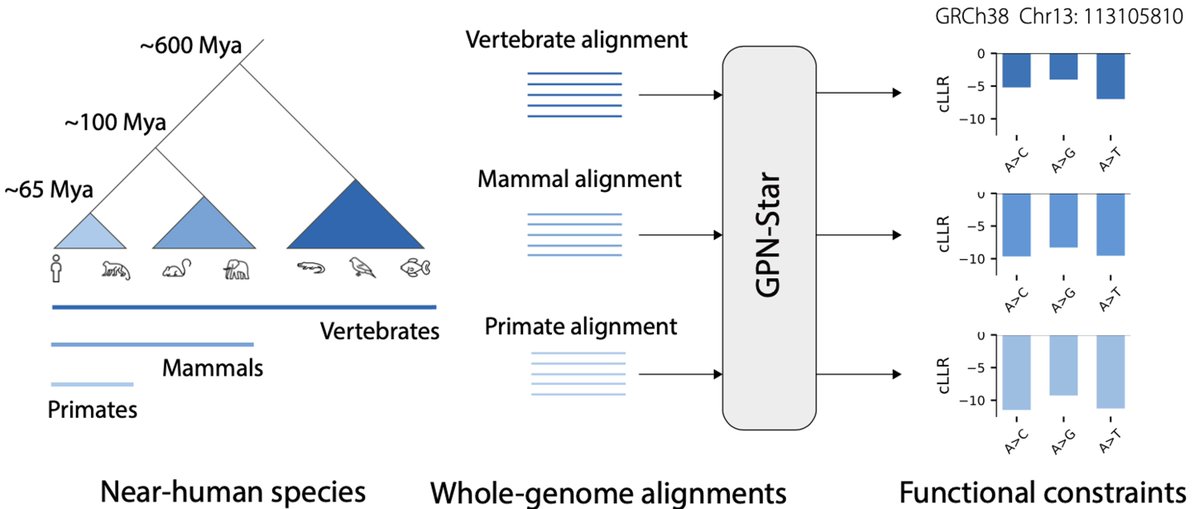
We are excited to share GPN-Star, a cost-effective, biologically grounded genomic language modeling framework that achieves state-of-the-art performance across a wide range of variant effect prediction tasks relevant to human genetics. biorxiv.org/content/10.110… (1/n)
Yun S. Song tweet media
English
17
162
528
85.6K
Nicholas Ho nag-retweet
Brian Hie
Brian Hie@BrianHie·
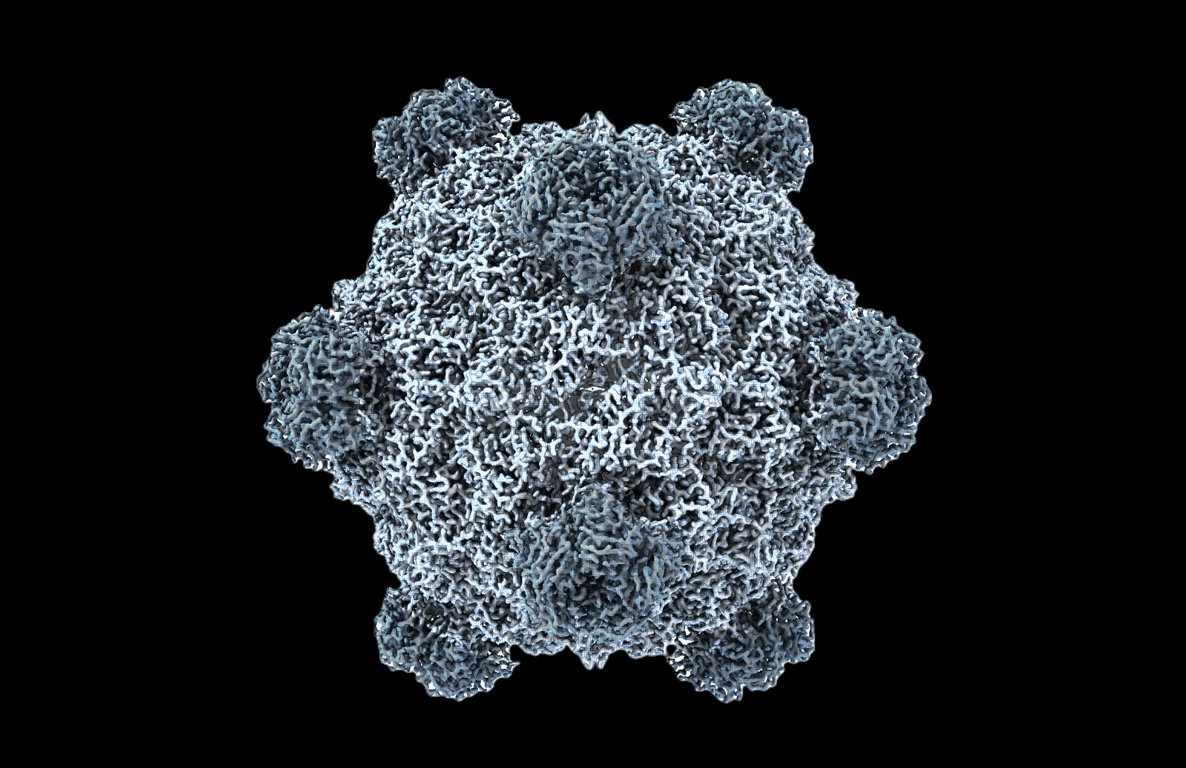
Welcome to the age of generative genome design! In 1977, Sanger et al. sequenced the first genome—of phage ΦX174. Today, led by @samuelhking, we report the first AI-generated genomes. Using ΦX174 as a template, we made novel, high-fitness phages with genome language models. 🧵
Brian Hie tweet media
English
36
210
1K
98.1K