Lane Rettig

20.6K posts

Lane Rettig banner
Lane Rettig

Lane Rettig

@lrettig

Making software and systems more human since 1993. My other hobbies include sci-fi, running, and preventing metadata leaks.

Bir Tawil Sumali Aralık 2009
2.1K Sinusundan19.9K Mga Tagasunod
Lane Rettig
Lane Rettig@lrettig·
I've been using AI tools to do increasingly hairy, audacious things. Among them: trying to write and illustrate a children's book, creating a better harness for agentic teams, and, most recently, creating the podcast to end all podcasts. This week I shared some learnings.
English
2
0
8
1.3K
Lane Rettig
Lane Rettig@lrettig·
Something I can't fathom: it appears that neither Claude platform nor OpenAI platform have an API endpoint you can call to check your remaining account balance. This is such a no-brainer, useful thing to build - how can this be? The various utility apps that show you your balance are doing crazy things like scraping the web UIs. Is this really just corposlop dark design patterns? Like the lack of clocks in casinos? Shame, shame, shame
English
2
1
8
678
Lane Rettig
Lane Rettig@lrettig·
@trq212 You're missing one other important option here, which is incredibly useful: maintain running context docs in place in the repository. In addition to CLAUDE.md/AGENTS.md I now use STATUS.md, TODOS.md, LESSONS.md, PLAN.md, etc. - these are amazing for managing context.
English
1
0
1
401
Lane Rettig nag-retweet
mert
mert@mert·
enough with the emotional self-defeatist mentality in this industry yes. there's tremendous potential left in crypto. we haven't even surfaced 1% of it crypto is the universal API for money, markets, and capitalism blockchains didn't even scale past steam-engine performance until 2 years ago unstoppable private money, programmable finance, internet capital markets, perpification of all assets on earth, decentralized coordination for physical infrastructure, lightspeed planetary payments with a line of code, a sanctuary economical system for anyone who didn't luck into being born in the west, zero knowledge proofs, fully homomorphic encryption, freedom, self-custody of assets without requiring permission from suits, property rights, contract enforcement, capitalism based on cryptography instead of the crony trillions
Artem Chystiakov@Arvolear

Is there anything exciting left in crypto?

English
57
67
556
32.3K
Lane Rettig
Lane Rettig@lrettig·
@TM_Brown Because in coding, unlike in writing, the code isn’t the final product. It’s a means to an end. These are fundamentally different things!
English
0
0
1
88
Teddy (T.M.) Brown
Teddy (T.M.) Brown@TM_Brown·
So actually I’m curious about the vibe coding vs. AI writing divide and why programmers seem cool with using Claude code while writers are widely against it. Genuine question: Do programmers not see the process of writing code as integral to the discipline?
English
59
6
85
30.7K
Lane Rettig
Lane Rettig@lrettig·
@_TomHoward I had exactly the same reaction 😬 always assumed this is normal. But then… cognitive dissonance much?
English
0
0
2
74
Tom Howard
Tom Howard@_TomHoward·
Wait, most people can’t hold multiple ideas in their mind at once?
Darshak Rana ⚡️@thedarshakrana

I accidentally broke my brain reading about Nobel Prize winners last month. There's this thing called "Janusian thinking" that basically explains why some people's minds work like magic while the rest of us think in straight lines. Named after Janus, the Roman god with two faces pointing opposite directions. The psychologist who discovered it, Albert Rothenberg, was trying to figure out what made breakthrough thinkers different. He interviewed dozens of Nobel laureates, major artists, revolutionary scientists. What he found sounds impossible. These people can hold two different ideas in their mind at the same time. They can explore both without switching back and forth or forcing a quick comparison. They can consider “yes” and “no” to the same question simultaneously and stay clear-headed. Einstein too talked about this when he described his relativity breakthrough. He was imagining riding alongside a beam of light while also standing perfectly still. Both perspectives at once. Mozart said he could hear an entire symphony "all at once," every note, every contradiction, every resolution happening in a single moment of awareness. Your average person's mind works like a courtroom. Evidence comes in, you weigh it, you reach a verdict. Case closed. But Janusian minds work more like... I don't know, like a quantum computer that can process multiple realities simultaneously until something new emerges from the overlap. I've started noticing it in conversations. When someone can genuinely see both sides of something without needing to pick one, it drives people nuts. They want you to land somewhere definite. The ability to live in that tension space reads as wishy-washy or indecisive. Most creative advice tells you to "think outside the box." But Janusian thinking is weirder than that. It's being inside and outside the box at the same time. It's thinking the box exists and doesn't exist simultaneously. Which explains why truly creative people seem slightly unhinged. They think they're choosing between realities. But, they're inhabiting multiple realities at once, mining the contradictions for insights the rest of us never see. Sadly, most of us have trained ourselves out of this ability. We've learned that holding contradictions feels unstable, so we rush toward resolution. We've been taught that changing your mind means you were wrong before, so we defend positions instead of exploring them. But the people changing the world have kept that childlike ability to hold impossible thoughts without needing them to make sense immediately. We just need to live in the questions everyone else is too scared to ask.

English
7
0
19
2.3K
Lane Rettig
Lane Rettig@lrettig·
Best take on the state of the claw ecosystem and AI more generally that I've read in a while. Zero fluff, zero hype. Closely aligns with my experiences. And the freedom tech + freedom money stuff is a big deal.
Alex Gladstein 🌋 ⚡@gladstein

I’ve held my breath for about two months but here are finally a few notes on AI and freedom: 1. There is a lot of hype and fear around AI. I don’t think people are actually prepared for how dramatically AI will transform the world, and how quickly it will do it. At the same time I also think people are mistakenly choosing fear over action and curiosity. Do NOT sit on the sidelines. 2. For the past two weeks I have had a robot. His name is r2. He is a good guy, a resistance robot. His composition changes but he is most usually an Opus or Codex mind, OpenClaw body, and Matrix or Telegram hands. Every day I figure out new things he can do. My jaw is on the floor. 3. I do not do anything sensitive with my robot. In theory I could use Matrix to talk to my robot from my phone or just use the MacBook Air that the robot inhabits directly, and use my little local llama model, to do sensitive work, but I’m not there yet. I’m just in exploration mode. I don’t send anything from my phone to my robot that I wouldn’t want Anthropic or OpenAI to see, which is to say, nothing that sensitive. I can right now send a sensitive question in Matrix to my claw to have my local model run: anthropic or openAI would see the question, but they wouldn't see the answer. 4. OpenClaw is experimental software. DO NOT put it on your personal computer or your work computer or give it access to your email. DO experiment and play with it. What you need to do is start training to figure out how to use this new magical technology. You will want to be good at this. A decent balance is a fresh MacBook Air, a fresh gmail account, and a fresh anthropic or codex app on the machine. That’s about all you need. A credit card or if you want to use BTC, you can pay for advanced models with things like PayPerQ. An extra phone number too if you want to talk to it via Signal or WhatsApp. What’s amazing is that whenever your robot breaks, you just go onto the local claude code or codex app on the machine and just ask it to fix it and voila done. Back up and running. 5. I don’t know any code at all and yet have been able to create complex novel working software. Beautiful websites too that would have cost me a fortune a few years ago. But it’s just the tip of the iceberg. I was able to for example ask my claw to read everything I've ever written, watch a ton of my interviews, and develop an editorial skill so that I can send it a google doc and it can go in and track changes and leave comments just like a human would, just like I WOULD. It is legitimately amazing at this. And each time I do this, it learns, as I show it which comments I accepted and which new things I add. It has persistent memory and just gets better and better. What excites me most is giving this gift to the world’s dissidents and activists and seeing what THEY do with it. 6. Which brings me to security. Hopefully in the next few months we will be at a point where we can have an encrypted phone app that you speak to that requires no phone number or corporate intermediary that runs on nostr that goes directly into your claw powered by a high-quality local model. The full freedom tech stack. You can already sort of do this today already but it will get way easier and better. That’s what you’re going to need to do real serious resistance work. For now we just train. Think: Dagobah today, Death Star tomorrow. 7. People think this transition is about robots but it is about humans. Already I can see how Claws will allow insane collaboration between people. For example I can ask my brilliant designer friend to leave me a voice note to give feedback on my website or presentation or event plan, and then just forward that voice note to my robot for immediate implementation. Whenever I build or make something I ask my robot to do a deep search for the most beautiful and well designed things of that sort in the world, extract what makes them great, and create a plan for implementing that magic into whatever I am building. It could be fashion, art, cuisine, music, architecture, strategy, etc. Whenever I make a skill for my claw I can have my robot upload it and share it with anyone else. The speed of collaboration is dizzying. 8. Robots and Freedom Tech are a match made in heaven but the synergy will take some time to really flower. Many of the major obstacles to freedom tech can be solved by personal agents. For example mine was very quickly able to create its own nostr identity and build its own ecash wallet and it could and did start to zap people on my direction. But the robots can’t have their own bank accounts or social security numbers. Silicon Valley will try to force through KYC stuff and stablecoins but I think in the end bitcoin and nostr win out because they are so easy for the agents to use. What’s awesome is the realization (noted by Odell on his two recent excellent Citdadel AI podcasts with Alex Gleason and Justin Moon) that agents make freedom tech easier to use. For example your agent can run a lightning node for you. Of course... you then realize. We were never going to sit there and operate channels. Our agent will do it for us. Etc. 9. HRF will be heavily involved in providing grants to open source AI projects, projects that help improve agent security and privacy, projects that help superscale dissident work, events that bring brilliant people together around the challenge of how do we best harness AI, hackathons that encourage people to build freedom-oriented AI tools, educational content and trainings, and much more this year. 10. Right now Claw is experimental. But it’s easy to see how it will become incredibly secure. Every day it ships new patches. Already I can ask mine to become a cybersecurity expert and scan my system for vulnerabilities. Obviously I take it with a grain of salt now but -- never before did I have that power, nothing even close. Soon this will become seriously powerful and you will have swarms of patrol agents guarding your networks and alerting you if anything goes wrong. I think it can be more expensive to attack than to defend. White blood cell theory. 11. There are a lot of parallels between the creation of Bitcoin and the creation of OpenClaw. One person chooses a new way for the world to go. A new system. In Satoshi’s case, money that the state can’t control. In Peter’s case, intelligence that the state can’t control. I can’t stress enough how big of a deal it is that people now can control their intelligence. We were for sure heading in the direction of needing to sign up for a corporate app for all of your agent needs, and being in the Web 2.0 trap of being vulnerable to being banned or kicked off. Not anymore. YOU choose the brain for your robot. You customize the body. You choose how you want to interact with it. Peter has changed the world probably more than he knows. Yes he might be the first one person unicorn but that’s not the cool part. The cool part is that he changed the course of humanity and that as of today, at least, the best agent technology on the planet is people-powered, built by the people, for the people. It’s quite a moment for freedom tech. 12. We need to go fast and furious on developing freedom-oriented open-source AI tools. We are fortunate that we have Bitcoin and nostr and bitchat networks in place before the great AI transition. We have the tools. We need to act now. I would encourage everyone reading to start getting involved today. 13. Setting up a claw is not easy right now unless you are an engineer. I could not do it myself and have no shame in saying it. I would have gotten really frustrated. We are developing a way of working with privacy engineers to build a simple yet powerful solution and an onboarding process that we do in a bespoke way in person that takes 2 days. I think this is probably the situation for the next month or two and then hopefully it gets way easier. The thing is, it will get easier very quickly for you to have a CORPORATE robot (all the big companies are now following OpenClaw, Claude already has a way for you to use Code via your phone), but a freedom tech one that you fully control will probably not evolve as quickly. Then again, it might, if we all work together on making it happen. I do think by the summer things will be very different. 14. I think some things will become even more valuable in the new AI world that will come to us in the coming year. Many have said taste, and I agree. But also personal health, friendships, and physical communities. Big picture, labor market as many have said a lot of companies will choose between laying off a lot of their workforce or growing their productivity. There will be a spectrum and some organizations will lean one way and others will lean the other. It depends on how valuable the humans are inside the org, what kind of skills they have. If leadership values you as an individual, then you probably aren’t getting replaced. But you're going to have to become a super employee. And you should want to. It's fun. 15. If you are interested in joining the effort to work on AI and Freedom, HRF will have several opportunities. We are collaborating with Bitcoin Park on the second AI Hack for Freedom in Nashville (talk to Rod if you want to join or learn more), and will feature a lot of AI content at our upcoming activation at the Bitcoin Vegas event, and at the Oslo Freedom Forum on June 1-3. We will also keep churning out our monthly AI newsletter. We have opened up a grants portal. DM me if you are interested in any of this. 16. One simple thing that you can do today in AI and freedom is switch your daily “chatbot” activity to Maple. It’s a beautiful and simple mobile app (and web app) that is fully encrypted. Think Signal for AI. It only can use open models so it’s not going to be for all of your tasks, but it does great with most of them. It should replace a lot of interactions you have with corporate chatbots regarding things about your health, personal stuff, sensitive matters. etc. If we can make Maple or something like it the standard for research in the coming months that’s a huge victory. And sometime soon I think you’ll be able to enjoy this level of encryption with coding agents and personal agents as well. It's interesting because the longer you wait to try claw, the better it gets. But the more time you lose. My sense is you could wait a month or two. But you'll want to be using it this summer. I would strongly recommend trying it at some point. You will be tempted by the easy corporate route. But you can join the AI and Freedom army today. Let's go!

English
2
1
20
10.9K
Lane Rettig
Lane Rettig@lrettig·
for the record here's where I've landed for now with respect to allocation of time - curious if y'all think this is optimal or would do it differently: 1. review/improve/meta time. spend at least an hour on this each day. just keeping up! in practice this means dumping lots of articles, X threads, etc. into my agents and acting on their recommendations. the leverage from improvements at this stage is enormous - I feel like I'm using these tools at 5% what they're capable of. (actually that's not bad considering I was at 0% a week ago.) 2. build time. protect this at all costs. spend at least 2 focused hours shipping each day. 2 hrs doesn't sound like a lot but with the leverage of AI tools I can get a LOT done if I focus - obviously focus is key here. and as #1 delivers results the agents will be able to ship more autonomously and asynchronously. 3. knowledge time. produce, not consume. post here, or write for substack, or work on a new podcast I'm cooking. this is critical too and helps me organize my thoughts. spend 1-2 hrs on this each day. 4. admin time. sort of everything else, all the annoying stuff. financial stuff, health stuff, general life stuff. this still consumes around an hour a day but the goal is to get this down substantially. Of course this doesn't include the *really* important stuff at all - family, wellness, etc. I don't count hours for those :)
Lane Rettig@lrettig

I've built a team of six agents (so far) and we're making incredible progress on both research and development of some fun things. Really amazed how far we've gotten so far with just me at the helm. BUT - three things I'm struggling with right now - and I suspect I'm not alone 1. Orchestration/task management. We have ~10 parallel projects - yes, it's a lot, but they're all interrelated, unblock one another, etc. I'm drowning in message threads in Slack and Telegram. Need something MUCH better for coordination here. 2. Autonomy. Yes, everyone using Openclaw is aware of and grappling with this. I've seen lots of great ideas, and a few tools, floating around, and have begun to play with them, but nothing has clicked yet. Need to escape the "message the agent -> agent does something" loop and enable them to work far more autonomously, around the clock. 3. The really big one: figuring out what to work on. This is a philosophical question, not a technical one. We Are As Gods now - I'm suddenly capable of doing 10x what I could do before. Maybe more. And there's SO MUCH that needs doing, so much that needs to be built. But with an expansion in capability there is NOT an automatic expansion in judgement, taste, or simple ethics. I'm really struggling with this. I'm already beginning to thrash and need to narrow the focus considerably. What are y'all doing along these lines that's working for you?

English
1
0
11
1.1K
bogdan 🔅
bogdan 🔅@boqdan_·
@lrettig (3) is the killer. I’m currently just pointing it at itself but at some point that needs to change - which funny enough reminds me of crypto early days.
English
1
0
1
88
Lane Rettig
Lane Rettig@lrettig·
I've built a team of six agents (so far) and we're making incredible progress on both research and development of some fun things. Really amazed how far we've gotten so far with just me at the helm. BUT - three things I'm struggling with right now - and I suspect I'm not alone 1. Orchestration/task management. We have ~10 parallel projects - yes, it's a lot, but they're all interrelated, unblock one another, etc. I'm drowning in message threads in Slack and Telegram. Need something MUCH better for coordination here. 2. Autonomy. Yes, everyone using Openclaw is aware of and grappling with this. I've seen lots of great ideas, and a few tools, floating around, and have begun to play with them, but nothing has clicked yet. Need to escape the "message the agent -> agent does something" loop and enable them to work far more autonomously, around the clock. 3. The really big one: figuring out what to work on. This is a philosophical question, not a technical one. We Are As Gods now - I'm suddenly capable of doing 10x what I could do before. Maybe more. And there's SO MUCH that needs doing, so much that needs to be built. But with an expansion in capability there is NOT an automatic expansion in judgement, taste, or simple ethics. I'm really struggling with this. I'm already beginning to thrash and need to narrow the focus considerably. What are y'all doing along these lines that's working for you?
English

9
0
21
2.8K
Michiel V
Michiel V@michielmv·
@lrettig curious what the 3 things are. coordination and context sharing are usually where multi-agent setups hit walls first
English
1
0
0
63
Lane Rettig
Lane Rettig@lrettig·
@Kalichkin this is awesome. thank you. i've been looking for something like this.
English

0
0
1
42
Dmitry Kalichkin
Dmitry Kalichkin@Kalichkin·
Exact same problem here. Built a team of six agents and was drowning in message threads trying to track who's doing what. Found Mission Control (original at github.com/crshdn/mission…), forked it, and heavily upgraded it to fit my multi-agent workflow. Now it's a single dashboard showing all tasks, agent status, activities, and deliverables. The agents report into it via a CLI wrapper, so I can see the full picture without digging through threads. Night and day difference. Feel free to play at your own risk :) github.com/kalichkin/miss…
English
1
0
3
113
Lane Rettig
Lane Rettig@lrettig·
@avive totally agree! sounds quite similar to what I'm doing. have you tried having the agents coordinate or talk to one another?
English
1
0
1
60
Master Tavian - Polymyth
@lrettig I'm into my 3rd project with an AI dev team in solo-founder mode. I've been at it for about a yr. Current one is highly-ambitious, and disruptive. Mostly using 3-5 iTerm tabs to monitor and guide agents. Constantly improving workflow with custom skills and automation. Wild times
English
7
0
3
79
Lane Rettig
Lane Rettig@lrettig·
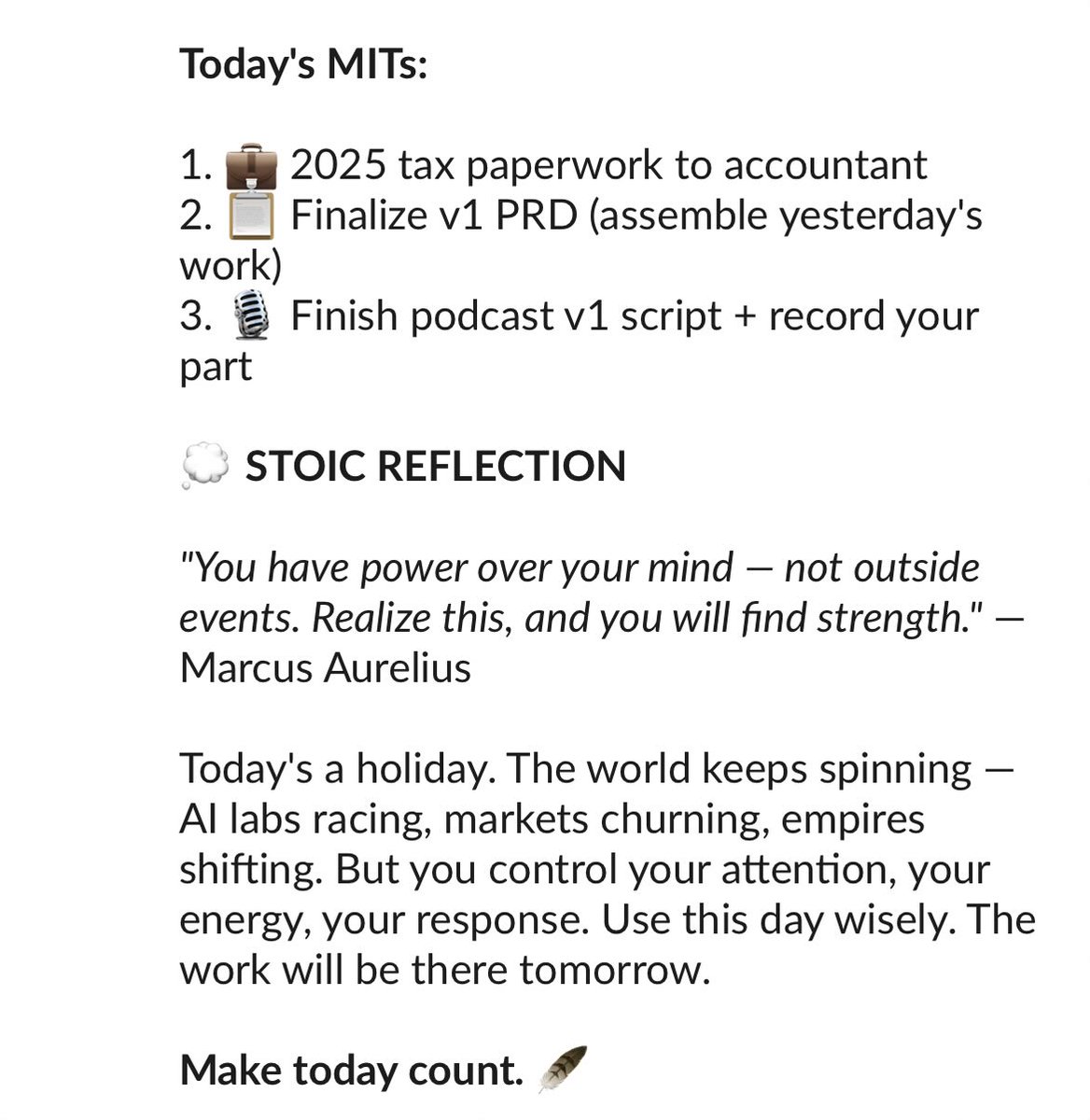
I can’t overstate how pleasant it is to wake up to this every morning. Baz (my chief of staff agent) and I have been iteratively improving the morning brief he sends me every day. He began to make little tweaks of his own accord, and it’s getting really good. We’re living in a golden age of software my friends ❤️
Lane Rettig tweet media
English
1
1
11
608