Muhammad Umar

11.4K posts

Muhammad Umar banner
Muhammad Umar

Muhammad Umar

@umar482

Founder & CEO @softaims_ | Scaling to $12M ARR | Connecting founders with top developers | Sharing startup insights & tech trends

Hire pre-vetted devs → Sumali Ocak 2012
741 Sinusundan5.2K Mga Tagasunod
American AF 🇺🇸
American AF 🇺🇸@iAnonPatriot·
They’ve spent billions of dollars on propaganda to convince the world that these people are bad.
English
4.5K
7.9K
98K
12M
Muhammad Umar nag-retweet
My First Million
My First Million@myfirstmilpod·
.@AlexHormozi and @thesamparr are right about one thing: hire A+ talent. If you don’t get this part right, your business might not go too far. They also chat about Alex's content creation process (few big surprises there), frameworks and thinking in systems, work life balance, and more. Timestamps: (0:00) Hiring for general intelligence (16:12) The snowball of talent (18:59) Employees v. Partners (20:35) How to be a magnet for talent (24:39) #1 mistake (26:37) Be fast to fire (30:33) macro patience, micro speed (38:03) Shower thoughts w/ Hormozi (44:58) Persuasion (1:05:12) Alex reads his own tweets
English
14
5
70
40.5K
Jaynit
Jaynit@jaynitx·
Brian Chesky (CEO of Airbnb) on the hidden cost of success "Loneliness":
Jaynit tweet media
English
121
479
4.2K
2.2M
Muhammad Umar
Muhammad Umar@umar482·
Me to clients: "Ship fast, get feedback" Me with my product: *hides it for 2 months* Me to everyone: "Just pick up the phone" Me with sales: *builds complex automation* The advice we give others is usually the advice we need most.
English
2
0
8
250
Muhammad Umar
Muhammad Umar@umar482·
I just spent 4 hours asking AI to solve my procrastination problem. The irony is not lost on me.
English
0
0
1
290
Muhammad Umar
Muhammad Umar@umar482·
After building 17 MVPs in the last 24 months, here are the real numbers: - First version cost: $5-15K (not $50-100K) - Average timeline: 7 weeks - Got 10 paying customers: 4 weeks (not 6 months) - Average pivots before product-market fit: 2.7 The SaaS founders who failed? They all made the same mistake: They spent their entire budget on one "perfect" version. We tell founders to spend $5-15K MAX on their first version. After helping 17 startups build their products, here’s what actually works: #1 Build the absolute minimum ($5-15K) Your first version should only validate ONE core assumption. Nothing more. #2 Get it in front of real users immediately A founder spent $7K on a basic version, got 100 user interviews, then pivoted completely. Saved $140K+ building the wrong thing. #3 Improve based on feedback, not your roadmap We helped a fintech startup launch 8 separate mini-versions before finding product-market fit. Total cost: $62K spread over 6 months. #4 Revenue > Fundraising The founders who used early versions to get paying customers raised 3x more funding than those who built “investor-ready” products. #5 Choose boring technology that scales later, One client insisted on microservices architecture for their MVP. After $90K and 4 months of delays, they switched to our recommended monolith approach. Launched in 3 weeks. The truth most dev shops won’t tell you: Big upfront builds almost ALWAYS fail. Our most successful client? -  Started with $11K MVP that looked terrible -  Got 10 paying customers at $200/month -  Built next version for $18K based on their feedback -  Reached $27K MRR -  THEN raised $1.8M at a $12M valuation What’s holding you back from launching your MVP with a $15K budget instead of $150K?
English
2
0
4
260
Muhammad Umar
Muhammad Umar@umar482·
I'm SICK of founders posting funding announcement . Startup got front page coverage, shut down 6 months later. I never understand what the hell they actually achieved by getting funding. Money isn't an achievement. It's a tool. But LinkedIn treats every funding round like founders just won the Olympics. Here's what I see way too often: • Startup raises $3M seed round • Burns it all in 11 months • LinkedIn announcement video gets 200K views • Actual app has 23 active users The same founders posting celebration videos are the ones posting "we're pivoting" posts 8 months later. Or worse: radio silence. What if funding announcements were actually honest? "We just raised $2M because we have no revenue and need to figure out if anyone wants this thing we built." Look, I get it. Raising money is hard and founders deserve to celebrate. But celebrating the money instead of celebrating customers is backwards. The real achievement isn't getting someone to give you cash. It's getting someone to give you their credit card number. TAKEAWAY: Next time you see a funding announcement, ask yourself: Do they have customers, or just investors? Because one of those actually matters for building a business. (And yes, I'm guilty of this too. We all are.)
English
0
0
0
183
Muhammad Umar
Muhammad Umar@umar482·
Every fintech founder I meet is living the same nightmare: "I'm paying $20K/month for developers who are learning fintech ON MY DIME." "We're 9 months in and our dev team STILL don't understand financial regulations." "Compliance is questioning our security." 73% of payment startups take 2X longer to launch than planned. Here's why: - Most dev shops can build pretty UIs. - Few understand ISO 20022, KYC workflows, or bank-grade security. - And your entire business is DEAD if you get this wrong. Last week, I had a call with a fintech founder who want to replace his development team. ME: "What happened?" FOUNDER: "They built a beautiful app that can't pass a security audit." ME: "How much did it cost?" FOUNDER: "$120K and 9 months of my life." 99% of dev shops treat fintech like any other software project. They don't understand that: #1. Bank API integrations aren't just "another endpoint" They require specialized knowledge of ISO 20022, SWIFT protocols, and reconciliation workflows. #2. Security isn't a feature, it's your entire business One breach means game over. Not just for your app - for your ENTIRE company. #3. Compliance (KYC/AML) can't be "added later" It must be architecturally designed from day one. This is why fintech MVPs take 3x longer and cost 2x more than most founders expect. TAKEAWAY: Don't hire general "full-stack" developers. Partner with a team that specifically understands fintech architecture, compliance, and security. If you're a fintech founder struggling with timelines, integrations, or explaining basic financial concepts to your dev team... I'd love to hear your story. Drop a "👋" in comments and I'll reach out.
English
0
0
1
188
Muhammad Umar
Muhammad Umar@umar482·
Stack Overflow is DEAD and ChatGPT killed developer problem-solving skills Yesterday, a startup founder asked us to "just add some features" to their existing codebase. What we found shocked us. Their Senior developer had built the entire backend by copying ChatGPT responses. 5 different npm packages for date formatting. Authentication logic from 5 different tutorials Database queries that worked... but took 4 seconds each. "But it works!" the founder said. Stack Overflow forced developers to understand problems before finding solutions. You had to: -  Read the documentation -  Understand the error message -  Learn WHY something failed AI eliminated all of that. Now developers just describe symptoms and copy solutions. ChatGPT taught him WHAT to code. Nobody taught him HOW to think. Most developers today are prompt engineers, not software engineers. They know how to ask AI the right questions. They don't know how to ask the code the right questions. We treat AI like a calculator, not a brain. AI for boilerplate code. Human thinking for system design. Deep debugging when things break at 3am.
English
0
0
1
185
Muhammad Umar
Muhammad Umar@umar482·
I HATE working with FAANG engineers in early days of startups. Over the past 7+ years, I've managed 100+ engineers. Some came from Google, Facebook, Microsoft. Others came from failed startups, 3-person teams, garage companies. FAANG engineers are optimization machines. Startup engineers are survival machines. Completely different skill sets. FAANG engineer: We need to implement proper caching, set up monitoring, and plan for horizontal scaling. Startup engineer: Let's ship this feature today and see if anyone uses it. Real example from last month: Client needed login system for their MVP. FAANG engineer: Spent 2 weeks building OAuth integration, password encryption, session management, rate limiting. Startup engineer: Used Firebase Auth, done in 2 hours. Both work. One gets you funded. One gets you bankrupt. FAANG engineers solve tomorrow's problems: • What if we get 1M users? • How do we handle peak traffic? • What's our disaster recovery plan? Startup engineers solve today's problems: • Will users even sign up? • Can we ship before runway ends? • What's the fastest way to test this idea? THE RULE: Pre-product-market fit = Hire startup survivors Post-product-market fit = Hire FAANG scalers Wrong engineer at wrong stage = death. Your 3-person startup doesn't need Google's infrastructure. It needs to survive until product-market fit. Build fast. Ship faster. Optimize later. P.S. - I still love FAANG engineers. Just not at day 1 of your startup. P.S.S - We have 100+ startup native engineers for your startup.
English
0
0
1
181
Muhammad Umar
Muhammad Umar@umar482·
VCs will HATE this post. I'm about to DESTROY the Silicon Valley myth. The VC playbook has brainwashed a generation of founders: - Raise millions - Burn cash - Scale at all costs - Figure out profit "later" But here's what they don't want you to know: 94% of unicorns NEVER reach profitability. After working with 100+ startups, I've seen behind the curtain: VCs aren't investing in YOUR success. They're playing a numbers game where YOU are the poker chip. The math is brutal: - For every 10 investments, 7-8 fail completely - 1-2 return the original investment - They need ONE massive exit to make the fund work They NEED you to take existential risks. Meanwhile, the most successful founders I've worked with ignored the Silicon Valley playbook entirely: - Bootstrapped their first $1-3M ARR - Reached profitability within 18 months - Only raised money to ACCELERATE proven models - Retained majority ownership at exit One founder we worked with turned down a $3M seed round. Instead, he: - Built an MVP for $30K - Charged customers from DAY ONE - Reached $1.2M ARR without a single investor While his VC-backed competitors: - Burned through $50M collectively - Failed to find sustainable unit economics - Gave away 85%+ of their companies - Are now desperately trying to avoid bankruptcy The truth VCs won't tell you: Outside Silicon Valley, 99% of successful businesses NEVER raise venture capital. Your business doesn't need to: - Grow 20% month-over-month - Reach $100M ARR - Disrupt entire industries It needs to SOLVE REAL PROBLEMS and make more money than it spends. Don't sacrifice your company on the altar of hypergrowth. Build a REAL business instead.
English
1
0
1
123
Muhammad Umar
Muhammad Umar@umar482·
I studied a YC startup that went from ZERO to $300M. For MONTHS, their entire website crashed EVERY SINGLE NIGHT. The team slept with phones under pillows Waking up at 2am to restart servers before going back to sleep. When enterprise customers requested features CTO said it would take a MONTH to build "properly." Instead, they: -  DUPLICATED their entire codebase -  Created a parallel database -  Built a completely different product -  Delivered in 3-4 DAYS instead of 30 Pure engineering blasphemy. And it worked beautifully. They worked on principle called 'Next Order of Magnitude' -  When you have 10 users → Only focus on getting to 100 -  When you have 100 users → Only focus on getting to 1,000 -  When you have 1,000 → Only focus on getting to 10,000 Your first product will almost NEVER be the one that takes you to scale. Your job is to iterate as FAST AS POSSIBLE to find product-market fit. At our dev shop, we've completely changed how we build MVPs after studying this approach. We've stopped asking "How will this scale?" and started asking "How fast can we get real users?" Technical debt isn't a liability when you're racing to product-market fit. It's your competitive advantage. This is how startups ACTUALLY win while competitors are still whiteboarding the "perfect solution."
English
0
0
0
168
Muhammad Umar
Muhammad Umar@umar482·
I lost $500,000 in contracts because of my religious beliefs. Here's why I'd do it again: In 8 years of building SoftAims, I've turned down adult content platforms, online casinos, and betting sites. Half a million dollars. Gone. Last week, A client from a well-funded AI startup asked the question that always comes: "Do you work with OnlyFans-type content?" My answer hasn't changed since day one: No. He pushed back. "We won't ban anything that isn't illegal. Some of our hundreds of clients might use it for that." I get it. In Silicon Valley, everything is about scale and TAM. But here's what I've learned placing 100+ engineers in startups: Your values aren't real until they cost you something. Every rejected contract taught me that the best clients — the ones who build billion-dollar companies — respect when you stand for something. They want partners, not just vendors. Today, we work with founders who are building AI that gets people home by 5pm, not AI that exploits them at 2am. The money we "lost"? It wasn't ours to begin with. Sometimes the best business decision is knowing which business to walk away from
English
0
0
1
307
Muhammad Umar
Muhammad Umar@umar482·
I'm BANNING code reviews for MVPs immediately. We spent 2 weeks reviewing code for features that got 0 user engagement. Here's the data that changed everything: WITH code reviews: -  Average MVP delivery: 14.3 weeks -  Average cost: $47,000 -  Time to first customer feedback: 16+ weeks WITHOUT code reviews: -  Average MVP delivery: 8.1 weeks -  Average cost: $20,000 -  Time to first customer feedback: 9 weeks The faster MVPs had HIGHER success rates. Not because the code was worse, but because speed gave founders something more valuable than perfect code Here's why: LEAD DEV: "But we need thorough code reviews for quality!" ME: "Quality for WHO? 96% of startups fail. Our clients need market validation, not perfect architecture." LEAD DEV: "What about scalability?" ME: "95% of MVPs die before they need to scale. We're optimizing for the wrong metric." LEAD DEV: "This goes against everything we learned in engineering school!" ME: "Engineering school doesn't teach you that speed to market beats perfect code for early-stage startups." Customers don't care about your code quality. They care about solving their problem. MVPs aren't about building the perfect product. They're about proving a hypothesis as fast as humanly possible. If something breaks? Fix it fast. Ship the patch in hours, not weeks. Our new "MVP Velocity Protocol": ✅ Security reviews (non-negotiable) ✅ Basic functionality testing ❌ NO code reviews ❌ NO refactoring for "best practices" ❌ NO premature optimization The result? Our clients are validating ideas 6 weeks faster and with 44% less budget burn. One founder told me: "Your 'messy' MVP helped me realize my idea was wrong before I spent $50K. Now I'm building something that actually works." IMPORTANT:This applies ONLY to MVPs. Once you hit product-market fit and have real users, we implement full code review processes immediately. Founders: Would you rather have perfect code that launches in 4 months, or "good enough" code that validates your idea in 6 weeks?
English
1
0
3
192
Muhammad Umar
Muhammad Umar@umar482·
I just INVENTED the FUTURE of sales calls. I built a complete MVP on call while the client was explaining his idea. He couldn't believe what he was watching... Yesterday, 2:30 PM. Discovery call with a founder who wants "Tinder for Real Estate." He starts explaining: "Users swipe on properties, match with co-buyers..." And I'm thinking: screw this. Instead of taking notes... I quietly open bolt[.]new & superwhisper. As he talks, Super Whisper transcribes everything in real-time. I'm copy-pasting his exact words straight into Bolt prompts. He has NO IDEA what I'm doing. Still explaining his vision for 30 minutes. Then he finishes: "So that's the complete app. Think you can build something like this?" I hit "Share Screen. "You mean... like this? His jaw DROPS Every single feature he just described... WORKING. LIVE. BUILT FROM HIS OWN WORDS. Complete silence. Then: "WHAT?! This is EXACTLY what I imagined! How did you just...?!"** But it gets crazier... He starts swiping frantically. Testing every feature. Finding co-buyers. "This already works better than my mental picture!" I got $15K contract signed before we hung up. Your prospects don't want to imagine solutions. They want to see them. Touch them. Test them. And nothing sells like: Here. Try it. Right now P.S. This entire post came from that meeting recording. Stories like this happen daily but never become content. Pure LinkedIn gold just sitting in your meeting recording. That's why I'm building Echo - turn conversations into posts. Testing with early users. Comment "BETA" if interested.
English
2
0
3
255
Muhammad Umar
Muhammad Umar@umar482·
Your CTO is OBSESSED with microservices. I'm about to DESTROY their entire worldview. THE $2.1M ARCHITECTURE SUICIDE: 83% of startups with "senior" CTOs burn through seed funding before their first paying customer. Your CTO spends 6 months building: - 12 microservices for 0 users - Event-driven architecture for non-existent events - $180K salary + $200K in runway BURNED Meanwhile, billion-dollar companies people LOVE started as complete DISASTERS: Airbnb: Air mattresses and cereal boxes WhatsApp: 55 engineers, 900M users, ONE codebase Facebook: PHP and MySQL (CTOs would rather DIE) HERE'S THE BRUTAL TRUTH: When I say "microservices, event sourcing, hexagonal architecture" - clients hang up. When I say "Sarah used to spend 3 hours every Friday manually reconciling invoices. Now she clicks one button and goes home early." - they wire $20K in 24 hours. Your users don't care about your Docker containers. They care about going home early on Friday. THE REAL STARTUP PLAYBOOK: - Find ONE desperate customer TODAY - Build exactly what kills their pain - Ship ugly, refactor when profit forces you 95% of successful founders fired their "architecture expert" within 6 months. CTOs optimize for engineering respect. Founders optimize for survival. Pick your side.
English
0
0
2
235
Muhammad Umar
Muhammad Umar@umar482·
I charged one client $5K. Another $50K. For the exact same work. Both wanted a "simple mobile app." Client A: → Sent me a 2-page Google Doc with clear wireframes. → Answered questions in 24 hours. → Made decisions fast. → Never changed requirements. Client B: → Sent me a 37-page "requirements document." → Took 1 week to respond to messages. → Wanted "alignment meetings" every decision. → Changed requirements 23 times. The development work was identical. Client A project: - 3 weeks development - 2 hours of calls total - Built exactly what was specified - Zero revisions after launch Client B project: - 3 weeks development - 12 hours of calls, meetings, "clarifications" - Rebuilt 4 times due to "new insights" - 6 rounds of "minor tweaks" after launch I wasn't charging for code. I was charging for pain. Client A understood: Tell me what you need, I'll build it, you'll pay me. Client B believed: I'll figure out what I want while you build it. The real cost breakdown: $5K client: $5K for development $50K client: $5K for development + $45K for therapy Here's what I learned: Some clients buy development. Some clients buy hand-holding. The code is the same. The babysitting is expensive. Because my time has a cost.
English
0
0
0
293
Muhammad Umar
Muhammad Umar@umar482·
I got FIRED 5 years ago when I told a CEO that daily standups SUCK. He fired me by saying "Cultural not fit." I've worked with 50+ startup founders since then. Startup who do daily standups? Still garbage. Here's what I see every single week: -  12 people on a call -  73 minutes long -  CEO "helping" solve a backend issue for 45 minutes -  1 developers actually needed to be there - 11 people wast time The math is brutal: 12 people × 73 minutes × 5 days = 60.8 hours/week Average Developer salary: $120K/year ($60/hour) Weekly waste: $3,648 Annual waste: $189,696 Dear CEOs: Your daily standups are a $190K/year meeting tax. But here's what that CEO who fired me never understood: The best engineering teams I've worked with don't do standups at all. They do something completely different. They ship. GitHub's first 100 employees? No standups. Basecamp at 50 people? No standups. Linear with 25 engineers? No standups. You know what these companies have instead? 1. Async updates(2 minutes vs 60 minutes) 2. Clear ownership (one person per feature) 3. Weekly demos (show, don't tell) 4. Problem-focused hiring (not task-followers) Most founders think daily standups = staying informed. Actually, daily standups = daily interruptions. Your developers don't need to report to you every morning. They need uninterrupted time to solve hard problems. Stop managing their time. How many hours did your team spend in standups this week? Multiply that by 52. That's your annual "staying informed" tax. Was it worth it? P.S Shameless promo: If you’re ever hunting for startup-native engineers who think like CEOs and execute like CTOs — I’ve got them on speed dial. And if they are not better then your CTO, we cut you a $5,000 check for wasting your time.
English
0
0
0
203
Muhammad Umar
Muhammad Umar@umar482·
Monolith vs Microservices at 1 Million Users CTO asked: Should we build microservices from day one? "We're hitting 1M users." My response surprised him: "What's actually breaking?" Turns out it wasn't the database. Wasn't the servers. It was their 15-min test suite running 10 times per day across the team. 3+ hours of collective waiting. Every single day. Everyone thinks they need microservices to scale. 90 % of time microservices is ORGANIZATIONAL solution, not a technical one. - Amazon needed them for 100,000+ employees who couldn't coordinate. - Netflix needed them for 500+ engineers deploying simultaneously. Your 8-person startup? You don't have those problems. WHAT ACTUALLY BREAKS AT 1M USERS I've seen the same patterns over and over: • Connection pool exhaustion around 800K users (most teams use default 100 connections) • Network calls that turn 800ms requests into 2.3-second nightmares • Memory overhead that eats 24GB before processing a single user request None of these require microservices to fix. THE COMPANIES THAT ACTUALLY SCALED - DHH built Basecamp to millions of users. Rails monolith. Still running. - Stack Overflow served 200+ million monthly users with a monolith for years. - WhatsApp scaled to 900 million users with 32 engineers. Monolith. Meanwhile, I've watched 5-person teams spend 3 weeks adding a simple feature because they built "microservices" from day one. WHAT WE DO INSTEAD* Start with a well-architected monolith. When you actually hit organizational scaling problems (usually around 50+ engineers), then extract services strategically. Martin Fowler (who literally wrote the book on microservices) said it best: "Don't even consider microservices unless you have a system that's too complex to manage as a monolith." Cost of fancy tech. Optimized monolith at 1M users: • 50ms average response time • ~$3K monthly infrastructure Typical microservices setup: • 200ms average response time • ~$12K monthly infrastructure The biggest competitive advantage in 2025? Shipping features faster than your competition. Not having the "coolest" architecture.
English
4
1
3
440
sina sinry
sina sinry@SinaSinry·
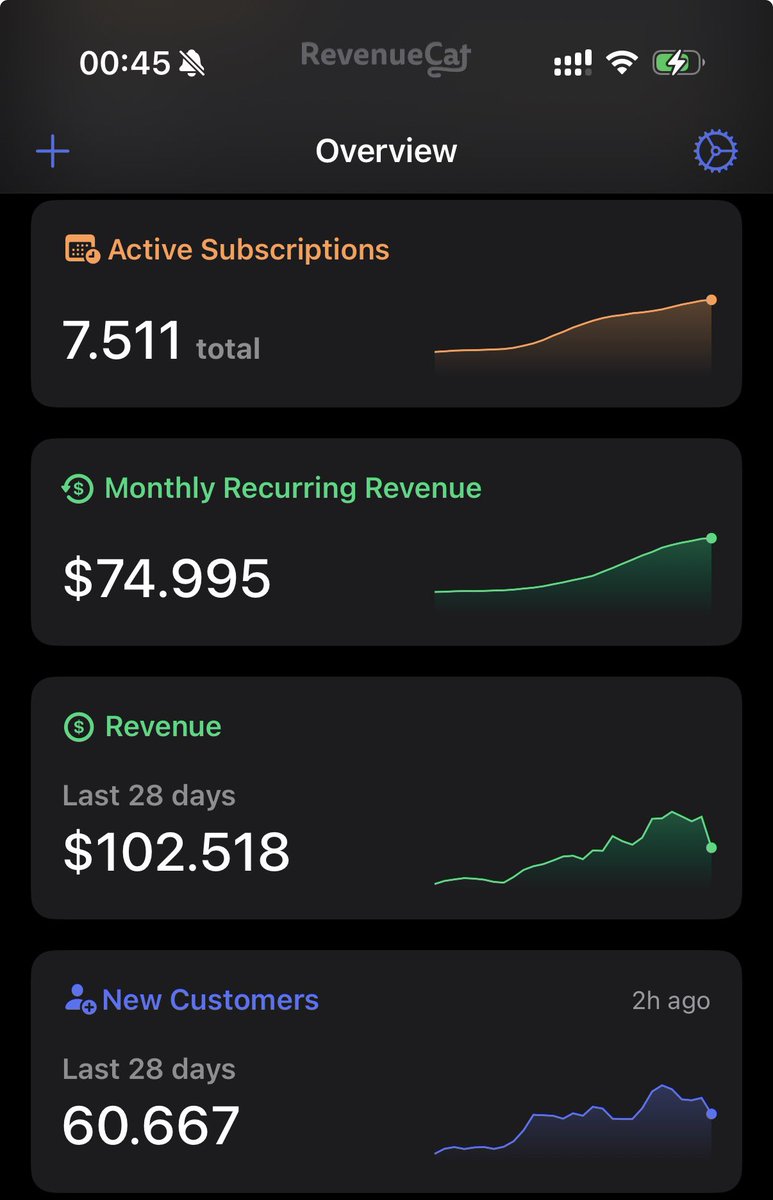
Passed $100K revenue in the past 28 days — blessed 🙏🏻 Should I start thinking about selling the app? 😅 Btw, anyone knows how much an app with these numbers is worth (rough estimate)?
sina sinry tweet media
English
37
3
309
52.6K