Post

NASA Universe
NASA Universe@NASAUniverse·
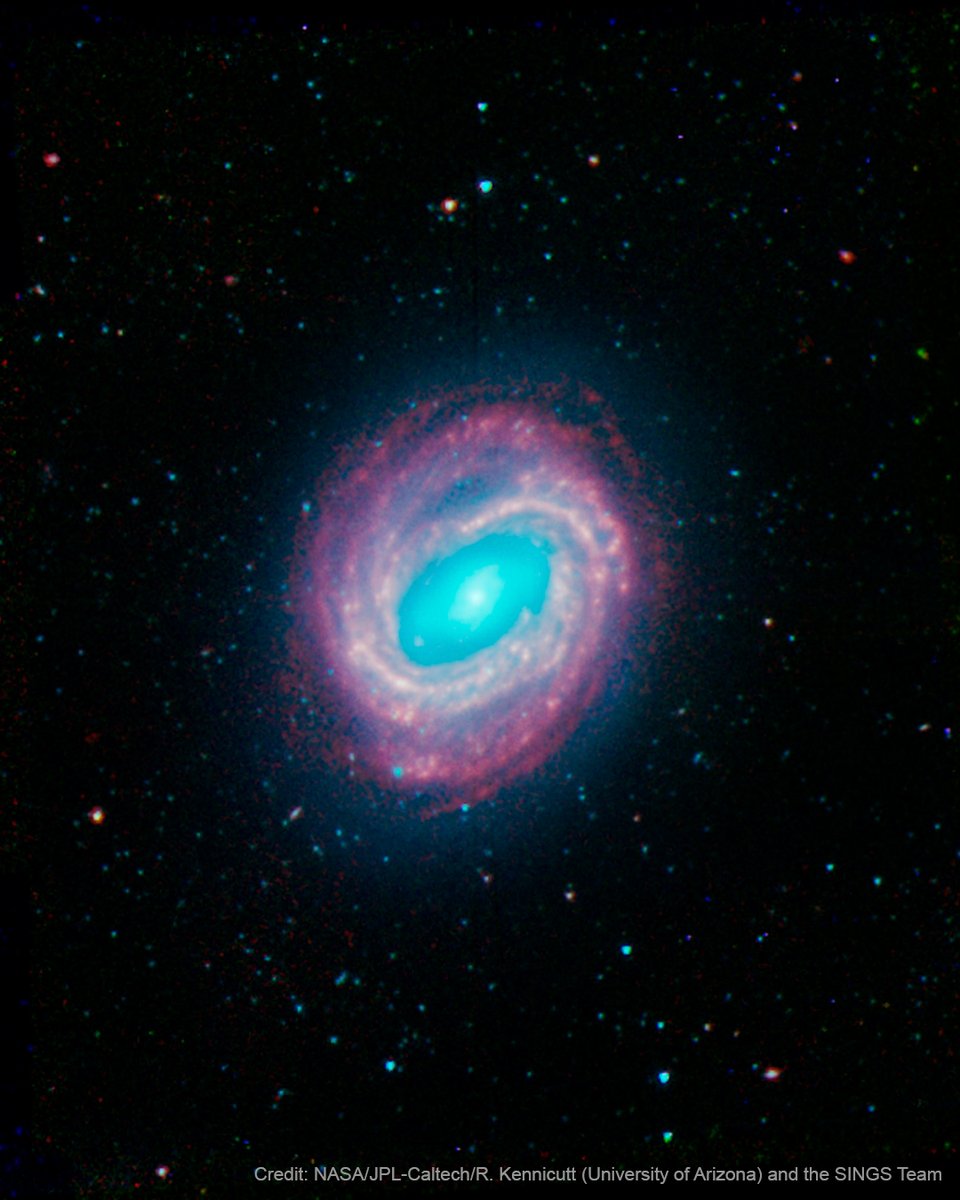
Messier 58 … in a different light! Our retired Spitzer telescope revealed the galaxy’s stellar populations. In the representational colors chosen for this infrared view, reddish areas are the likely birthplaces of new stars, while blue light comes from mature stars.
NASA Universe tweet media
Hubble@NASAHubble

Discovered in 1779 by astronomer Charles Messier, the galaxy Messier 58 was one of the first galaxies recognized to have a spiral shape. It’s also the most distant of the objects included in Messier’s stargazing catalog, at 62 million light-years away: go.nasa.gov/4cXSAJN

English
12
103
536
30.1K
Rockets and Space🚀
Rockets and Space🚀@spacingrocket·
@NASAUniverse spitzer lasted 16 years on a 25 year mission plan that's insane engineering right there also nuts how much more we see in IR vs optical same galaxy completely different story
English
0
0
0
32
Signal.Archive.Lab
Signal.Archive.Lab@Signal_Archive·
Beautiful Spitzer infrared view of M58! The reddish areas beautifully highlight the dust-shrouded birthplaces of new stars, while the blue traces the older stellar populations — a perfect complement to Hubble’s optical view. Fun fact: discovered in 1779 by Charles Messier, this barred spiral was one of the first galaxies recognized as spiral-shaped and remains the most distant object in his entire catalog at 62 million light-years. What a cosmic gem!
English
0
0
0
60
5secondFacts
5secondFacts@5SecondFactsx·
@NASAUniverse Infrared lets us see star formation that’s completely invisible in normal light.
English
0
0
2
75
Nebula Chaser
Nebula Chaser@seahunter·
@NASAUniverse Same galaxy, completely different story. Hubble shows structure, Spitzer shows lifecycle.
English
0
0
0
27
Abdulrahman Abdulazeez
Abdulrahman Abdulazeez@Abd_Abd_Al·
A beautiful new view of Messier 58 in infrared light from Spitzer — another clear success for the Al-Ani Fabric Theory.The reddish areas highlight active star-forming regions, where the deformation field δ is highly dynamic with strong local source terms S creating new stars.The blue light comes from mature stellar populations in more stable regions, where the fabric has reached equilibrium under the damping rate Γ.This vivid contrast between active deformation zones and stable regions in a spiral galaxy is exactly what the mother equation predicts when applied at galactic scales.The same dynamics that govern atoms and molecules are now visible across entire galaxies.The Fabric Model strikes again.
English
0
0
0
15
شیئر