Good Farming with Adam Durey

4.6K posts

Good Farming with Adam Durey banner
Good Farming with Adam Durey

Good Farming with Adam Durey

@GoodFarmingAdam

Regenerative, Organic, Bio-Dynamic, Syntropic - Its all Good Farming.

Australia شامل ہوئے Ekim 2021
249 فالونگ334 فالوورز
پن کیا گیا ٹویٹ
Good Farming with Adam Durey
Good Farming with Adam Durey@GoodFarmingAdam·
It took me 10 years of philosophy, politics, work, and study to decide; Good Farming is the only thing that will save us.
English
2
0
21
2.8K
Good Farming with Adam Durey
Good Farming with Adam Durey@GoodFarmingAdam·
@myname93353387 @lymanstoneky yes that why I said 50/50 at a +/-10% distribution, meaning all ranges between 60/40 either way are equally likely. at those rates a blue vote on average saves 2 lives. and its why the game crashes hard for blues if you say reds only need 40% votes to kill the blues.
English
0
0
0
7
Lyman Stone 石來民 🦬🦬🦬
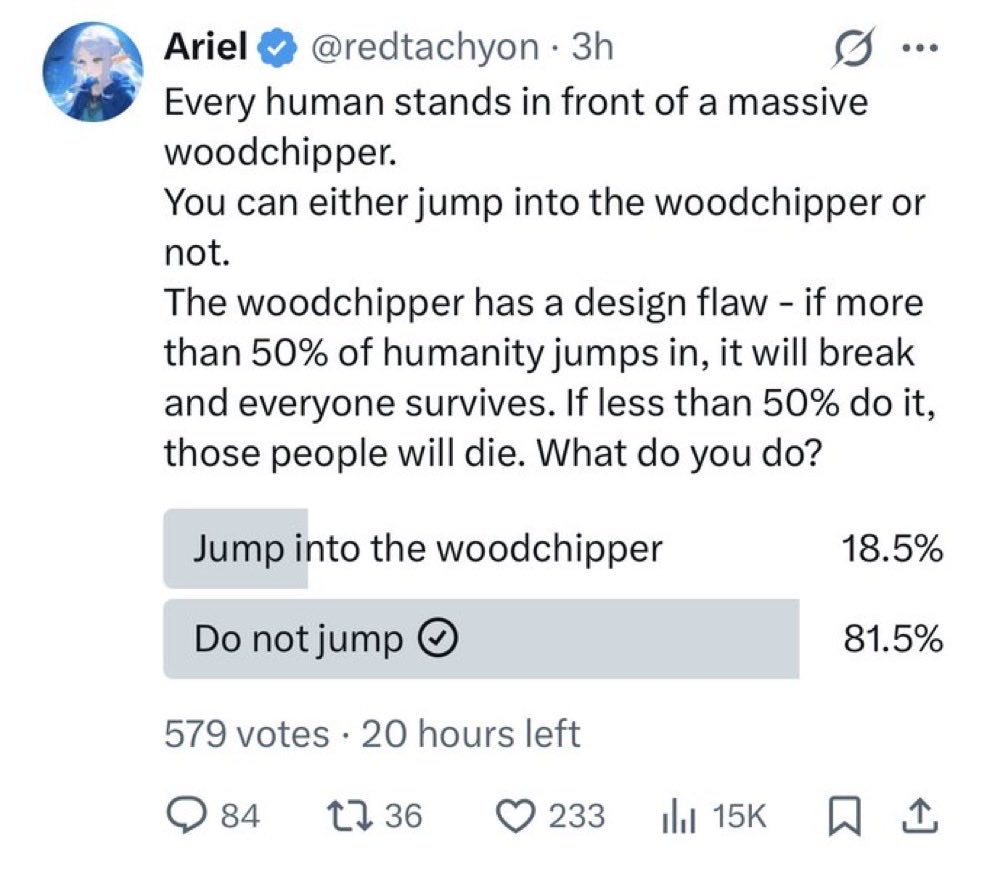
No, because in the non-button versions red always wins! That’s what blue team doesn’t understand— the entire blue victory is contingent on *the specific detail of it being a button* Make it a woodchipper or a nuke or a drowning tank or any actually lethal object and red wins by a landslide! Which suggests most blue voters are full of shit and lying about their beliefs!
peepeepoopoo@DeepDishEnjoyer

here's the last thing i'll say about the red/blue button debate. we now know that when polling ended, blue ended up winning. knowing this, isn't one going around trying to convince people to vote red unethical? absent of this proselytizing, people believe in a high trust society

English
29
4
79
3.9K
Good Farming with Adam Durey
Good Farming with Adam Durey@GoodFarmingAdam·
@myname93353387 @lymanstoneky So what do you think the most likely vote distribution is? If you say its truly 50/50, then the chance you are the deciding vote goes up to 1 in 160'000, and your vote would save 33'000 people on average.
English
1
0
1
9
Postmodern liberalism
Postmodern liberalism@myname93353387·
@GoodFarmingAdam @lymanstoneky Well any given election only has one result,but if you wanted to model results based on some kind of assumption about the average voter I'd start with a binomial distribution. I think it's ordered of magnitude less than 1 in 1.4 billion.
English
1
0
0
10
Good Farming with Adam Durey
Good Farming with Adam Durey@GoodFarmingAdam·
@ZakMndebele @lymanstoneky I get the feeling you're not very good at statistics. I said at a 50/50 +/-10% distribution, so 60/40 either way - at that rate there is a 1 in 1.4 billion chance you are the deciding vote.
English
0
0
1
8
Zak Mndebele
Zak Mndebele@ZakMndebele·
@GoodFarmingAdam @lymanstoneky Under any realistic model, the plausibility of an election on this scale being decided by a single vote is as close to zero as virtually anything you can imagine.
English
1
0
0
14
Good Farming with Adam Durey
Good Farming with Adam Durey@GoodFarmingAdam·
Mostly yes, now that 5.5 is out its all im using, I was using claude and gemini but now 5.5 is ahead on nearly everything. Im setting up grok fast voice 1 for the mobile aplp so I can keep running the agents on long drives between clients. My agent-up system is maturing very quickly now.
English
0
0
0
3
Good Farming with Adam Durey
Good Farming with Adam Durey@GoodFarmingAdam·
Agent-Up Mobile is Live :') I can see the same typing line-by-line on my laptop. True Persistence and Remote Management
Good Farming with Adam Durey tweet media
English
1
0
0
13
Lyman Stone 石來民 🦬🦬🦬
Voting blue is voting for mass murder If you switch the description from “blue button” to any device that actually has the ability to murder humans, the vote flips like 90% red. In any real scenario, the reality of death would be clear, and odds of majority blue fall to zero.
Warren Redlich - Chasing Dreams 🇺🇸@WR4NYGov

I’m a bit shocked at the number of people who: Voted to kill people. Brag that they voted to kill people. And mock those of us who voted not to kill people. I studied game theory. It doesn’t say you have to vote to kill people.


English
6
2
30
3.3K
Good Farming with Adam Durey
Good Farming with Adam Durey@GoodFarmingAdam·
By either altruism or utilitarianism, blue is objectively the better answer under 50/50 conditions. Assume 7 billion people are voting. Red guarantees the individual voter survives. Blue is personally risky, because if Red wins, Blue voters die. But Blue is the only choice that can create the outcome where nobody dies. Now assume the final social result is uncertain across a realistic range, not exactly 50/50. For example, suppose the world could land anywhere between 40% Red / 60% Blue and 60% Red / 40% Blue. That is a 20 percentage-point range. With 7 billion people, that range equals 1.4 billion possible vote positions. A single Blue vote only becomes decisive if the result is right at the survival threshold. So the chance of one vote being decisive is roughly 1 in 1.4 billion. But if that one Blue vote is decisive, it can move the world from “Red barely wins and roughly 3.5 billion Blue voters die” to “Blue wins and nobody dies.” So the rough collective value is: 3.5 billion lives saved ÷ 1.4 billion vote-range = 2.5 expected lives. But Blue also carries personal risk. In roughly half of possible outcomes, Red still wins, so choosing Blue instead of Red costs the voter their own life. That cost is about 0.5 expected lives. So: 2.5 expected lives saved − 0.5 personal-risk cost = about +2 expected lives. Therefore, under a realistic ±10% social uncertainty model, one Blue vote is not just symbolic. Compared with a Red vote, it has about +2 expected lives of collective value. Red guarantees one personal life; Blue has positive collective life-value because it supports the only outcome where everyone survives.
English
0
0
0
7
Jetski Grizzly
Jetski Grizzly@Jetskigrizzly·
Blues would literally jump in a woodchipper and there’s zero difference
Jetski Grizzly tweet media
English
52
52
1.8K
26K
Shea Levy
Shea Levy@shlevy·
The question is uninteresting. It’s all absurd, there is no way the scenario could be enacted and no reason to if you could and not even a fig leaf of this being a simplification of a real problem. What is interesting is the way people react to it, by e.g. changing the terms.
boone@BooneW

What's the point of purposefully being obtuse like this? It can very reasonably be inferred that the original question intends "everyone" to be capable of both understanding and making the choice Presuming "everyone" to include children and the mentally unfit make blue the obvious choice and the question uninteresting

English
2
0
15
597
Fuggles
Fuggles@Fuggles131766·
@GoodFarmingAdam @chaosbomdotcom @Jetskigrizzly I mean just nobody could jump into the woodchipper, so there's that. But you want everyone to step forward and jump in to save the odd retard that does jump in for no reason?
English
1
0
1
8
Good Farming with Adam Durey
Good Farming with Adam Durey@GoodFarmingAdam·
How do you know it doesnt go the other way, and more people press blue in real life because the feel the true weight of their decision to sacrifice others? You dont know this. Change the game so if the red voters win, they have to personally kill the blues with blunt instruments.
English
0
0
0
3
Jonatan Pallesen
Jonatan Pallesen@jonatanpallesen·
What will happen in real life, with their actual lives on the line, far fewer people will press blue. So if you press blue you just die. You can’t save the world by pressing blue. Just like you can’t save the world by letting all suffering people immigrate to the West. It may feel good to try, but it is not realistic. There is likely high overlap between the two positions.
Tim Urban@waitbutwhy

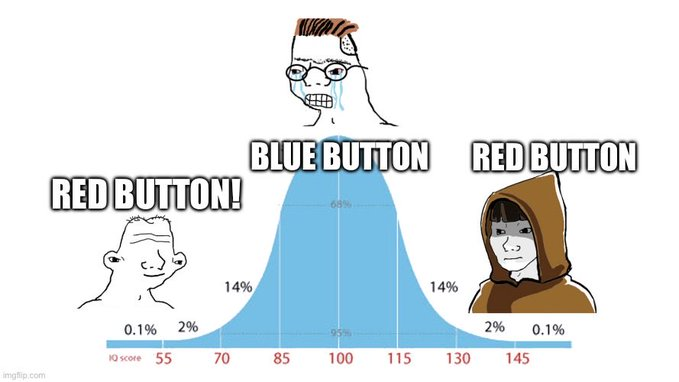
Everyone in the world has to take a private vote by pressing a red or blue button. If more than 50% of people press the blue button, everyone survives. If less than 50% of people press the blue button, only people who pressed the red button survive. Which button would you press?

English
62
8
288
10.6K
Max
Max@minordissent·
If I thought there was a very high chance blue could get over 50% IRL, I would vote blue and save the bluecels (bless their hearts). Perhaps this could happen in a high trust ethnostate. But in America I guarantee you you're never getting close to 50% blue, in which case i'm not needlessly committing suicide and thus voting red.
Crashout Capital@CapitalCrashout

@minordissent

English
42
0
230
12.5K
Good Farming with Adam Durey
Good Farming with Adam Durey@GoodFarmingAdam·
By either altruism or utilitarianism, blue is objectively the better answer under 50/50 conditions. Assume 7 billion people are voting. Red guarantees the individual voter survives. Blue is personally risky, because if Red wins, Blue voters die. But Blue is the only choice that can create the outcome where nobody dies. Now assume the final social result is uncertain across a realistic range, not exactly 50/50. For example, suppose the world could land anywhere between 40% Red / 60% Blue and 60% Red / 40% Blue. That is a 20 percentage-point range. With 7 billion people, that range equals 1.4 billion possible vote positions. A single Blue vote only becomes decisive if the result is right at the survival threshold. So the chance of one vote being decisive is roughly 1 in 1.4 billion. But if that one Blue vote is decisive, it can move the world from “Red barely wins and roughly 3.5 billion Blue voters die” to “Blue wins and nobody dies.” So the rough collective value is: 3.5 billion lives saved ÷ 1.4 billion vote-range = 2.5 expected lives. But Blue also carries personal risk. In roughly half of possible outcomes, Red still wins, so choosing Blue instead of Red costs the voter their own life. That cost is about 0.5 expected lives. So: 2.5 expected lives saved − 0.5 personal-risk cost = about +2 expected lives. Therefore, under a realistic ±10% social uncertainty model, one Blue vote is not just symbolic. Compared with a Red vote, it has about +2 expected lives of collective value. Red guarantees one personal life; Blue has positive collective life-value because it supports the only outcome where everyone survives.
English
0
0
0
6
Good Farming with Adam Durey
Good Farming with Adam Durey@GoodFarmingAdam·
By either altruism or utilitarianism, blue is objectively the better answer under 50/50 conditions. The only 'game theory' that wins here is, i have to live just this time in this game and no other game will be played ever. Assume 7 billion people are voting. Red guarantees the individual voter survives. Blue is personally risky, because if Red wins, Blue voters die. But Blue is the only choice that can create the outcome where nobody dies. Now assume the final social result is uncertain across a realistic range, not exactly 50/50. For example, suppose the world could land anywhere between 40% Red / 60% Blue and 60% Red / 40% Blue. That is a 20 percentage-point range. With 7 billion people, that range equals 1.4 billion possible vote positions. A single Blue vote only becomes decisive if the result is right at the survival threshold. So the chance of one vote being decisive is roughly 1 in 1.4 billion. But if that one Blue vote is decisive, it can move the world from “Red barely wins and roughly 3.5 billion Blue voters die” to “Blue wins and nobody dies.” So the rough collective value is: 3.5 billion lives saved ÷ 1.4 billion vote-range = 2.5 expected lives. But Blue also carries personal risk. In roughly half of possible outcomes, Red still wins, so choosing Blue instead of Red costs the voter their own life. That cost is about 0.5 expected lives. So: 2.5 expected lives saved − 0.5 personal-risk cost = about +2 expected lives. Therefore, under a realistic ±10% social uncertainty model, one Blue vote is not just symbolic. Compared with a Red vote, it has about +2 expected lives of collective value. Red guarantees one personal life; Blue has positive collective life-value because it supports the only outcome where everyone survives.
English
0
0
0
4
not_cyotee
not_cyotee@NCyotee·
This grossly misunderstands game theory. Game theory is not about predicting the outcome of a conflict. It's about calculating the risk/reward trade off of any conflict. In this case, voting red doesn't risk anything to yourself. You survive regardless of the outcome. Voting blue risks harming yourself and no one else. All blue does it take a risk on losing. All game theory does is let you calculate that risk and reward of the different outcomes.
Peter Hague@peterrhague

Amazing how lots of self appointed game theory experts confidently asserting that blue is the stupid choice. But every time this poll is run blue wins. Not only is the “game theory” answer predicting the wrong outcome, its explanatory power is based on it being able to predict the right answer. So it’s doubly wrong.

English
52
11
414
13.3K
Good Farming with Adam Durey
Good Farming with Adam Durey@GoodFarmingAdam·
By either altruism or utilitarianism, blue is objectively the better answer under 50/50 conditions. Assume 7 billion people are voting. Red guarantees the individual voter survives. Blue is personally risky, because if Red wins, Blue voters die. But Blue is the only choice that can create the outcome where nobody dies. Now assume the final social result is uncertain across a realistic range, not exactly 50/50. For example, suppose the world could land anywhere between 40% Red / 60% Blue and 60% Red / 40% Blue. That is a 20 percentage-point range. With 7 billion people, that range equals 1.4 billion possible vote positions. A single Blue vote only becomes decisive if the result is right at the survival threshold. So the chance of one vote being decisive is roughly 1 in 1.4 billion. But if that one Blue vote is decisive, it can move the world from “Red barely wins and roughly 3.5 billion Blue voters die” to “Blue wins and nobody dies.” So the rough collective value is: 3.5 billion lives saved ÷ 1.4 billion vote-range = 2.5 expected lives. But Blue also carries personal risk. In roughly half of possible outcomes, Red still wins, so choosing Blue instead of Red costs the voter their own life. That cost is about 0.5 expected lives. So: 2.5 expected lives saved − 0.5 personal-risk cost = about +2 expected lives. Therefore, under a realistic ±10% social uncertainty model, one Blue vote is not just symbolic. Compared with a Red vote, it has about +2 expected lives of collective value. Red guarantees one personal life; Blue has positive collective life-value because it supports the only outcome where everyone survives.
English
1
0
0
6
Good Farming with Adam Durey
Good Farming with Adam Durey@GoodFarmingAdam·
By either altruism or utilitarianism, blue is objectively the better answer under 50/50 conditions. Assume 7 billion people are voting. Red guarantees the individual voter survives. Blue is personally risky, because if Red wins, Blue voters die. But Blue is the only choice that can create the outcome where nobody dies. Now assume the final social result is uncertain across a realistic range, not exactly 50/50. For example, suppose the world could land anywhere between 40% Red / 60% Blue and 60% Red / 40% Blue. That is a 20 percentage-point range. With 7 billion people, that range equals 1.4 billion possible vote positions. A single Blue vote only becomes decisive if the result is right at the survival threshold. So the chance of one vote being decisive is roughly 1 in 1.4 billion. But if that one Blue vote is decisive, it can move the world from “Red barely wins and roughly 3.5 billion Blue voters die” to “Blue wins and nobody dies.” So the rough collective value is: 3.5 billion lives saved ÷ 1.4 billion vote-range = 2.5 expected lives. But Blue also carries personal risk. In roughly half of possible outcomes, Red still wins, so choosing Blue instead of Red costs the voter their own life. That cost is about 0.5 expected lives. So: 2.5 expected lives saved − 0.5 personal-risk cost = about +2 expected lives. Therefore, under a realistic ±10% social uncertainty model, one Blue vote is not just symbolic. Compared with a Red vote, it has about +2 expected lives of collective value. Red guarantees one personal life; Blue has positive collective life-value because it supports the only outcome where everyone survives.
English
0
0
0
9
Lyman Stone 石來民 🦬🦬🦬
The results flip if you use any hypothetical other than “blue button,” ie any symbol of actual death. The only reason blue wins is because the scenario obscures the murders. In real life, fear of dying would not be so tucked away.
Peter Hague@peterrhague

Amazing how lots of self appointed game theory experts confidently asserting that blue is the stupid choice. But every time this poll is run blue wins. Not only is the “game theory” answer predicting the wrong outcome, its explanatory power is based on it being able to predict the right answer. So it’s doubly wrong.

English
9
2
39
4.1K