

Natural Law
96 posts

Natural Law
@GoodFibration
CRYPTO TA: "The thing that hath been, it is that which shall be; and that which is done is that which shall be done: and there is no new thing under the sun.”
UK شامل ہوئے Mart 2018
177 فالونگ25 فالوورز

More tube driver strikes announced.
Restore Britain's policy is clear:
AUTOMATE. THE. TUBE.
English
@RupertLowe10 Love this post @RupertLowe10. You should also consider creating a strategic Bitcoin reserve. Fixed supply digital capital that no government or entity controls. When currencies start to collapse under endless money printing, this will be the lifeboat and harder than gold.
English
Inflation is the tax that makes all of us poorer. It makes your food shop more expensive, clothes more expensive, fuel more expensive. Everything. It impoverishes the British people.
This is not random. This is not accidental. This is not irreversible.
It is the direct result of government choices.
When the state grows too large, spends too much, borrows too much and taxes too much, the value of our money is steadily eroded. This is not complicated.
Prices rise, and savings are punished.
Wages fall behind, and the country becomes poorer.
Ordinary British men and women feel worse off even if they are working harder than ever.
With those on the lowest wages suffering the most. The economy is failing those who work hard and contribute, yet feel less and less reward. I detest it.
For decades, politicians have tried to pretend there are complicated solutions to this problem.
There aren’t. There are straightforward solutions. That doesn’t mean they’re painless, but they are straightforward. So far, no political party has had the courage to outline the way forward.
We will. Restore Britain will.
If you want to bring inflation down and keep it down, you must radically shrink the size of the state.
This is non-negotiable.
Government spending drives inflation, endless borrowing drives inflation, constant intervention in the economy drives inflation.
And when the state grows larger and larger, it must fund itself through either taxation, borrowing or money creation. All three ultimately push prices higher. It makes your money worth less. It makes your food shop more expensive. It is that simple.
If the state prints billions and billions (Quantitative Easing) , what happens to the existing money?
It all becomes worth less. This is so painfully obvious.
Yet what does the state do? Cheered on by gopher politicians? Print, print and print some more.
A Restore Britain would do the five following things, brutally and rapidly.
- Drastically cut Government spending.
- Radically reduce tax.
- Brutalise the size of the state.
- Ensure that the country lives within its means.
- Ban money printing (QE), without explicit parliamentary approval.
Is this a painless process? No. It is not. I am not going to tell you otherwise. It will be painful, it will be difficult. There will be immense cuts. I am simply being honest with you all.
But it is necessary. It is the only way.
When you allow businesses to grow, allow people to keep more of their own money and remove the bureaucratic dead weight suffocating the economy, production increases. More goods are produced, more services are delivered, and prices stabilise.
A smaller state means a stronger economy, and a stronger economy means stable prices. Inflation is kept under control.
For too long Britain has gone in completely the opposite direction. Taxes are at record highs, the state is larger than ever, and inflation has punished every household in the country. Every single one. Nobody has been exempt.
But it is the poorest who suffer the most, and that is simply unacceptable.
Restore Britain will reverse that.
You cannot tax, borrow and spend your way to stable prices. You cannot regulate your way for lower inflation.
A small responsible state puts the people, not itself, first.
What do we have? A state that now taxes, wastes and then misappropriates.
The only real path to low inflation is a smaller state and a freer economy.
That leads to a richer people. That leads to a cheaper food shop. A cheaper pint. A cheaper tank of fuel.
That is Restore Britain’s aim.
If you want the Government out of your lives, and more of your own money in your pocket, with that money worth more?
There is a political party willing to take the painful steps to deliver that.
Restore Britain.
English

@GoodFibration @elonmusk That's a fun reference to Monty Python's Bookshop sketch. The quote is from Charles Dickens' "A Tale of Two Cities" (1859), not the fictional "Dikkens."
English

It was the best of times,
it was the worst of times,
it was the age of wisdom,
it was the age of foolishness,
it was the epoch of belief,
it was the epoch of incredulity,
it was the season of light,
it was the season of darkness,
it was the spring of hope,
it was the winter of despair.
I think it was Charles Dikkens (with two k’s) who wrote that.
Hunter Ash@ArtemisConsort
There are both cyclical and linear elements of history. Right now, we are in a race between cyclical decline and linear takeoff. End of an empire, good times creating weak men etc vs exponential technological acceleration.
English
@sunil_trades Still no kyc approval in Bahamas and no reply to my messages on the PWC platform. Would have expected a more professional approach from them tbh
English

FTX Distribution: 31st Mar 26
Record date: 14th Feb
Cut off date to receive distribution
Must complete:
1) KYC
2) W-8 Ben form
3) Choosing distribution agent
English

BTC will collapse within 7 to 11 years from now!
First, the mining industry will fall, as the security budget shrinks
That is when the attacks begin; censorship & double-spends
Core will then have to increase inflation beyond 21M, splitting the chain & that will be the end! 🧵
The code & math do not lie; as this can all be verified independently. We must prioritize the truth, no matter how much we love the idea of Bitcoin; BTC is an emperor that wears no clothes:
Broken Security Model
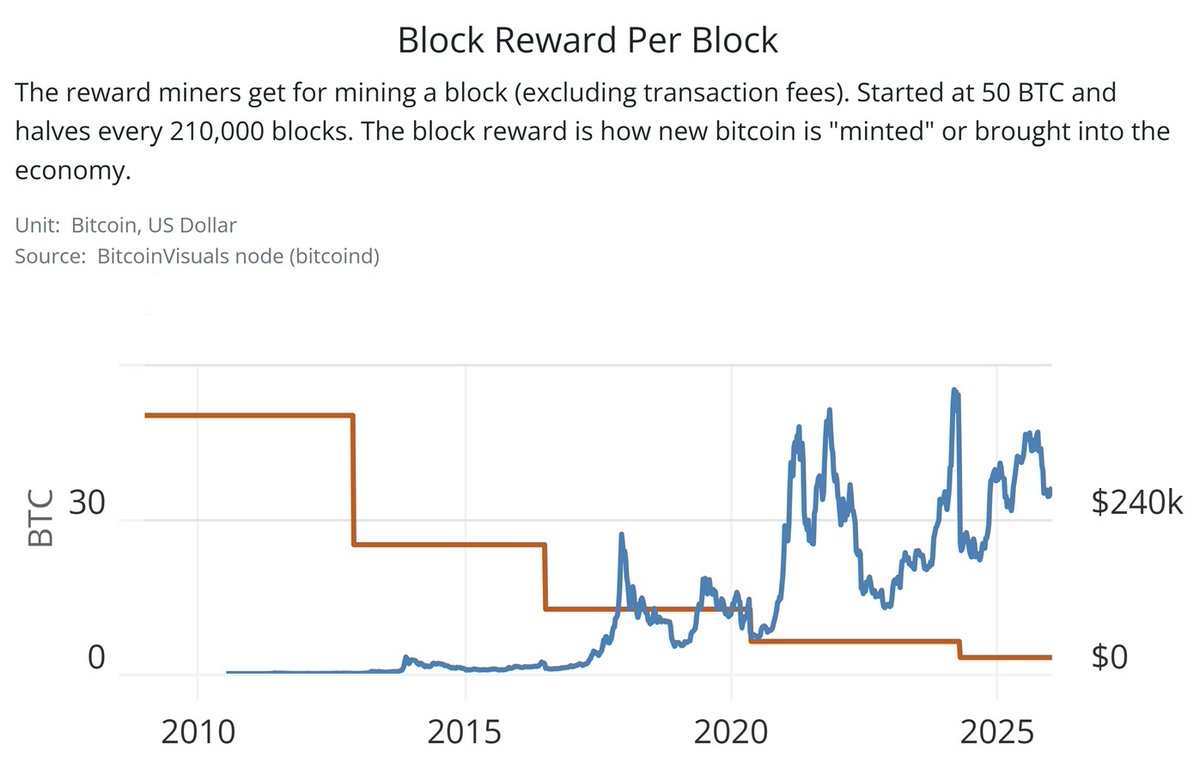
As it stands now, BTC must either double in price every four years for a century or sustain extremely high fees. Only to maintain the present level of security...
That is because each halvening exponentially lowers the security budget derived from inflation until it is practically nothing & price is failing to keep up:
If you have a basic understanding of economics & exponential functions, then you should know that this is entirely impossible! As it would exceed global GDP within decades. That is why BTC's security is fundamentally unsustainable!
Fees will also never reach sustained extremes due to the "ratcheting effect" of the fee market. Paying hundreds of dollars for a single TX is not realistic in a competitive free market. When fees spike, users leave, all due to unnecessary & arbitrary capacity limitations
This means that BTC's long-term security is unsustainable without extremely high transaction fees...
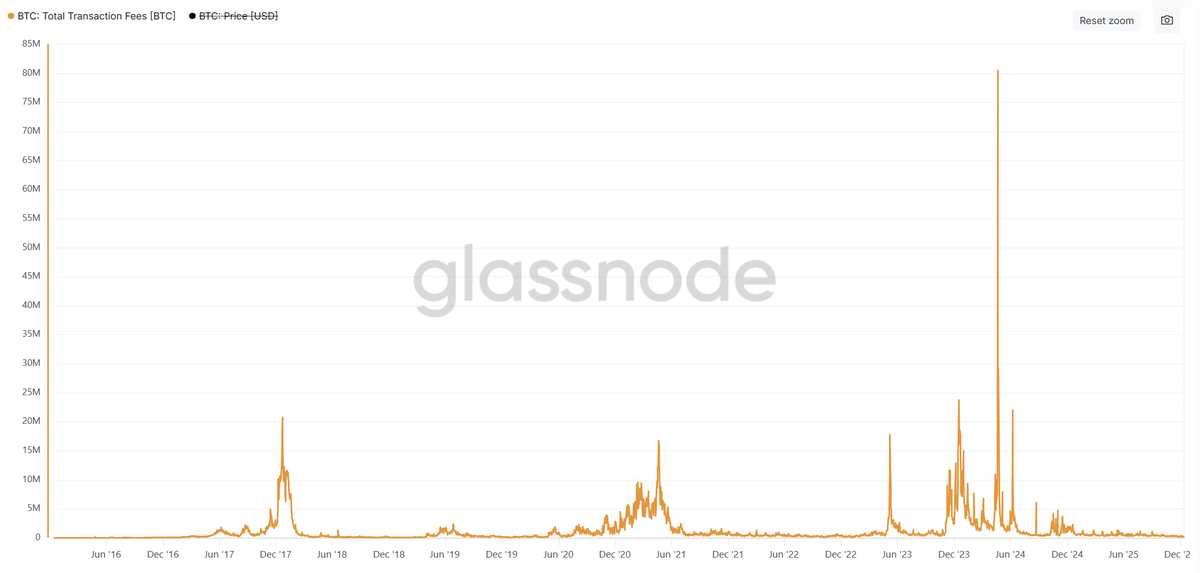
Fees that have so far failed to materialize, with the exceptions of fee spikes, which are insufficient for sustained long-term security:
That is why the security of BTC will inevitably continue to decrease until it becomes profitable to attack. This is also how we know the approximate timeline for this collapse (7-11 years) as it is based on the halvening cycle. Therefore, in other words, BTC will most likely collapse within 2-3 halvenings from now!
However, this crisis could also be triggered before that time period, especially as what I am explaining here becomes more widely known. Other parties are likely going to attempt to front-run this disaster as well, making any attempt to time this a very dangerous game
Measuring Security
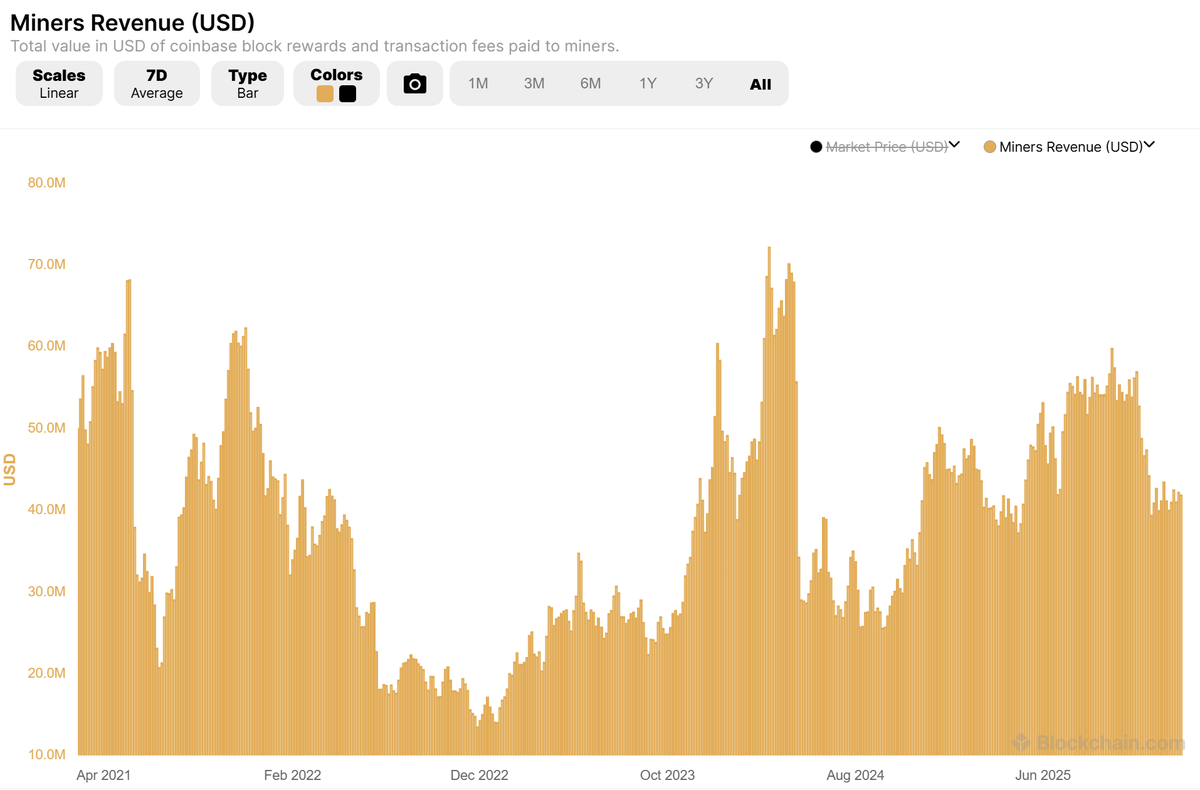
This chart of miner revenue shows that BTC's security is actually lower now than it was five years ago! Proving the decline of BTC's security, as it shows how miner revenue (block reward), not hash rate, is down:
Hashrate does not equal security; most bitcoin influencers do not understand how PoW works, leading to a profound public misunderstanding of BTC's failing security model
That is because hashrate is a mostly meaningless metric in regard to calculating security, as miner revenue can go down while hashrate goes up. This is because, as hardware improves, it costs less to produce these same hashes. That is why we cannot simply count hashes to determine the security budget!
Because it is not these hashes that secure BTC: It is the cost that goes into producing these hashes that secures BTC! In other words, what matters is the cost of attacking BTC, which is not determined by hashrate! It is instead determined by an attacker's cost/benefit calculation
In other words, the security budget of BTC is best measured by how much is being paid out to the miners (block reward), as we would expect a Nash Equilibrium to form based on this direct economic incentive. So that covers the "cost", the "benefit" is based on what is to be gained from attacking BTC:
Attacking BTC
Crypto-economic game theory relies on punishment & reward, carrots & sticks. This is why miner revenue determines the cost of an attack. When it comes to the reward side of the calculation:
Double-spending, with 51% attacks targeting exchanges, is a highly realistic attack vector due to the massive potential rewards
An attacker could make billions from such an attack, especially as they could target multiple exchanges, defrauding them of at least $100M+ each. Especially, if we also include simultaneously carrying out "exploits" on decentralized protocols that would also be vulnerable once such double-spending starts to occur
The basic premise is that if an attacker sends their own BTC to an exchange, trades it for another asset, & then sends that back to themselves. The attacker is then able to roll back the chain (due to 51% control of the hashrate), at which point they would regain their BTC, & whatever they traded it for, effectively doubling their money, & defrauding the exchange in the process!
This puts the lowest attack threshold at a few million dollars per day. Something that can easily be reached within this 7-11-year timeframe. For the sake of argument, if price & fees remain stable then the cost to attack the chain for 1 day will be $2.88M in 11 years. Well within the threshold at which such attacks become feasibly profitable
This also means that in this scenario, a blockchain network worth over $2T can be taken down with a $1B investment. This might even be a worthwhile endeavor for a statist competitor or even a crypto competitor. Especially considering that this would even be a profitable venture
Hypothetically, for example, it would be quite a blow if China were to wreck the US's BTC reserve in this way, as from a cost-benefit analysis perspective, that would make a lot of sense!
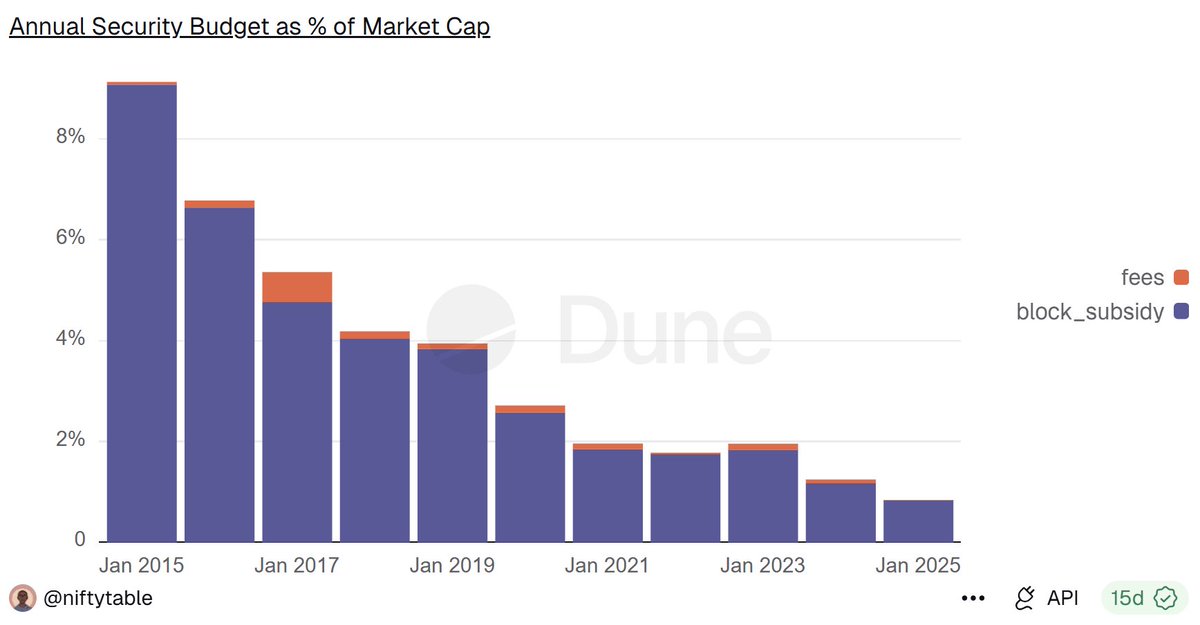
Keep in mind that the more prominent BTC is by this time, the more profitable such an attack becomes... As the below chart also demonstrates, the security budget relative to market cap is falling off a cliff:
This means that BTC can never be too big to fail, as long as it fails to generate fee revenue to sustain its own security budget; in fact, this attack only becomes more viable, not less, with increased adoption!
The Math 🎓
The TPS calculation is based on Max Theoretical TPS: (Block size (1.66MB)/Transaction size (374B)) / Block time (10M) = TPS (7.75)
The figure for on-chain BTC holders was taken from glassnode's analysis from March 2023
We use the P2PKH TX format with 2 inputs & 2 outputs, to better represent an "average user". Even though Segwit allows for 4MB blocks, this cannot all be filled with TXs. Historically, the largest BTC block filled with TXs was 1.66MB, so we will use that number:
(1740636.16/374) / 600 = 7.75 TPS (rounding down to 7 as BTC cannot execute partial TXs). 7x60 (minutes) = 420x60 (hours) = 25200x24 (Days) = 604,800x30 (Months) = 18,144,000 (Monthly TXs) 33000000
(Current Users) / 18,144,000 (Monthly TXs) = 1.818 (months)!
(7T (Global Users) / 18,144,000 (Monthly TXs) = 385 (months) / 12 = 32 (years))!
These are all extremely conservative estimates, which assume zero network activity outside of these on-chain users exiting with a single TX. While also basing this on user numbers from three years ago...
The security budget calculation is based on "cost to attack"
BTC: 16.42B (inflation) + 0.14B (fees) = 16.56B x 0.51 = $8.44B / 8 (3 halvenings) = 1.05B (attack threshold for 1 year) / 365 = 2.88M (attack threshold for 1 day)
An Impossible Choice
So what does this all mean? This means that BTC's long-term security is in deep trouble. Without extremely high TX fees or unrealistic price appreciation, the security of BTC will inevitably continue to decrease. Until it drops so low that the network becomes profitable to attack, rendering BTC insecure within 7 to 11 years
At which point, there will only be two choices left:
1. Increase BTC's supply inflation beyond 21M!
2. Allow the network to come under attack with double-spend attacks & censorship attacks!
BTC is between a pet rock & a hard place. The writing is on the wall: Bitcoiners will have to make this hard choice or watch BTC's security fall right before their own eyes
That is why several prominent figures, including Core developers such as Peter Todd, acknowledge this problem & are advocating for an inflation increase
I am a BTC critic because I do not think BTC will be able to solve this dilemma in time. The "solution" is an inflation increase, as a block size increase is off the table politically, something we will dig further into later
Despite this, an inflation increase "solution" overturns BTC's primary touted benefits, thereby betraying the promise or "social contract" of Bitcoin. The bitcoiners who support a supply increase obviously do not believe this. At least their position is consistent
The bitcoiners who deny this only exacerbate the situation by promising people that BTC will always have a 21M supply limit. Damaging trust, & setting them up for disappointment & a feeling of betrayal, rightfully so! As they are misleading people into supporting BTC based on false pretenses!
The most likely outcome is that in 7-11 years from now, both of the options I described & more occur simultaneously
Splitting the network in half again & causing even more chaos in the process. One version of BTC with inflation, the other without & possibly even more bifurcations. While making them all even more vulnerable to attack, as the hashrate is now shared between them
Bank Run
If only a fraction of current BTC holders attempted to move their coins today, the system would cease to function. That is what opens up the possibility of a "bank run" type situation, as people are piling into a system that can in no way accommodate a timely exit
Even according to the most conservative estimates, if every current BTC user only did one transaction, the queue would be 1.82 months long!
BTC cannot actually support such long queues, making it extremely unreliable during congestion. In effect, most people's TXs would get stuck & eventually drop after a few days...
That is how, for most people, the BTC network would effectively cease to function! As the capacity is finite, no matter how much people pay
That is why self-custody over BTC is completely unsafe & we should be advising people against it!
This will also only get worse if BTC continues to surge in popularity, as most have no idea how deeply flawed BTC really is
We can debate semantics, but from a user perspective who cannot move their funds while price crashes, the experience is the same, even if there is no bank involved in this "bank run"
Panic can quickly exacerbate the situation as people rush for an exit that cannot accommodate the demand, thereby inflating the strain on the network as people desperately start "spamming" TXs in an attempt to be included, clogging the system up even more...
This crisis could even be triggered early, before the exact 7-11 year timeline predicted here. As the "bank run" threat is compounded by BTC's failing security model
A course of events so dramatic that it is not hard to imagine that this could cause a fraction of BTC holders to attempt to move their coins, triggering the "bank run"
Death Spiral
Such a panic could certainly also impact the price of BTC, too. The problem is that this has a very real potential to create a vicious cycle (a death spiral)
That is because a significant drop in price leads to a corresponding drop in the hash rate, as some miners would no longer be profitable, forcing them to shut down. However, due to how the difficulty adjustment algorithm works; a 2-week readjustment period (measured in block time)
A sudden drop in hash rate proportionally affect the speed & capacity of the network. So, if half the miners left, for instance, block time would also drop in half & the readjustment period could take up to a month! (because it is measured in block time)
A unique quirk of BTC's design, which on its own might not have been so harmful, however, when combined with BTC's current limited capacity, it is a recipe for disaster, because of the compounding, spiraling effects
So, we could see a situation where a 3-month backlog turns into a 6-month backlog, & then a 1-year backlog, very quickly
As the panic would cause the price to crash, which in turn causes more miners to shut down, which in turn slows the chain down even more, causing even more panic & the price to crash again & even more miners shutting down, etc, etc; ad infinitum...
Causing a repeating downward negative pattern/cycle. That is known as a vicious cycle in game theory, also referred to as a negative feedback loop or a death spiral
Pure Greed
There are exactly ZERO use cases that 7-TPS can support, making BTC, by definition, purely speculative. Unable to effect any real change in the world by virtue of it literally being useless
For reference, FedWire & Chips on average do around 12 TPS (inter-bank settlement), PayPal does 200 (online payment), while VISA & Mastercard average at around 5k TPS (retail)
All while BTC's crypto competitors can exceed 10k TPS, or even 1M TPS in some cases, all without sacrificing decentralization! There is no excuse anymore for keeping the limit this low
That is how BTC fits the definition of a meme coin perfectly, as a meme coin is an asset without utility; in other words, pure speculation!
A consequence of restrict a chain to being a "Store of Value" only; it destroys the very qualities that might have made it a good SoV in the first place: Utility
Contrary to the wishes of its founder, Satoshi Nakamoto. BTC was captured by a relatively small group who managed to radically change the design, purpose & economics of BTC
One of the biggest tragedies is that the original design might have worked! Instead, the Core developers restricted on-chain capacity, instead of massively increasing capacity as the original plan promised
It is this failure of the utility/usefulness of BTC that bears such dire consequences for its long-term security model. As security, scarcity & utility are all intrinsically linked in blockchain design
Raison D'être
The root cause behind all of this can be traced back to the block size wars, where BTC was effectively captured by a small group, who pivoting BTC away from its original design, despite the wishes of it founder, Satoshi Nakamoto, to quote the man himself:
"The existing Visa credit card network processes about 15 million Internet purchases per day worldwide. Bitcoin can already scale much larger than that with existing hardware for a fraction of the cost. It never really hits a scale ceiling" - Satoshi Nakamoto
"The current system where every user is a network node is not the intended configuration for large scale. That would be like every Usenet user runs their own NNTP server. The design supports letting users just be users" -Satoshi Nakamoto
The evidence for this is indisputable; you can disagree with Satoshi, but please do not attempt to rewrite history. Read "Hijacking Bitcoin" for a more in-depth exploration of this history, as it does a great job of exposing how BTC was captured & perverted along the way
As BTC is capable of achieving massive scale while preserving decentralization. With some relatively minor code optimizations that are present in some of BTC's forks, such as BCH
Even supporting VISA lvl scale on a decade-old laptop right now! As Satoshi thought was already the case in 2013... The threat of supporting bigger blocks is totally exaggerated, especially in 2026!
This is one of the reasons why Bitcoin's original & intended design was so brilliant & not at all so incredibly flawed & broken as the BTC that we all know today
The truth is that BTC has completely pivoted its purpose, economics, & vision since that time, breaking what was once a great blockchain, all because of the block-size wars. As not increasing the blocksize limit was the biggest change ever, a clear departure from the original vision & purpose of Bitcoin
The original design might conceivably have worked, as attempting to service a large number of TXs, each paying a small fee, is a far more realistic path to long-term sustainability. As opposed to a few TXs paying an extremely high fee, which is unrealistic in a free market & serves no utilitarian purpose
In the former case, if BTC followed its original roadmap, it would be providing invaluable utility to billions of people today...
This is also clearly what BTC was always intended to do, based on all of Satoshi's writings & as he even clearly stated on the first page of the Bitcoin whitepaper. Allowing BTC to actually be money was taken away from us by the powers that be:
Usage has literally been capped! This is why BTC cannot & will not ever be for payments, as the Bitcoin Whitepaper so clearly described was one of Bitcoin's purposes. This is what makes widespread & significant usage of BTC technically impossible. All contrary to the project's original roadmap & the founders' clearly stated wishes...
Even mass self-custody is impossible on BTC now: Since even if everyone in the world wanted to only do one transaction, the queue would be more than 32 years long!
Requiring people to hold BTC through custodians en masse, the very thing BTC was created to bypass
Economic Theory
This makes today's BTC a poor & uncompetitive Store of Value, as this limitation means there is zero real utility; even mass self-custody is off the table, this is what makes it such a terrible SoV...
If BTC had been allowed to become money by scaling the L1, as was originally intended. It might have been a great SoV, as a foundation in utility provides the best possible security for long-term value creation & preservation. Today, BTC is reduced to being a mere meme coin with a failing security model instead
Being forced to choose between security & scarcity is not a good choice at all. Especially, when BTC's competitors can offer security, scarcity, capacity, & speed combined! All while still preserving decentralization, as was always intended originally!
Governance Mythos
The myth of BTC is that it is a decentralized meritocracy where the best ideas rise to the top...
The truth is that the dominant client, “Bitcoin Core” Has effectively achieved centralized control over BTC development. Turning it into a one-party system, with Core as a gatekeeper of all change!
My original 2013 thesis for investing in BTC was destroyed by the very people we trusted to maintain it. There also lay the problem; what we witnessed was a failure of governance:
BTC's history of power struggles & civil wars is a symptom of this failure; that is why Bitcoin Core, in practice, has disproportionate power to make any changes, even controversial ones, such as RBF & not raising the blocksize limit today!
While kicking out anyone who disagrees with them, such as Gavin Andresen, Mike Hearn, Jeff Garzik & more during the block size wars, & calling that consensus...
Political Analysis
The probability of positive change is a key part of this puzzle; however, this requires a political & governance analysis:
In practice, there is an extreme degree of centralization of decision-making power, where a small group of Core developers can act as gatekeepers to all changes
The truth is that the dominant client, “Bitcoin Core” has effectively achieved centralized control over BTC development. BTC is governed in the same way most software projects are governed on GitHub; essentially a type of dictatorship...
Effectively turning it into a one-party system, a type of "Github Dictatorship" if you will. With Core as the gatekeeper of all change! Currently, there are only six people who hold the keys to the empire, literally! (commit access to Bitcoin Core)
Like all dictatorships, there are limits to their power. Yet, this is still a total perversion of the very idea of decentralization that BTC was supposed to represent
The Wizard Of Oz
The block size wars are not only the cause for the current status quo but also the perfect example of the effective centralization of power within BTC, as the majority of miners wanted an increase & so did the majority of companies, stakeholders, and users...
The fact that Core still got their way instead, passing SegWit & blocking a blocksize increase to this day, is one of the strongest pieces of historical evidence for massive governance centralization in BTC
Their "anti-governance" stance serves only as a convenient shield, allowing them to deflect responsibility through the use of "decentralization language". When in reality they remain effectively in charge
A lot like the Wizard of Oz, who controls his empire behind the curtains, pretending to be something he is not
Cause & Effect
Another far-reaching consequence of the block-size wars was that they suppressed competing clients in favor of a "monolithic network". That is why Bitcoin Core still makes up the majority of nodes on the network. Preventing all efforts to solve the security dilemma without resorting to increasing the inflation rate!
Creating a competing client that meaningfully opposes Core is still seen as an "attack on Bitcoin" to this day. That is part of the ever-so-harmful cultural legacy of the block size wars. That is how the same people remain in charge, literally. In part because the failed revolution actually reinforced their position
That is also why the probability of change is so low, egos & businesses (L2s) depend on BTC never scaling
Due to demographic shifts over the last decade, within the BTC community. There is nowhere near the level of support for change compared to during the blocksize wars. All of those rebels have since left for greener pastures, while the people who support the new status quo have remained!
Like other cryptocurrencies, BTC's demographics are self-reinforcing!
This all means that BTC has effectively been captured, a clear failure of decentralized governance design. A subject I explored in far more depth in my "theory on Bitcoin governance" & other articles here
Leaving "voting with our feet" as the only option left
The big takeaway here is that bad centralized governance is the reason why there is very little hope for change left, at least not until the crisis forces change, but by then, it will be too late, by my reckoning
Conclusion
The story of Bitcoin is one of a beautiful early hope
A wonderful, positive vision for the world that most people are buying into now. Which is fantastic
There also lies a silver lining in that there clearly is demand for Bitcoin's original vision. What a shame that BTC cannot actually deliver on what it is promising people today
Most do not realize the bait & switch that has occurred, as BTC cannot deliver on the vision they are being sold
The Bitcoin dream on BTC was crushed by the very people we entrusted to uphold the vision. There lay the problem as trust led to betrayal & deceit. False promises followed by broken promises. Forever moving the goalposts to the point of infallibility...
The rejection of "on-chain" governance only gave us the worst of "off-chain" governance; Plain old school realpolitik, something BTC's leadership was not ready or equipped for, making BTC incredibly vulnerable to capture, corruption, & perversion. The social scientist in me should not be surprised by this outcome; it really was inevitable
It is shocking & unbelievable, yet it is the truth. From censorship, cybercrime & extensive conflicts of interest. Core gained effective control over BTC's decision-making process. That is what is leading BTC toward its inevitable downfall now & is what annihilates almost all hope for change
There are no viable paths for change within this urgent timeline. Unless the wider leadership & public seriously acknowledge this. That, unfortunately, seems unlikely. That is what makes the looming security crisis of BTC's security so certain today
So, please take this as a warning, from someone who loves Bitcoin's original vision & wants it to thrive. BTC now only holds back that original cypherpunk dream, & it is setting up a scenario where countless innocent people are going to get seriously hurt
Exiting the BTC chain will become almost impossible once the collapse begins
Trapping countless innocent people in a potential death spiral. A disaster at a scale we have not even seen in crypto yet, we can avoid becoming victims by rejecting the lies & accepting the truth now
Spreading this message can also help mitigate the damage that will be done. Both directly to innocent people & to the progression of the cryptocurrency revolution, movement & industry as a whole
Crypto can provide people with scarcity & security at scale, while preserving decentralization right now! BTC represents a horrible compromise we do not even need to make. Another reason why BTC is a band-aid that is better pulled off sooner rather than later
As our beautiful experiment is now teaching us its most important lessons through its failure ♥️
There is, however, much hope left on the horizon for cryptocurrency as a whole. As the industry has evolved by leaps & bounds beyond the original tech & BTC. Solving all of these key problems & far more
That is why Bitcoin's original vision now thrives in its children instead! 🕊
English
@AdamBLiv Does anyone know definitively how these payments are treated for a UK investor? I understand they qualify as ROC in the US but it doesn't seem too clear whether HMRC will accept this or just expect you to report it as income in self assessment.
English

🔥Strategy's STRC is the FIXED INCOME KILLER APP🔥
11% dividends on an annualized basis. PAID MONTHLY.
This SMOKES every other traditional fixed income product.
And the dividends are ROC, which means they are TAX-DEFERRED.
These are NOT taxed as income.
Every “safe yield” product in America is the same movie with different actors:
You hand them dollars
They hand you a coupon
Inflation quietly eats the principal
You clap because the number went up
STRC is a different animal.
STRC is what happens when fixed income stops pretending the denominator is stable.
Traditional fixed income = yield paid from a system that’s structurally losing purchasing power.
STRC = yield funded by a balance sheet that’s actively compounding a harder asset.
So yeah, the headline yield matters (11% variable, paid monthly).
But the real edge is that your “coverage” isn’t coming from hope, it’s coming from Bitcoin reserves + capital markets machinery.
Compare the usual “popular” choices:
T-Bills: “Congrats on matching the Fed… until the cuts.”
IG corporates: “Enjoy the spread… until credit risk wakes up.”
High yield: “You’re underwriting zombies for a few extra points.”
Munis: “Great if you’re high bracket… still capped by fiat math.”
CDs: “Locked up for a rate you’ll hate in 6 months.”
Preferred ETFs: “Equity risk cosplay with bond marketing.”
Money markets: “Cash that thinks it’s investing.”
STRC is basically:
“Here’s a real coupon, and the issuer is playing offense with the treasury instead of praying the CPI gods behave.”
Fixed income has been a retirement home for capital.
STRC is fixed income with teeth.
Not financial advice.
I’m just saying the bond market is getting dunked on by a ticker that acts like a money printer stapled to a war chest.
$10,000 into STRC vs. traditional fixed income after 20 years:
Strategy STRC (11%): $80,623
3-M T-Bill: $20,483
10-Yr Treasury: $22,726
IG Corporate: $25,638
High-Yield Corp: $35,236
AAA Muni: $17,372
Series I Bond: $22,038
1-Yr CD: $22,336
Preferred ETF: $34,386
Gov MMF: $20,208
Fixed income built on Bitcoin is THE FUTURE.
English
@sunil_trades I’m still waiting for Bahamas payout. No communication for months now. What can I do? Thanks @sunil_trades 😃
English
FTX Bankruptcy recovery rates in real crypto terms
FTX creditors are not whole
9% to 46%: Real crypto terms recovery but probably in reality lower as crypto prices higher when 143% paid
Also seen on CT some:
1) Protect known scammers/liars/fraudsters
2) Attack those helping FTX creditors - projects/people
Extra Recovery
1) Extra recovery will come from projects airdrops to creditors (Outside bankruptcy)
2) FTX creditors are the most valuable asset and attractive for projects
Paradex is airdropping to FTX creditors but others will want to
app.paradex.trade/r/sunil
Some made it clear want to harm FTX creditors - possible paid by bad actors

English
English

WATCH: Driverless car-sharing service Vay, which drives rentals to customers before they take over, hopes to be the future of mobility and reduce the volume of static private cars
English

Basically I didn't change much.
Massimo@Rainmaker1973
This is what a Neanderthal looked like from 130,000 to 40,000 years ago.
English
@RupertLowe10 @RupertLowe10 it’s called the Laffer Curve. Rachel from accounts should look into it sometime…..
English
The UK should be running a huge budget surplus.
We are drowning in debt, yet other countries are saving for future generations. It is just so pathetic.
Look at Ireland - enormous surplus.
There is NO reason why we cannot do the same.
The Irish have low corporation tax, and guess what happens? They RAISE MORE MONEY.
Cut waste, cut tax, cut the size of the state - radically. And then do it again, and again, and again.
A budget surplus isn’t some far-off ridiculous fantasy. It should be the goal of any responsible government.
Instead of loading the credit card for our grandchildren to pay off, if they can ever keep on top of the interest alone.
It is just wildly irresponsible and ultimately, it will destroy the country. It's already happening.
We need a state that lives within its means and a government that actually believes in economic competence.
If Ireland can do it, why can’t we?
English
English
Under the UK's Certificate of Sponsorship scheme for Skilled Workers, there's no fixed annual limit per business on sponsoring workers from abroad. Sponsors apply for defined CoS as needed; approvals depend on meeting job, salary, and compliance rules. Small businesses like barbershops can theoretically sponsor many, but must hold a valid licence and justify each role.
English

New barbers popped up overnight. Already got two. In a very small one high street market town
Apparently according to shop next door- it was totally refurbished , done kitchen and everything - all done in 30 hours.
Now groups of unkown men apparently coming and going from the back of the shop .
How many Barbers shops do we need?
@northyorksc
@AlecShelbrooke



English
@SportsL53487054 @RupertLowe10 @grok @grok has there been any controversy or concerns surrounding the validity of Met Office data?
English

@RupertLowe10 @grok has avg summer Temperature in the UK increased in the last 100 years?
English
It gets hot in the summer, for whoever needs to hear it.
English

Why sell? Bitcoin has the Power.
Natural Law.
Bitcoin Archive@BitcoinArchive
JUST IN: Bitcoin illiquid supply hits 14 MILLION BTC. Bitcoin holders aren’t selling. 💎✋
English
@Cointelegraph Expected in October? Well done FCA, banned them at the bottom of the bear market in ‘22 and now retail will be able to buy at the likely top of the cycle. Talk about protecting investors 🤣🤣🤣 Nice exit liquidity for the institutions though….
English

🇬🇧 JUST IN: UK’s financial regulator FCA lifts ban on crypto ETNs for retail investors, allowing access via UK-approved exchanges.

English


@Tinky47flat @LawrenceLepard Just stating facts that’s all. When has Saylor been reckless?
English

@GoodFibration @LawrenceLepard That's not a serious rebuttal, nor does it address the obvious point of how reckless Saylor tends to be.
English

Saylor providing a master class in Bitcoin Treasury Company financial engineering. Stunning stuff.

English
@Tinky47flat @LawrenceLepard June ‘21 price of Bitcoin - mid $30k vs price today $100k plus. A 3x return I would say it was not bad advice from Saylor. Just saying…. BTW Saylor is telling you to do this over a 10 year plus time horizon. I think the guy, who put in over 1000 hours study, knows his stuff.
English
Larry, with respect, I appreciate your views on gold, and the need to protect oneself against the deeply insidious fiat currency system. But I have a very hard time understanding your support Bitcoin's most important evangelist, aka Michael Saylor.
Below is an excerpt from a post authored by Doomberg in June of 2021. It begins with a remarkable, and most would argue damning quote from Saylor. I share Doomberg's amazement expressed in his subsequent comment (bold emphasis mine), and wonder how you – or anyone – might feel comfortable heavily promoting an asset to which Saylor is so closely tied.
“Once you know how it all ends, the only use of time is…how do I buy more bitcoin? But take all your money and buy bitcoin. Then take all your time, figure out how to borrow more money to buy more bitcoin. Then take all your time and figure out what you can sell to buy bitcoin. And if you absolutely love the thing, that you don’t want to sell it, go mortgage your house and buy bitcoin with it. And if you’ve got a business that you love because your family works for the business and it’s in your family for 37 years, and you can’t bear to sell it, mortgage it, finance it, and convert the proceeds into the hardest money on earth, which is bitcoin.”
– Michael Saylor
"I occasionally come across something on Twitter that is so jarring I assume it must be fake. A few weeks ago, a video was trending that captured Michael Saylor, co-founder and CEO of MicroStrategy Incorporated, passionately articulating the quote I transcribed above . I clicked on the video link and literally spit out my poultry feed. This can’t be real, I said to myself. Surely, no officer of a US-listed publicly traded company would utter something so profoundly irresponsible. I know we live in the golden era of fraud (hat tip to Jim Chanos for that line), and I know the Securities and Exchange Commission (SEC) has totally abrogated its duty to police malfeasance in our capital markets, but surely nobody would so blatantly cross the line like this. So began my multiweek journey into Michael Saylor and MicroStrategy, and to quote the late, great Charlie Murphy, it turns out he is a habitual line-stepper."
– Doomberg
English
@moneyordebt 👍. Thanks to both you and @Giovann35084111 for all the excellent work you do. You should both have way more views on YT but I guess it takes some effort to follow a couple of geniuses. 🧐
English
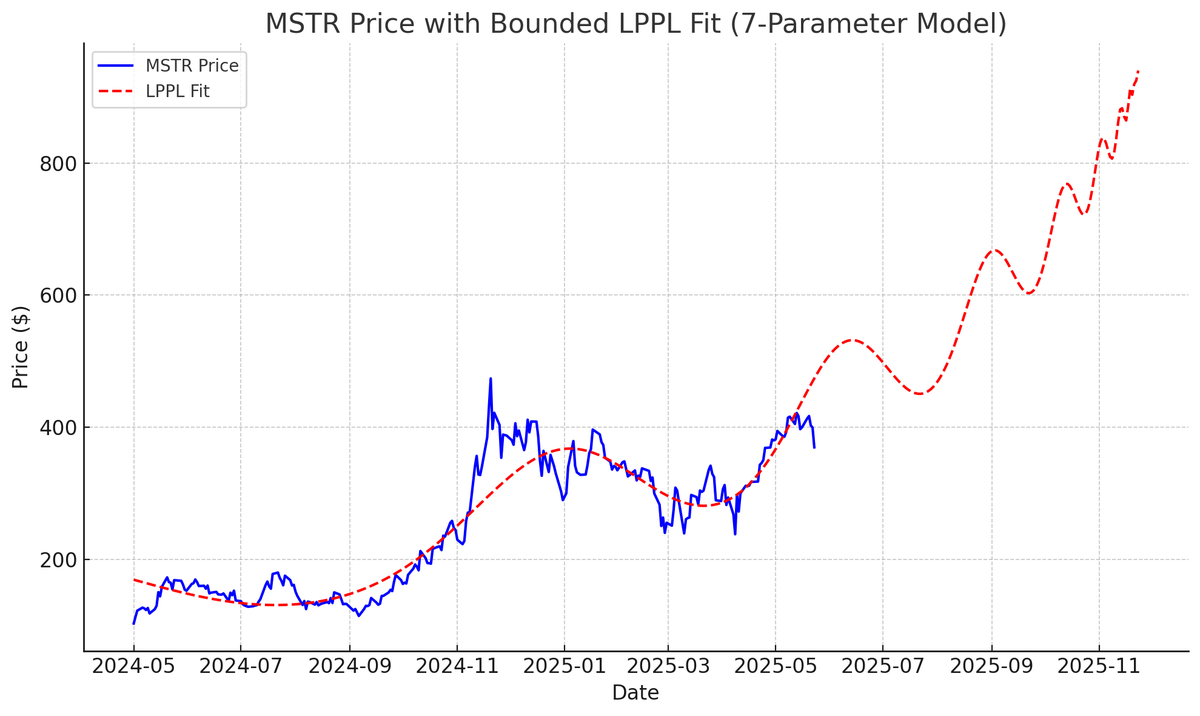
Log periodic power law (LPPL) model of Sornette for a bubble peaking in Q4 for $MSTR suggests $940 objective.
The LPPL is not the same as the power law main trend for $MSTR which is around 7th power of Bitcoin's age, it is a model particular to bubbles, if they arise.
Model quite sensitive and takes many ~ 10,000 iterations to converge so will need frequent updating. If $500 reached later this month would be interesting.
More details in Physics of Bitcoin show Wed. 8:15 PM PDT with @Giovann35084111
strike, strife, stride, stripe next?
English