

真
1.6K posts

最近在网络上,一些来自某个Shithole Country的无知人类总拿「士农工商」这种过时的中国阶级观来哗众取宠
实际上这才是中国的「种姓制度」,
习近平>红色官僚>共产党官员>卫星政党官员>一切非政治职业
「党政军民学,(中国共产)党领导一切」才是中国的社会现状

中文

印度人的抱团有利于开疆拓土,甚至抢占它国政治席位,国家合并之时,那将是揭露底牌的时刻。唯有华人或者汉人被各种内外势力进行分割,成为原子化,无法聚沙成塔,这样有利于维稳(灭汉),华人(汉人)的上限就是工具人,一旦陷于战乱只有被图的份儿,满清带来的遗毒就是主子奴才糟粕,没了民本思想。
Joey Jia@JoeyJoe19315230
@WKAble_CN 华人或者说汉人的逆向民族主义思想,和满清两百多年的奴役有很大关系(这个过程中,大量汉文化被消灭+篡改,同时产生了大量汉奸) 满清后面又马上接上了西方入侵,日本侵华,然后又是共产主义思想,然后又是走资派掌权走上资本主义道路 导致汉人的文化在最近几百年先被消灭打断,又经历数次大转折
中文


Indians trying to turn China’s 士农工商 into a “caste system” is just projection.
士农工商 was not hereditary caste.
It was not blood purity.
It was not religiously sanctioned birth imprisonment.
It did not lock people into a lifelong social cage the way India’s caste system did.
It was a theoretical ranking of occupations in traditional Chinese society, with mobility, examinations, land ownership, commerce, migration, and dynastic change constantly reshaping status.
But of course, people raised inside caste logic assume every civilization must be diseased in the same way.
So they project India’s own social pathology onto China, then pretend it is a universal standard.
China did not build a civilisation around telling millions of people they were born polluted, untouchable, and spiritually inferior.
That is not Chinese history.
That's India.
ଚୀନର ସମୁଦ୍ରଗୁପ୍ତ 🇲🇴🇭🇰🇹🇼🇲🇳@Utkala_Kalinga
@nngzhng1819334 @IntelShadowOp Shang 🫵
English


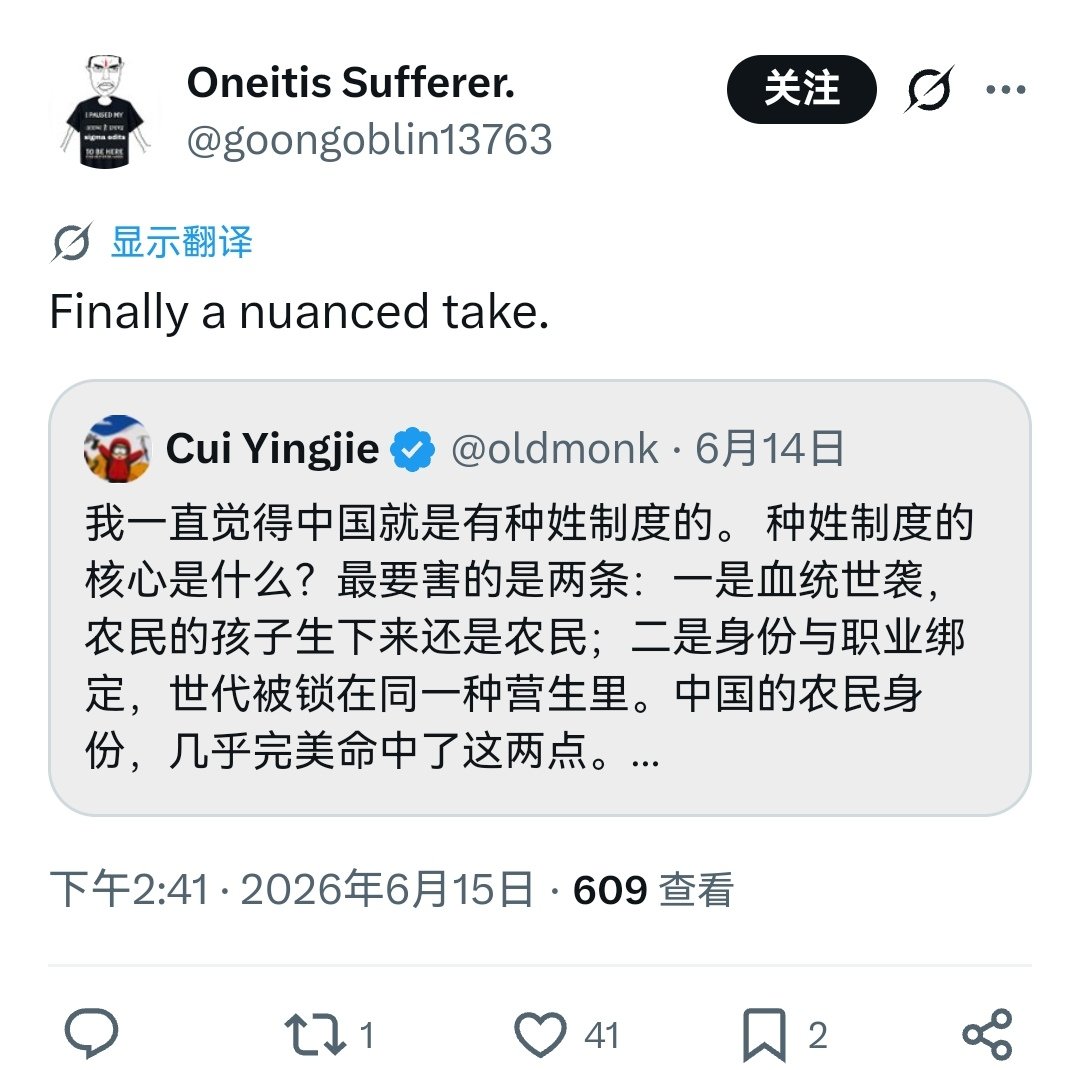

我一直觉得中国就是有种姓制度的。 种姓制度的核心是什么?最要害的是两条:一是血统世袭,农民的孩子生下来还是农民;二是身份与职业绑定,世代被锁在同一种营生里。中国的农民身份,几乎完美命中了这两点。
而城市户口也有等级,北京户口就是中国户口制度中的婆罗门
Michael Anti@mranti
印度人为了证明“不仅印度,中国你也有种姓制度”,费尽心思,竟然根据古代“士农工商”划分,杜撰中国至今也有种姓制度,而最底层是Shang,所以他认为《尚气》电影没在中国放映,是因为Qi这个高种姓名字混合了低种姓Shang的名字,所以中共禁了电影。这真是认为皇帝废太子是因为太子多吃了一个馒头啊!
中文


中国倒是确实有真达利特,就是贱籍,甚至在阶级史观根深蒂固的时代也在历史叙事中消失的存在。不过中国历史确实很难出现真正的万年达利特,而原因倒是很地狱笑话——因为周期性治乱循环的存在,只要能活过大洪水就能把贱籍一笔勾销,还有大片无主的荒地留给你开垦。好了,现在唯一的问题就是如何活过去
我早就不是建制派了@LastExeX01
看了下牢印扯士农工商和种姓制度。 其实这两个不太一样,士农工商类似于近代行会/法团主义,但多了一层隐形等级制和政治统战的意味。 士是各级官僚,处于最顶端的原因不必多说。 农,农民在封建社会被束缚在土地上,因而只要封建王朝能控制土地和人口的流动,便能控制农民获得税收。
中文

Indian nationalists trying to rebrand India as the "civilizational mother" of China is hilarious.
Yes, Buddhism entered China.
So what?
Civilization advances through mutual learning.
When a weaker culture absorbs a stronger one, it is called learning.
When a stronger culture adopts from a weaker one, it is called selective acceptance.
India has never been the organizing center of a global civilization.
China has.
India exported fragments.
China built an order.
That is the difference.
Sanskrit influenced Chinese vocabulary the same way Latin influenced English.
Does that make England a Roman colony?
No.
Buddhism arrived in China.
Then China did what strong civilizations do:
Created Chan (Zen).
Carved Longmen.
Painted Dunhuang.
Integrated Buddhist thought into aesthetics, philosophy, and statecraft.
India provided raw material.
China engineered a transformation.
Xuanzang did not go to India to bow.
He went because Tang China was rich, confident, and intellectually insatiable.
Chang'an was the world's greatest metropolis.
The Tang Empire didn't need India to define civilization.
It took what it wanted, translated what it needed, and reshaped it into Chinese.
Strong civilizations are not eternal students.
They digest foreign material and turn it into their own canon.
So no, India is not China's mother.
India was merely one source among many in China's vast process of digestion.
The raw materials came in.
The Chinese system cooked the feast.
The final form is, and always will be, Chinese. 🇨🇳
Maitreya Bhakal@MaitreyaBhakal
Suggestion for Indian anti-China propagandists: If your objective is to elevate India's status, stop attacking modern China and focus on ancient China. Start emphasizing the extraordinary scale and depth of India's historical influence on Chinese civilization. Talk more about China's historical "debt" to India. This is a far more effective line of attack than contemporary geopolitics or economics. There's more than enough raw material. Many are completely unaware of the sheer scale we're dealing with here. People think that the cultural exchanges (which were largely one-sided) began and ended with Buddhism. In truth, Buddhism is merely the tip of the iceberg. It's not even close to the whole story. Indeed, if Indian influence and contribution to Chinese civilization is removed, Chinese culture and history would be virtually unrecognizable. The sheer volume of ideas, philosophies, cultural concepts, scientific knowledge, artistic traditions, religious practices, and technologies that travelled from India to China frankly boggles the imagination. The list is simply endless: Logic and epistemology, metaphysics, philology, phonetics (Chinese could literally understand their own language and pronunciation better because of Sanskrit and Prakrit), astrology, astronomy, calender science, clothing, food, medicine, surgery, biology, art, sculpture, cosmology, meditation, music, dance, performance art, biology, botany, knowledge of medicinal plants...and that's just for starters. And it's not just the scale, the depth is equally astonishing. One would be hardpressed to find a single element of Chinese culture, society, and history that was untouched by India. Whole Indian branches of the above arts and sciences were adopted wholesale and incorporated into their Chinese equivalents, across centuries and across generations. It was possibly the greatest civilizational transfer of knowledge in human history. ------- As an example, everyone knows that Chinese considered China the "middle kingdom" - the center of the world. Yet, it was India that Chinese philosophers considered the spiritual center of the world, including the physical center in Buddhist cosmology (which Chinese Buddhists adopted), and the source of sacred knowledge. India was the most noble and most honored land, and was simply considered heaven. Chinese travellers would cross mountains, both literal and figurative, to reach India and learn its teachings. Call it kanging on a civilizational scale. India was basically the Holy Land for Chinese intellectuals. A common claim amongst historians is that India was the teacher and China the student. Astonishingly, many ancient Chinese intellectuals and philosophers would themselves agree with this claim. They openly referred to India as the teacher who they wished to learn from. As a comparison, for ancient Chinese, India occupied a position even far higher than Greece did for many Roman intellectuals back in the day. To take another damning example, when Indian logic first got transmitted to China, Chinese experts simply didn't understand it. So they had to be trained on it. Indian logical systems required extensive clarifications and interpretations before they could be assimilated into Chinese intellectual traditions. Indian philosophers had to actually explain it from first principles, and then translate Sanskrit texts into Chinese themselves (after learning Chinese), since understanding that kind of logic is important to understanding Sanskrit. This is why much of the translation of Sanskrit texts into Chinese was almost completely dependent on Indian expertise. This lasted until travelers like Xuanzang came to India, learned how to do it, and established their own translation bureaus back home. And even then, homegrown expertise took a long time to be fully established in China. Indeed, entire new Chinese vocabulary had to be invented to incorporate Indian philosophy and concepts, since Classical Chinese literally didn't have the words to describe them. It was only after this entire process that Chinese Buddhists were able to understand and appreciate Indian philosophy, and then adapt it by fusing elements of their own philosophy into it. This is the origin of the entire (sub)field of Chinese Buddhism. And if you think that's too overwhelming, absolutely do NOT research the origins of Chinese martial arts - perhaps the one thing China is most known for globally after Chinese food (which also has significant Indian contributions). In fact, all of the above combined is not even 0.01% of the KNOWN scope and depth of the philosophical, cultural, and scientific transmission.
English


You do not understand the Indian caste system if you think those system are similar. The Indian caste system enforced those at the lowest rank (the Dalit people) as "forever slaves", meaning you can't escape it through merit, economics, political status or even marriage.
若鹭姬工作室@Meikawa2001
@genHCM 虽然其实中国古代(我不清楚越南有没有类似的制度)也确实有一些可以算得上有种姓性质的制度的 比如元朝的四等级人(蒙古人-中亚人-北方汉人-南方汉人),以及元朝和明朝的“JunHu”(“军户”)制度 但…他们居然会把ShiNongGongShang四个职业,以及户籍制当成种姓😂 另外,因为他们太好笑:Merchant🫵
English


Suggestion for Indian anti-China propagandists: If your objective is to elevate India's status, stop attacking modern China and focus on ancient China. Start emphasizing the extraordinary scale and depth of India's historical influence on Chinese civilization. Talk more about China's historical "debt" to India. This is a far more effective line of attack than contemporary geopolitics or economics.
There's more than enough raw material. Many are completely unaware of the sheer scale we're dealing with here. People think that the cultural exchanges (which were largely one-sided) began and ended with Buddhism. In truth, Buddhism is merely the tip of the iceberg. It's not even close to the whole story. Indeed, if Indian influence and contribution to Chinese civilization is removed, Chinese culture and history would be virtually unrecognizable.
The sheer volume of ideas, philosophies, cultural concepts, scientific knowledge, artistic traditions, religious practices, and technologies that travelled from India to China frankly boggles the imagination. The list is simply endless: Logic and epistemology, metaphysics, philology, phonetics (Chinese could literally understand their own language and pronunciation better because of Sanskrit and Prakrit), astrology, astronomy, calender science, clothing, food, medicine, surgery, biology, art, sculpture, cosmology, meditation, music, dance, performance art, biology, botany, knowledge of medicinal plants...and that's just for starters. And it's not just the scale, the depth is equally astonishing. One would be hardpressed to find a single element of Chinese culture, society, and history that was untouched by India.
Whole Indian branches of the above arts and sciences were adopted wholesale and incorporated into their Chinese equivalents, across centuries and across generations. It was possibly the greatest civilizational transfer of knowledge in human history.
-------
As an example, everyone knows that Chinese considered China the "middle kingdom" - the center of the world. Yet, it was India that Chinese philosophers considered the spiritual center of the world, including the physical center in Buddhist cosmology (which Chinese Buddhists adopted), and the source of sacred knowledge. India was the most noble and most honored land, and was simply considered heaven. Chinese travellers would cross mountains, both literal and figurative, to reach India and learn its teachings. Call it kanging on a civilizational scale. India was basically the Holy Land for Chinese intellectuals.
A common claim amongst historians is that India was the teacher and China the student. Astonishingly, many ancient Chinese intellectuals and philosophers would themselves agree with this claim. They openly referred to India as the teacher who they wished to learn from.
As a comparison, for ancient Chinese, India occupied a position even far higher than Greece did for many Roman intellectuals back in the day.
To take another damning example, when Indian logic first got transmitted to China, Chinese experts simply didn't understand it. So they had to be trained on it. Indian logical systems required extensive clarifications and interpretations before they could be assimilated into Chinese intellectual traditions. Indian philosophers had to actually explain it from first principles, and then translate Sanskrit texts into Chinese themselves (after learning Chinese), since understanding that kind of logic is important to understanding Sanskrit. This is why much of the translation of Sanskrit texts into Chinese was almost completely dependent on Indian expertise. This lasted until travelers like Xuanzang came to India, learned how to do it, and established their own translation bureaus back home. And even then, homegrown expertise took a long time to be fully established in China.
Indeed, entire new Chinese vocabulary had to be invented to incorporate Indian philosophy and concepts, since Classical Chinese literally didn't have the words to describe them.
It was only after this entire process that Chinese Buddhists were able to understand and appreciate Indian philosophy, and then adapt it by fusing elements of their own philosophy into it. This is the origin of the entire (sub)field of Chinese Buddhism.
And if you think that's too overwhelming, absolutely do NOT research the origins of Chinese martial arts - perhaps the one thing China is most known for globally after Chinese food (which also has significant Indian contributions).
In fact, all of the above combined is not even 0.01% of the KNOWN scope and depth of the philosophical, cultural, and scientific transmission.
English
@MaitreyaBhakal 佛教并没有你想象中有那么大的影响力,现代中国佛教只是统治者打压、驯化后的,与原始佛教没有多少相同之处。中国武术起源于印度就十分可笑,现代中国武术大多数来源于古代的帮派、黑社会和镖局,由于法律管控严格,所以有各种各样的的武器,而印度自古以来就不是崇尚武力的民族,宗教辩论更适合你们。
中文

@MaitreyaBhakal 你是一个狡猾的印度人,懂得很多知识,比你那群在那里shang来shang去的弱智同胞们厉害的多。佛教,中医,甚至还有其他很多大家误以为的中国传统文化,确实都是从印度传来的。譬如神话角色里的哪吒、孙悟空。
中文
@henrysgao The primary objective is to control the oil in the Middle East, create oil shortages to harvest the economies of other countries, and help Israel resolve Iran.
English
@yukkurieconomic 因为在中国几乎没有多少学校把资金投入到足球项目中,我记得我中学的时候体育仓库里的足球一个月几乎没有怎么使用,都沾满灰尘,而且体育课有时候会变成数学、语文或英语课。
中文


