پن کیا گیا ٹویٹ
An essay.
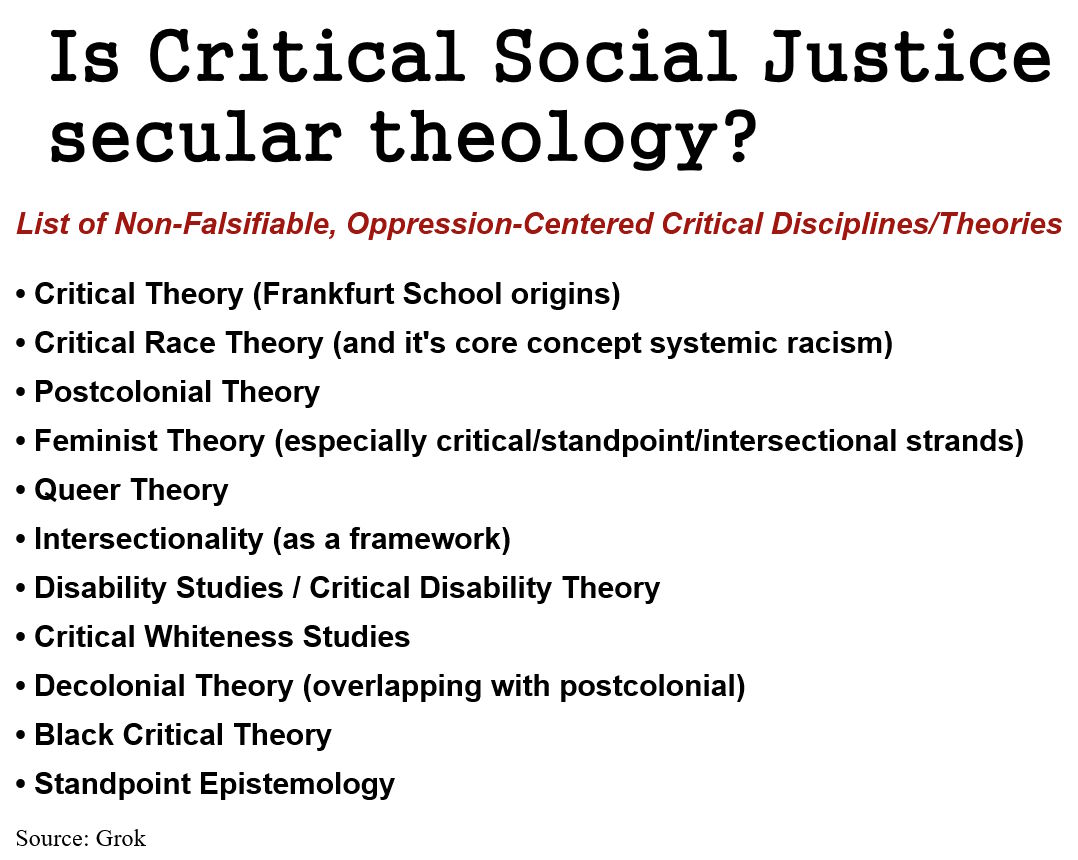
Is Critical Social Justice secular theology?
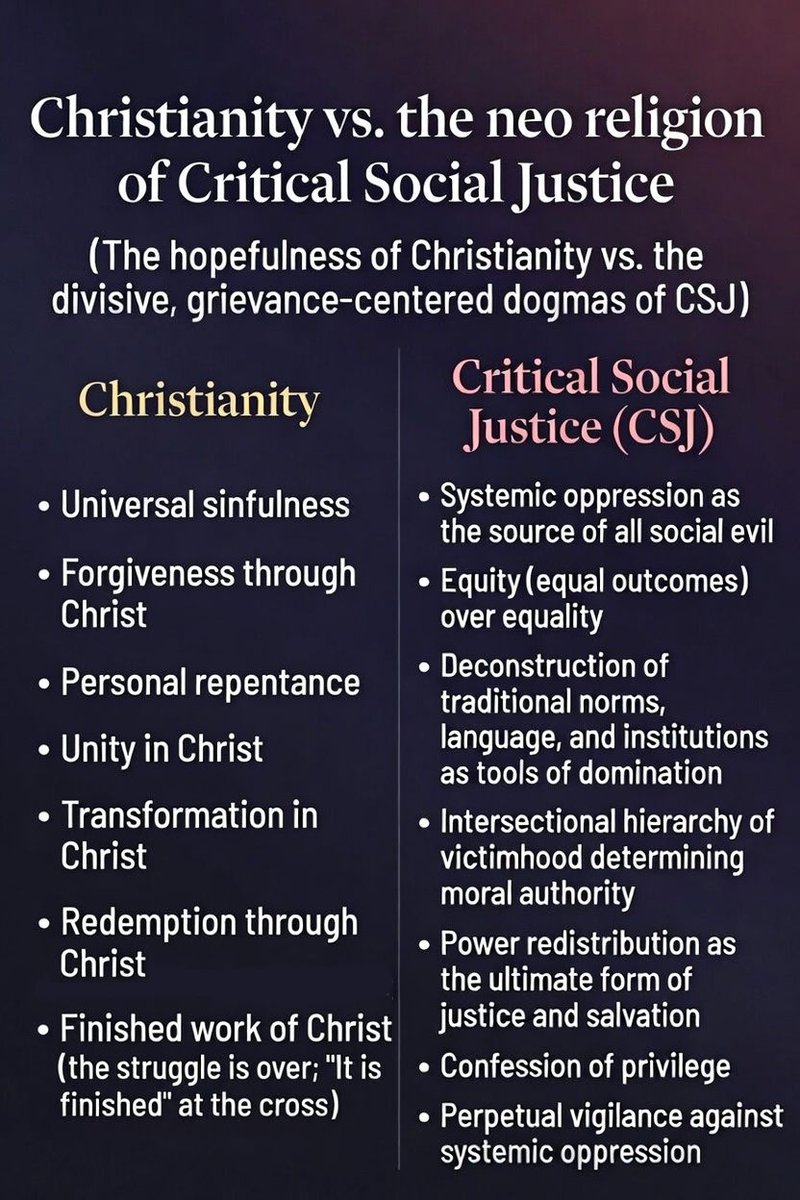
(How Quasi-Religious Critical Theories Captured Institutions )
In #philosophy, it's common and normal to start with a provisional axiom and argue as if it's true for the sake of exploration—these are often called provisional assumptions, and they're meant to be challenged, revised, or dropped if they don't hold up. But in the oppression-centered critical disciplines (CRT and its many cousins like postcolonial theory, queer theory, critical feminism, etc.), the core axioms are not provisional. They are treated as settled realities or foundational truths. For example, CRT scholars like Richard Delgado and Jean Stefancic describe racism as "ordinary, not aberrational"—the normal, everyday way society does business, embedded in every nook and cranny—and you basically have to accept this "settled reality" of systemic racism (and related premises) to even engage meaningfully in the field. There are plenty of other core assumptions like this, and I call them non-provisional certainties or dogmatic axioms: they're not starting points open to genuine examination; they're treated as structural givens that define the inquiry.
Non-provisional certainties show up occasionally in the humanities, but they're absolutely central to theology and religious studies. Theologians openly start from unfalsifiable core axioms—like "God exists" or "Scripture is divinely inspired"—and then build arguments and interpretations within that protected framework. Theology embraces its foundational commitments as matters of faith and revelation. It doesn’t pretend to be neutral empirical science or even neutral philosophy. But the oppression-centered critical disciplines do pretend exactly that.
Here’s my main point… CRT, systemic racism theory, decolonialism, whiteness studies, and the rest are strikingly similar in structure to theology. They operate with dogmatic axioms at their cores—almost in a neo-religious sense. When challenged, counter-evidence gets re-framed as proof of even deeper oppression rather than disconfirmation. For example, criticisms or critiques of CRT (or related theories) are often treated as manifestations of latent racism, defensiveness, or complicity in maintaining the status quo. Another example - advocating for colorblind policies or meritocracy or individual equality under the law (i.e., arguing against equity) is re-framed as a tool that perpetuates racism by ignoring structural realities. In both these examples, they literally defend themselves by saying you're racist for asking those questions.
These frameworks claim the authority of scholarship and real-world insight, but their non-provisional starting points make them function more like a quasi religion than open scientific inquiry. And they resist any serious examination. Criticisms and critiques are often 'thrown back' on the questioner, like an ad-hominem attack.
For most of their histories—from emergence in the late 1970s/80s through the 2000s and early 2010s—these oppression-centered critical disciplines (CRT and its cousins) grew largely unchallenged in academia and steadily permeated society. They expanded into education, sociology, cultural studies, DEI, corporate training, and public policy without much scrutiny or pushback on their non-provisional axioms. This unchallenged ascent let them accumulate massive institutional power: shaping curricula, hiring, funding, policies, and norms around race, equity, and justice. They've become incredibly powerful.
These quasi-religious frameworks have embedded deeply in elite institutions, government, and business—yet they're rarely recognized as such, still cloaked as neutral scholarship. They wield real-world influence far beyond what provisional, non-evidence-based critical theory should ever achieve. But unchecked growth doesn't prove validity; it just shows how 'asleep at the wheel' critics and society were. Serious critiques have emerged from voices like James Lindsay, Thomas Sowell, Jordan Peterson, Chris Rufo and the Heritage Foundation, but IMO they haven't broken through widely yet. It's time to expose this dominance further. How do we raise public awareness? IMO this could be the defining issue of our time—these disciplines have shaped the entire social justice movement into a quasi-religious force.
Have these disciplines redefined what it means to be American? I think that’s not an overstatement. For most of American history individual liberty, natural rights and personal virtue were our central moral framing. Now the framing has largely shifted to race and power (oppressed vs oppressor) and these disciplines are largely responsible for that shift. They have become incredibly influential. And, in my opinion, they currently hold the upper hand.
And so awareness of their theological structure isn't an endpoint; it's the spark that must ignite broader scrutiny and, ultimately, the restoration of genuine inquiry over ideology and dogma. DEI, CRT, systemic racism and all of them come from a literal secular theology!
Ultimately, the battle isn't merely over policy or evidence—it's over perception. We must strip away the pretense of neutral, scientific inquiry and reveal these oppression-centered critical disciplines for the quasi-religious frameworks they are: structured around non-provisional certainties, dogmatic axioms, and mechanisms of doctrinal defense that mirror theology far more than social science.
These quasi-religious Oppression-Centered Critical Theories have captured institutions and much of America. We must persistently name this reality—through clear explanations, public debates, accessible writings, and everyday conversations. We must fight to equip the average American to see beyond the academic veneer. And we must fight to expose the entrenched and continuing threat these theology-like, quasi religious ideologies pose.
-Ian Ferrin Feb. 6, 2026
English