SentosaLife
108 posts

Want to start investing but don’t know where to begin?
I found an amazing beginner's guide to investing from Goldman Sachs.
Do you want to receive it?
1. Like this post
2. Comment "send" below
3. Get immediate access
English



Pretend you are selling a house for $1.65mm
A buyer bids $1.495mm
What would be your counteroffer?
(serious replies only)
English
@Quality_stocksA What do you mean by “a market cap above 10%”?
English

💎🧼🍾 Companies in the consumer staples sector with a net profit margin > 1⃣5⃣% and a market cap above 10%
🇺🇸🚬 Altria $MO 39.6%
🇬🇧🚬 British Am. Tobacco $BATS 29.6%
🇮🇳🚬 ITC $ITC 29.3%
🇺🇸🥤 Coca-Cola $KO 24.1%
🇺🇸🧃 Monster Beverage $MNST 23.1%
🇺🇸🍷Brown-Forman $BF 22.4%
🇺🇸🚬Philip Morris $PM 22.2%
🇬🇧🍺 Diageo $DGE 20.0%
🇺🇸🧼 Procter&Gamble $PG 18.6%
🇫🇷🍷 Pernod Ricard $RI 18.3%
🇺🇸🍺 Constellation Brands $STZ 17.4%
🇯🇵🚬Japan Tobacco $2914 16.9%
🇺🇸🍫 Hershey $HSY 16.9%
🇬🇧🧼 Reckitt Benckiser $RB 16.1%
🇫🇷🧴 L'Oreal $OR 15.0%
English

Make your first guess of the country 99.99% will fail to answer the correct name

English


Just had a one hour wait in immigration queue in Madrid Airport. One officer for a few plane loads of people. Happens every week. Welcome to Spain. Thanks Brexit.
English

I talk a lot about the value of getting into the right rooms.
Here’s my plan to help you get into them:
Something amazing happens when you bring together ambitious big thinkers into a single room.
Unfortunately, access to these rooms is not evenly distributed.
I want to do my part to fix that.
In 2024 and beyond, I’m making it my mission to open up access to these rooms so that everyone can benefit from them the way I have.
What that means: Live events in cities around the world, at the lowest possible cost (ideally free or close to it).
The exact format of these events is TBD, but I have lot of ideas:
- On stage fireside chat
- Small group breakouts (depth)
- Large group gathering (breadth)
- Optional dinners/events
If this is something you’d be excited to attend, comment below with your city so we can add it to our list!
Let’s create more amazing rooms—and open the doors to them.
The future is bright.
English


Name this pro golfer?
Winning guesses receive a FREE instructional program 🔥
English

Bond math is now key to today's financial markets
Let know if you'd like the sheet.
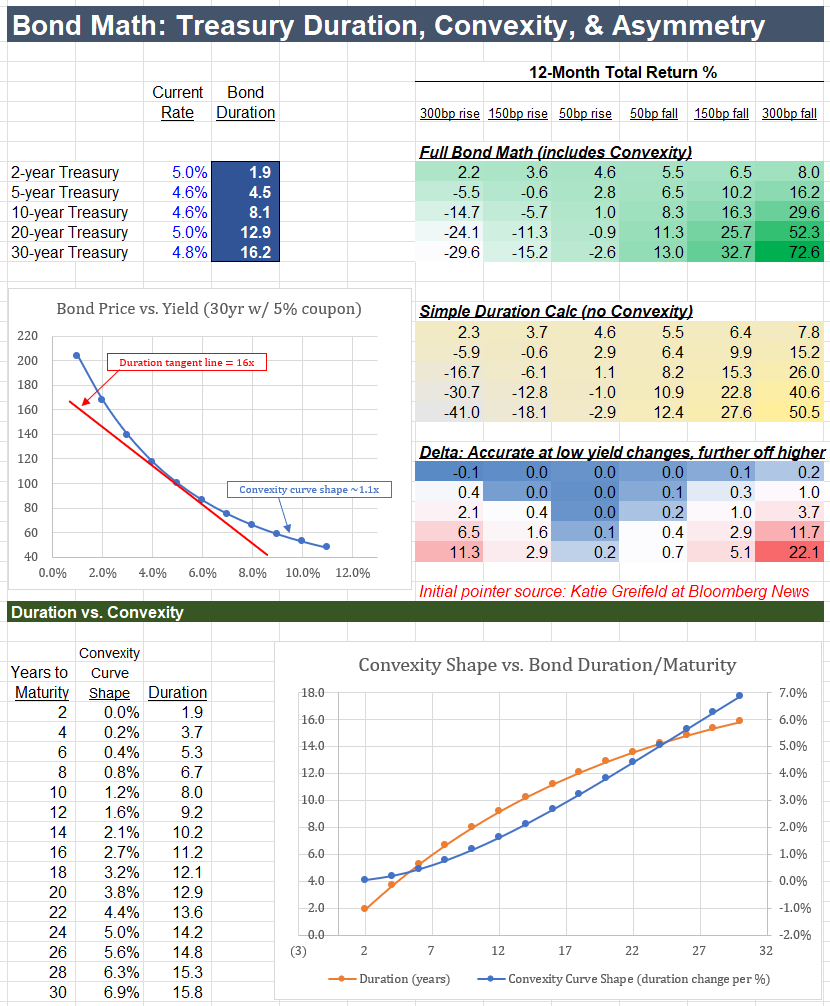
The table on the right reflects a powerful new dynamic:
If rates fall 50bps, 20yr Treasuries earn 11.3% over the next year.
But if rates rise by 50bps, they lose just 0.9% -- an 11:1 up/down ratio.
The 5 year-average 20yr yield is just 2.5%, compared to today's 5%+ yield.
At that lower history, the same 50bps up/down math sat at just 2:1, much less skewed.
So in the context of recession fears, commodity shock, and mixed econ data, that return skew is drawing cross-asset investors -- hedge funds & asset managers normally less involved in Treasuries.
This competition for capital is one of many mechanisms by which higher rates challenge equity returns.
Several items are pushing long rates up: the rise of JGB long rates, US deficits, persistent inflation, the dollar, and others.
But implicit in the new investor framing of long-bond risk/reward is also the changing impact of the duration math, and the role of convexity across the curve.
Which is worth understanding.
Duration describes the average time it takes to receive any set of cash flows.
Whereas a bond's maturity is simply the date principal is repaid.
As a result, maturity and duration differ if there is a coupon: the larger the coupon relative to the principal (& price), the shorter the relative duration.
So, if a 10yr bond at par has no coupon, its duration is 10 years.
If the same bond has a 10% coupon, its duration is 6.5 years, since much of the total cash investors get comes in every year via coupon.
But the duration has another very useful property:
It also exactly equals the bond price change associated with a 1% change in its yield.
Thus, for the same 6.5 year duration bond, if the yield falls to 9%, the price rises from 100 to exactly 106.5.
The next question is how duration changes:
Is the 6.5 duration constant as yields move from 10% to 9% to 8%?
No -- because the weighted average life has changed at each increment.
This change is the bond's "convexity."
And it is the driver of why a 3% rate fall means a gain of 70%+ while a 3% rise means a loss of just 30%.
You can see that difference in the first chart below:
Red is the duration of a 5% coupon / 5% yield 30-year bond: 16 years.
Blue is the actual bond price across yields.
The difference between the two lines is the effect of convexity:
The price change slows as yields rise
And rises steeply as yields fall.
Next shows the curve of convexity itself shifting across maturities.
Directional views on Treasuries here are a function of growth path, fed policy, and a host of other factors.
Sometimes you make that bet.
But other times, or if you're restricted to markets competing for scarce capital,
Knowing the asymmetries & reaction functions across markets
Improves your ability to anticipate and act
In your area of focus.
That's all for now.
Let know if you'd like the math.
English

Excited to be part of one of the world’s oldest tournaments this week the @accionaopen It’s now leading the way in sustainability on the @DPWorldTour Tomorrow’s tee time is 2pm… Bring it on Madrid! 🇪🇸
English