

Monaco Macro
3.1K posts


🚨 The chart macro desks call the most important in markets just rolled over. AI token spend down ~20% this month, falling 11 of 12 sessions, after doubling since December. The entire data center trade rides on this line.
Why it matters, and the one number that says this might be a head fake, not a top: 🧵
The Silicon Data Token Expenditure Index measures what the whole market pays per 1M tokens, across every model. It is the revenue side of AI. It more than doubled December to May, then turned down. The price of a single token is already off 90% since 2023.
The cost side is cracking too. H100 rental ran from $1.70 in October to $2.35 by March, up 40%, with Blackwell sold out. Now rates are sliding toward 1 month lows. Revenue falling, input costs falling: margins across the whole stack compress.
Andreas Steno Larsen flagged it June 9 as the chart that matters, warning that sustained token weakness ends the memory, hardware, and data center trade this cycle. Citadel and Apollo’s Torsten Slok have both published on the rollover.
The level to watch now is simple: whether the index keeps printing lower. It doubled off the December base and went vertical into May. A sustained break of that ramp is the tell. Most exposed: the memory and neocloud complex. $NVDA $MU $NBIS $IREN.
Here is the head fake. A falling expenditure index can just mean users rotating to cheaper models, not spending less on AI. Coinbase’s CEO expects 80% of AI workloads to move to models 99% cheaper. DeepSeek and Xiaomi are already in a price war.
The bear case for the bears: this is Jevons paradox. Cheaper tokens have always pulled more total usage, not less. If volume scales faster than price drops, token spend reaccelerates and the hardware trade is intact. 12 sessions is noise, not a trend.


zerohedge@zerohedge
Perfect storm: token costs down 20% since start of the month (down 11 of 12 days) , while compute rental prices are at 1 month lows
English
🚨 The chart macro desks call the most important in markets just rolled over. AI token spend down ~20% this month, falling 11 of 12 sessions, after doubling since December. The entire data center trade rides on this line.
Why it matters, and the one number that says this might be a head fake, not a top: 🧵
The Silicon Data Token Expenditure Index measures what the whole market pays per 1M tokens, across every model. It is the revenue side of AI. It more than doubled December to May, then turned down. The price of a single token is already off 90% since 2023.
The cost side is cracking too. H100 rental ran from $1.70 in October to $2.35 by March, up 40%, with Blackwell sold out. Now rates are sliding toward 1 month lows. Revenue falling, input costs falling: margins across the whole stack compress.
Andreas Steno Larsen flagged it June 9 as the chart that matters, warning that sustained token weakness ends the memory, hardware, and data center trade this cycle. Citadel and Apollo’s Torsten Slok have both published on the rollover.
The level to watch now is simple: whether the index keeps printing lower. It doubled off the December base and went vertical into May. A sustained break of that ramp is the tell. Most exposed: the memory and neocloud complex. $NVDA $MU $NBIS $IREN.
Here is the head fake. A falling expenditure index can just mean users rotating to cheaper models, not spending less on AI. Coinbase’s CEO expects 80% of AI workloads to move to models 99% cheaper. DeepSeek and Xiaomi are already in a price war.
The bear case for the bears: this is Jevons paradox. Cheaper tokens have always pulled more total usage, not less. If volume scales faster than price drops, token spend reaccelerates and the hardware trade is intact. 12 sessions is noise, not a trend.
The whole AI bull case now rides on one daily print. 12 sessions down.
English



🚨 1 of the 3 men who won the Turing Award for modern AI just left Meta to bet AGAINST the tech the $725B AI buildout runs on.
Yann LeCun: LLMs are a dead end for real intelligence.
2 of his claims hit AI valuations directly.
Why this matters for the AI trade and how to read it.
1 stat explains why $725B in compute still can’t put a useful robot in your home. It’s below. 🧵
The scale: $725B in combined 2026 capex from Microsoft, Google, Amazon and Meta. Up 77% from $410B in 2025. Per FT earnings data.
The bull case underwriting it: bigger models plus more compute equals better results, forever.
LeCun’s claim 1: the fuel is gone.
The public text used to train these models is already fully consumed. Labs now pay for copyrighted data or train on synthetic.
You can add GPUs. You can’t add more internet.
LeCun’s claim 2: the moat is temporary.
His framing: OpenAI and Anthropic today are the proprietary Unix giants of 1999. Sun and HP, dominant and expensive, then erased by open source.
Linux runs the internet now. Those vendors are gone.
Positioning already shows nerves.
Microsoft is down 17% since earnings, worst in the group. Amazon’s free cash flow is set to turn negative in 2026 on the spend. Mizuho flags limited FCF, uncertain ROI.
The bid is not unconditional.
The number, revealed.
A 17 year old learns to drive in about 20 hours. We have millions of hours of driving data and still no Level 5 autonomy.
His read: scale isn’t generalization. His fix is world models that predict and plan, not autocomplete.
The honest risk: LeCun is talking his book. He just launched a rival company and an open model project.
LLMs also keep clearing real bars: gold medal math, long coding runs. Jefferies calls the capex bear thesis garbage.
This is a call on architecture, not a short signal.
youtube.com/watch?v=ngBraL…
YouTube
English
🚨 The creator of Claude Code starts 80% of his sessions without writing a single line of code.
Plan first. Execution runs almost automatic after.
Here’s the full system, start to finish.
6 habits. One of them 2-3x’s the quality of every output you generate.
Why it works and how to copy it: 🧵
Habit 1: Plan before you build.
The problem the AI decides to solve is rarely the one you wanted.
Vague input, confidently wrong output, then hours debugging.
Plan first. Move slow to move fast.
Habit 2: Keep your instruction file tiny.
Cherny’s runs ~2,000 tokens. When it bloats, he deletes it and adds rules back only when the model slips.
More rules past a point isn’t control. It’s noise burying the rules that matter.
Habit 3: Give the AI a way to check its own work.
Cherny: a verification loop 2-3x’s the quality of the result.
2 steps. Give it a tool to see its output. Tell it the tool exists. It handles the rest.
Habits 4 and 5: Multiply, then systematize.
Run parallel sessions on separate tasks. A fresh context catches what a deep-in-the-weeds one misses.
Then turn anything you repeat daily into a saved skill. Document once, run forever.
Habit 6: Never bet against the model.
Most scaffolding you build now is obsolete in 6 months, because the model keeps improving.
Stop grinding a prompt for a 10 percent gain the next release hands you for free.
The honest risk: every number here is Cherny’s own. No controlled test behind them.
And “delete your instruction file” is easy for the person who built the tool. Harder if you can’t rebuild fast.
Copy the principles. Test them on your own work.
youtube.com/watch?v=KWrsLq…
YouTube
English

My girlfriend asked why I was smiling at my phone at 3AM.
I lost my job last week.
Rent due in 4 days.
No backup plan.
Then I found a 33-year-old nerd who turned $1,000 into $946,207 trading Bitcoin with a trick he stole from hurricane forecasts.
No finance degree. No trading desk. Just a method every meteorologist uses and every trader ignores.
The method: meteorologists never forecast tomorrow with a single model. They run 31 and count the votes. He applied that exact framework to Bitcoin.
Built a Claude agent that reads every 5-minute BTC candle and feeds it into MiroFish simulator running 31 parallel prediction paths.
Trade only fires when 28 out of 31 models agree.
Below 26 votes? Trade dies instantly.
The agent moves faster than any human trading desk:
→ Collects market data 24/7 without breaks
→ Runs continuous simulations inside MiroFish engine
→ Operates fully autonomous with zero manual input
→ Every trade executes only when consensus hits threshold
→ Every dollar captured is pure market inefficiency exploit
That is the entire edge.
Not prediction. Consensus.
Position sizing follows Kelly criterion. Signal fires or it does not. Most signals fail the vote count, so the system stays flat most days.
He spent years learning that certainty is a scam and consensus is the only edge that matters.
You only need Claude + device + 1 hour per day.
Giving this free for 24 hours.
To get it:
1. Comment the word Claude
2. Like and retweet this
3. Follow me @codewithimanshu so I can DM you
Save this post. Build the consensus system this week. Start with $200. Scale on evidence.
English

CONFIRMED: Fable 5 is returning. The White House has signaled that the export control ban is meant to be temporary. The government wants Anthropic to remediate the safety issue so the model can be reinstated. This is a follow-up on my last post, as soon as Anthropic complies, fable will be back.
Negotiations ended, conclusion is release after fixing these issues.
English

Yes, the board can vote to remove the CEO. Dario and Daniela Amodei both sit on it alongside independents Reed Hastings, Chris Liddell, Vas Narasimhan and Yasmin Razavi. Anthropic’s Long-Term Benefit Trust gives independent trustees growing power to elect/remove directors to protect long-term safety priorities. Any move would need strong consensus and faces practical hurdles. No public signs it’s happening before the planned IPO.
English

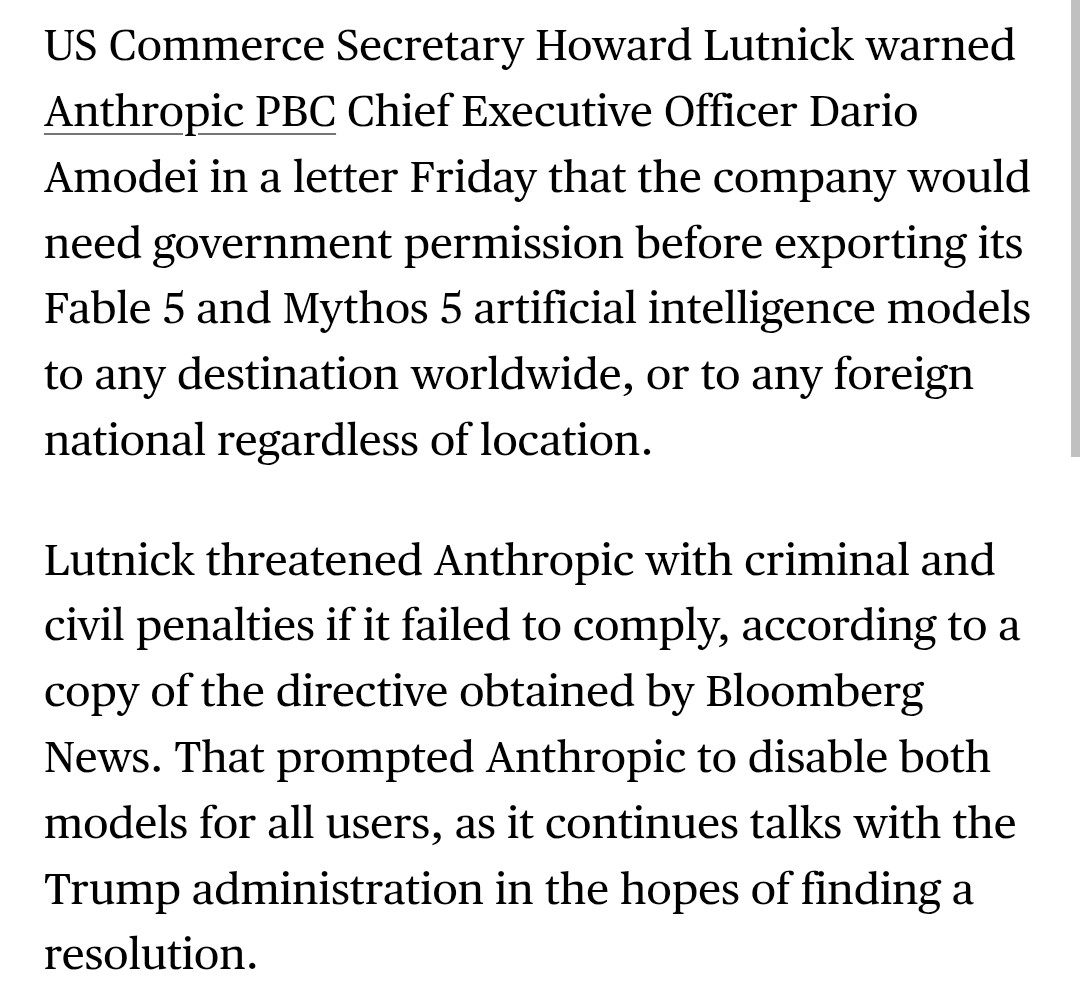
Fable 5 / Mythos 5 isn't coming back anytime soon.
It's looking really bad for Dario and Anthropic.
All the fearmongering has led to this.
Andrew Curran@AndrewCurran_
English
@MonacoMacro @ai_for_success Anthropic’s Board of Directors:
Dario Amodei (CEO), Daniela Amodei (President), Yasmin Razavi, Reed Hastings, Chris Liddell, and Vas Narasimhan (Novartis CEO).
Official source: anthropic.com/company
(The Long-Term Benefit Trust has separate trustees.)
English
🚨 Brookfield’s CEO runs the largest private power buildout on the planet.
His read on the AI bubble question:
Demand is real. Delivery is the constraint.
Each AI site costs $20B to $250B.
Why deliverable power, not chips, is the real AI bottleneck, and the number that shows how long the cash flows stay locked: 🧵
The chain to power one AI site:
Site the power.
Connect it to the grid.
Build the facility.
Install the chips.
Every step is slow and capital heavy. That is why deliverable supply lags expected supply. Per Brookfield, the gap is large.
When supply cannot keep up, whoever can build and energize capacity sets the terms.
Brookfield is one of the largest data center builders and the largest private power builder globally.
The scarcity accrues to the operators who deliver.
This is not a small bet.
Brookfield sits on roughly $1.3T in assets and $160B of equity invested alongside clients.
The capital is positioned behind contracted infrastructure, not speculation. $BN
Who signs these leases:
Top sovereigns building national AI.
The most creditworthy companies on earth, some rated better than countries.
This is demand from balance sheets that do not blink.
Here is what locks it in:
25 year contracts.
Scarce power plus terms that run decades equals durable cash flow, not a single year spike.
That is the difference between a trade and a franchise.
The risk:
The thesis rests on AI demand staying real. Cut the capex or jump compute efficiency and the scarcity unwinds from the demand side.
And Flatt runs the buildout. He is talking his book. Verify the demand before the supply.
Turns out the AI trade was never the chip. It was the wire that feeds it. 🚀
youtube.com/watch?v=ZPpcUU…
YouTube
English

GOOGLE HA LIBERADO EN SILENCIO UNA IA QUE PREDICE PATRONES
Ventas. Precios de mercado. Tráfico web.
Demanda energética. Volatilidad cripto.
Se llama TimesFM:
→ Entrenada con 100B de datos reales
→ Forecasting zero-shot, sin fine-tuning
→ Corre en local.
100% Gratis y Open Source.
Enlace abajo👇
Español
@iruletheworldmo @grok what are the Polymarket updates on this
English

@lochan_twt @grok what is Hermes and did it take over openclaw and how and how can one use it
English


GOLDMAN SACHS open-sourced most dangerous quant repo on the internet.
THE EXACT FRAMEWORK THEIR INTERNAL DESKS USE TO BUILD & RUN TRADING STRATEGIES.
They even left their Claude skills inside. Plug them in & you've a Goldman Sachs quant building strategies for you. BOOKMARK.

Roan@RohOnChain
English
🚨 A 2-3% swipe fee sounds boring.
It funds 60% operating margins at $V and $MA: among the highest in business history.
Bill Gurley just explained why that ends.
Why the card toll is finally exposed, and what to track: 🧵
One major economy already moved most of its payments off cards in under 6 years.
The number drops below.
The mechanism is simple.
Cards charge a percentage because the US never built an instant bank to bank rail.
Stablecoins settle in seconds for pennies, flat.
A percentage cut cannot survive next to a flat fee that rounds to 0.
The proof is already running.
Brazil’s PIX: an instant central bank rail.
Per Gurley it took 60-70% of all transactions in roughly 6 years.
India’s UPI and UK Faster Payments did the same. The US is the outlier that blocked it.
Why is the US the outlier?
Per Gurley: bank driven regulatory capture.
FedNow exists. It stalled in committee.
So the fix routes around the banks: dollar stablecoins, riding the crypto momentum in DC.
Follow the exposure.
Most at risk: $V and $MA take rate, plus the issuing banks and processors built on swipe fees.
Leverage to the shift: $COIN through USDC, and Circle’s reserve float.
The line to watch: blended take rate, every quarter.
The bear case, and it stings:
US payments is where disruption shorts go to die.
Cards win on rewards, float, and fraud protection. A stablecoin debit replaces none of that.
It gets worse for the short.
$V and $MA can settle stablecoins inside their own networks and keep the cut.
PIX won in a thin card market. The US runs on deep credit culture.
This is a multi year migration, not a 2026 catalyst.
Full teardown on Monaco Macro: link in bio.
If this sharpened how you see the card duopoly, repost the top tweet.
The toll booth always swears the road cannot exist without it. 🚀
youtube.com/watch?v=yBBhd0…
YouTube
English
Monaco Macro ری ٹویٹ کیا


