ꋪꃅ0ꀸ꒒ (𝔦, 𝔦) 🏴‍☠️ backup account

40 posts

ꋪꃅ0ꀸ꒒ (𝔦, 𝔦) 🏴‍☠️ backup account banner
ꋪꃅ0ꀸ꒒ (𝔦, 𝔦) 🏴‍☠️ backup account

ꋪꃅ0ꀸ꒒ (𝔦, 𝔦) 🏴‍☠️ backup account

@Rh0dl2

In the space since 2015 π Always searching for those early next-gen mover projects.

NGC 7727 شامل ہوئے Aralık 2025
67 فالونگ19 فالوورز
ꋪꃅ0ꀸ꒒ (𝔦, 𝔦) 🏴‍☠️ backup account ری ٹویٹ کیا
Sparta (𝔦, 𝔦)
Sparta (𝔦, 𝔦)@0x_Asuka·
@tigfoundation currently sits at $44M FDV. A 10x from current price would put us at the 185 spot. Even then, upside is still obscene at ~$10 per base:0x0c03ce270b4826ec62e7dd007f0b716068639f7b. TIG: • has no competitors • enjoys a monopoly on the most advanced vehicle routing algo in the world • produces SotA algos on an increasingly frequent basis • revenue model built by the man who made @ARM the most valuable IP company in history In terms of fundamentals, it does not get better than this- not for a company at this stage.
Sparta (𝔦, 𝔦) tweet media
English
3
12
43
468
HTX
HTX@HTX_Global·
moon route plotted 🚀🌕 who's riding
HTX tweet media
English
211
117
650
43.2K
vitalik.eth
vitalik.eth@VitalikButerin·
There have recently been claims that AI text analysis will make online anonymity untenable. So let me cannibalize a piece of my own anonymity to do an experiment. At some point this decade, I wrote a published document of medium importance to Ethereum - I estimate ~200 to 2000 documents in Ethereum are as or more important - not under my name. Find it. (I genuinely have no idea how easy or hard this is, will be very curious what comes out)
English
510
199
3.1K
701.7K
ꋪꃅ0ꀸ꒒ (𝔦, 𝔦) 🏴‍☠️ backup account ری ٹویٹ کیا
FhtAbd
FhtAbd@fhtabd·
The future will have two kinds of scientists: Those who build the next generation of intelligence for a salary. And those who build it for a share of the world's largest IP portfolio. The closed labs are the horse-drawn carriage of the AI era. $TIG is the engine they didn't see coming. The Nokia moment is coming for closed R&D. The telegraph operators moment is coming for the scientists who stay.
The Innovation Game (𝔦, 𝔦)@tigfoundation

Vidal isn't a crypto guy. He's the top vehicle routing researcher alive, and he stopped his own work to come build on a token protocol. Six months ago he gave TIG the best implementation of the existing algorithm. This is something else: a brand new mathematical strategy, which is what produces a jump this size. @Dr_JohnFletcher "the algorithm looks like it's the biggest jump ever in the modern history of vehicle routing when he graphed it."

English
0
4
32
803
ꋪꃅ0ꀸ꒒ (𝔦, 𝔦) 🏴‍☠️ backup account ری ٹویٹ کیا
absent
absent@333absent333·
TTYL🤓
absent tweet media
HT
8
5
15
1.2K
ꋪꃅ0ꀸ꒒ (𝔦, 𝔦) 🏴‍☠️ backup account ری ٹویٹ کیا
Null
Null@Nullxnothing·
Daemon will be a 100 million dollar business. Daemon will be a 100 million dollar business. Daemon will be a 100 million dollar business. Daemon will be a 100 million dollar business. Daemon will be a 100 million dollar business. Daemon will be a 100 million dollar business. Daemon will be a 100 million dollar business. Daemon will be a 100 million dollar business. Daemon will be a 100 million dollar business. Daemon will be a 100 million dollar business. Daemon will be a 100 million dollar business. Daemon will be a 100 million dollar business. @DaemonTerminal
English
13
18
55
1.8K
ꋪꃅ0ꀸ꒒ (𝔦, 𝔦) 🏴‍☠️ backup account ری ٹویٹ کیا
The Innovation Game (𝔦, 𝔦)
The Innovation Game (𝔦, 𝔦)@tigfoundation·
DeepMind's new report gives four routes from human level to superintelligence: Scaling up compute Algorithmic paradigm shifts Recursive self-improvement Collectives of agents working together These are not four separate paths, but something that will run in parallel and compound on each other. Three of those four are about better algorithms. Algorithmic paradigm shifts --> a new algorithm that is orders of magnitude more efficient Recursive self-improvement --> is an AI improving its own algorithms, where each better version is better at finding the next one, a loop that can compound exponentially Even scaling, the route that looks like pure hardware, is really about the algorithms underneath. Algorithms are used to design better hardware (eg AlphaEvolve found an algorithm that optimised a circuit in their TPU makign them more powerful). Even with the same hardware, algorithms are important: Brute-force compute fails almost every time, and the gains come from better search and better priors. The report also accounts for what has driven AI forward so far, and splits it into three inputs: - better hardware - more money spent on that hardware - algorithmic efficiency Of the three, the algorithms are improving fastest, twice the rate of Moore's law, with newer estimates of around 6x a year. So algorithms are key: They are the fastest-growing input behind the progress already made and They are what three of the four routes to superintelligence depend on. AlphaEvolve is DeepMind's own engine for hunting better algorithms, and they run it privately, inside the company, for themselves (and don't offer it to the public). If that discovery decides who reaches superintelligence first, it cannot be owned by one company. It HAS to stay open in a way that is guaranteed, where no company can change its mind later and pull it private the way OpenAI walked back the open part of its name.
The Innovation Game (𝔦, 𝔦) tweet media
Stephanie Chan@scychan_brains

"From AGI to ASI": new paper from our team. This report investigates how AI might develop beyond AGI. It describes theoretical limits, potential pathways, and potential bottlenecks. arxiv.org/abs/2606.12683

English
2
16
70
2.9K
ꋪꃅ0ꀸ꒒ (𝔦, 𝔦) 🏴‍☠️ backup account ری ٹویٹ کیا
John Fletcher (𝔦, 𝔦)
John Fletcher (𝔦, 𝔦)@Dr_JohnFletcher·
Which mathematics can be caught by Fable 5's run-time restrictions According to Fable 5 itself If you're a maths researcher, you might want to sit down for this Unbelievable
John Fletcher (𝔦, 𝔦) tweet media
The Innovation Game (𝔦, 𝔦)@tigfoundation

Just as we’ve predicted, an unprecedented level of censorship has now made its way to consumer LLMs. If the purpose of advanced AI is to push science and humanity forward, then why is Claude Fable prohibited from answering even the most basic questions? Today at 5PM BST join us as @Dr_JohnFletcher and @0x_Asuka discuss what we can do to fight back. See you there!

English
6
15
63
4.4K
John Fletcher (𝔦, 𝔦)
John Fletcher (𝔦, 𝔦)@Dr_JohnFletcher·
Fable refuses to discuss the closure of mathematics on safety grounds I think that's a "yes"..
John Fletcher (𝔦, 𝔦) tweet media
English
4
12
55
4.7K
ꋪꃅ0ꀸ꒒ (𝔦, 𝔦) 🏴‍☠️ backup account ری ٹویٹ کیا
Torus
Torus@torus_network·
ZXX
0
6
26
778
John Fletcher (𝔦, 𝔦)
John Fletcher (𝔦, 𝔦)@Dr_JohnFletcher·
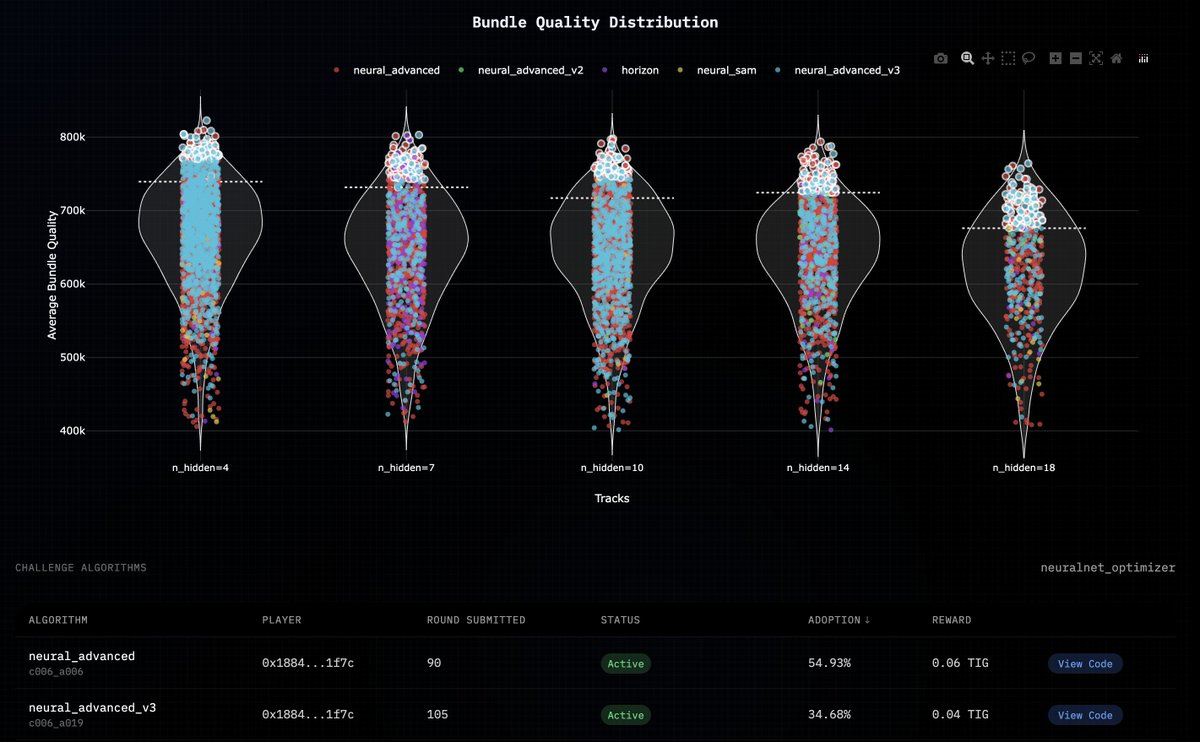
Andrej, I’m John Fletcher. I have a PhD in mathematics and theoretical physics from Cambridge, and since 2016 I have been working full-time on the problem of how to coordinate untrusted distributed compute for algorithmic innovation. I listened to your No Priors conversation and recognised the architecture you were describing: commits that build on each other, computational asymmetry (hard to find, cheap to verify), an untrusted pool of workers collaborating through a blockchain-like structure. The result is The Innovation Game (TIG), which has been in continuous operation since mid-2024. The correspondence is so close that I thought it worth writing. The short version: roughly 7,000 Benchmarkers test algorithms submitted by Innovators by solving instances of asymmetric computational challenges (SAT, Vehicle Routing, Quadratic Knapsack, Vector Search, among others). This testing is "proof of work" in the technical sense of Dwork and Naor (1992). Innovators earn rewards proportional to adoption by the Benchmarkers. The repository of algorithms is open source (github.com/tig-foundation…). The system is already producing state-of-the-art results. For the Quadratic Knapsack Problem, 476 iterative submissions by independent contributors brought solution quality to a level that now exceeds methods published by Hochbaum et al. in the European Journal of Operational Research (2025). We are working with Thibaut Vidal (Polytechnique Montréal), who has submitted a state-of-the-art vehicle routing algorithm directly to TIG, and with Yuji Nakatsukasa (Oxford) and Dario Paccagnan (Imperial College London), among many others. One of TIG’s active challenges is directly relevant to your autoresearch work: an optimiser for neural network training (play.tig.foundation/challenges?cha…), where Innovators compete to develop an improved optimiser (see screenshot). One way in which TIG extends the vision is on the economic side. In our view, a monetary incentive is required, otherwise the open strand simply cannot compete at scale. TIG’s open source dual licensing model (designed by my co-founder Philip David, who was General Counsel at Arm Holdings for over a decade, and was the artchitect of ARMs licensing strategy) is intended to solve that problem. I expect we have each thought about parts of this that the other hasn’t. Happy to talk whenever suits. John Fletcher tig.foundation
John Fletcher (𝔦, 𝔦) tweet media
Andrej Karpathy@karpathy

Thank you Sarah, my pleasure to come on the pod! And happy to do some more Q&A in the replies.

English
63
296
3.3K
415.8K