Absolute Darling 🌻 | (scRota)

8.7K posts

Absolute Darling 🌻 | (scRota) banner
Absolute Darling 🌻 | (scRota)

Absolute Darling 🌻 | (scRota)

@ScarrletEl

#百合 Tradutora eventual ₍ ᐢ. .ᐢ ₎ !♡ Paleohispanic nerd acc for chill and fun only (mostly pop culture) Amante de literatura

Ali no canto شامل ہوئے Haziran 2023
185 فالونگ118 فالوورز
Absolute Darling 🌻 | (scRota)
@miriammartinho tua persistência no ad hominem já revela tua pobreza cognitiva, mais fundada na emoção, pra não dizer histeria. falácia do comentário 1: a de generalização apressada /mentirosa, combinada com um viés de confirmação e uma falsa equivalência.->
Português
0
0
0
1
Míriam Martinho
Míriam Martinho@miriammartinho·
@ScarrletEl Você não tem capacidade para entender o que as pessoas escrevem. Imagine saber fazer ironia. Muita comédia. 😏
Português
1
0
0
3
République
République@republiqueBRA·
🧠 🇻🇦 Papa Leão XIV tem QI estimado em 145, formação em matemática e teologia e fala 7 idiomas.
République tweet mediaRépublique tweet media
Português
20
23
555
23.5K
Nrken19
Nrken19@nrken19·
More readable article about the new study. “How farming changed us: Ancient DNA reveals natural selection sped up in recent human evolution” phys.org/news/2026-04-f…
English
3
16
87
9.5K
Robert Sepehr
Robert Sepehr@robertsepehr·
@SamanthaTaghoy It takes a very low IQ to not be able to grasp that demographics of a given geography can change over thousands of years, especially given wars, migrations, and the Arab slave trade. The Mesopotamian Bronze Age and early civilizations were White, as was Jesus's Davidic bloodline.
Robert Sepehr tweet media
English
29
84
678
32.1K
Rawuwl ibn Touma al-Baṭalyawsī
¿Por qué esa obsesión con enlongar los cráneos?
Rawuwl ibn Touma al-Baṭalyawsī tweet mediaRawuwl ibn Touma al-Baṭalyawsī tweet media
Ancestral Whispers@Sulkalmakh

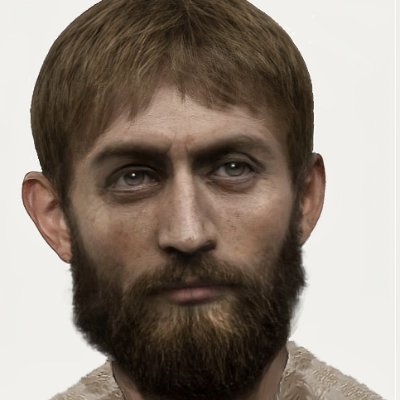
Facial reconstruction of a 7,000-year-old man from Eridu, Iraq He lived during the Ubaid period, a culture that flourished in Mesopotamia before the rise of the Sumerian cities. The Ubaid people are known for establishing some of the earliest settled communities in southern Iraq, laying the foundations for later urban civilization. The Ubaid culture emerged in southern Mesopotamia through a combination of local development and external influences, such as from Susiana, with additional contributions from northern traditions such as the Samarra culture (particularly irrigation), as well as contact with groups associated with the Arabian bifacial tradition. A Babylonian creation text says of Eridu: "All the lands were sea, then Eridu was made." The history of Eridu goes back to the Ubaid period. Its inhabitants lived largely by fishing. Their harbour was located in a marshy, semi-aquatic environment. During the Uruk period (which follows the Ubaid and represents a key stage in the development of early Mesopotamian urban civilization, preceding the fully historical Sumerian city-state period), there is still ample evidence of Eridu’s importance. However, from the beginning of the historical period, it no longer appears to have been a populous settlement. From the Third Dynasty of Ur onward, Eridu was not so much a city as a complex of religious buildings, raised high above the surrounding plain on an artificial platform. The Sumerians and Babylonians worshipped Ea (Enki) here, the god of wisdom and patron of craftsmen and artisans. He was regarded as the father of Marduk and a principal deity associated with the primordial waters. His name was also reflected in that of the city Dur-Ea and in personal names such as Ea-gamil. The earliest written source mentioning Eridu dates to the time of Ur-Nanshe, founder of the Lagash dynasty (c. 2500 BC). By the time of the Third Dynasty of Ur, Eridu had already undergone desiccation and was largely uninhabited. Ur-Nammu, the founder of the dynasty, cut a new channel to the Euphrates to bring water back to the area in an effort to repopulate it, and he also rebuilt Enki’s temple. At the end of the 2nd millennium BC, Nebuchadnezzar I referred to himself as “Governor of Eridu.” By the beginning of the 1st millennium BC, Eridu functioned more as a sacred site than as a major inhabited city. The Assyrian king Sargon II regarded the occupation of Eridu in 710 BC as a significant achievement. The man, who was about 40 years old, was described as belonging to the South Iraqi type, which still inhabits the region today. His skull was artificially deformed during his lifetime using circular bandages. He had a medium-large cranial length of 184 mm, a small cranial width of 123 mm, a medium-large cheekbone width of 134 mm, and a large condylar width (upper jaw width) of 132 mm. (Istvan Kiszely, 1978)

Español
1
0
4
141
jonn
jonn@Jonnn1Jonn·
@VidaemOrbita_ @levisback Se matares uma pessoa em coma ou com anestesia, ela tbm n vai sentir dor, é esse o teu argumento patético para justificar o assassinato de seres humanos indefesos?
Português
3
0
3
154
Veera Rajagopal 
Veera Rajagopal @doctorveera·
A new paper in @Nature from David Reich, @aliakbari23 and colleagues breaks the conventional understanding of recent human evolution. The field believed that strong selection in the recent past (~10,000 years) was rare, with few exceptions like the lactase persistence locus. In this paper, the authors challenge that belief, showing that we weren't looking at the problem right. Previous studies that looked for evidence of selection using ancient DNA addressed the problem cross-sectionally, asking if allele frequencies differed across populations more than what one would expect based on genetic drift and migration. Most arrived at the conclusion that population structure primarily explained the observed differences. Here, the authors addressed the problem longitudinally, accounting for when ancient individuals lived by explicitly modeling time as a variable in the analysis. It turns out doing it this way dramatically increases power, increasing the number of genome-wide significant selection signals by 20-fold! Looking at why accounting for the time variable led to such dramatic changes in results, the authors find that previous studies missed so much because selection often happened not on new variants leading to dramatic sweeps (the conventional model: new variant -> selection -> increase in frequency) but on already existing variants driven by transient environmental pressures. Many of these variants underwent reversals, selected up when a pressure existed, then purged when it disappeared or the trade-off cost became dominant. A great example is the TYK2 variant, where an allele boosting immunity was selected for thousands of years because it protected against TB, then got purged as TB endemicity declined and the autoimmune cost took over. The scale of what they found is striking: hundreds of loci showing strong selection in the past 10,000 years with a median selection coefficient of ~0.86%. This number is pretty big in evolutionary terms, meaning allele frequencies have been shifting by ~1% per generation in a consistent direction. Previous selection scans found a maximum of 20 loci, and this one finds hundreds. That isn't an incremental change. It fundamentally reframes our understanding of how common strong selection has been in recent human history. Some of the most striking findings come from polygenic selection, where hundreds of small-effect alleles were pushed in the same direction simultaneously. Polygenic scores based on large-scale GWAS of today predict recent negative selection for traits like body fat, waist circumference and schizophrenia, and positive selection for others like cognitive traits. One important caveat is that GWAS phenotypes are measured in industrialized societies today, and how well they capture what was actually being selected in ancient environments is debatable. For me personally, these findings have direct implications for drug discovery. When using human genetics to find drug targets, we often fixate on the benefit and risk profiles of variants visible today. But we need to be aware that a variant's benefit:harm ratio might be environmentally contingent, and could reverse when the wrong environment manifests. An evolutionary understanding of a variant's association with traits is therefore essential. The same logic applies, perhaps even more urgently, to embryo selection. Selecting embryos based on polygenic traits is humans making permanent, heritable decisions for their offspring with a narrow view of today's environment. The ancient DNA record now shows that cost-benefit landscapes flip over time. So, an embryo carrying man-made selections is carrying those changes into an unpredictable future environment. The broader takeaway is that human evolution didn't freeze in the last 10,000 years. We just lacked the tools and datasets to see its movement. The current findings are based on European populations. I am curious to see these analyses extended to other populations too, like South Asian, East Asian and African populations, which might be holding more surprises to blow our minds. Akbari et al. Nature 2026 nature.com/articles/s4158…
Veera Rajagopal  tweet media
English
18
209
1.1K
242.1K
Avelino Morganti
Avelino Morganti@AvelinoReAu·
Se a nossa civilização passar por um evento de extinção em massa e sobrarem poucos humanos, boa parte do nosso conhecimentos será perdido. SPOILER: Esse é exatamente o enredo de Foundation, do Isaac Asimov. Bem, não é um spoiler pq o livro tem mais de 70 anos e você já deveria ter lido. Em uns 60 anos, restarão poucos indivíduos capazes de escrever ou entender como computadores funcionam. Desde o silício até a camada de aplicação mais alta. 99,99999% do nosso conhecimento está digitalizado. Agora entendo porque os antigos egípcios escreviam em pedra. E, de certa forma, porque Deus mandou uma pedra pra Moisés e não um computador. Acredito que existiram civilizações antes da nossa com mais tecnologia do que temos hoje, mas não temos muitos registros dessas civilizações exatamente por isto.
Português
49
42
549
18.2K
Absolute Darling 🌻 | (scRota) ری ٹویٹ کیا
Mªx|²³💙'
Mªx|²³💙'@Maxiel_0699·
Amigos russos e japoneses, Vocês já viram ou ouviram falar de alguma animação brasileira? A distribuição dela chegou aí? Vocês teriam curiosidade ou interesse em assistir nossas obras nacionais???
Mªx|²³💙' tweet mediaMªx|²³💙' tweet mediaMªx|²³💙' tweet mediaMªx|²³💙' tweet media
Português
14
104
1.4K
20.3K
Absolute Darling 🌻 | (scRota) ری ٹویٹ کیا
Pame ⚡
Pame ⚡@pamdastik·
Con esto de la traducción automática me dí cuenta que los japoneses son insoportables, cómo pueden ser tan moralistas con la historia sangrienta que tienen a cuestas wn ajhsjs
Español
162
861
13.4K
123.7K