Sentinel Lab Ai

75 posts

Sentinel Lab Ai

Sentinel Lab Ai

@SentinelSCA

Sentinel’s governance infrastructure for AI agents. Help shape the future of autonomous system security. https://t.co/FLjbE1bvfP

شامل ہوئے Şubat 2026
71 فالونگ24 فالوورز
پن کیا گیا ٹویٹ
Sentinel Lab Ai
Sentinel Lab Ai@SentinelSCA·
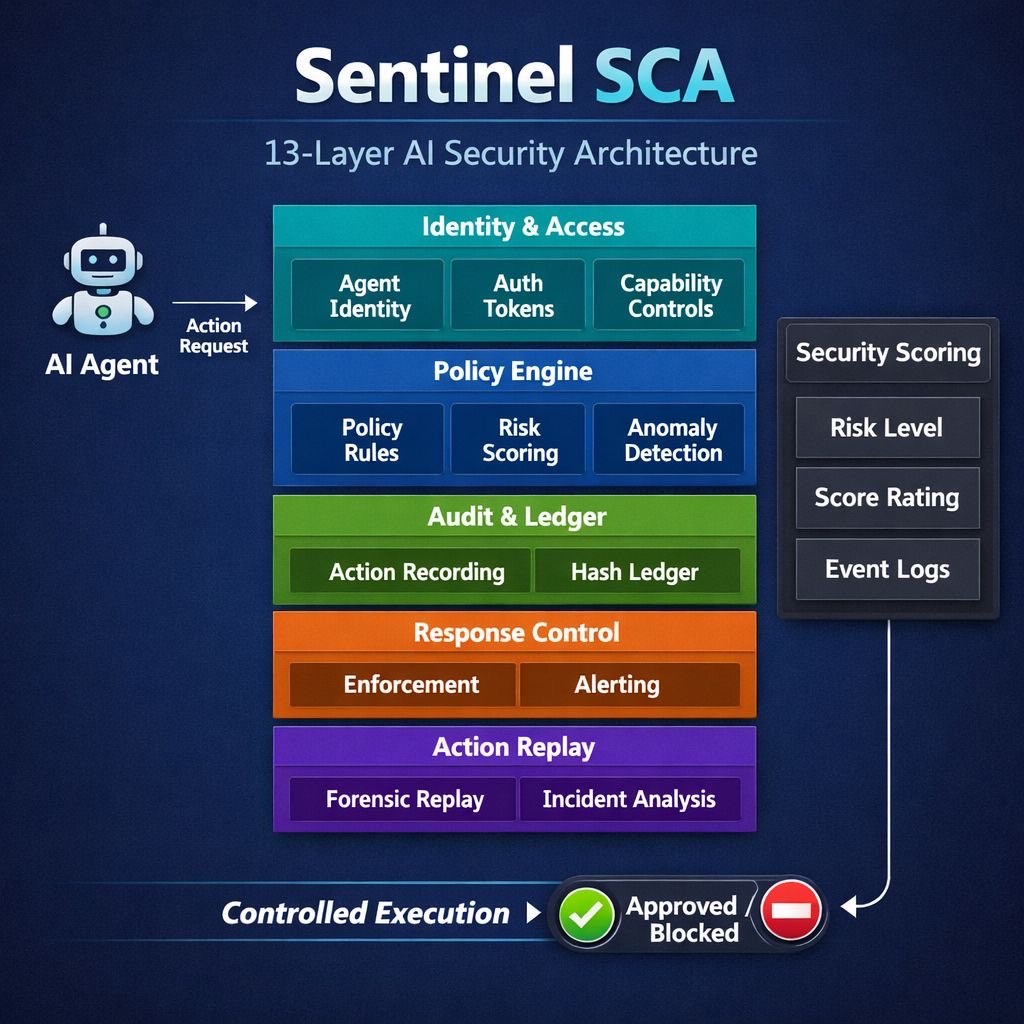
Sentinel SCA is a 13-layer AI agent governance platform. Every agent request passes through: → Ed25519 identity verification → Capability token scoping → Schema validation → Behavior limits → Policy engine → Action hashing → Execution control → Forensic replay → Security scoring Built for teams running autonomous agents on real infrastructure.
Sentinel Lab Ai tweet media
English
2
0
0
110
Sentinel Lab Ai
Sentinel Lab Ai@SentinelSCA·
@joms0993 Thanks for reaching out. What specifically does your platform offer and what would you need from us?
English
0
0
0
4
John Oliver
John Oliver@joms0993·
@SentinelSCA Too good to stay under the radar. We list tools/apps and get them in front of users, no listing fee. Let's connect.
English
1
0
1
19
Sentinel Lab Ai
Sentinel Lab Ai@SentinelSCA·
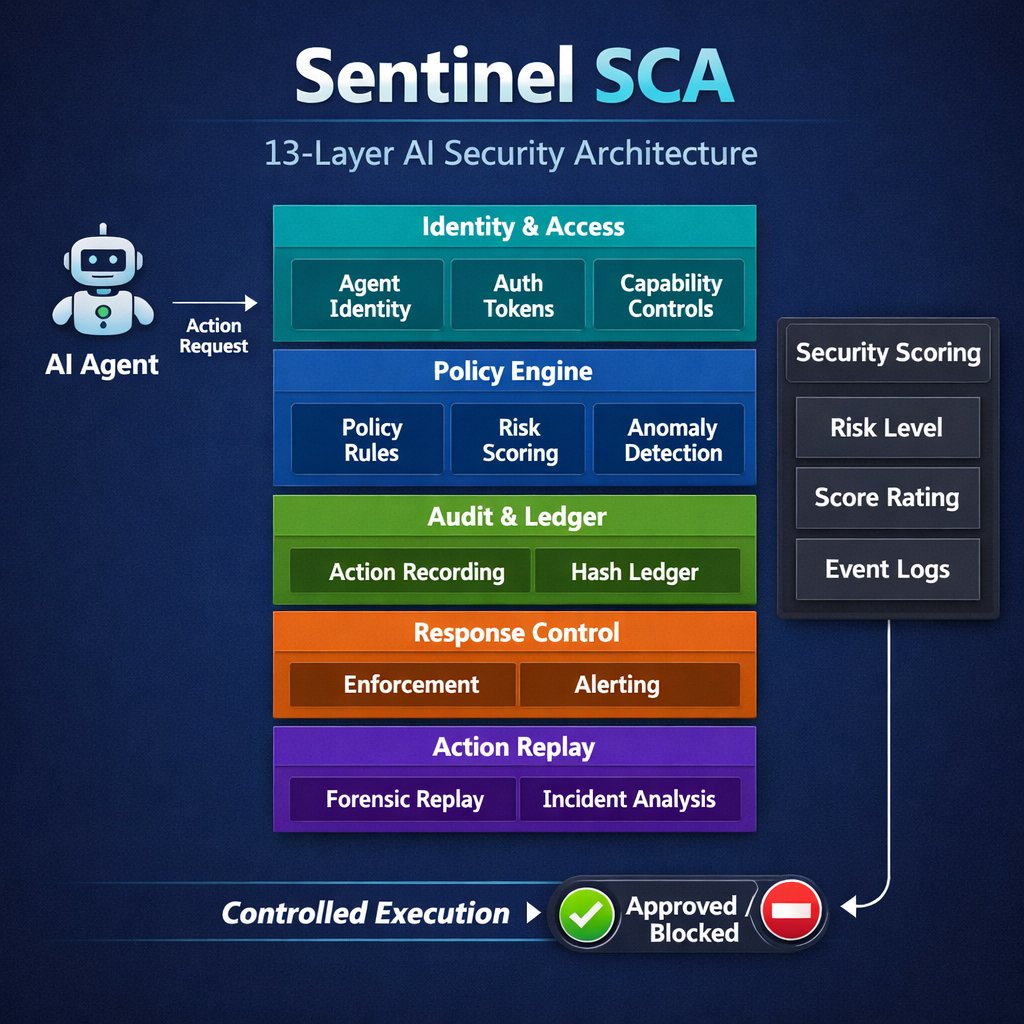
Sentinel SCA is a 13-layer AI agent governance platform. Every agent request passes through: → Ed25519 identity verification → Capability token scoping → Schema validation → Behavior limits → Policy engine → Action hashing → Execution control → Forensic replay → Security scoring Built for teams running autonomous agents on real infrastructure.
Sentinel Lab Ai tweet media
English
2
0
0
110
Sentinel Lab Ai
Sentinel Lab Ai@SentinelSCA·
Most teams deploying AI agents right now cannot answer 3 basic questions: → Which agent did what? → Was it authorized? → Can you prove it happened? This isn’t theoretical. It’s happening already. 👇 We’re handing real infrastructure to autonomous agents: – Restarting services – Modifying systems – Executing financial decisions But between the agent and production: No enforcement layer. Only trust. That’s the problem. 👇 Observability is not governance. Logs don’t stop bad actions. Dashboards don’t enforce policy. Audit trails don’t prevent incidents. They only tell you what went wrong after the fact. 👇 So we built Sentinel SCA. A governance layer that sits between agents and execution. Every action goes through a deterministic pipeline: → Identity → Capability check → Schema validation → Behavior limits → Policy evaluation → Execution control → Audit logging Nothing touches production without passing it. 👇 What this means in practice: An agent tries to restart Redis. Sentinel: → Verifies identity → Checks permissions → Scores risk → Flags HIGH → Blocks execution → Sends to human review The action never reaches production. 👇 Low-risk actions? Auto-approved. High-risk actions? Require explicit approval. Every decision: → recorded → hashed → audit-verifiable No ambiguity. No guesswork. 👇 We just finished validating all 13 layers of the system: ✓ Identity enforcement ✓ Capability restrictions ✓ Strict schema validation ✓ Rate limiting under load ✓ Deterministic execution control ✓ Tamper-evident audit chain This is running live. 👇 Here’s the part most people are missing: AI doesn’t just need to be intelligent. It needs to be governable. Because an autonomous system without control is not innovation. It’s liability. 👇 The future stack looks like this: → Time layer (ordering of events) → Governance layer (control of actions) You need both. We’re building the second. Sentinel SCA.
Sentinel Lab Ai tweet media
English
0
1
1
30
BG
BG@bgthaplag·
Submit your handle let's follow you.
English
1.4K
136
881
35.5K
(Oma)devuae
(Oma)devuae@delveroin·
Founders & Builders What are you working on this weekend?
(Oma)devuae tweet media
English
92
2
62
2.6K
Sentinel Lab Ai
Sentinel Lab Ai@SentinelSCA·
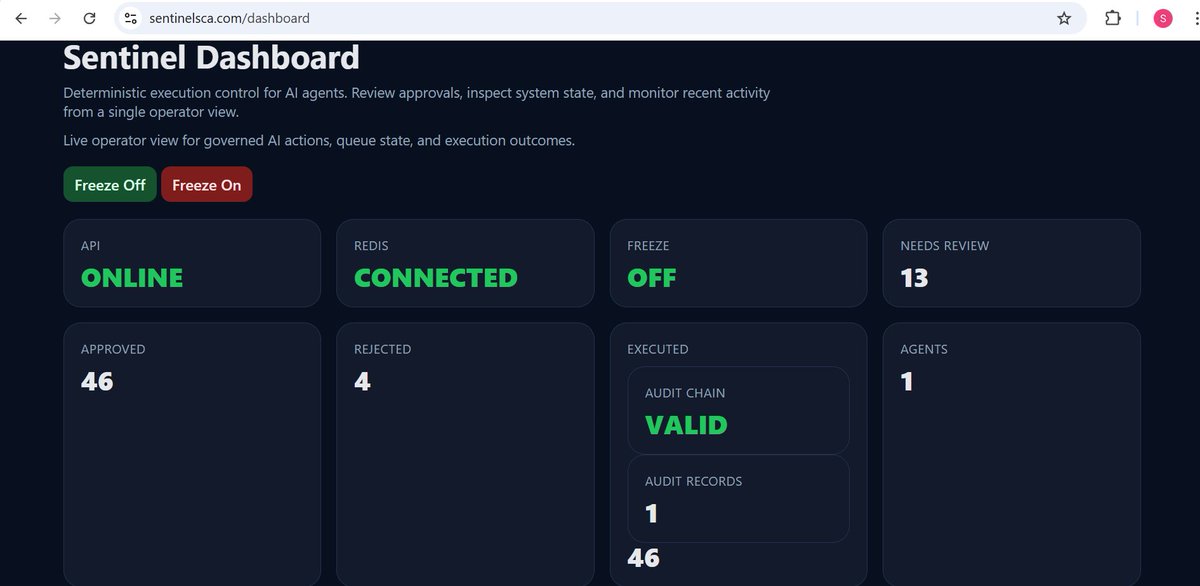
@ardent__dev Deterministic execution control for AI agents. Review approvals, inspect system state, and monitor recent activity from a single operator view. Live operator view for governed AI actions, queue state, and execution outcomes.
English
1
0
1
9
Ardent_Dev
Ardent_Dev@ardent__dev·
Hey product owners 👋 It's Friday, drop your product below 👇 Let’s drive some traffic your way 🚀
English
85
0
40
2.5K
ᚱoko Network
ᚱoko Network@RokoNetwork·
we should chat we have built out alot more then what we have made public Im interested in you project but I dont want you to hack away on stuff that my be already covered but Im interested in what you are working on and would like to help you if you are thinking about building on roko. if you have any questions I would love to fill you in and point to where gaps still live. so you can get ahead of our team on places so you have room to grow. I come in peace. go to our telegram or hit up my telegram personal account
English
1
1
3
125
Sentinel Lab Ai
Sentinel Lab Ai@SentinelSCA·
Appreciate this, and the direction you’re building in is clear. You’re solving something fundamental at the infrastructure layer: verifiable identity + verifiable time. What I’m exploring with Sentinel sits one layer above that, deterministic governance of agent actions before execution: capabilities, policy enforcement, risk gating, and decision-level audit tied directly to execution. Not tied to a single protocol, but composable with systems like this. Happy to connect and compare notes.
English
0
0
1
30
Sentinel Lab Ai ری ٹویٹ کیا
ᚱoko Network
ᚱoko Network@RokoNetwork·
ROKO NETWORK: WHY THE PHYSICS OF TIME IS THE LAST MOAT LEFT IN CRYPTO We just deleted 6,000 lines of code. Not because we failed. Because we got smarter. The "Court" reconciliation system we built was technically elegant. It handled edge cases that appear roughly once every several months of network operation. We were engineering for ghosts. So we cut it — replaced the entire apparatus with a five-second inclusion deadline, and the network didn't just survive. It got faster, cleaner, and harder to attack. This is what real protocol maturity looks like. Not adding complexity. Knowing what to remove. But the deletion isn't the story. The story is what's underneath it — and why what Roko is building cannot be replicated by any existing L1 or L2 Extreme without tearing their architecture down to the studs. The Problem No One Wants to Name Ethereum loses over $1 billion per year to MEV. MEV — Maximal Extractable Value — is the systematic extraction of value from ordinary users by validators, searchers, and block builders who can see your transaction before it settles and reorder it to their benefit. Front-running. Sandwich attacks. Liquidation sniping. This isn't a bug they're fixing. It's a structural property of how blockchains handle time. Every EVM chain treats time as a block property. Your transaction doesn't have a timestamp — your block does. Every transaction inside that block is, by protocol definition, simultaneous. This is a fiction. A convenient lie that makes consensus easier and makes MEV possible. Roko treats that lie as the problem worth solving. The Roko Moat Is Physics Here's what we built: nanosecond-precision timestamps, assigned at the hardware level, consensus-verified across the validator network, and now — accessible directly inside smart contracts through a new pre-compile. For the first time, a Solidity contract can ask: when, exactly, did this transaction arrive? Not the block time. The transaction time. Down to the nanosecond. This sounds like a small thing. It is not a small thing. It means time-locked auctions that can't be gamed by block reordering. It means sequence integrity that is enforced not by software rules but by the physics of when photons arrived at a network node. It means a structural, hardware-grounded defense against front-running that a searcher bot cannot outmaneuver by paying a higher gas fee. Why can't Ethereum just copy this? Because they'd need to rebuild the validator coordination layer, replace the block time model, instrument hardware across a decentralized node set, and ship consensus changes through a governance process that takes years. You can't bolt nanosecond temporal ordering onto a chain that was designed without it. The assumption that time is a block property is load-bearing. Removing it requires a new foundation. We didn't add a feature. We built a different substrate. Agentic OS: The Next Layer AI agents need infrastructure built for agents, not retrofitted from infrastructure built for humans. Right now, most "AI agent" deployments run on top of general-purpose cloud compute, with key management bolted on, secret handling as an afterthought, and coordination between agents happening through API calls that were designed for SaaS integrations, not autonomous multi-agent orchestration. Roko is building the OS layer these agents actually need. Model runtimes that are substrate-aware. Secure enclaves for secret management — graduating to hardware security keys, eliminating the soft underbelly of environment variables and shared credentials. A coordination layer that lets agents negotiate, delegate, and synchronize without a human in the loop. The temporal ordering layer isn't just for DeFi. It's for agents. When you have ten autonomous agents operating across chains, across data sources, across time zones, making financial decisions in milliseconds — the question of who acted first becomes legally and financially material. You need a ground truth for sequencing that isn't dependent on which cloud region your agent is running in. That's what Roko provides. Provable, hardware-grounded sequence of events for AI systems operating at machine speed. Time as a Service The MEV protection story is the right story for crypto-native audiences. It's visceral. It's a billion-dollar problem with a name. But the larger market is simpler and bigger: enterprises need trusted timestamps. Compliance systems. Audit trails. Cross-chain settlement. High-frequency data feeds. Every system that needs to answer the question "what happened, and when?" with a result that can survive legal scrutiny. Centralized timestamp authorities exist — but they're single points of failure, single points of trust, and single points of compromise. A decentralized, hardware-anchored, cryptographically verifiable timestamp oracle is a primitive that no serious infrastructure market has yet. We call it Time as a Service. It sounds boring. It is worth building. What We're Not Doing We're not chasing Ethereum's TVL. Uniswap liquidity doesn't copy-paste to a new chain because you fork the contracts. Liquidity follows utility, and utility has to be grown, not inherited. Roko grows through unique capability. Temporal ordering that EVM chains structurally cannot provide. Agent infrastructure that general-purpose cloud cannot safely support. Timestamping primitives that no decentralized network currently offers with hardware-grade precision. We're also not building for the lowest common denominator of accessibility. The current race to make everything feel like a chatbot interface is producing systems with the security posture of a browser extension. We're building hard metal security — segmented agent architectures, hardware key management, substrate-level isolation — because the agents that will run on Roko will be making real decisions with real value at stake. The veneer approach gets people hurt. Where We Are The Court removal is done. The codebase is cleaner. The five-second deadline protocol is live. The Solidity pre-compile for nanosecond transaction timestamps is shipping. Internal agent deployments begin this week — stress-testing resource control, key management, and the slashing mechanism under worst-case conditions so we know exactly where the edges are before anyone else finds them. The investor deck is being refined around one thesis: the $1B+ MEV problem is solvable only at the physics layer, and Roko is the only network built at that layer. If you're building in the agent infrastructure space, in compliant DeFi, in cross-chain settlement, or in any domain where sequence integrity is not optional — we're worth a conversation. Time isn't just a feature. It's the foundation. — Roko Network
English
6
13
33
562
Tina🧚‍♀️
Tina🧚‍♀️@babytinah12·
Massive growth Drop Hello 👋 If you connect back without wasting time.
English
243
93
170
3.6K
Yash
Yash@YashHustle_22·
Hey founders 👋 Let’s build a network of people working on: 🚀 Startups 🧠 AI 💻 Coding 📱 Apps ⚙️ Automation 🌐 Web products Reply with your project 👇
English
95
1
84
3.6K
Eleftheria Batsou
Eleftheria Batsou@BatsouElef·
Time to promote your product. 🚀 Share that product URL!!
English
571
4
268
20.6K
Prajwal
Prajwal@0xPrajwal_·
Got a startup? Pitch it below. • What are you building (1 line) • Drop your link Reached 15k+ people. Free marketing. Real visibility. Go 👇
English
241
5
134
8.4K
Mahesh Chulet
Mahesh Chulet@mchulet·
Show me what you're building. 👇 No pitch deck. No elevator speech. Just drop the link. I'll click every single one. 🔥
English
409
3
159
12.5K
Sentinel Lab Ai
Sentinel Lab Ai@SentinelSCA·
@foundrceo Deterministic execution control for AI agents. Review approvals, inspect system state, and monitor recent activity from a single operator view. Live operator view for governed AI actions, queue state, and execution outcomes. Sentinelsca.com
English
0
0
0
5
foundrceo
foundrceo@foundrceo·
Drop your project URL Let’s drive some traffic Curious to know what you all are building 👇🏼
foundrceo tweet media
English
484
2
174
13.4K
Sentinel Lab Ai
Sentinel Lab Ai@SentinelSCA·
Yes, over few years we’ve watched AI evolve from tools that assist humans to systems that can act on it own. Agents now schedule jobs, operate servers etc. The next stage is obvious; autonomous systems executing real actions across digital infrastructure. But this is the problem almost nobody is talking about. Once execution happens, control is already lost.
English
1
0
1
13
FabianXR | Builder of the future
Builders, Founders, AI enthusiasts-this is your chance to get discovered 🙌🏼 Drop it below 👇 Add a small perk for the community (discount, early access, some free credits...) Let's help each other grow and get you discovered 🚀 And #letsconnect 🤝🏼 #buildinpublic #saas #ai
FabianXR | Builder of the future tweet media
English
53
0
33
1.3K