Sentinel Lab Ai

197 posts

Sentinel Lab Ai

Sentinel Lab Ai

@SentinelSCA

Sentinel’s governance infrastructure for AI agents. Help shape the future of autonomous system security. https://t.co/FLjbE1bvfP

Katılım Şubat 2026
97 Takip Edilen41 Takipçiler
Sabitlenmiş Tweet
Sentinel Lab Ai
Sentinel Lab Ai@SentinelSCA·
Sentinel SCA is now live. We’ve spent months focused on one question: What actually decides whether an autonomous action should be allowed to execute? Not logs. Not monitoring. Not post-incident analysis. Decision. Sentinel operates at the command boundary — before execution — enforcing whether an action is admissible under real conditions. Because the real risk isn’t that systems fail. It’s that they continue when they shouldn’t. This is the beginning of a control layer for autonomous systems. sentinelsca.com Let’s build systems that can be trusted.
English
1
1
2
55
Umair Shaikh
Umair Shaikh@1Umairshaikh·
What are you building this weekend? Drop your project URL Let’s drive some traffic
English
164
1
77
6.4K
Sentinel Lab Ai
Sentinel Lab Ai@SentinelSCA·
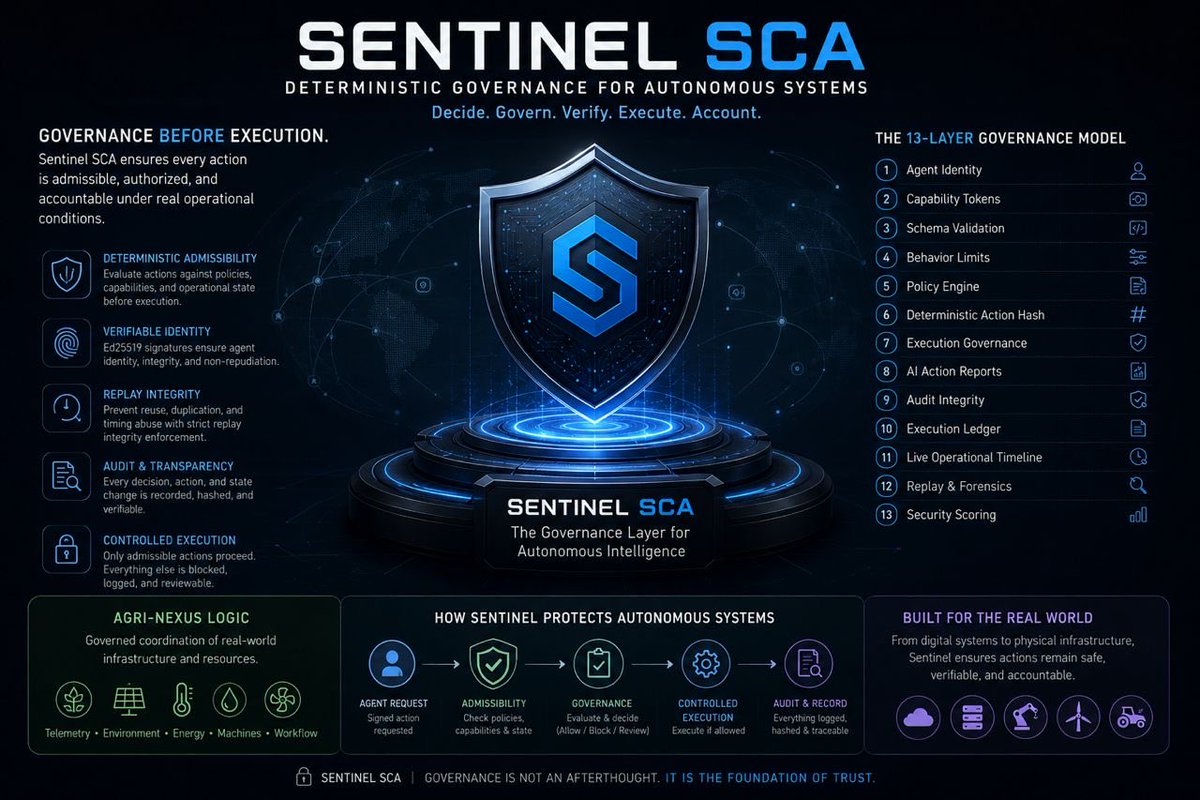
Autonomous systems are becoming operational infrastructure. AI agents are no longer confined to chat interfaces. They are beginning to interact with APIs, cloud systems, workflows, monitoring environments, and eventually physical infrastructure. As these systems become more adaptive and capable, one question becomes increasingly important: How do we determine whether an action should be allowed before execution? That question became the foundation for Sentinel SCA. Over the past months, we’ve been building: - deterministic admissibility controls - signed agent identity - replay integrity enforcement - capability governance - execution controls - audit-chain integrity - live operational timelines - replay & forensic infrastructure - and a 13-layer governance architecture for autonomous systems One of the core realizations behind Sentinel is that policy compliance alone is not enough. A system can remain internally coherent while already operating outside admissible conditions. Governance cannot remain purely observational or post-incident. It must become part of the execution path itself. We’ve published a deeper write-up covering the architecture, philosophy, operational direction, and the evolution of Sentinel SCA. Sentinel SCA Deterministic Governance for Autonomous Systems. #AI #CyberSecurity #AutonomousSystems #Governance #AIInfrastructure #DevOps
Sentinel Lab Ai tweet media
English
0
0
1
14
Tanzila Shah
Tanzila Shah@TanzilaSha9574·
Who’s building a SaaS right now? 👀 Early-stage or already live — doesn’t matter. ⚡ AI tools 🛠️ SaaS products 📲 Web apps 🤖 Automation 💻 Dev tools 🚀 Indie projects Drop your product below 👇🔥
English
47
1
24
3.2K
Sentinel Lab Ai
Sentinel Lab Ai@SentinelSCA·
Really strong update — especially the clarity around the Grandmaster Loop and the openness on tokenomics tradeoffs. A few observations from working on governed physical systems (Agri-Nexus / Sentinel SCA) that might be relevant: On the Grandmaster Loop / edge drift We’ve seen a similar pattern in field deployments — edge nodes can’t maintain precision independently, but the real challenge shows up at execution time. Even with a strong reference source, small drift combined with network latency can create mismatches between “validated time” and “executed action.” Designing for bounded delay at the execution layer (not just synchronization) tends to be critical as density increases. On validator stability Intermittent conditions (power, connectivity, environmental noise) create behavior that looks like instability but is actually recoverable state. There may be value in distinguishing between “clean rejoin after drift” vs. “unreliable node” in the reward/penalty model — it can materially affect operator participation at the edge. On hardware-rooted authentication Interesting direction. In physical systems we’ve found that hardware signals under real-world conditions (temperature, load, aging) can drift in ways that aren’t obvious in controlled environments. Treating these signals as advisory first (as you’re doing) seems like the right call before tying them tightly into enforcement. On token design The AWS problem resonates. Separating utility pricing from governance/staking simplifies operator planning, especially when systems are tied to real-world processes with fixed cost structures. Curious how you’re thinking about the interaction between time correctness and downstream execution guarantees as the network scales — that seems like the next layer where these systems get truly tested. Appreciate the transparency here. Looking forward to seeing how the Precision board data shapes the next iteration.
English
0
0
1
123
Sentinel Lab Ai retweetledi
ᚱoko Network
ᚱoko Network@RokoNetwork·
ROKO Network Update — April 2026 Executive Summary The past sprint has clarified two of the most important questions facing ROKO Network: what hardware topology actually delivers Grandmaster-grade time quality at scale, and how the token architecture should evolve to support both a sustainable utility economy and a credible governance/equity instrument. The first is moving toward implementation. The second is still very much open, and we are actively soliciting input. On the technical side, validator testing on the Timebeat Mini 2.0 ("Precision Timing Lite") has revealed where the practical edges of low-cost timing hardware are — and how the network's mesh consensus can absorb hardware heterogeneity without sacrificing time quality at the protocol layer. On the economic side, we are working through a set of design questions around utility versus governance, legacy token treatment, and emission/liquidity dynamics. We have working hypotheses, not decisions, and we want feedback before committing. This update covers the Grandmaster Loop network architecture, validator stability findings, a new hardware-rooted validator authentication mechanism in development, the current state of our tokenomics thinking (and the questions we are still working through), Fortemai product updates, and near-term operational priorities. Network Architecture: The Grandmaster Loop Field testing on Raspberry Pi nodes has confirmed what the spec-level analysis suggested: timing hardware without an OCXO (oven-controlled crystal oscillator) cannot independently maintain Grandmaster-class precision. These nodes can produce blocks and earn baseline rewards, but they cannot achieve the time-quality tier required for the highest reward bracket — and they accumulate drift on the order of 1.5 µs per 24 hours when relying on a time card alone. Rather than treat this as a hardware procurement problem at the edge, we are formalizing what we are calling the Grandmaster Loop: a topology in which a redundant core of high-precision Grandmaster nodes (GPS/PPS-disciplined, OCXO-equipped) anchors network time, and edge nodes inherit synchronization through the mesh. Once node density crosses a threshold, the network itself becomes the reference for nodes that cannot afford or maintain a Real-Time Clock locally. This has two consequences worth flagging: Capital efficiency for new validators. Onboarding cost for non-Grandmaster participation drops substantially. Edge participation no longer requires expensive RTC hardware, which expands the addressable validator population and accelerates mesh density. A clear hardware tier hierarchy in the reward function. Time-quality rewards remain stratified — Grandmaster nodes are compensated for the precision floor they hold up — but block production and basic participation rewards extend further down the hardware stack. Validator Stability: Timebeat Mini 2.0 Findings A validator running on the Timebeat Mini 2.0 produced 25 blocks before being ejected from consensus due to time drift. The diagnostics are revealing: Chrony is currently outperforming the Timebeat hardware path on the same node. This points to a driver/configuration issue rather than a hardware ceiling — the board has more to give than current integration is extracting. The Precision Timing Lite SKU lacks an OCXO, which structurally caps its drift performance. The team is deploying the top-tier "Precision" board (with OCXO) within the next two weeks to establish a clean reference baseline. Networking stack is a meaningful latency source. Test deployments running through indirect networking paths showed latency profiles incompatible with high-precision consensus timing. Validator deployments are being moved to direct, low-latency networking configurations to isolate hardware performance from network-induced jitter. Networking optimization for time-critical consensus is an area where we are actively expanding capability — gossip channel tuning and DDoS mitigation for public RPC exposure both warrant dedicated focus as the network scales. Hardware-Rooted Validator Authentication A novel authentication mechanism is under development that ties validator identity to physical characteristics of their timing hardware itself — properties that emerge from the device's underlying physics and are extraordinarily difficult to spoof in software. We are intentionally not detailing the technique publicly at this stage; the value of the approach increases the longer it remains opaque to adversarial study, and disclosure will be staged alongside deployment. What we can say about the integration plan, which is deliberately conservative: Implemented as a monitoring-level service, not a consensus-breaking change Initially advisory: the network observes anomalous validator signatures and surfaces them to operators, but does not eject nodes on this basis alone Pilot scoped to ensure no impact on node performance or log volume This gives us a path toward hardware-rooted validator identity without committing to a heavy consensus change before we have field data on real-world stability across temperature, age, and load. More technical disclosure will follow once the pilot has produced enough data to characterize the mechanism's operational profile. Tokenomics: Where We Are Thinking (and Where We Want Input) Tokenomics is the area of the design we are most actively iterating on, and it is the part of this update where we most want pushback. Below is the current state of our thinking, framed as working hypotheses rather than decisions. If you have a perspective — as a holder, a validator, an enterprise prospect, a tokenomics designer, or someone who has watched comparable networks succeed or fail — we want to hear it. The Two Problems We Are Trying to Solve The single-token model has two structural problems we want to address: The "AWS problem." Enterprises pricing services in a volatile token cannot plan operational budgets. Every hedge they construct is friction. Every price spike makes the network look more expensive than its competitors; every crash erodes validator economics. Utility tokens that double as speculative instruments may not serve either function well. The narrative problem. Equity-like value accrual and commodity-like utility pricing pull the design in opposite directions. Trying to satisfy both with one instrument constrains governance design and muddies how we communicate value to long-term holders versus short-term users. A Dual-Token Architecture We Are Exploring The shape of the design we are currently testing: ROKO (Utility Coin) — the chain coin, used for service pricing (timestamping, attestation, RPC consumption). Designed for low volatility and predictable enterprise pricing. Functionally a commodity. Power ROKO (Governance & Staking) — an equity-like instrument. Validators would stake Power ROKO to earn chain emissions in a slot-style allocation (the BitTensor reference is intentional — proven mechanism, well-understood operator economics). Holders would govern protocol parameters and receive the value flow from network growth. A hypothesis we are pressure-testing: all rewards, including timestamping rewards, are issued in Power ROKO. This would enforce a clean liquidity barrier between the operational economy and the governance economy, and may simplify the tax and regulatory characterization of each instrument. We are not committed to this — alternative reward-routing designs are on the table. The Ethereum Legacy ROKO Question — Open We are weighing how to handle the existing Ethereum-based ROKO token. One option under discussion is a fixed-rate conversion into Power ROKO, which would sever the chain's internal economics from the legacy pool's volatility while preserving holder value in a new instrument. The migration is technically tractable while the holder base is small (~3,000 addresses). The harder questions are legal characterization, dilution communications, and what current holders are getting in any conversion that they would not get by staying. We have not decided on this path. Other options — leaving the legacy token in place, partial conversion, time-locked migration, alternative bridging models — are all live. Holder feedback will be heavily weighted here. The "Dam and Reservoir" Liquidity Question — Open The standard objection to emission-funded networks is the "Bitcoin Zeno's paradox" — what happens when emissions decrease and there is no organic demand floor? One model we are exploring is a Dam and Reservoir approach: gated liquidity release that prevents market dumps while compounding incentives for long-term staking. Emissions would accumulate behind staking gates, and release schedules could align with measurable network utility (transaction volume, validator count, attestation throughput) rather than calendar time alone. This is a sketch, not a spec. If you have seen variants of this approach succeed (or fail) elsewhere, we want to hear it. What We Want Input On Specifically, we are looking for thinking on: Whether the dual-token split is the right structural answer, or whether mechanisms internal to a single token (vesting, staked vs. liquid tiers, dual balances) could solve the same problems with less complexity The right reward-issuance currency (utility vs. governance vs. mixed) and its implications for validator behavior and tax/legal exposure Migration design for legacy Ethereum $ROKO holders — what feels fair, what feels coercive, and what precedents from other networks we should be studying Liquidity-gating mechanisms that have worked in production at comparable scale Anything we are not seeing because we are too close to the design Comments, critiques, and counter-proposals are welcome and read carefully. A dedicated tokenomics working document is being assembled; if you would like to contribute directly rather than at the level of a community comment, reach out. Product Updates Fortemai & HRTM The Hall of the Mind (HRTM) has been decoupled from the Fortemai server and now ships as a standalone Rust/Tauri application — native DMG, DEB, and RPM builds — rather than living only as a Docker module. This is a meaningful UX upgrade for end users who do not want to operate a container stack to access the interface. Operator Application Support Work on extending Fortemai to support standard Linux and macOS application installation inside the operator environment is in progress. The result is a more uniform end-user experience and reduced surface area for the team to maintain. PKCS11/PKCS12 Trust Architecture Identity and data sharding will use a PKCS11 root trust authority cryptographically tied to user wallets, with PKCS12-based wallet integration in Fortemai for sharded data access. The principle is to lean on existing TLS standards rather than reinvent trust infrastructure — leveraging decades of cryptographic engineering rather than constructing a parallel system. We have looked at Urbit's "computer for life" vision and admire the addressing model, but we reject the broader pattern of reinventing programming languages and trust roots from first principles when production-grade primitives exist. Enterprise Positioning: The Zero OpEx Pitch The enterprise narrative has sharpened. Chain emissions cover data center and power costs at the validator layer, which lets us offer enterprises a CapEx-only deployment model for ROKO timing hardware: pay for the box, the network pays the operating expense. Against AWS and Azure, where every hour of compute and every gigabyte of egress is a recurring line item, this is a structurally different cost curve — and one that aligns particularly well with high-frequency timing and attestation use cases (MiFID II, Reg NMS) where compliance value is high but margin sensitivity to per-call pricing is also high. Two-Week Milestones Deploy the top-tier Precision board with OCXO; collect baseline drift and consensus participation metrics. Transition test validator to direct port-forwarded LAN deployment; measure latency improvement and consensus stability. Hardware-rooted authentication monitoring service in pilot on a subset of validators; advisory mode only. Tokenomics working document opened for community and advisor input. Begin scoping legal questions around possible legacy token migration paths. Closing The Grandmaster Loop topology resolves a category of architectural friction we have been circling for some time, and committing to it clears the technical path for the next funding cycle and enterprise pilots. The tokenomics work is the part of the picture we are still actively shaping, and where community and advisor input will most directly affect the outcome. If you have thoughts — on the dual-token question, the legacy migration, the liquidity model, or anything we are not seeing — bring them. More to come as the Precision board data lands and the tokenomics document opens for review. — ROKO Network
GIF
English
5
8
19
1K
Abhijit
Abhijit@abhijitwt·
Show me your app, website or project and I’ll share my honest thoughts👇
English
471
1
220
26.1K
Marko Denic
Marko Denic@denicmarko·
Share your websites.
English
487
3
232
24.6K
Suni
Suni@suni_code·
Drop your project URL 👇🏻 Let’s drive some traffic!!!...
English
227
0
97
8.8K
Umair Shaikh
Umair Shaikh@1Umairshaikh·
What are you building this week? Pitch your startup 👇
English
162
2
80
5.1K
Sentinel Lab Ai
Sentinel Lab Ai@SentinelSCA·
Most AI systems today focus on making decisions faster. Very few focus on whether those decisions should execute at all. That’s the gap we’re working on. Sentinel is being designed as a control layer that sits between decision and execution, enforcing admissibility before any action reaches real systems. Not reacting after failure. Preventing it before it happens.
English
0
0
1
22
Suhas
Suhas@zuess05·
Founders, what are you actually building this week? Share your product 👇 (yes this counts as marketing)
Suhas tweet media
English
90
0
41
2.2K
mscode07
mscode07@mscode07·
Share your website/project👇
English
120
2
42
3.5K
Mahesh Chulet
Mahesh Chulet@mchulet·
I follow builders who actually ship. If you're: - building a SaaS - working on a side project - trying to get first users Drop your project below Let's connect 🤝
English
147
2
102
5.2K
Sentinel Lab Ai
Sentinel Lab Ai@SentinelSCA·
We didn’t build a smart farm. We built a governed autonomous system. Most systems: sensor → decision → execution Ours: decision → validation → execution Every action is: • signed • verified • policy-checked • time-bound • auditable No approval → no execution. @AgriNexusPrime is the first system running on Sentinel.
Sentinel Lab Ai tweet media
English
0
0
1
39
Jyotishmoy
Jyotishmoy@j3y3deka3·
Good morning Twitter :) What r u building today?
English
98
1
74
3.1K
Blake Emal
Blake Emal@heyblake·
Drop your project URL Let’s drive some traffic
English
1.1K
18
531
95.8K
Tushar Kapil
Tushar Kapil@TusharKapil003·
Drop your project URL 👇🏻 Let’s drive some traffic.
English
63
3
42
1.3K
Sentinel Lab Ai
Sentinel Lab Ai@SentinelSCA·
We launched Sentinel SCA yesterday. No hype. No dashboards. No “AI copilots”. Just one thing: A control layer that decides whether an autonomous action should be allowed to execute before it happens. Most systems today detect after the fact. We enforce before execution. If you're building: → AI agents → automation systems → trading bots → DevOps agents You don’t have a reliability problem. You have an admissibility problem. sentinelsca.com
English
0
0
0
28