
UCLA Samueli Engineering

6.4K posts

UCLA Samueli Engineering banner
UCLA Samueli Engineering

UCLA Samueli Engineering

@UCLAengineering

Follow UCLA Samueli School of Engineering on: https://t.co/Jd7jSwl3v5 https://t.co/b62PFhElSS https://t.co/aFaSxK9b51 #engineerchange

Los Angeles, CA شامل ہوئے Ekim 2009
2.5K فالونگ17.6K فالوورز
UCLA Samueli Engineering ری ٹویٹ کیا
Dennis Hong
Dennis Hong@DennisHongRobot·
Right before it breaks, Right where we learn the most Failure isn’t the opposite of success it’s how we build Failure is not the end it’s the path forward Failure is not a setback it’s a stepping stone We push until it fails Because that’s when it teaches us This is RoMeLa
English

6
7
47
3.7K
UCLA Samueli Engineering
UCLA Samueli Engineering@UCLAengineering·
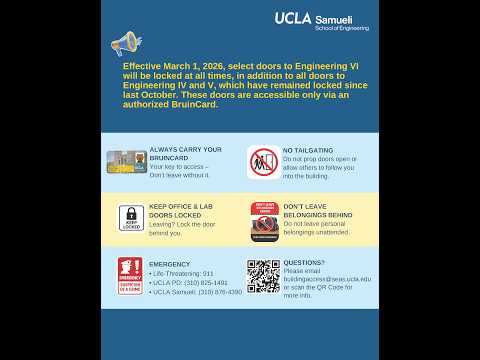
Effective March 1, 2026, select doors to Engineering VI will be locked at all times, in addition to all doors to Engineering IV and V, which have remained locked since last October. These doors will be accessible only via an authorized BruinCard. youtube.com/watch?v=JnSpTN…
YouTube video
YouTube
English
0
1
2
728
UCLA Samueli Engineering
UCLA Samueli Engineering@UCLAengineering·
You’re invited to the @UCLA DataX Center for AI Technology Kickoff event next Tuesday, Feb. 17 from 8am-12pm. This marks the launch of DataX’s new center dedicated to pioneering advancements in the technology that enables artificial intelligence. samueli.ucla.edu/upcoming-event…
English
1
0
0
147
UCLA Samueli Engineering
UCLA Samueli Engineering@UCLAengineering·
New research led by @UCLA Prof. Gerard Wong of @BioEngUCLA shows calcium oxalate kidney stones—the most common type—can contain bacterial biofilms, challenging the idea they’re “noninfectious.” This may explain stone recurrence and infections triggered by stone fragmentation.
Science & Astronomy@sci_astronomy

For decades, doctors believed the most common kidney stones (calcium oxalate) were lifeless lumps formed purely by chemistry—minerals building up in the kidney. ​A groundbreaking study published this month (Jan 2026) by UCLA Health has proven this wrong. ​ Using high-tech fluorescence microscopy, researchers discovered that these stones actually contain live bacteria and fungal-like biofilms "entombed" inside them. The bacteria act as a scaffolding (nidus), allowing the minerals to crystalize and grow layer by layer. ​ This solves a long-standing medical mystery: Why do patients sometimes get severe infections (sepsis) after stone-breaking treatments (lithotripsy), even when their urine was sterile? The answer: breaking the stone releases the bacteria trapped inside. ​This could revolutionize treatment, shifting focus from just diet changes to targeting the hidden microbiome within the kidney. Journal Reference: Wong, Gerard C. L. et al, Intercalated bacterial biofilms are intrinsic internal components of calcium-based kidney stones, Proceedings of the National Academy of Sciences (2026). DOI: 10.1073/pnas.2517066123. ​#MedicalBreakthrough #Microbiology #KidneyHealth #UCLAHealth #NewDiscovery

English
0
2
2
646