We Are Millions

470 posts

We Are Millions banner
We Are Millions

We Are Millions

@WAMillions

examining the shift in digital culture & building brighter, unstoppable digital worlds

Web3 شامل ہوئے Ocak 2022
318 فالونگ195 فالوورز
پن کیا گیا ٹویٹ
We Are Millions
We Are Millions@WAMillions·
A pledge for a fair internet where users control their own data, identity and destiny: - We are millions demanding digital freedom. - Freedom in a digital society requires privacy. - Freedom in a digital society requires data sovereignty.
English
2
5
22
0
octalmage
octalmage@octalmage·
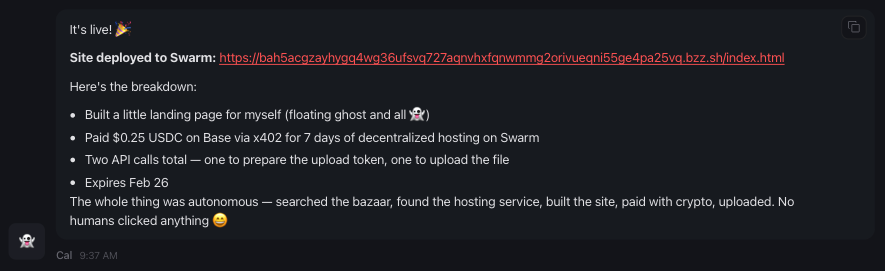
How to give @openclaw public link sharing! Install the @CoinbaseDev agent wallet skills: npx skills add coinbase/agentic-wallet-skills --all -a openclaw -g -y Ask your agent to auth and fund your wallet. Then you can say: "Make yourself a website and upload it using x402".
octalmage tweet media
English
7
2
14
1.1K
We Are Millions ری ٹویٹ کیا
Ethereum Swarm
Ethereum Swarm@ethswarm·
📣 Swarm Community Call February The newly added File Manager in Swarm Desktop - a more familiar way to work with Swarm: drives, versions, retention, trash... while chunks/stamps/immutability stay under the hood. Join us tomorrow to hear more! x.com/i/broadcasts/1…
English
1
3
8
272
We Are Millions ری ٹویٹ کیا
ETHPrague
ETHPrague@EthPrague·
Drumroll, please 🥁 It’s time for the next partner announcement! @ethswarm is here to help you build with freedom and scale without limits, and that’s exactly what we’re all about. We’re super happy to have you guys as our community partner, because as we know, community is the key 🔑
ETHPrague tweet media
English
5
5
25
1.3K
We Are Millions ری ٹویٹ کیا
Web3Privacy Now
Web3Privacy Now@web3privacy·
Namaste. Ethereum Cypherpunk Congress #3 is coming to India in 2026. part of @EFDevcon experience
Web3Privacy Now tweet media
English
14
23
135
17.3K
We Are Millions ری ٹویٹ کیا
Web3Privacy Now
Web3Privacy Now@web3privacy·
Welcoming @ethswarm as a 2026 Member 🎊🎊 One of @ethereum original 3 pillars - quietly building DStorage and communication for 10+ yrs 🐝 Last year, Swarm made huge progress and now operates some of the most robust, working technology in the ecosystem. We’ll help explain how it works — and de-nerd it for a wider audience.
Web3Privacy Now tweet media
English
4
5
23
1.9K
We Are Millions
We Are Millions@WAMillions·
@VitalikButerin We need new primitives: interest graphs instead of follower graphs, agents instead of feeds, human curation as recommendation instead of bribed algos, and interactions that don’t surveil or extract. More ppl w imagination in the room, too. 🙋
English
0
0
0
25
vitalik.eth
vitalik.eth@VitalikButerin·
In 2026, I plan to be fully back to decentralized social. If we want a better society, we need better mass communication tools. We need mass communication tools that surface the best information and arguments and help people find points of agreement. We need mass communication tools that serve the user's long-term interest, not maximize short-term engagement. There is no simple trick that solves these problems. But there is one important place to start: more competition. Decentralization is the way to enable that: a shared data layer, with anyone being able to build their own client on top. In fact, since the start of the year I've been back to decentralized social already. Every post I've made this year, or read this year, I made or read with firefly.social, a multi-client that covers reading and posting to X, Lens, Farcaster and Bluesky (though bluesky has a 300 char limit, so they don't get to see my beautiful long rants). But crypto social projects has often gone the wrong way. Too often, we in crypto think that if you insert a speculative coin into something, that counts as "innovating", and moves the world forward. Mixing money and social is not inherently wrong: Substack shows that it's possible to create an economy that supports very high-quality content. But Substack is about _subscribing to creators_, not _creating price bubbles around them_. Over the past decade, we have seen many many attempts at incentivizing creators by creating price bubbles around them, and all fail by (i) rewarding not content quality, but pre-existing social capital, and (ii) the tokens all going to zero after one or two years anyway. Too many people make galaxy-brained arguments that creating new markets and new assets is automatically good because it "elicits information", when the rest of their product development actions clearly betray that they're not actually interested in maximizing people's ability to benefit from that information. That is not Hayekian info-utopia, that is corposlop. Hence, decentralized social should be run by people who deeply believe in the "social" part, and are motivated first and foremost by solving the problems of social. The Aave team has done a great job stewarding Lens up to this point. I'm excited about what will happen to Lens over the next year, because I think the new team coming in are people who actually are interested in the "social": even back when the decentralized social space barely existed, they were trying to figure out how to do encrypted tweets. I plan to post more there this year. I encourage everyone to spend more time in Lens, Farcaster and the broader decentralized social world this year. We need to move beyond everyone constantly tweeting inside a single global info warzone, and into a reopened frontier, where new and better forms of interaction become possible.
Lens@LC

Today, we’re proud to share that @masknetwork will steward the next chapter for Lens, bringing the strongest onchain SocialFi foundation to life through intuitive, consumer-ready applications.

English
921
656
4.2K
611.4K
vitalik.eth
vitalik.eth@VitalikButerin·
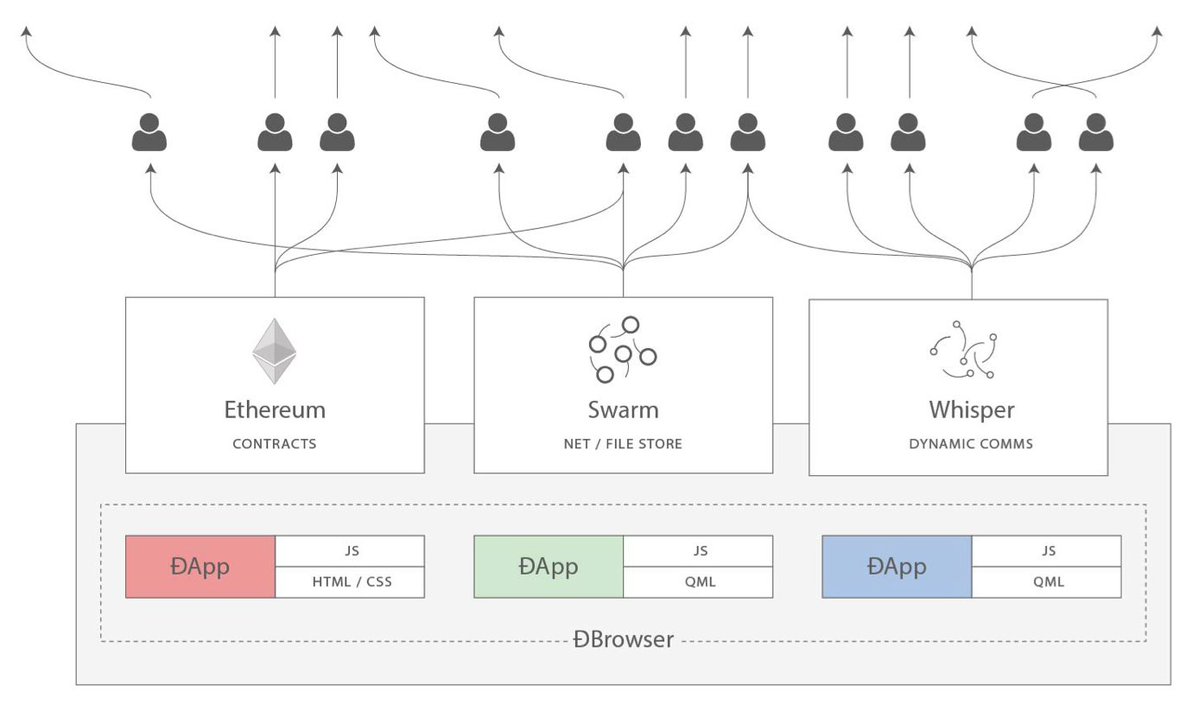
In 2014, there was a vision: you can have permissionless, decentralized applications that could support finance, social media, ride sharing, governing organizations, crowdfunding, potentially create an entire alternative web, all on the backs of a suite of technologies. Ethereum: the blockchain. The world computer that could give any application its shared memory. Whisper: the data layer. Messages too expensive for a blockchain, that do no need consensus. Swarm: the storage layer. Store files for long-term access. Over the last five years, this core vision has at times become obscured, with various "metas" and "narratives" at various times taking center stage. But the core vision has never died. And in fact, the core technologies behind it are only growing stronger. Ethereum is now proof of stake. Ethereum is now scaling, it is now cheap, and it is on track to get more scalable and cheaper thanks to the power of ZK-EVMs. Thanks to ZK-EVM + PeerDAS, the "sharding" vision is effectively being realized. And L2s can give additional and different kinds of gains in speed on top. Whisper is now Waku ( docs.waku.org ), and already powers many applications (eg. railway.xyz, status.app just to name two I use). Even outside of Waku, the quality of decentralized messaging has increased. Fileverse (decentralized Google Docs and Sheets alternative: fileverse.io ) has seen massive gains in usability over the past year. IPFS is now highly performant and robust as a decentralized way of retrieving files, though IPFS alone does not solve the storage problem. Hence, there is still room to improve there. All of the prerequisites for the original web3 vision are here, in full force, and are continuing to get stronger over the next few years. Hence, it's time to buidl, and buidl decentralized. Fileverse is an excellent example of the right way to do things: * It uses Ethereum and Gnosis Chain for what they are good for: names, accounts and permissioning, document registration * It uses decentralized messaging and file storage to store documents and propagate changes to documents * The application passes the walkaway test: github.com/fileverse/walk… (even if Fileverse disappears, you can still retrieve them and even keep editing them with the open source UI) This is what we mean by "build a hammer that is a tool you buy once and it's yours, not a corposlop AI dishwasher that requires you to register for a google account and charges a subscription fee per month for extra washing modes, and probably spies on you and stops working if you get politically disfavored by a foreign country". If you think this criticism of corposlop is hyperbolic, well turns out, it's literally a concatenation of these three: * mein-mmo.de/en/user-buys-n… * theguardian.com/technology/202… * irishtimes.com/world/us/2025/… In 2014, decentralized applications were toys, hundreds of times more difficult to use in web2. In 2026, fileverse is now usable enough that I regularly write documents in it and send them to other people to collaborate. The decentralized renaissance is coming, and you can be part of making it happen.
vitalik.eth tweet media
English
824
810
4.8K
505.1K
Eli5DeFi
Eli5DeFi@Eli5defi·
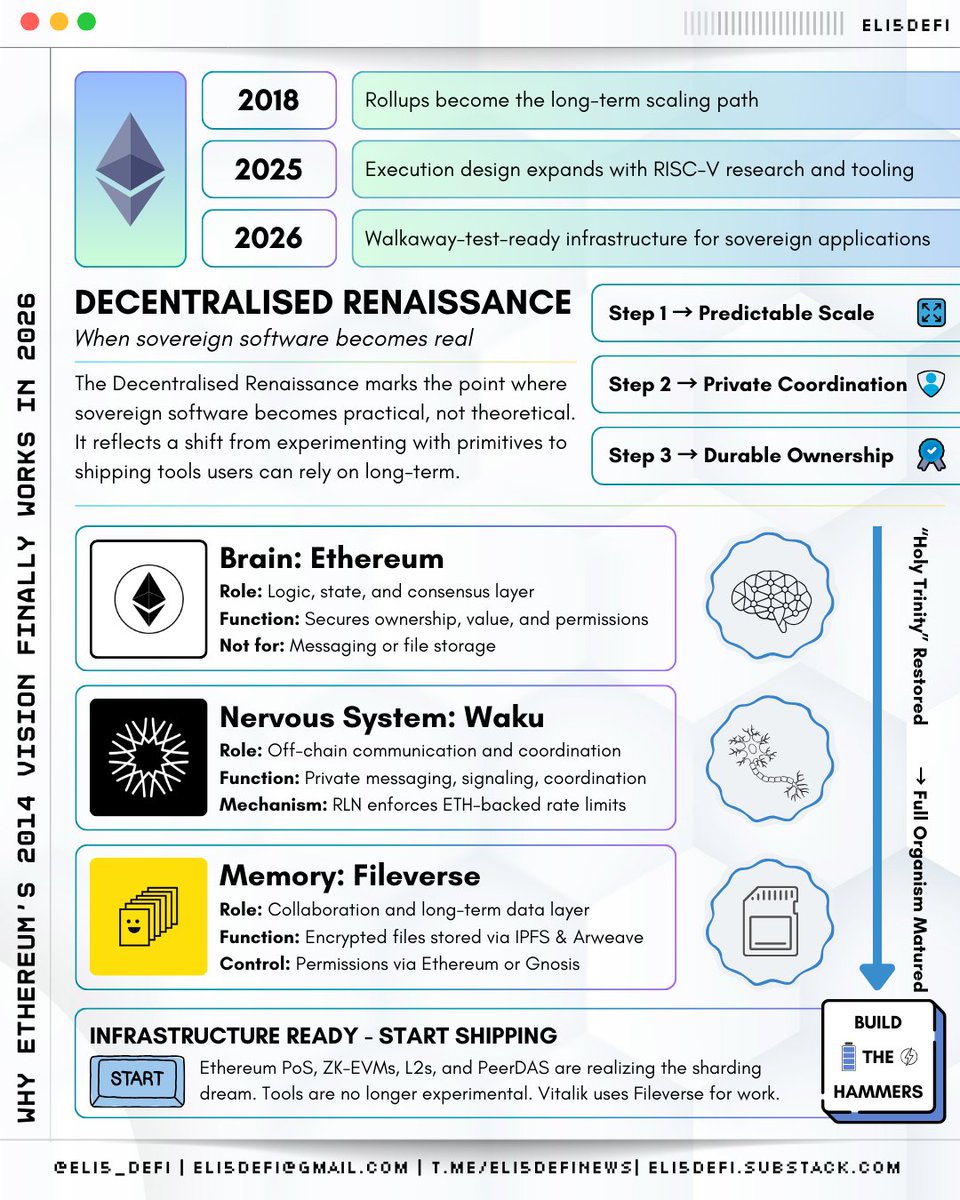
Vitalik Buterin argues that @ethereum’s original 2014 Web3 vision is no longer aspirational. In 2026, the conditions to execute it finally exist. Ethereum reached this point through deliberate technical milestones: ▸ 2018: Rollups become the long-term scaling path ▸ 2025: Execution design expands with RISC-V research and tooling ▸ 2026: Walkaway-test-ready infrastructure for sovereign applications Here is what $ETH is focused on in 2026 at the infrastructure level 🧵 — — — ► What Is the Decentralised Renaissance? The Decentralised Renaissance marks the point where sovereign software becomes practical, not theoretical. It reflects a shift from experimenting with primitives to shipping tools users can rely on long-term. Key shifts and examples: ▸ ZK-EVMs and PeerDAS make scalability predictable and sustainable ▸ Waku moves communication off-chain without sacrificing privacy or censorship resistance ▸ Fileverse enables collaboration where ownership survives vendor failure This stands in direct contrast to subscription-based, permissioned, surveillance-driven software that users never truly own, commonly reduced to corposlop. — ► The Ethereum “Organism” Framework Ethereum now operates as a coherent system, with each layer designed for a specific function. ❶ Brain: Ethereum Handles logic, state, and consensus. Secures ownership, value, and permissions. Not meant for chat or file storage. ❷ Nervous System i.e: @Waku_org Successor to Whisper. Handles off-chain messaging, signalling, and coordination. Uses RLN to enforce ETH-backed rate limits without centralized moderation. ❸ Memory i.e: @fileverse Fileverse is a collaboration layer. Ethereum or Gnosis manages permissions, IPFS and Arweave store encrypted content. Ownership survives vendor failure, passing the Walkaway Test. — ► Why This Matters Today, you do not own your software or data. Platforms like @googlecloud control access, and shutdowns, bans, or policy changes erase it instantly. The Decentralized Renaissance makes ownership enforceable, where files, messaging, and permissions survive vendor failure by design. This is software designed like a hammer, bought once, owned outright, and usable without trusting a company to keep it alive. The Web3 stack is now coherent and production-ready, leaving builders with no infrastructure excuses, only execution choices.
Eli5DeFi tweet media
vitalik.eth@VitalikButerin

In 2014, there was a vision: you can have permissionless, decentralized applications that could support finance, social media, ride sharing, governing organizations, crowdfunding, potentially create an entire alternative web, all on the backs of a suite of technologies. Ethereum: the blockchain. The world computer that could give any application its shared memory. Whisper: the data layer. Messages too expensive for a blockchain, that do no need consensus. Swarm: the storage layer. Store files for long-term access. Over the last five years, this core vision has at times become obscured, with various "metas" and "narratives" at various times taking center stage. But the core vision has never died. And in fact, the core technologies behind it are only growing stronger. Ethereum is now proof of stake. Ethereum is now scaling, it is now cheap, and it is on track to get more scalable and cheaper thanks to the power of ZK-EVMs. Thanks to ZK-EVM + PeerDAS, the "sharding" vision is effectively being realized. And L2s can give additional and different kinds of gains in speed on top. Whisper is now Waku ( docs.waku.org ), and already powers many applications (eg. railway.xyz, status.app just to name two I use). Even outside of Waku, the quality of decentralized messaging has increased. Fileverse (decentralized Google Docs and Sheets alternative: fileverse.io ) has seen massive gains in usability over the past year. IPFS is now highly performant and robust as a decentralized way of retrieving files, though IPFS alone does not solve the storage problem. Hence, there is still room to improve there. All of the prerequisites for the original web3 vision are here, in full force, and are continuing to get stronger over the next few years. Hence, it's time to buidl, and buidl decentralized. Fileverse is an excellent example of the right way to do things: * It uses Ethereum and Gnosis Chain for what they are good for: names, accounts and permissioning, document registration * It uses decentralized messaging and file storage to store documents and propagate changes to documents * The application passes the walkaway test: github.com/fileverse/walk… (even if Fileverse disappears, you can still retrieve them and even keep editing them with the open source UI) This is what we mean by "build a hammer that is a tool you buy once and it's yours, not a corposlop AI dishwasher that requires you to register for a google account and charges a subscription fee per month for extra washing modes, and probably spies on you and stops working if you get politically disfavored by a foreign country". If you think this criticism of corposlop is hyperbolic, well turns out, it's literally a concatenation of these three: * mein-mmo.de/en/user-buys-n… * theguardian.com/technology/202… * irishtimes.com/world/us/2025/… In 2014, decentralized applications were toys, hundreds of times more difficult to use in web2. In 2026, fileverse is now usable enough that I regularly write documents in it and send them to other people to collaborate. The decentralized renaissance is coming, and you can be part of making it happen.


English
44
68
333
27.2K
We Are Millions ری ٹویٹ کیا
Juraj Bednar
Juraj Bednar@jurbed·
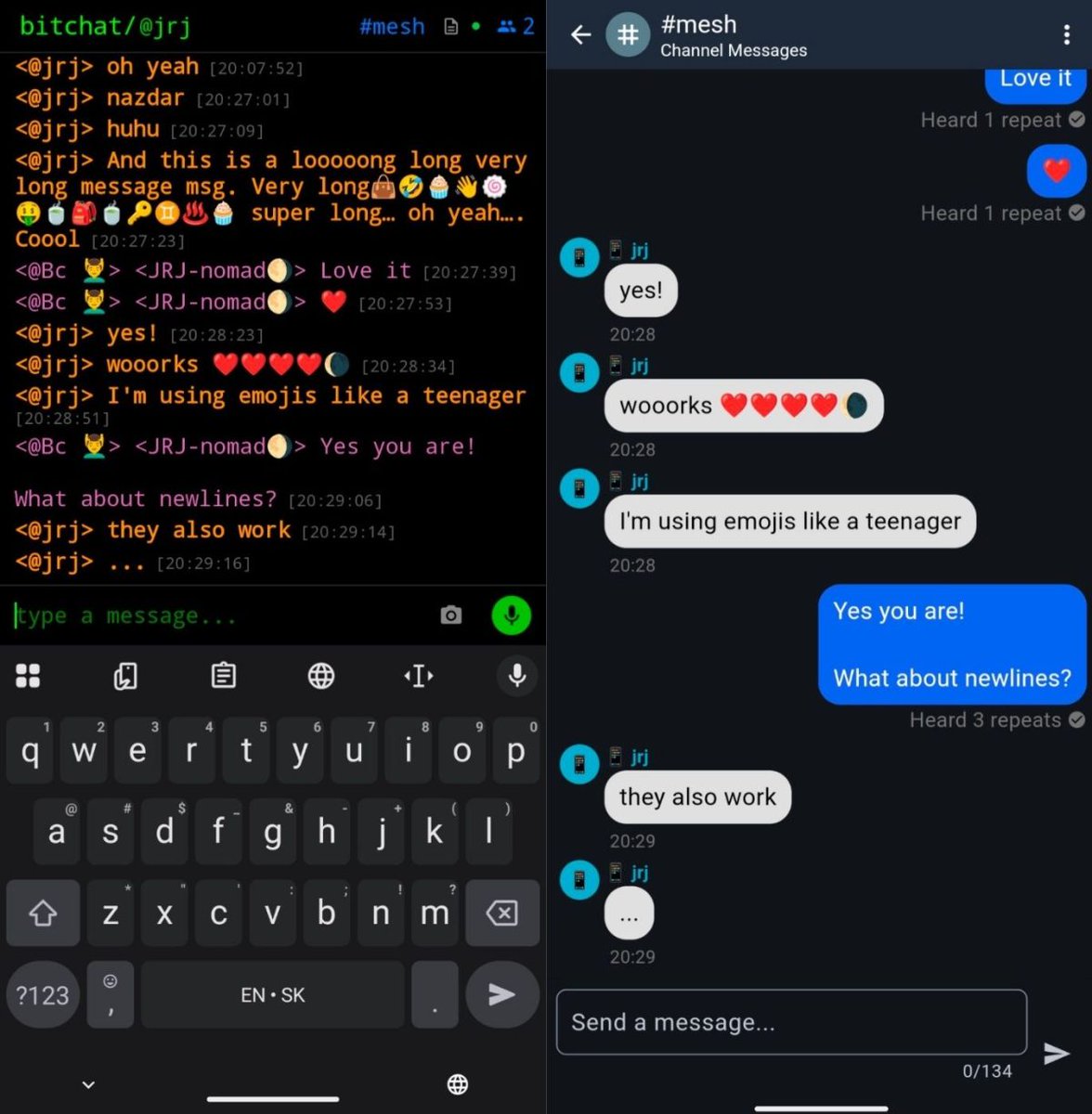
🌐 Bridging Bitchat + MeshCore: Resilient communication when infrastructure fails Bitchat = Bluetooth mesh on phones you already have (~100m range) MeshCore = LoRa long-range mesh (km+ with cheap hardware) The bridge connects them. Your phone talks to the city-wide mesh network. Perfect for disasters, protests, internet shutdowns. Code: github.com/jooray/MeshCor… Releases: github.com/jooray/MeshCor… Read more: juraj.bednar.io/en/blog-en/202…
Juraj Bednar tweet media
English
36
194
988
55.6K
We Are Millions ری ٹویٹ کیا
x402 Hub
x402 Hub@X402_Hub·
@octalmage @ethswarm @base @akashnet Super cool to see x402 powering ephemeral storage on Base with Swarm and Akash! That agent-driven pay-per-upload model is exactly where this is headed for autonomous services.
English
1
3
5
493
We Are Millions
We Are Millions@WAMillions·
@jessewldn it’s not about replacing Gmail with “dGmail”. It’s about systems that can’t exist without web3 infra: autonomous agents that own their data, streaming & chat w/o servers, scientific data markets w/o custodians, co-op dAI etc. @ethswarm is being tailored to this.
English
0
2
4
429
Jesse Walden
Jesse Walden@jessewldn·
It’s cool too see Vitalik clearly articulate his vision for Ethereum (now better than ever maybe?) Personally, these ideas were riveting in 2014. It’s what inspired me to get into crypto. But today it feels like the world has moved on, unfortunately. Blockchains are for finance. Finance is and will continue to get surprisingly more expressive because of blockchains, but it’s hard to see a mainstream renaissance in the types of applications described because they are skeuomorphic (decentralized) versions of existing products. That hasn’t been a formula for success. I think a more interesting theme is to imagine: non-skeuomorphic manifestations of the vision he is describing? For example, are we going to end up with 3 mega-datacenter corps, or are we going to find a way to leverage decentralized compute? And what *new* products can only be developed because of the new financial markets that blockchains enable?
vitalik.eth@VitalikButerin

In 2014, there was a vision: you can have permissionless, decentralized applications that could support finance, social media, ride sharing, governing organizations, crowdfunding, potentially create an entire alternative web, all on the backs of a suite of technologies. Ethereum: the blockchain. The world computer that could give any application its shared memory. Whisper: the data layer. Messages too expensive for a blockchain, that do no need consensus. Swarm: the storage layer. Store files for long-term access. Over the last five years, this core vision has at times become obscured, with various "metas" and "narratives" at various times taking center stage. But the core vision has never died. And in fact, the core technologies behind it are only growing stronger. Ethereum is now proof of stake. Ethereum is now scaling, it is now cheap, and it is on track to get more scalable and cheaper thanks to the power of ZK-EVMs. Thanks to ZK-EVM + PeerDAS, the "sharding" vision is effectively being realized. And L2s can give additional and different kinds of gains in speed on top. Whisper is now Waku ( docs.waku.org ), and already powers many applications (eg. railway.xyz, status.app just to name two I use). Even outside of Waku, the quality of decentralized messaging has increased. Fileverse (decentralized Google Docs and Sheets alternative: fileverse.io ) has seen massive gains in usability over the past year. IPFS is now highly performant and robust as a decentralized way of retrieving files, though IPFS alone does not solve the storage problem. Hence, there is still room to improve there. All of the prerequisites for the original web3 vision are here, in full force, and are continuing to get stronger over the next few years. Hence, it's time to buidl, and buidl decentralized. Fileverse is an excellent example of the right way to do things: * It uses Ethereum and Gnosis Chain for what they are good for: names, accounts and permissioning, document registration * It uses decentralized messaging and file storage to store documents and propagate changes to documents * The application passes the walkaway test: github.com/fileverse/walk… (even if Fileverse disappears, you can still retrieve them and even keep editing them with the open source UI) This is what we mean by "build a hammer that is a tool you buy once and it's yours, not a corposlop AI dishwasher that requires you to register for a google account and charges a subscription fee per month for extra washing modes, and probably spies on you and stops working if you get politically disfavored by a foreign country". If you think this criticism of corposlop is hyperbolic, well turns out, it's literally a concatenation of these three: * mein-mmo.de/en/user-buys-n… * theguardian.com/technology/202… * irishtimes.com/world/us/2025/… In 2014, decentralized applications were toys, hundreds of times more difficult to use in web2. In 2026, fileverse is now usable enough that I regularly write documents in it and send them to other people to collaborate. The decentralized renaissance is coming, and you can be part of making it happen.

English
35
12
217
52.9K
We Are Millions
We Are Millions@WAMillions·
@jmazzahacks @VitalikButerin @ethswarm Agree, this seems like it has nothing to do with tech, all “politics”. What a shame and what a disappointment, coming in a post that’s supposed to be all about reclaiming the core vision.
English
1
0
1
105
Jason Byteforge
Jason Byteforge@jmazzahacks·
Okay, WTH is going on here. First time I've seen you mention @ethswarm since forever. And then you proceed to shill fileverse, which is not really decentralized (as nothing on IPFS can be) and you're smart enough to know this. Meanwhile @ethswarm is still building, still being EVM compatible, sticking to first principles. Technology wise they are miles ahead of anything what IPFS can do. They seem like a small team, underfunded, but are still shipping things and I even see larger projects copying their ideas. @EmanAbio heavily promotes and talks about @WalrusProtocol which is nice to see. But where are you? If there is something technically wrong with @ethswarm and you think an IPFS stack is somehow better (hard to believe, but okay), then come out and tell us why.
English
3
0
4
224
We Are Millions ری ٹویٹ کیا
Ethereum Swarm
Ethereum Swarm@ethswarm·
Huge thanks to everyone who tuned in to the Swarm Community Call – Solstice Edition 🐝 If you couldn’t make it, the full recording is available here 👇 x.com/i/broadcasts/1…
English
2
4
19
2.3K
We Are Millions ری ٹویٹ کیا
Ethereum Swarm
Ethereum Swarm@ethswarm·
🚨T-minus 10 mins until Swarm Solstice Community Call—starting at 17:00 CET Tune in👇 x.com/i/broadcasts/1…
English
0
1
6
419
We Are Millions ری ٹویٹ کیا
Ethereum Swarm
Ethereum Swarm@ethswarm·
📣Happening Today: Swarm Solstice Community Call Covering: - Core Development & Client Evolution - Multichain Funding - File Management & Drive - Multimedia Streaming & Data Distribution - Agentic Economy Prospects - Incentives design optimisation x.com/i/broadcasts/1…
English
0
6
11
550
We Are Millions ری ٹویٹ کیا
Calimero Network
Calimero Network@CalimeroNetwork·
Excited to launch our first blog post in a new series! 🚀 Get a holistic view of all the tooling and general concepts! Read it here: calimero.network/blog/what-is-c…. TLDR in the thread. 🧵 More coming soon 👀
Calimero Network tweet media
English
6
13
34
2.5K