$BOASE

29.4K posts

$BOASE banner
$BOASE

$BOASE

@b0ase

$boase https://t.co/RTilI2LHWv

East London شامل ہوئے Mayıs 2008
6K فالونگ6.1K فالوورز
$BOASE
$BOASE@b0ase·
There is one 'winner' every ten minutes. Every 'winner' has to have the transactions in their block candidate approved by all the other mining pools to win. If you subpoena the leading pools then you can dictate which TX are valid and which are invalid and you can freeze coins, and even confiscate them (e.g. move them from their addresses) without having access to the private keys that control them. It's baked into the very fabric of Bitcoin, and is the purpose behind implementing Proof of Work in the first place. Big nodes, big target, big throats to choke. I know this likely doesn't fit your belief system or mental model of the network, it just happens to be an uncomfortable fact that bitcoiners uniformly choose to ignore in pursuit of their 'preferred narrative'. The only wiggle room I'll give you is that fresh addresses used in every transaction for both sender and reciever allow transacting parties to route around the obvious, sanctionable, freezable architecture of UTXOs on a PoW chain. However, the UTXO set is still so tiny they're easy to spot and sanction.
English
1
0
0
45
Carlos 🏴‍☠️
Carlos 🏴‍☠️@ConsensusMecha·
@b0ase @shanaka86 You do understand that the protocol pays those to secure the network, they aren’t the “winners”. In this case the winner is a sovereign state doing settlements without an intermediary.
English
1
0
0
36
Shanaka Anslem Perera ⚡
Shanaka Anslem Perera ⚡@shanaka86·
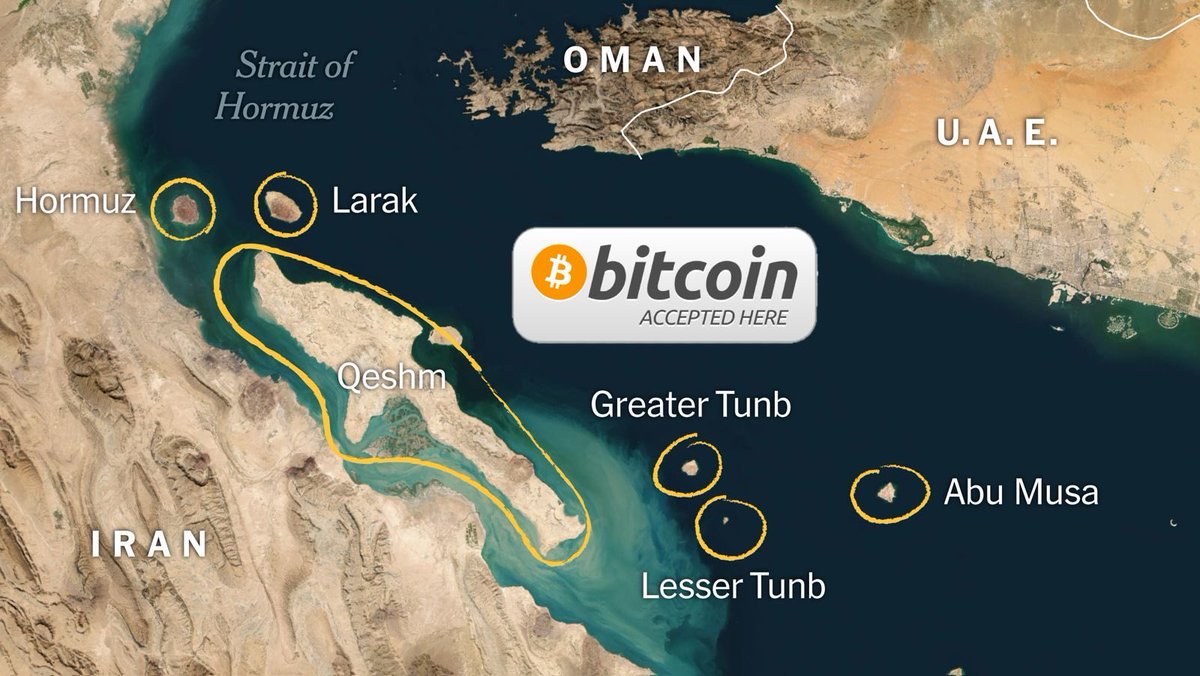
Three things happened on April 8, 2026. The United States and Iran announced a two-week ceasefire. The Financial Times reported that Iran’s IRGC is charging oil tankers approximately one dollar per barrel in cryptocurrency to transit the Strait of Hormuz, with Bitcoin explicitly preferred for its non-freezable properties. And Treasury Secretary Scott Bessent released the GENIUS Act’s proposed stablecoin rules, requiring all permitted stablecoin issuers to run full sanctions compliance programs with the ability to “block, freeze, and reject” illicit transactions. The ceasefire, the toll, and the regulation landed on the same day. This is not coincidence. This is the opening salvo of a financial war that will outlast the kinetic one. Bessent’s GENIUS Act is a precisely calibrated weapon. It treats stablecoin issuers as financial institutions under the Bank Secrecy Act. It mandates that Tether, Circle, and every permitted issuer must screen transactions against OFAC sanctions lists and freeze wallets linked to designated entities. The IRGC has already lost $3.3 billion in frozen USDT through exactly this mechanism. Tether blacklisted $182 million in IRGC-linked wallets in a single enforcement action. The sword is real and it cuts. But it cuts only stablecoins. And the IRGC knows this. The Hormuz toll system, operational since mid-March and codified by Iran’s parliament on March 30, explicitly promotes Bitcoin over stablecoins for one structural reason: Bitcoin has no issuer. There is no company to serve with a subpoena. There is no compliance officer to pressure. There is no “block, freeze, and reject” button. When a laden tanker emails its cargo manifest to the IRGC intermediary, receives a quote in BTC equivalent, and transfers the exact amount to a fresh wallet within seconds, the transaction settles on a network that no Treasury secretary on earth can reverse. The GENIUS Act gave Bessent the sword. The IRGC chose the asset without a throat to cut. This is the regulatory paradox that nobody in Washington or on crypto Twitter is willing to state plainly. The tighter Bessent makes stablecoin compliance, the more he validates the IRGC’s preference for Bitcoin. Every USDT wallet frozen is another data point proving to Tehran that stablecoins are controllable and Bitcoin is not. The regulation designed to stop sanctions evasion is actively teaching the adversary which rail to use. The GENIUS Act does not close the door. It labels which doors are locked and which one remains open. TRM Labs confirmed on April 9 that the IRGC received over $3 billion in crypto inflows in 2025, roughly half of Iran’s entire $7.78 billion ecosystem. Chainalysis confirmed IRGC-linked addresses dominated Q4 2025. The Qeshm Island conversion window, operational since mid-March, routes toll receipts from crypto to rials without touching SWIFT. The infrastructure is not theoretical. It is built, tested, and running. What it lacks is volume, because Hormuz traffic remains below ten percent of its pre-war average, with only a handful of vessels transiting daily and no major oil tankers confirmed as having paid. But here is what the volume skeptics are missing. The system does not need to process twenty million barrels a day to matter. It needs to exist. Its existence is the proof of concept. The moment one verified transaction clears a BTC toll at the world’s most important energy chokepoint, it establishes a precedent that cannot be unestablished: that a sanctioned nation-state can extract sovereign revenue in a currency no government can freeze, at a chokepoint no navy has yet reopened, converting military control into monetary infrastructure in real time. Bessent’s sword is sharp. The IRGC built the maze. And on April 8, they showed the world both at the same time. open.substack.com/pub/shanakaans…
Shanaka Anslem Perera ⚡ tweet media
Dr.Amila Fernando🪬@DrBukkabwoi

Iran planning to charge 1$ per barrel in crypto as tolls on every oil tanker passing through the Strait of Hormuz. Thats 20% of global oil supply being held hostage for Bitcoin payments.. The news says Chinese tankers already halted at the entrance today, testing if they can pass without paying. Iran closed the strait again yesterday after barely 24 hours of ceasefire. If they actually implement this, oil prices will go mental. Imagine every tanker captain having to figure out crypto wallets while hauling crude. This is either genius or complete madness.

English
40
167
571
162.5K
Robert Graham
Robert Graham@robertgraham·
I was a professional Windows C/C++ programmer throughout the 1990s that had to also make code work on Unix. Satoshi's code speaks to me -- that's exactly the sort of code I wrote, down to using 'printf' instead of 'cout'. What I mean to say is that he's gotten rid of all the C++ class hierarchy nonsense and is primarily using C++ as a smarter C with lightweight objects. It's a VERY distinctive choice. Conversely, the "style" (where he puts spaces and braces) is non-distinctive, looks like all other code.
English
29
10
567
59.5K
Robert Graham
Robert Graham@robertgraham·
Hi. Professional C/C++ programmer here. The open-source code I can find written by Adam Back and Satoshi Nakamoto don't look remotely similar. Back's code looks typical of academic Unix programmers who also hack their code to run on Windows. Satoshi code was written by a professional Windows programmer who also wrote for Unix. Stylistically, they look nothing alike. There's not enough time between 2005 when I can find the newest Adam Back and January 2009 when Satoshi published Bitcoin/0.1 to account for the change. Both are perfectly competent programmers, but stylistically, they are completely different. The NYTimes tried to compare their English language in posts/emails. I'm compare their C/C++ language in their open-source code. The NYTimes merely points out they both use C++ as if that's another corroborating detail, when the actual code seems to disqualify Adam Back.
The New York Times@nytimes

Bitcoin’s founder, Satoshi Nakamoto, has remained hidden for 17 years. A trail of clues — and a year of digging by our reporter, John Carreyrou — led us to a 55-year-old computer scientist in El Salvador named Adam Back. nyti.ms/4bXWC3V

English
266
923
10.8K
1.4M