@koolkrypto223 @hyperlendx @HyperTrendLabs True. Much will also depend on the chain moat too. The simple forks from other chains will only end up valuable if hyperevm can add valuable user cases ultimately.
English
Bowse
744 posts






hwHLP Update hwHLP has seen a large influx of capital following the recent liquidation event, with TVL jumping from ~$4M to ~$20M. To protect long-term depositors and ensure the outsized yield from liquidations is distributed fairly, we have paused hwHLP exchange-rate updates while we finalize a distribution plan. The yield generated from this liquidation event will not be reflected via the exchange rate. Instead, it will be distributed via a direct airdrop to all hwHLP positions (including lending, LP collateral, and YTs) that had legitimate exposure to hwHLP at the time the yield was earned. We are currently working through on-chain data to determine the appropriate snapshot time for this airdrop. Depositors will receive the full yield they are entitled to, while short-term scalping capital will not dilute returns. We will share a detailed follow-up explaining the snapshot logic, timeline, and how this will be handled going forward to prevent similar situations. Deposits and exchange rate activity will resume in the next 48 hours. Thanks for your patience.


Integrity has always been one of Hyperliquid's core values. The house of all finance must be credibly neutral. This means no private investors, no market maker deals, and no protocol fees to any company. The initial state of any blockchain is a crucial part of its story that can never be erased. The original ethos of Bitcoin was a permissionless network accessible to all. Hyperliquid's genesis distribution followed this spirit, going entirely to early users with core contributors excluded. The full distribution is verifiable onchain without obfuscation. This principle of fairness frustrates a few users and builders who are used to special treatment. It means that Labs has zero tolerance for team members with integrity yellow flags. It means we do things the hard way as a community. But the world deserves a financial system owned by the people, where fairness to all users is in the DNA. Nothing else is worth building.



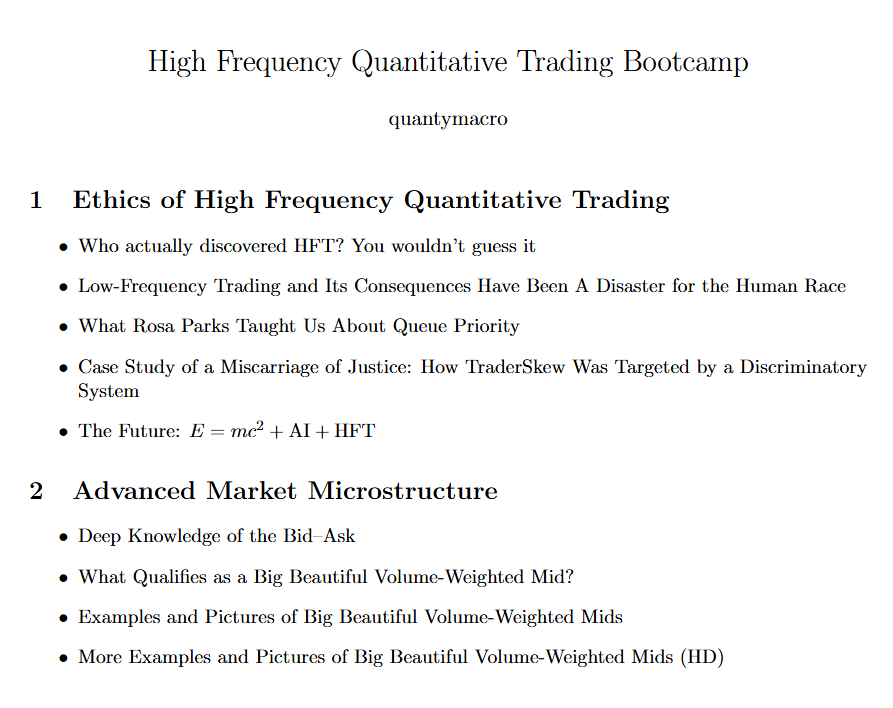
I’m thinking of running a High Frequency Quantitative Trading bootcamp — DM if interested ideal participants - CFA Level 1 and above - Harvard MBA preferred - Kalshi/Polymarket Badge is a bonus - proficiency in Python/Excel - free next month
A few things here: 1. The point of my piece was not "Ethereum is Amazon." It was not a business model comparison, so debating Amazon's profitability is really not the point. 2. That said, Amazon had very small profit for most of its history, with net margins around 1-3%. These are extremely low for a tech company, which is why Amazon was criticized so much by analysts. Amazon was a $150B+ company while having ~$100M in net income. I did not say "Amazon was unprofitable," I said "it took 22 years for the [profit] line to go up." True, there was a deeper growth flywheel if you look at revenue and FCF (largely driven by AWS). But that's precisely the point—the biggest companies in the world traded on profit at that time, but Amazon wasn't focused on profit, because it was chasing the exponential. 3. Outside of the Amazon points, the core of Santi's claim is that unlike Amazon, L1s don't have moats. Totally disagree with this. Was debating the same question yesterday with @QwQiao, and I think it's really incontrovertible that L1s have moats. x.com/hosseeb/status… He claims L1s: * Attract liquidity… but can’t keep it - Evidence? * Open source… great for innovation, terrible for margins - Evidence? * Blockspace… structurally a commodity - Evidence? * Users… mercenary - Evidence? I don't see the evidence for this. Obviously these are true for Blast or for some other chain that fell off the face of the earth, just as it did for Amazon's competitors. But these do not appear to be true for Ethereum or Solana—both have managed to hold onto liquidity, create valuable blockspace, with sticky users, all while being open-source.