Jorge 𐤊 ױ

36.4K posts

Jorge 𐤊 ױ banner
Jorge 𐤊 ױ

Jorge 𐤊 ױ

@cryptojorch

España شامل ہوئے Şubat 2023
263 فالونگ1.2K فالوورز
Jorge 𐤊 ױ ری ٹویٹ کیا
The 𐤊rypto Tyger
The 𐤊rypto Tyger@thecryptotyger·
$QUBIC says 15,000,000 TPS $KAS would need ~50,000 BPS to match it Both sound insane So here’s the real question Who actually gets there first The one promising it or the one that has to scale into it Pick your fighter 👇
The 𐤊rypto Tyger tweet mediaThe 𐤊rypto Tyger tweet media
That, Thailand 🇹🇭 English
6
2
9
1.1K
Jorge 𐤊 ױ ری ٹویٹ کیا
Qubic
Qubic@_Qubic_·
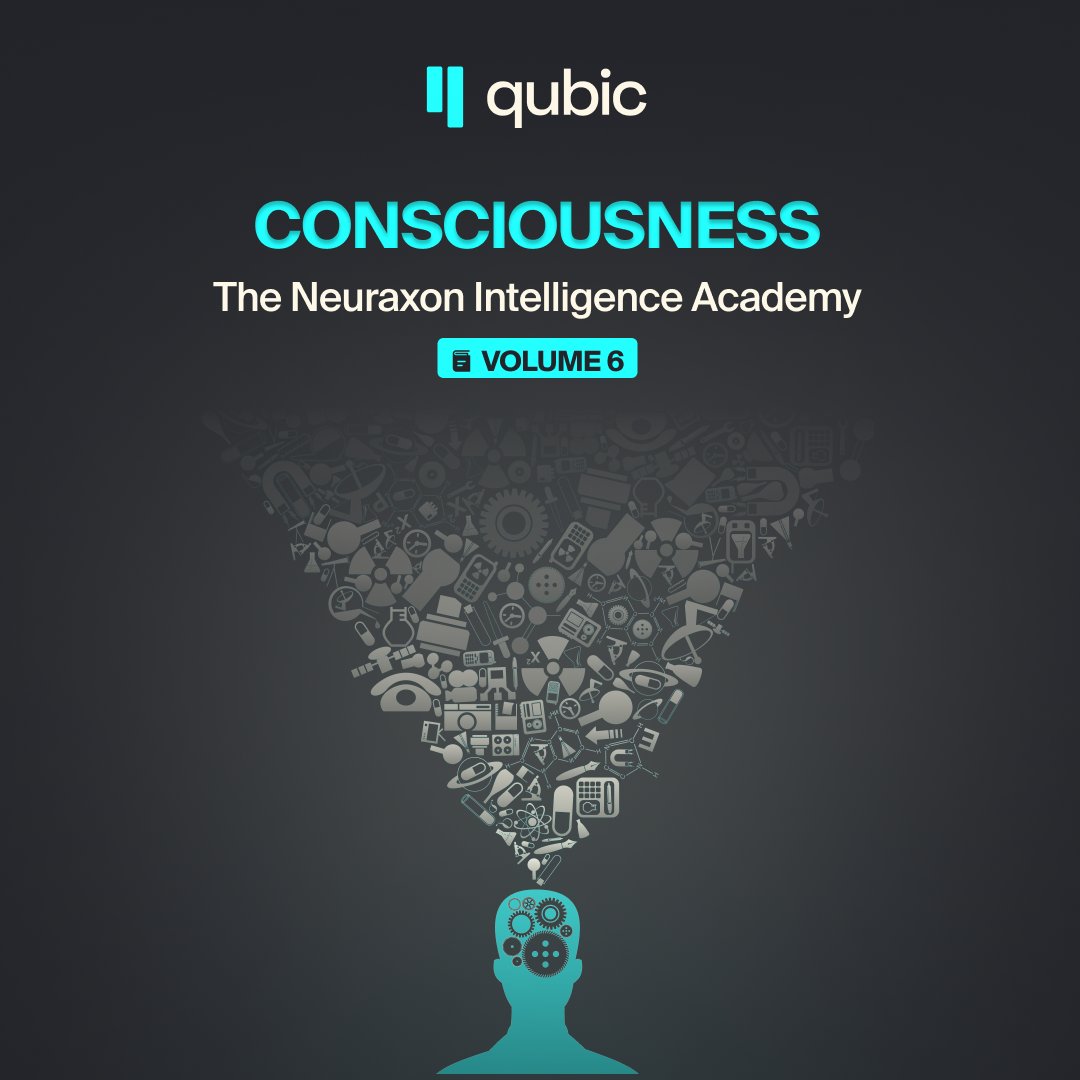
Everyone talks about AI getting smarter. Almost nobody asks whether it could become conscious. Intelligence solves problems. Consciousness experiences them. Science has serious theories for both, and most of the AI discourse confuses the two entirely. Our scientific team just published the Neuraxon Intelligence Academy vol.6 breaking all of this down: - The hard problem of consciousness and why it remains unsolved - Global Workspace Theory, Integrated Information Theory, Predictive Coding - Why simulating a brain's behavior and recreating its experience are two completely different things - How MultiNeuraxon computes properties tied to conscious processes Peer-reviewed neuroscience meets real architecture. No sci-fi speculation.
Qubic tweet media
English
20
30
180
5K
Jorge 𐤊 ױ ری ٹویٹ کیا
Qubic
Qubic@_Qubic_·
A tiny AI just destroyed systems 10x its size across 8 benchmarks. Not close. Not "competitive." Destroyed. Here's why that matters, and what it means for where AI is actually heading. 🧵
Qubic tweet media
English
26
82
359
18K
Jorge 𐤊 ױ ری ٹویٹ کیا
J Nicholas Gross
J Nicholas Gross@JNGross·
fed the Google whitepaper to Claude with the prompt: "take a look at the Google paper, pick out the key parameters, and give me your analysis of the relative strengths, weakness and adaptability for both Bitcoin and Kaspa in table form" there's literally no parameter for which $KAS Kaspa is not superior, security wise the narrative for the past few years, that somehow $BTC is more secure as a POW chain, has now gone out the window in face of the quantum threat
J Nicholas Gross tweet media
English
11
100
225
11.3K
Jorge 𐤊 ױ ری ٹویٹ کیا
Shai (Deshe) Wyborski
Shai (Deshe) Wyborski@DesheShai·
UTXO set commitments are $kas Kaspa's quantum achilles hill In light of the recent truly astounding advances in building quantum computers, I think it's time to explain the most significant threat to Kaspa's consensus mechanism that such machines pose. It's not an immediate threat, but arguably something that requires more attention given the shift in the landscape. Before I start, I want to mention that @mcpauld invited me to a recorded session where we will talk about the new quantum advances, their meaning, and their consequences to blockchains. Stay tuned to know when it is published. Incremental Hash commitments and MuHash When a new Kaspa node syncs from an existing one, it gets a copy (actually, two copies, but never mind) of the UTXO set, along with a commitment. The commitment is a small hash that cryptographically assures that the supplied UTXO set matches the expected one. Hashing the entire UTXO set is an ever-daunting task, whose computational cost grows with the number of UTXOs. It's reasonable to do once during sync for verification, but for a miner, recomputing the entire hash for every new block would gradually make mining less and less accessible. To address this, Kaspa headers use an incremental hash. It's a special kind of hash that is used to commit to a set of strings (each representing a UTXO). What makes it special is that given the current commitment, as well as a list of elements to add and remove, one can compute the hash of the resulting set without recomputing the entire hash. So when creating a new block, the miner just uses the existing hash and updates it according to the UTXOs consumed and created in its block. As long as the block wasn't pruned, all nodes can repeat this check and verify that the miner is honest. Generally speaking, hashes are not incremental. Incremental hashes are specially designed to provide this functionality. In particular, Kaspa uses MuHash, a very lightweight incremental hash. Quantum Shor Attacks I will not go into the details of what quantum computers can or cannot break. But what's important to remember is that they can break what we call "discrete log assumptions". Stock hash families like Keccak, SHA, Blake, and so on do not rely on any such assumption, so they are considered quantum secure (in the sense that it is impossible to quantum-optimize them beyond the obligatory Grover quadratic speedup). However, MuHash relies on elliptic discrete log assumptions, very similar to ECDSA. This means that a quantum adversary can invert the hash commitment. In other words: they can find a completely different UTXO set with the same MuHash commitment. Consequences The UTXO set can only be verified independently of the UTXO commitment until the block is pruned. After that, Kaspa clients will accept any UTXO set that matches the commitment. This, for example, allows the following 51% attack: 1. Locate the UTXO commitment of the latest pruning block 2. Use your quantum computer to find another UTXO set with the same commitment 3. Build a competing heavier chain that assumes the UTXO set at pruning is the one you manufactured and not the original one Voila! A 51% the length of a single pruning window that can rewrite Kaspa's enitre history. Comparison to the current state Currently, Kaspa relies on social consensus in the short term, followed by cryptographic security in the long term. Social consensus prevents committing to UTXO sets that weren't a consequence of legitimate transactions. Cryptography uses state commitment to cement the UTXO set agreed upon by consensus. This is a very mild relaxation of Bitcoin's trust model, which does not require social consensus in the short term for chain consistency. Breaking MuHash means that the cryptographic backbone of this model no longer holds. UTXO commitments become unreliable, compromising Kaspa's trust model. I want to stress two things: 1. The attack only requires one application of Shor's algorithm to find a preimage. It might require some clever mix-and-match to find a preimage you actually like, but factors like BPS or difficulty do not make the attack any harder. 2. The attack cost is directly proportional to the length of a pruning window (in RW time, not blocks). So shorter pruning windows = less quantum secure network. Partial Solutions 1. Relying on archival nodes. If archival nodes are always available, then the problem "goes away". The issue is that archival nodes become a trusted source of truth. Currently, we don't have to trust archival nodes, because the UTXO commitment ensures that the UTXO set they describe is genuine. With this assumption quantum-broken, we need to either trust archival nodes or have enough archival nodes to trust decentralization. One of Kaspa's strong points over Bitcoin's antiquated model is a trust model that does not require trusted archives. Removing this will make Kaspa de-facto centralized. Worse yet, the reliance on archival nodes is fragile, as if, for some reason, there is a period of time longer than a pruning window that was not archived by anyone, the chain becomes indefinitely unverifiable. 2. Changing Hash There are post-quantum hashes like LtHash. The first issue (but not the key one) is that such a commitment is much larger (2KB versus a few dozen bytes). Recall that the UTXO commitment is a part of the header, so using such large commitments will make headers 9-10 times larger, drastically increasing storage costs for pruned nodes. (One can argue that pruned non-mining nodes can run in a mode that chucks away the commitments after verifying them. This will reduce storage, but it is impossible to sync from such nodes trustlessly, recreating the few sources of truth problem.) But even if we do magically find a tiny post-quantum hash, that will only provide a partial solution. A quantum adversary could not forge the UTXO set from the latest pruning point, but would have to go back far enough to split from a block that still uses MuHsah. Possible solution I haven't spent any time trying to come up with a better solution. It is very possible that a better approach exists. Below is a strating point for a discussion, not a concrete proposal: 1. Converge on a post-quantum incremental hash, lets call it QuHash 2. Decide on a block from which commitments must be in QuHash 3. Decide on a period of time (say, a year) after which reorgs below the QuHash depth are considered invalid. This is a very problematic solution, for several reasons: 1. (After qday) any archival information from before the QuHash days cannot be trusted. This includes any form of cryptographic receipt. All could be easily forged without tampering with the commitment. 2. (After qday) there will no longer be a reliable way to verify a UTXO set "all the way to genesis", just "all the way to when we started using QuHash". What happened before qday is delegated to social consensus. 3. Headers will become larger by an order of magnitude. Conclusion MuHash is a considerable quantum weak point that is unique to Kaspa. Arguably, it's time to start brewing up solutions.
English
12
23
97
3.4K
Pumpolinsky
Pumpolinsky@pumpolinsky·
You have 100,000, how are you allocating? 👇 • 🤖 Bittensor ( $TAO ) • ⚡ Kaspa ( $KAS ) • ⭕️ Render ( $RNDR ) • 🧠 Qubic ( $QUBIC ) • 🧬 ICP ( $ICP ) • 🤖 Hedera( $HBAR ) • 🚀 Solana ( $SOL ) • 🌊 Sui( $SUI )
English
120
21
140
10.9K
Jorge 𐤊 ױ ری ٹویٹ کیا
Chain INK
Chain INK@0xchainink·
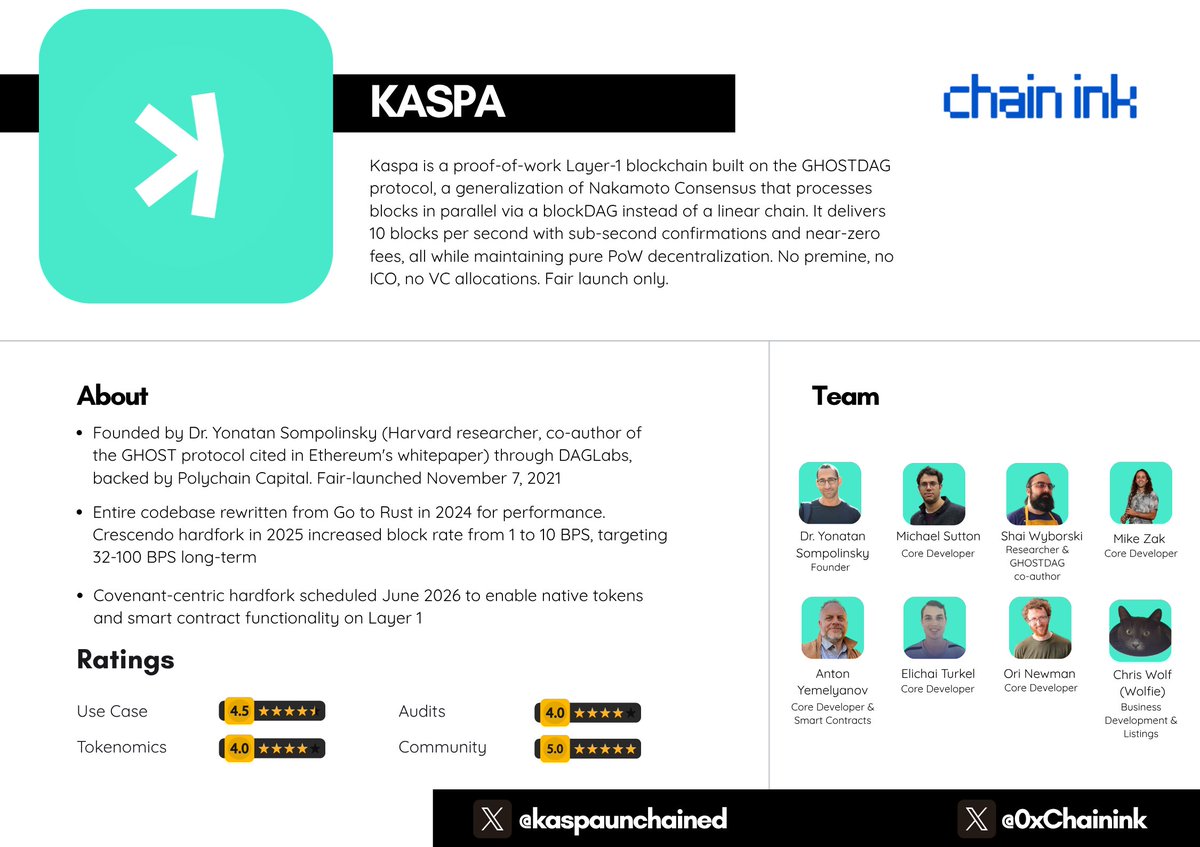
$KAS : Review 📜 What if you could take Bitcoin's security model, make it 600x faster, and then add ZK-powered smart contracts without sacrificing a single atom of decentralization? Meet Kaspa - a fair-launched, proof-of-work Layer-1 blockchain that replaces the traditional single-chain structure with a blockDAG, processing 10 blocks per second with sub-second confirmations, designed by the Harvard researcher whose GHOST protocol is cited in Ethereum's whitepaper. And with the Toccata hard fork weeks away, it's about to become programmable. Let's explore how Kaspa is rewriting the rules of proof-of-work. 👇 ⚪ Kaspa at a Glance Kaspa is a decentralized, scalable Layer-1 cryptocurrency built on proof-of-work and powered by the GHOSTDAG protocol, a novel consensus mechanism that extends Nakamoto's original design. Unlike traditional blockchains that discard competing blocks, GHOSTDAG allows parallel blocks to coexist and orders them within a Directed Acyclic Graph (blockDAG). The $KAS token is the native currency, distributed entirely through mining with no premine, presale, or founder allocations. The name "Kaspa" means "silver" or "money" in Aramaic. As of April 2026, $KAS trades around $0.03 with a market cap of approximately $800M. The max supply is ~28.7 billion KAS, with over 95% already emitted through mining. The network currently processes 10 blocks per second following the Crescendo upgrade. Marketplace Insight: The Toccata hard fork (June 5-20, 2026) is about to transform Kaspa from the fastest PoW payment network into a fully programmable platform with native tokens, covenants, ZK verification, and based ZK apps. Proving costs scale with app activity rather than the entire network, unlocking canonical bridging, stateful multi-contract flows, and DeFi on pure proof-of-work. ⚪ Mission Kaspa's mission is to create a PoW that operates with internet speed, combining the reliability of proof-of-work with the responsiveness demanded by modern applications. The project aims to realize Satoshi Nakamoto's original peer-to-peer electronic cash vision but with the throughput, speed, and now programmability that Bitcoin's single-chain design structurally cannot achieve. 🟢 A Brief History DAGLabs was founded by Dr. Yonatan Sompolinsky with the purpose of implementing the GHOSTDAG protocol, invented by Yonatan with his then PhD advisor Professor Aviv Zohar. Sompolinsky gained recognition in the blockchain academic world in 2013 when he and Zohar conceived the GHOST protocol, famously cited in Ethereum's whitepaper as a design goal. Together with a small team including Michael Sutton, Shai Wyborski, and others, Sompolinsky founded Kaspa under DAGLabs, with backing from Polychain Capital. Kaspa's November 7, 2021 launch had no premine, no ICO, and no early allocations. Anyone could start mining from day one. DAGLabs was dissolved around the time of Kaspa's fair launch, transitioning the project to a decentralized, community-led model. Since then, Kaspa has been developed by a global group of open-source contributors with no central governance or business model. In 2024, the team completed a full rewrite of the codebase from Go to Rust, dramatically improving performance. The Crescendo hardfork in 2025 increased the block rate to 10 BPS while maintaining network stability. Now, the Toccata hard fork (originally scheduled May 5, moved to June 5-20, 2026 to finalize the sequencing architecture) is set to introduce extended covenant opcodes, ZK proof verification via Groth16 and RISC Zero, native token issuance, SilverScript programming language, and the Computational DAG (CDAG) for resource management. Feature freeze hit April 15, followed by testnet validation and mainnet node upgrades. Yonatan currently holds a post-doctoral position at Harvard researching transaction ordering protocols and MEV, while continuing to lead Kaspa's research direction. 🟢 Ecosystem Narrative Kaspa's ecosystem is built on a simple but powerful premise: you can have proof-of-work security at proof-of-stake speeds if you change the underlying data structure from a chain to a DAG. With Toccata, you can now add programmability without compromising any of it. Key dynamics include: ➛ BlockDAG architecture allows multiple blocks to be created and confirmed in parallel, eliminating the bottleneck that forces traditional blockchains to be slow. Blocks reference multiple predecessors, forming a graph instead of a single linked list. ➛ GHOSTDAG consensus orders parallel blocks using a greedy algorithm that favors well-connected, honest blocks. The upcoming DAGKnight protocol will further improve ordering with adaptive, parameterless consensus. ➛ Toccata hard fork (June 2026) adds powerful covenants via extended opcodes, enabling native L1 programmability. Introduces a Computational DAG (CDAG) to manage resource usage and sets the stage for sovereign programs (vProgs). ➛ ZK verification at Layer 1 with support for Groth16 and RISC Zero verifiers, enabling based ZK apps where proving costs scale directly with app activity instead of the entire network. This unlocks canonical bridging, stateful multi-contract flows, and privacy-preserving applications. ➛ Partitioned sequencing allows L1 to serve all three roles for based ZK rollups: sequencing, data availability, and settlement. No external dependencies. ➛ SilverScript is a new high-level programming language built specifically for Kaspa covenants, lowering the barrier for developers to build programmable transaction logic, smart wallets, vaults, and DeFi applications. ➛ Native token issuance (KRC-20) directly on Layer 1, with atomic transfers built into the Kaspa transaction model. No external smart contract systems needed. ➛ Kaspa Industrial Initiative (KII) is testing the network in enterprise environments including supply chain tracking, industrial automation, smart grid coordination, and settlement infrastructure. ⚪ Token Utilities $KAS is a pure proof-of-work currency evolving into a programmable asset: ➛ Peer-to-Peer Payments - Fast, feeless transactions with sub-second first confirmations and ~10 second probabilistic finality. Designed for everyday digital cash use. ➛ Mining Rewards - All KAS enters circulation through PoW mining using the kHeavyHash algorithm. No premine, no allocations, no insider supply. ➛ Transaction Fees - Minimal fees for on-chain transactions, designed to remain low even at high throughput levels. ➛ Smart Contract Fuel (Post-Toccata) - $KAS will power covenant execution, native token operations, ZK verification, and vProg settlement on Layer 1. ➛ Governance via KIPs - Kaspa Improvement Proposals allow the community to propose and adopt protocol changes based on technical merit and consensus. ⚪ Key Features ➛ BlockDAG + GHOSTDAG - Processes blocks in parallel via a Directed Acyclic Graph, ordering them through a greedy consensus algorithm. The core innovation that makes high-speed PoW possible. ➛ 10 BPS (Targeting 100) - Currently processes 10 blocks per second following the Crescendo hardfork, with a roadmap to 32, then 100 blocks per second. Sub-second first confirmations. ➛ Toccata Hard Fork (June 2026) - Adds extended covenant opcodes, ZK proof verification (Groth16, RISC Zero), native tokens (KRC-20), CDAG for resource management, partitioned sequencing for based ZK apps, and SilverScript programming language. The single biggest upgrade in Kaspa's history. ➛ Fair Launch - No premine, no ICO, no presale, no VC allocations, no founder tokens. 100% of supply distributed through open mining since day one. ➛ Rust Rewrite - Entire codebase migrated from Go to Rust in 2024, achieving significant performance improvements and enabling the 10x block rate increase. ➛ DAGKnight (Upcoming) - Adaptive, parameterless consensus protocol that will replace GHOSTDAG, providing optimal confirmation times without manual parameter tuning. ➛ Full Node on Standard PC - Efficient pruning and multithreaded CPU use mean anyone can run a full node on modest hardware, preserving true decentralization. 🟢 Meet the Kaspa Team Kaspa is built by academic researchers, applied cryptographers, and open-source contributors with no corporate structure, no central entity, and no executive hierarchy. Development is funded entirely by voluntary community donations via a multi-sig wallet. ▶️ Core Members: ➛ Dr. Yonatan Sompolinsky - Founder & Lead Researcher | Co-inventor of the GHOST and GHOSTDAG protocols. PhD under Professor Aviv Zohar at Hebrew University. Currently holds a post-doctoral position at Harvard researching transaction ordering and MEV. His GHOST protocol is cited in Ethereum's whitepaper. ➛ Michael Sutton (msutton) - Core Developer | Distributed Systems Researcher with an M.Sc from Hebrew University, where he researched parallel algorithms. Led the Rust rewrite and Crescendo implementation. Serves as one of four community-elected treasurers managing the dev fund. ➛ Shai Wyborski (deshe) - Researcher | Co-author of the GHOSTDAG paper. PhD candidate at Hebrew University and Ben-Gurion University researching classical and quantum cryptography. ➛ Mike Zak (svarog) - Core Developer | Cryptocurrency and Distributed Systems Developer contributing to core protocol implementation and network stability. ➛ Elichai Turkel (elichai2) - Core Developer | Applied Cryptographer and High-Performance Developer. Bitcoin Core contributor bringing deep cryptographic expertise to Kaspa's architecture. ➛ Ori Newman (someone235) - Core Developer | Cryptocurrency and Distributed Systems Developer. Key contributor to SilverScript development. ➛ Anton Yemelyanov (aspect76) - Core Developer, Advisor & Smart Contracts | 30 years systems engineering, 12+ years in cryptocurrency. Co-founder of the Scaling Bitcoin academic conference. Leading smart contract development efforts. ➛ Chris Wolf (Wolfie) - Business Development & Listings | Driving exchange listings, partnerships, and ecosystem business development. ➛ Chad Ballantyne (Rhubarbarian) - Marketing, Branding, PR, Web Development & Creative Content. ➛ Community-Governed - No CEO, no board, no foundation with allocated tokens. Dev fund is a multi-sig wallet managed by 4 community-elected treasurers requiring 2/4 signatures. All spending is publicly documented. 🟢 Ratings ➛ Use Case: ★★★★✦ (4.5/5) - Kaspa solves a problem that every other PoW chain has accepted as unsolvable: high throughput without centralization. The blockDAG architecture is a structural rethinking of how proof-of-work operates. 10 BPS with sub-second confirmations is already remarkable; 100 BPS would be historic. The Toccata hard fork transforms the equation entirely: covenants, native tokens, ZK verification with Groth16 and RISC Zero, SilverScript, and based ZK apps with partitioned sequencing. This isn't an incremental update, it's Kaspa evolving from digital cash into a programmable settlement platform while keeping PoW security. The 0.5 deduction is because Toccata hasn't shipped yet and the developer ecosystem around smart contracts is still pre-launch. ➛ Tokenomics: ★★★★ (4/5) - This is what fair-launch tokenomics should look like. Zero premine, zero VC allocation, zero founder tokens. Every single KAS in existence was mined. The max supply of ~28.7 billion is fixed and predictable. By design, ~87% of the supply was mined in the first 3.5 years, meaning inflation is now rapidly declining toward Bitcoin-like low levels. By July 2026, over 95% will be emitted. The emission follows a smooth chromatic curve (not halving steps), creating predictable monetary policy. Post-Toccata, smart contract execution will introduce burn mechanics through covenant commissions, adding deflationary pressure. ➛ Audits: ★★★★ (4/5) - Kaspa holds a 4.2 star rating on CertiK via CoinMarketCap, validating the project's security posture. The GHOSTDAG protocol has been peer-reviewed and published in academic literature. The codebase is fully open-source with 188 commits in the trailing 12 months versus an industry average of ~65, nearly 3x the activity. The network has never been exploited or suffered a consensus failure. The pure PoW model and academic foundations provide inherent security strength. The 1-point deduction is because smart contracts aren't live yet, and as Toccata ships and programmability launches, deeper protocol-level auditing will become increasingly critical. ➛ Community: ★★★★★ (5/5) - Kaspa has one of the most genuine, grassroots communities in all of crypto. Built entirely through mining and organic discovery, with no airdrop, no marketing budget, and no influencer campaigns. The fair launch created a community of true believers who chose to mine and hold from day one. Developer activity is nearly 3x the industry average with dozens of independent contributors. The KEF (Kaspa Ecosystem Fund) is funded entirely by voluntary community mining donations, not corporate treasury. Kaspa ambassadors are active globally, from Dubai energy summits to Oxford Union speaking events. The dev fund is a multi-sig wallet managed by 4 community-elected treasurers with all spending publicly documented. This is Bitcoin-era community energy applied to next-gen technology. 🟢 Conclusion Kaspa is what happens when a world-class academic researcher takes the best parts of Bitcoin's philosophy and asks "what if we made this actually fast, and then actually programmable?" The blockDAG architecture isn't a marketing gimmick. It's a peer-reviewed, mathematically rigorous generalization of Nakamoto Consensus that allows proof-of-work to operate at speeds previously reserved for proof-of-stake chains. The Toccata hard fork changes everything about Kaspa's positioning. Covenants, native tokens, ZK verification with Groth16 and RISC Zero, SilverScript, partitioned sequencing for based ZK apps, proving costs that scale with app activity instead of the entire network. This is Kaspa's Ethereum-moment: the transition from "fast digital cash" to "programmable settlement layer." And it's doing it without touching the PoW security model. The fair launch ethos remains unmatched. No premine, no VC, no founder allocations, no corporate entity. Just open-source code, academic rigor, and a community that funds development through voluntary mining donations. The risks are clear: Toccata hasn't shipped yet (moved to June 5-20 from the original May 5 date), the developer ecosystem around smart contracts is pre-launch, and the price sits well below previous highs. But the trajectory speaks for itself. A full Rust rewrite, a successful 10x block rate increase, ZK verification coming to Layer 1, and a community that builds in the open with zero corporate backing. If Toccata delivers, Kaspa won't just be the fastest proof-of-work chain. It'll be one of the most important L1s in crypto, period.
Chain INK tweet media
English
25
165
506
15.9K
Jorge 𐤊 ױ ری ٹویٹ کیا
StakeMyGold.com
StakeMyGold.com@stakemygold·
Holding gold on-chain without staking it is like having a Michelin-star chef in your kitchen and ordering DoorDash. The capability is there. You are just not using it. Earn ~12% APY on your $GGBR → stakemygold.com
English
32
26
71
24.7K
Jorge 𐤊 ױ ری ٹویٹ کیا
GoldFish
GoldFish@goldfishggbr·
Everyone talks about crypto's carbon footprint. Most of the time, that's fair, but it depends on what's behind the scenes. The gold backing $GGBR is in-situ or unmined. The environmental standard of tokenized gold should look like this.
GoldFish tweet media
English
129
124
682
15.3K
Jorge 𐤊 ױ ری ٹویٹ کیا
Yonatan Sompolinsky
@oneforonehaha note there exists a documentation website for programmability in Kaspa, the temporary link was published by izio a few weeks ago in the pub rnd channel progdoc.izio.fr/overview.html I presume it will migrate/redirect to a different URL soon. Please bombard core with questions and clarifications needed until they are sick of you and have no choice but to spell it all out fully clearly legibly onchain
English
2
28
164
3.3K
Jorge 𐤊 ױ ری ٹویٹ کیا
Qubic
Qubic@_Qubic_·
AI just diagnosed cancer. Without a single human telling it where to look. A team of specialized AI agents analyzed gigapixel pathology slides on their own. No manual guidance. No selected regions. Just agents collaborating to find what matters. This is what multi-agent AI looks like in the real world. 🧵
Qubic tweet media
English
39
132
637
24K
Jorge 𐤊 ױ ری ٹویٹ کیا
BSCN
BSCN@BSCNews·
⚡️MAJOR UPGRADE: KASPA SET FOR "TOCCATA" HARD FORK Kaspa (@kaspaunchained) is gearing up for the Toccata hard fork, a major upgrade that adds powerful covenants via extended opcodes and enables based zk apps with verifiers like Groth16 and RISC Zero. This brings native L1 programmability and partitioned sequencing to Kaspa’s blockDAG, unlocking canonical bridging, stateful multi-contract flows, and proving costs that scale directly with app activity instead of the entire network. The original May 5 activation has moved to June 5–20, 2026, to finalize the sequencing architecture for full stability. Feature freeze hits April 15, followed by testnet validation and mainnet node upgrades. Toccata sets the stage for the next era of scalable, expressive blockchain tech on Kaspa.
English
12
106
415
11.7K
Jorge 𐤊 ױ ری ٹویٹ کیا
Michael Sutton
Michael Sutton@michaelsuttonil·
imho we should stop treating Kaspa as being in sos mode whereby all means are required and justified. L2 fragmentation is a very real problem and risk, and we have the time to do it right. Hence vprogs. Hence escaping the L2 language and focusing on a single dimension of apps only
English
12
25
169
7.5K
Jorge 𐤊 ױ ری ٹویٹ کیا
Pumpolinsky
Pumpolinsky@pumpolinsky·
Hey @okx & @star_okx When are you going to list QUBIC on OKX 👀 Let’s show them how powerful and united the #QUBIC community truly is, 💪it’s time to make some noise!!
Pumpolinsky tweet media
English
8
51
259
5.6K
Jorge 𐤊 ױ ری ٹویٹ کیا
Yonatan Sompolinsky
@Vladcostea Tachyon is not solving scalability rather it is solving the particular scalability challenge zcash had needing to store the entire note commitment tree history. Its solution is an adaptation of archival nodes to zcash. (Worry not, zcash can succeed even wo solving trilemmas;)
English
5
32
276
6.2K
Jorge 𐤊 ױ ری ٹویٹ کیا
Michael Sutton
Michael Sutton@michaelsuttonil·
@Chris_Hutch7 @emdin @oneforonehaha @hashdag From all I know it will be a Solana-like experience. Of course my words carry weight and I can’t and won’t promise this until we’re much closer, but I see no big obstacles to this vision.
English
3
49
233
7K
Jorge 𐤊 ױ ری ٹویٹ کیا
₿ЯT 𐤊 🐈📈
Guys check this out this is the coolest thing ever. You can now store encrypted files or passwords directly on $KAS L1 at kassword.com/#. I used this to encrypt a 12 word Kaspium seed phrase with 1,000 $KAS in it. First one to decrypt it will get the coins. Let’s see how good Kaspa’s encryption is. Once again, we see another project #PoweredByKaspa that would be considered spam on Bitcoin. Study Kaspa. Save in Kaspa. Use Your Kaspa. It’s that simple.
KasRanks@Kas_Ranks

Kassword is live. Store any password. Your browser encrypts it. The Kaspa DAG stores it. Permanent. Unreadable. Yours. No server. No account. No reset. No trust. Just math. 5 KAS. Open source. kassword.com This was step two. #Kaspa $KAS #PoW #Stateless

English
4
70
269
11.9K