dataalways ⚡️🤖

2.7K posts

dataalways ⚡️🤖 banner
dataalways ⚡️🤖

dataalways ⚡️🤖

@dataalways

mev research @ flashbots

شامل ہوئے Temmuz 2013
389 فالونگ10.1K فالوورز
پن کیا گیا ٹویٹ
dataalways ⚡️🤖
dataalways ⚡️🤖@dataalways·
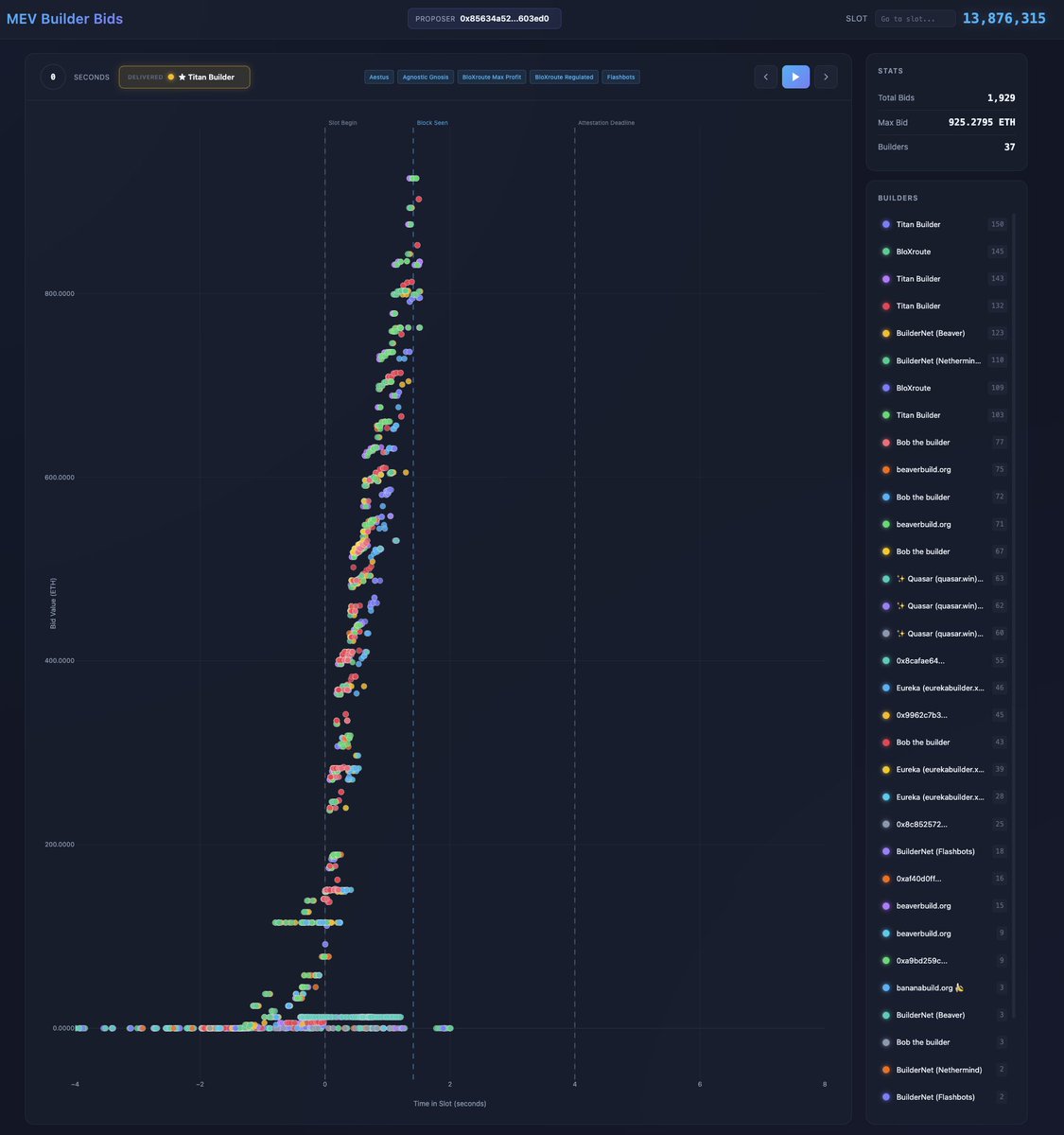
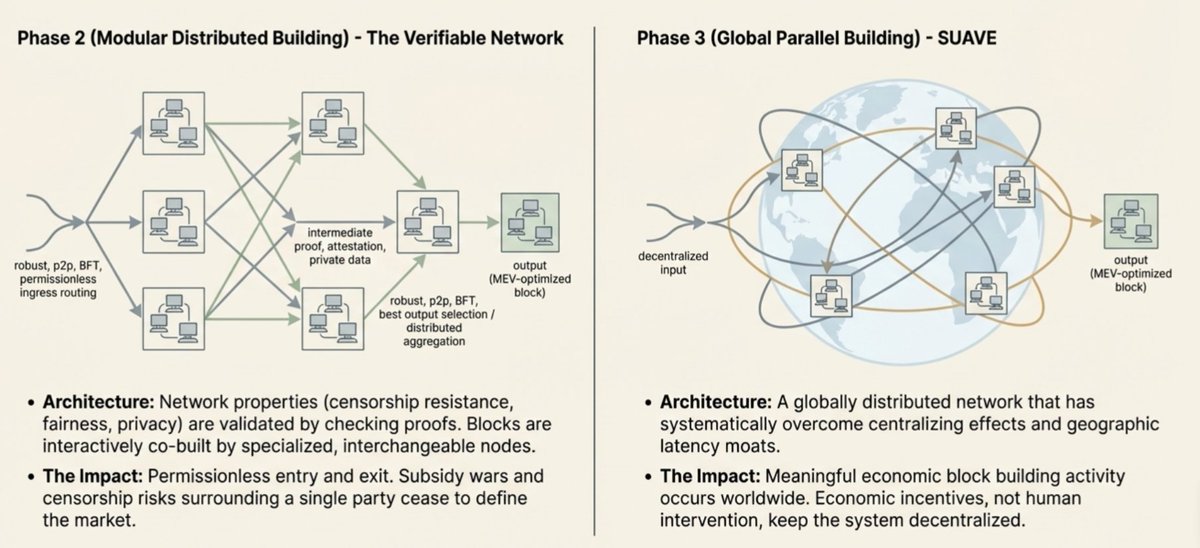
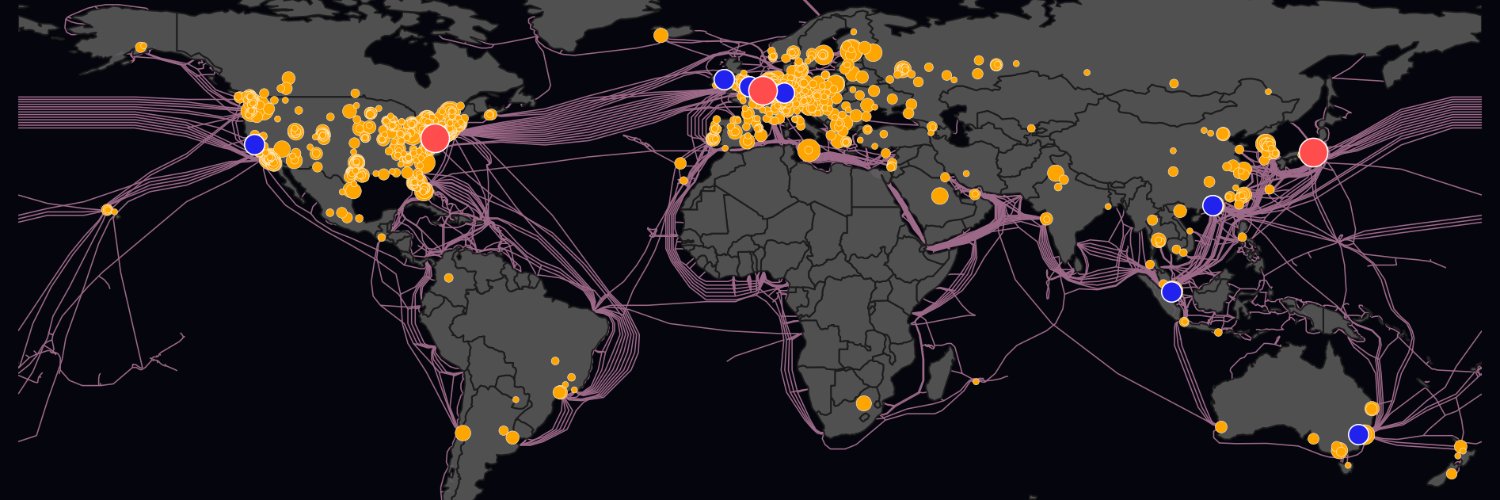
There's lots of debate over what market structure will look like with ePBS. I'm bullish trustless payments because a decentralized network shouldn't need to push 90% of blocks through three geographic chokepoints that just facilitate an offchain auction.
dataalways ⚡️🤖 tweet media
English
31
19
113
21.4K
dataalways ⚡️🤖
dataalways ⚡️🤖@dataalways·
@potuz_eth @0xQuintus @QuasarBuilder am hoping for as small as reasonable, but from looking at our relay data i suspect your timings will be too aggressive. tough to tell with the slot redesign how applicable those metrics are though.
English
1
0
2
125
quintus (sovs arc)
quintus (sovs arc)@0xQuintus·
I'm of the belief that we will end up with sealed bid options no matter what. Once one actor starts bidding sealed bids, everyone else will be at a disadvantage and have to follow suit. authenticated requests means that it's easy for new entrants to enter on an even playing field, by also submitting sealed bids. Without authenticated endpoints it will take them time to build up an IP mapping to be able to do that anyway. This would be an unnecessary barrier to entry
English
3
0
3
129
dataalways ⚡️🤖
dataalways ⚡️🤖@dataalways·
@0xShitTrader @zea2D_ haven't looked at our internal data, but presumably when bids are above a each builder's optimistic collateral, then all the blocks need to get simulated so the pennying becomes rate limited.
English
0
0
0
50
Eugene Chen
Eugene Chen@0xShitTrader·
@zea2D_ No—that explains why bundles get bid up but not why the block auction escalates so slowly.
English
2
0
1
559
dataalways ⚡️🤖
dataalways ⚡️🤖@dataalways·
@mostlyblocks @_eltitan fair, but EL rewards are already <10%. if the uplift is only 500ms then the delta is about one basis point. imo the reputational cost is higher than that
English
0
0
0
44
Michael
Michael@mostlyblocks·
@dataalways @_eltitan Hard to call where exactly it'll be post-ePBS. My general take is that any delay yielding an uplift not drowned out by variance would be sufficient incentive for a fork. The changes are not complex and node operators are very keen to differentiate.
English
1
0
0
89
Michael
Michael@mostlyblocks·
As a sophisticated proposer that has forked clients before, agree with @_eltitan that obscurity is not a winning strategy. That is, from the network perspective. For a sophisticated proposer, it's great.
mempirate@mempirate

An interesting discussion point on configurable timing games for the new direct proposer-to-builder API. I agree that sophisticated proposers will find a way around this any way, widening the gap between them and regular validators. (Or it just invites continued usage of relays)

English
1
0
6
497
dataalways ⚡️🤖
dataalways ⚡️🤖@dataalways·
@bertcmiller imo it’s mostly bad while spotlight is indexing things. should add paths for spotlight to ignore (esp. if there’s a lot of new LLM stuff)
English
0
0
0
115
@bertcmiller ⚡️🤖
@bertcmiller ⚡️🤖@bertcmiller·
Most annoying part of this is that it actually worked until recently, and for some inexplicable reason now this takes me to the app store instead of just launching my already installed Telegram
@bertcmiller ⚡️🤖 tweet media
English
4
0
3
1.2K
@bertcmiller ⚡️🤖
@bertcmiller ⚡️🤖@bertcmiller·
We are going to get AGI before we get decent search on MacOS aren't we
English
6
1
18
2.9K
dataalways ⚡️🤖 ری ٹویٹ کیا
🤖
🤖@phildaian·
🤖 tweet media
ZXX
0
3
15
1.5K
dataalways ⚡️🤖
dataalways ⚡️🤖@dataalways·
@OisinKyne @VitalikButerin it’s mostly fears around unconditional ILs turning into mev markets. but most of those fears are outdated for current market structure imo—though could come back depending on encrypted mempool designs etc.
English
0
0
1
83
oisin.eth | Obol
oisin.eth | Obol@OisinKyne·
> which *must* be included somewhere in the block (the block gets rejected otherwise) IIUC this is not true, the builder can just build a full block to censor it. Builders retain short term censorship power. (why we've adopted this approach i can't understand and I've asked the question more than once)
English
2
0
1
883
vitalik.eth
vitalik.eth@VitalikButerin·
Finally, the block building pipeline. In Glamsterdam, Ethereum is getting ePBS, which lets proposers outsource to a free permissionless market of block builders. This ensures that block builder centralization does not creep into staking centralization, but it leaves the question: what do we do about block builder centralization? And what are the _other_ problems in the block building pipeline that need to be addressed, and how? This has both in-protocol and extra-protocol components. ## FOCIL FOCIL is the first step into in-protocol multi-participant block building. FOCIL lets 16 randomly-selected attesters each choose a few transactions, which *must* be included somewhere in the block (the block gets rejected otherwise). This means that even if 100% of block building is taken over by one hostile actor, they cannot prevent transactions from being included, because the FOCILers will push them in. ## "Big FOCIL" This is more speculative, but has been discussed as a possible next step. The idea is to make the FOCILs bigger, so they can include all of the transactions in the block. We avoid duplication by having the i'th FOCIL'er by default only include (i) txs whose sender address's first hex char is i, and (ii) txs that were around but not included in the previous slot. So at the cost of one slot delay, only censored txs risk duplication. Taking this to its logical conclusion, the builder's role could become reduced to ONLY including "MEV-relevant" transactions (eg. DEX arbitrage), and computing the state transition. ## Encrypted mempools Encrypted mempools are one solution being explored to solve "toxic MEV": attacks such as sandwiching and frontrunning, which are exploitative against users. If a transaction is encrypted until it's included, no one gets the opportunity to "wrap" it in a hostile way. The technical challenge is: how to guarantee validity in a mempool-friendly and inclusion-friendly way that is efficient, and what technique to use to guarantee that the transaction will actually get decrypted once the block is made (and not before). ## The transaction ingress layer One thing often ignored in discussions of MEV, privacy, and other issues is the network layer: what happens in between a user sending out a transaction, and that transaction making it into a block? There are many risks if a hostile actor sees a tx "in the clear" inflight: * If it's a defi trade or otherwise MEV-relevant, they can sandwich it * In many applications, they can prepend some other action which invalidates it, not stealing money, but "griefing" you, causing you to waste time and gas fees * If you are sending a sensitive tx through a privacy protocol, even if it's all private onchain, if you send it through an RPC, the RPC can see what you did, if you send it through the public mempool, any analytics agency that runs many nodes will see what you did There has recently been increasing work on network-layer anonymization for transactions: exploring using Tor for routing transactions, ideas around building a custom ethereum-focused mixnet, non-mixnet designs that are more latency-minimized (but bandwidth-heavier, which is ok for transactions as they are tiny) like Flashnet, etc. This is an open design space, I expect the kohaku initiative @ncsgy will be interested in integrating pluggable support for such protocols, like it is for onchain privacy protocols. There is also room for doing (benign, pro-user) things to transactions before including them onchain; this is very relevant for defi. Basically, we want ideal order-matching, as a passive feature of the network layer without dependence on servers. Of course enabling good uses of this without enabling sandwiching involves cryptography or other security, some important challenges there. ## Long-term distributed block building There is a dream, that we can make Ethereum truly like BitTorrent: able to process far more transactions than any single server needs to ever coalesce locally. The challenge with this vision is that Ethereum has (and indeed a core value proposition is) synchronous shared state, so any tx could in principle depend on any other tx. This centralizes block building. "Big FOCIL" handles this partially, and it could be done extra-protocol too, but you still need one central actor to put everything in order and execute it. We could come up with designs that address this. One idea is to do the same thing that we want to do for state: acknowledge that >95% of Ethereum's activity doesn't really _need_ full globalness, though the 5% that does is often high-value, and create new categories of txs that are less global, and so friendly to fully distributed building, and make them much cheaper, while leaving the current tx types in place but (relatively) more expensive. This is also an open and exciting long-term future design space. firefly.social/post/lens/8144…
English
287
216
1.5K
257.6K
dataalways ⚡️🤖
dataalways ⚡️🤖@dataalways·
1. yes, we do know that there is a trade-off on execution quality (if you're denying this then 🤯🤯🤯) 2. agreed, it's better to have it than not have it 3. EIP authors didn't bother to do the work to quantify it The question isn't whether it has any positives, it's whether those positives justify the opportunity cost, the protocol complexity, the tech debt, and the negative externalities that come with it.
English
0
0
0
66
Shutter 🛡️⚔️
Shutter 🛡️⚔️@ShutterNetwork·
It remains to be seen whether the execution quality for LUCID would be worse than getting sandwiched Let’s look at the reasons why this concern shouldn’t be a reason to dismiss the LUCID encrypted mempool: 1. There could be a trade off here on execution quality, we don’t know until we do it 2. Using an encrypted mempool is optional. People don’t have to use it. But if the option doesn’t exist, then users cannot choose it and other developers cannot improve the other privacy aspects of Ethereum 3. Agree this is likely worse for HFT or latency-sensitive strategies, but for most DeFi users, waiting one block is a small price to pay for avoiding malicious MEV
English
1
0
1
135
dataalways ⚡️🤖
dataalways ⚡️🤖@dataalways·
Spicy take: execution quality through LUCID might be worse than getting sandwiched - 6s --> 18s median inclusion time - Higher fees from gas limit pricing - 150M+ gas of transactions changing pool states leading to huge slippage in routes - Big jump in reverts from the slippage
dmarz ⚡️🤖@DistributedMarz

If I'm doing DeFi on a chain with an "encrypted mempool", does that mean I need to trade based off prices that are 1 block old?

English
10
4
29
9.7K
dataalways ⚡️🤖
dataalways ⚡️🤖@dataalways·
@potuz_eth reorgs are more acceptable because it’s not the wallets fault. errors in their sims is a different class imo.
English
1
0
0
81
Potuz
Potuz@potuz_eth·
@dataalways This is wrong: there are plenty of edge cases today in Ethereum and wallets anyway report well on them. Do you wait for finalization to see your transaction included or you're happy to see it reported on the current canonical block? well, the same is for these txs.
English
1
0
0
111
dataalways ⚡️🤖
dataalways ⚡️🤖@dataalways·
@potuz_eth I’m doubtful that this will be a common offering. And imo as soon as there’s any edge cases then it’s just an inclusion preconf and the value is close to zero. Worst UX sin is a wallet having to change the outcome of a swap.
English
1
0
0
109
Potuz
Potuz@potuz_eth·
@dataalways No, when the PTC has attested, the clear text of these txs is known, anyone can execute and know what the post state of the tob of N+1 is. Yes, there are some subtleties and edge cases when keys aren't propagated well, but the above should be the standard
English
1
0
0
107
dataalways ⚡️🤖
dataalways ⚡️🤖@dataalways·
@potuz_eth iiuc they do ToB sim for quotes to approx then wait until the block is executed for results. here the ToB sims will be significantly less accurate and then the execution is 1.5 blocks later on average. and you can’t just ToB sim after the first block b/c there’s still noise.
English
1
0
1
136
Potuz
Potuz@potuz_eth·
@dataalways The nodes can, I don't know what wallets will do. They can, the same as today they can give information by running nodes in the backend
English
1
0
3
146
Potuz
Potuz@potuz_eth·
@dataalways The user knows the explicit outcome as soon as the keys are revealed which is in the current slot
English
2
0
0
218
dataalways ⚡️🤖
dataalways ⚡️🤖@dataalways·
@potuz_eth it’s not about when poststate is final, it’s about when the user knows the explicit outcome.
English
1
0
1
280
Potuz
Potuz@potuz_eth·
@dataalways The delay in inclusion time is wrong: the poststate of the tx is already determined when it's committed, it's irrelevant that it will be executed in the next slot: there is absolutely nothing that one can do either on chain or offchain with this tx if it were executed in N.
English
1
1
6
1.6K
dataalways ⚡️🤖
dataalways ⚡️🤖@dataalways·
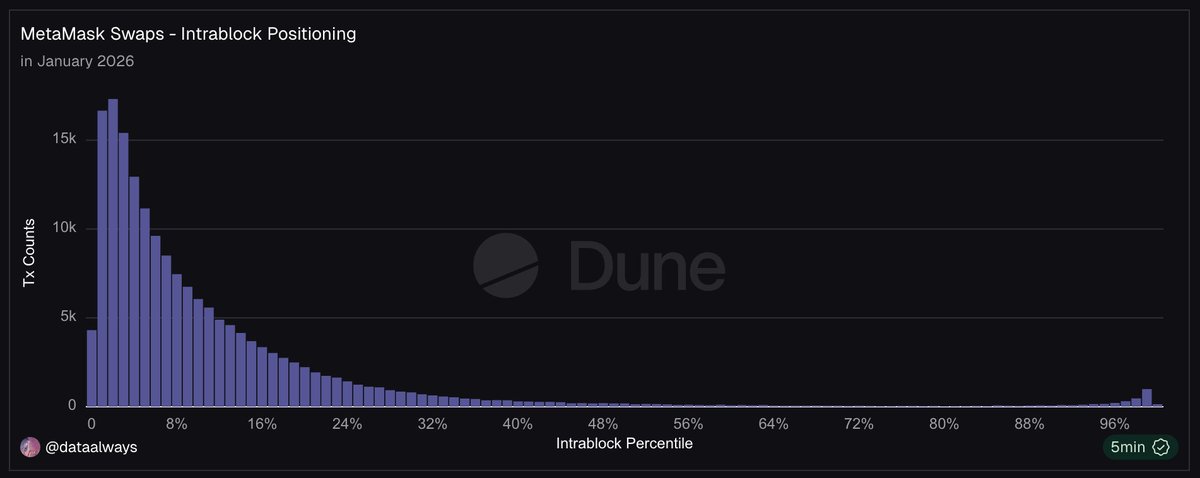
@weboftrees For example, this is where Metamask Swaps were located in the block in January. The bottom of the block is just not desirable blockspace for transactions that are state dependent.
dataalways ⚡️🤖 tweet media
English
0
0
1
129
dataalways ⚡️🤖
dataalways ⚡️🤖@dataalways·
@weboftrees the routing also just won’t be competitive by design because you lose conditional execution preferences of transactions inside of bundles. which is really important for routing when there’s noise.
English
1
0
0
121
dataalways ⚡️🤖
dataalways ⚡️🤖@dataalways·
@weboftrees people don't want to be included bottom of block today. and no one will want to when the gas limit is 5x higher. and the avg sandwich is causing less and less user harm. as base fees drop --> more public txs become profitable to sandwich, but the impact is smaller and smaller
English
1
0
0
109
Anders Elowsson 🌻
Anders Elowsson 🌻@weboftrees·
3s assumes that you were willing to share your trade privately with the builder that eventually won (but you can't know the winner beforehand; and you also need to share with the relay, etc). Otherwise, those 3s can turn into 9s, 15s, ... I would argue that 9s delay is not worse than getting sandwiched. As for reverts, I think the best comparison is having your trade executed bottom-of-block today.
English
1
0
1
130
Shutter 🛡️⚔️
Shutter 🛡️⚔️@ShutterNetwork·
Spicy take: encrypted mempools are not just about stopping malicious MEV and real-time censorship on Ethereum. They are about breaking the privileged and unchallenged position of centralized actors that extract value and entrench themselves in the transaction supply chain.
dataalways ⚡️🤖@dataalways

Spicy take: execution quality through LUCID might be worse than getting sandwiched - 6s --> 18s median inclusion time - Higher fees from gas limit pricing - 150M+ gas of transactions changing pool states leading to huge slippage in routes - Big jump in reverts from the slippage

English
3
4
13
593