Hasan

63 posts

Hasan banner
Hasan

Hasan

@hasanunlu9

Working on efficient TPU, founder @apexcompute, prev Autopilot @Tesla_AI

Los Altos, California شامل ہوئے Haziran 2012
978 فالونگ2.2K فالوورز
پن کیا گیا ٹویٹ
Hasan
Hasan@hasanunlu9·
After 8+ years on the Tesla Autopilot team and 3 years at Intel, I started @apexcompute to design a new architecture for efficient AI inference. For the past 9 months, we’ve been building our custom inference accelerator. Today we’re releasing Unified Engine v1. Last June we raised our seed round with @maxitechinc , DeepFin Research, @Soma_Capital and an incredible group of angel investors. In less than 9 months, we completed our RTL architecture and brought our first pre-silicon prototype to life on FPGA. Our architecture combines systolic array and vector processing in a single compute engine with multiple architectural optimizations, achieving very high FLOPs utilization. A single engine is super lean and it uses less than 90K LUTs and 1 MB Block RAM. It may also be one of the smallest logic-footprint compute engines developed so far. Our Unified Engine v1 supports: -matrix-matrix multiplication (~95% FLOPs utilization) -softmax (~90% FLOPs utilization) -broadcast and element-wise operations -RMSNorm / LayerNorm -block quantization/dequantization (fp4, int4) -multi-engine synchronization and many other operations. We even implemented memory-efficient attention similar to FlashAttention, reaching ~90% FLOP utilization. Full benchmarks and the software stack are available on our GitHub: github.com/apex-compute/u… We have basic compiler written in Python and it supports PyTorch tensors directly to easily test and transfer tensors between the accelerator and host using bf16, fp4 and int4 formats. Our FPGA prototype can already run LLM inference and outperform NVIDIA Jetson Orin Nano, even on a mid-tier FPGA setup (6.4x lower memory bandwidth, 18% slower clock speed at 4.5 Watts). Check the side-by-side comparison video below. Our GitHub includes low-level operator implementations, examples for tiled matrix multiplication, operation chaining, tensor parallelism, attention kernel and a full Gemma 3 1B model implementation. Many more models(Vision Transformers and VLA) are coming soon. Our accelerator IP is AXI-ready for deployment on any AMD(Xilinx) FPGA platform today. Even better, our two-engine prototype runs on an entry-level AMD(Xilinx) FPGA as a PCIe accelerator card. You can purchase it here buy.stripe.com/6oUaEQf6365bgA… for $50 to experiment our pre-silicon prototype on your desktop PC or Raspberry Pi 5. We will be releasing hardware bitstream updates as the architecture gets new features. More to come soon! We are expanding our team and looking for compiler engineers and floating-point hardware design engineers. If you're interested, please send me a DM.
English
29
39
386
36.7K
Hasan
Hasan@hasanunlu9·
We’ve released hardware v1.1 of the Apex Compute Unified Engine. If you have an FPGA from us, please update to the latest bin file version in the repo. We also added many new models. Here are the updates in this release, and many more hardware optimizations/features are coming in upcoming releases. RTL updates • Unified activation pipeline — GELU, SiLU, sigmoid, tanh implemented via a single (a+x)*sigmoid(-b*x) hardware block with configurable a and b parameters. ReLU is included as well. • Software reset added • Add-reduce block optimization — Used multi-input FP adder, latency reduced from 21 to 12 cycles, >45% reduction in LUT/FF total. • Argmax — top-4 selection for MoE support • Instruction set improvements — instruction queue replaced with instruction direct-mapped cache, supports absolute/relative jumps, this significantly reduced microcode size for matmul kernels and almost no instruction DMA overhead. • Timing — Kintex-7 frequency increased to 194 MHz Other FPGAs / Multi-Engine support • Bittware (Kintex UltraScale 15P) — new project, 400 MHz engine • Alveo U50 — stabilized build, HBM AXI tuning, 280 MHz engine and 450 MHz HBM, 8 engines synthesized • Kintex-7 — dual-engine build, 194 MHz target, updated address map Test infrastructure • Fmax debug test • Image patching test New models • Llama 3.2 1B • GPT-2 • Qwen 3 1.7B • SmolVLM2 500M • Parakeet • Swin Transformer Apex Compute - Unified Engine Repo: github.com/apex-compute/u…
English
1
2
11
1.1K
Hasan
Hasan@hasanunlu9·
@jackcookjack Using the sign bits of the scales (always positive and otherwise unused) is a great idea. We’ll try to add this to our hardware architecture in the next release. You can follow here github.com/apex-compute/u…
English
0
0
3
408
Jack Cook
Jack Cook@jackcookjack·
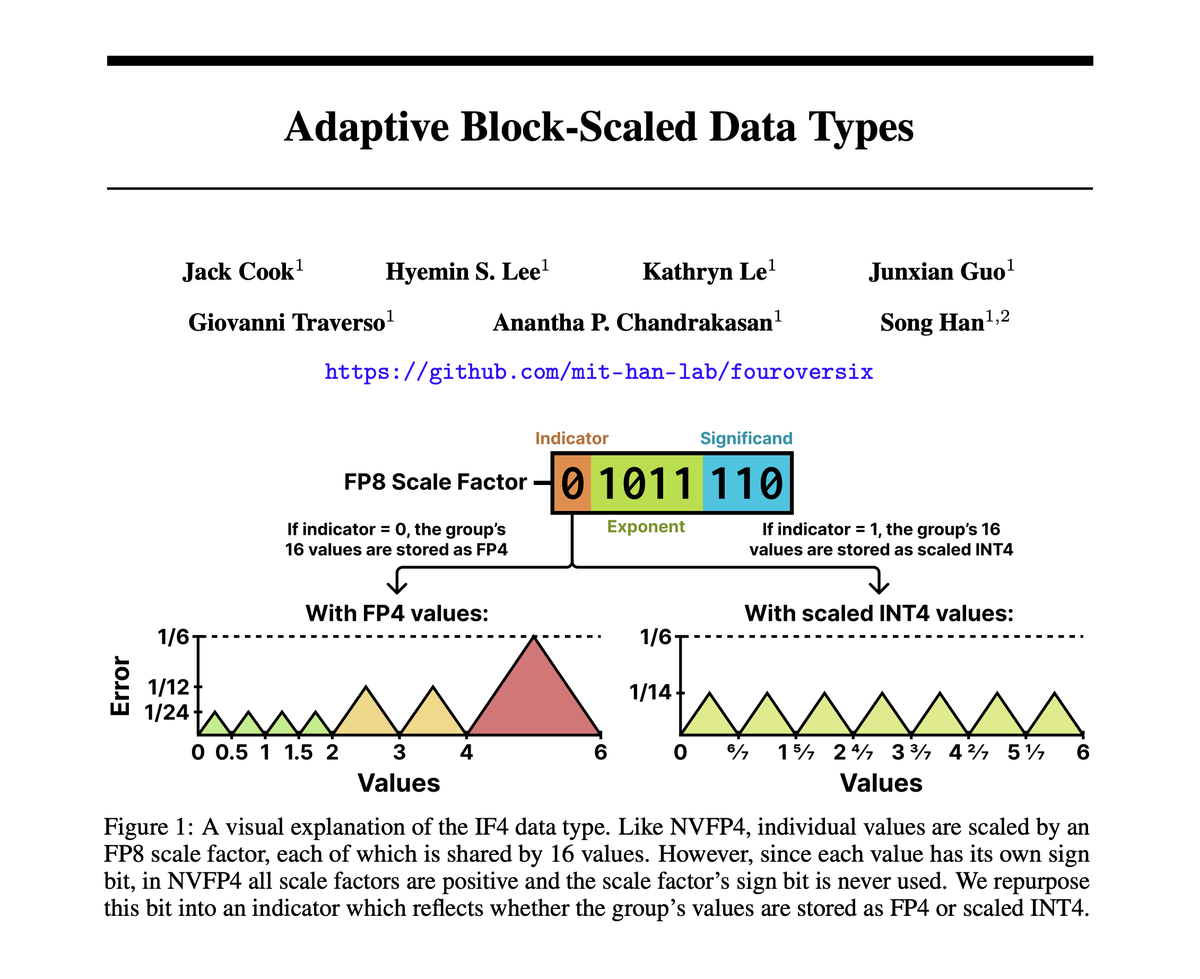
NVFP4 allows models to be quantized to 4 bits without too much performance degradation, but can we push 4-bit performance even further? Today, we're releasing a new class of low-precision block-scaled data types that natively adapt to your input data: for 4-bit quantization, IF4 (Int/Float 4) allows each scaled group of 16 values to be saved as FP4 or INT4 depending on which option offers less error. Selections are recorded using the scale factor’s sign bit, which is unused in NVFP4, allowing IF4 to offer better performance with no memory overhead! Our data types provide better downstream accuracy in LLMs, they can be implemented efficiently in next-generation hardware accelerators, and they reveal some interesting insights about low-bit quantization! 🧵
Jack Cook tweet media
English
14
83
440
50.9K
Gracia
Gracia@straceX·
In 1999, calculating 3D lighting required doing 1 / sqrt(x) millions of times a second. CPUs back then would completely choke on this math. so the developers of Quake III used this literal black magic code instead. How the hell does 0x5f3759df calculate a square root?👇
Gracia tweet media
English
82
280
4.1K
427.7K
Hasan
Hasan@hasanunlu9·
After 8+ years on the Tesla Autopilot team and 3 years at Intel, I started @apexcompute to design a new architecture for efficient AI inference. For the past 9 months, we’ve been building our custom inference accelerator. Today we’re releasing Unified Engine v1. Last June we raised our seed round with @maxitechinc , DeepFin Research, @Soma_Capital and an incredible group of angel investors. In less than 9 months, we completed our RTL architecture and brought our first pre-silicon prototype to life on FPGA. Our architecture combines systolic array and vector processing in a single compute engine with multiple architectural optimizations, achieving very high FLOPs utilization. A single engine is super lean and it uses less than 90K LUTs and 1 MB Block RAM. It may also be one of the smallest logic-footprint compute engines developed so far. Our Unified Engine v1 supports: -matrix-matrix multiplication (~95% FLOPs utilization) -softmax (~90% FLOPs utilization) -broadcast and element-wise operations -RMSNorm / LayerNorm -block quantization/dequantization (fp4, int4) -multi-engine synchronization and many other operations. We even implemented memory-efficient attention similar to FlashAttention, reaching ~90% FLOP utilization. Full benchmarks and the software stack are available on our GitHub: github.com/apex-compute/u… We have basic compiler written in Python and it supports PyTorch tensors directly to easily test and transfer tensors between the accelerator and host using bf16, fp4 and int4 formats. Our FPGA prototype can already run LLM inference and outperform NVIDIA Jetson Orin Nano, even on a mid-tier FPGA setup (6.4x lower memory bandwidth, 18% slower clock speed at 4.5 Watts). Check the side-by-side comparison video below. Our GitHub includes low-level operator implementations, examples for tiled matrix multiplication, operation chaining, tensor parallelism, attention kernel and a full Gemma 3 1B model implementation. Many more models(Vision Transformers and VLA) are coming soon. Our accelerator IP is AXI-ready for deployment on any AMD(Xilinx) FPGA platform today. Even better, our two-engine prototype runs on an entry-level AMD(Xilinx) FPGA as a PCIe accelerator card. You can purchase it here buy.stripe.com/6oUaEQf6365bgA… for $50 to experiment our pre-silicon prototype on your desktop PC or Raspberry Pi 5. We will be releasing hardware bitstream updates as the architecture gets new features. More to come soon! We are expanding our team and looking for compiler engineers and floating-point hardware design engineers. If you're interested, please send me a DM.
English
29
39
386
36.7K
kapilansh
kapilansh@kapilansh_twt·
Apple's M4 chip engineers earn $450k+ Intel's CPU architects earn $400k+ NVIDIA's hardware engineers power every AI model on the planet They all understand one thing almost no software dev ever studies: How a computer actually works at the hardware level "ETH Zurich – Digital Design & Computer Architecture" by Onur Mutlu Free on YouTube. 30+ full lectures. Spring 2023 By a professor who holds joint appointments at both ETH Zurich and Carnegie Mellon Starts from a single transistor. Ends with a complete CPU you understand entirely: • Logic gates – how electricity becomes computation at the most fundamental level • Instruction Set Architecture – the contract between software and hardware every dev ignores • Pipelining – how your CPU executes multiple instructions simultaneously without you knowing • Out-of-order execution – why your CPU secretly reorders your code to run faster • Memory hierarchy – the design decision that determines the speed of every program ever written Every line of code you've ever written ran on hardware you don't understand The engineers who built that hardware earn $450k Now you know where to start
kapilansh tweet media
English
48
311
3.3K
179.3K
Hasan
Hasan@hasanunlu9·
@nustiudinastea @apexcompute Without HBM and TSMC sub-5nm process nodes, it’s challenging. However, once we move to silicon on a 12nm process with LPDDR5, models up to 100 billion parameters become fairly straightforward.
English
0
0
1
49
alex giurgiu
alex giurgiu@nustiudinastea·
@hasanunlu9 @apexcompute Is there a chance this can scale to 1 trillion parameter models? And if yes, with what kind of memory?
English
1
0
0
78
Hasan
Hasan@hasanunlu9·
@seanmcdonaldxyz @apexcompute Instructions for running Gemma 3 1B on FPGA are available in our repo. You will need to purchase the FPGA board from the link and use a Linux PC with an available PCIe slot. We also have a few solutions for Raspberry Pi 5 using a PCIe extension, which we will share soon.
English
1
0
1
298
Hasan
Hasan@hasanunlu9·
@KimNoel399 @apexcompute We haven’t tried it on windows yet. If wsl gets pci device directly, it might work. We will test it and let you know.
English
1
0
3
305
Hasan
Hasan@hasanunlu9·
@PatrickToulme How is flops utilization in matrix-matrix multiplication?
English
0
0
1
629
Patrick C Toulme
Patrick C Toulme@PatrickToulme·
I built a TPU from scratch. Custom Verilog RTL. JAX→HLO→MLIR→ASM→VLIW→Binary. Real PJRT backend. Runs on Verilog simulator. No CUDA. No handwritten kernels. Pure compiler codegen. Below is a transformer layer compiling and executing from JAX.
English
65
145
1.8K
91.8K
ₕₐₘₚₜₒₙ
ₕₐₘₚₜₒₙ@hamptonism·
You don't need a tremendous level of skill or insight to do many important things. The world is built by flawed people.
ₕₐₘₚₜₒₙ tweet media
English
17
174
1.4K
53.7K
Hasan
Hasan@hasanunlu9·
@elonmusk @Tesla_AI Proud to be part of this and several others patents. The constraints forced us to squeeze every last logic gate out of the hardware.
English
1
1
32
550
Elon Musk
Elon Musk@elonmusk·
Necessity is the mother of invention. The @Tesla_AI team is epicly hardcore. No one can match Tesla’s real-world AI.
Ming@tslaming

BREAKING 🚨 TESLA HAS PATENTED A "MATHEMATICAL CHEAT CODE" THAT FORCES CHEAP 8-BIT CHIPS TO RUN ELITE 32-BIT AI MODELS AND REWRITES THE RULES OF SILICON 🐳 How does a Tesla remember a stop sign it hasn’t seen for 30 seconds, or a humanoid robot maintain perfect balance while carrying a heavy, shifting box? It comes down to Rotary Positional Encoding (RoPE)—the "GPS of the mind" that allows AI to understand its place in space and time by assigning a unique rotational angle to every piece of data. Usually, this math is a hardware killer. To keep these angles from "drifting" into chaos, you need power-hungry, high-heat 32-bit processors (chips that calculate with extreme decimal-point precision). But Tesla has engineered a way to cheat the laws of physics. Freshly revealed in patent US20260017019A1, Tesla’s "MIXED-PRECISION BRIDGE" is a mathematical translator that allows inexpensive, power-sipping 8-bit hardware (which usually handles only simple, rounded numbers) to perform elite 32-bit rotations without dropping a single coordinate. This breakthrough is the secret "Silicon Bridge" that gives Optimus and FSD high-end intelligence without sacrificing a mile of range or melting their internal circuits. It effectively turns Tesla’s efficient "budget" hardware into a high-fidelity supercomputer on wheels. 📉 The problem: the high cost of precision In the world of self-driving cars and humanoid robots, we are constantly fighting a war between precision and power. Modern AI models like Transformers rely on RoPE to help the AI understand where objects are in a sequence or a 3D space. The catch is that these trigonometric functions (sines and cosines) usually require 32-bit floating-point math—imagine trying to calculate a flight path using 10 decimal places of accuracy. If you try to cram that into the standard 8-bit multipliers (INT8) used for speed (which is like rounding everything to the nearest whole number), the errors pile up fast. The car effectively goes blind to fine details. For a robot like Optimus, a tiny math error means losing its balance or miscalculating the distance to a fragile object. To bridge this gap without simply adding more expensive chips, Tesla had to fundamentally rethink how data travels through the silicon. 🛠️ Tesla's solution: the logarithmic shortcut & pre-computation Tesla’s engineers realized they didn't need to force the whole pipeline to be high-precision. Instead, they designed the Mixed-Precision Bridge. They take the crucial angles used for positioning and convert them into logarithms. Because the "dynamic range" of a logarithm is much smaller than the original number, it’s much easier to move that data through narrow 8-bit hardware without losing the "soul" of the information. It’s a bit like dehydrating food for transport; it takes up less space and is easier to handle, but you can perfectly reconstitute it later. Crucially, the patent reveals that the system doesn't calculate these logarithms on the fly every time. Instead, it retrieves pre-computed logarithmic values from a specialized "cheat sheet" (look-up storage) to save cycles. By keeping the data in this "dehydrated" log-state, Tesla ensures that the precision doesn't "leak out" during the journey from the memory chips to the actual compute cores. However, keeping data in a log-state is only half the battle; the chip eventually needs to understand the real numbers again. 🏗️ The recovery architecture: rotation matrices & Horner’s method When the 8-bit multiplier (the Multiplier-Accumulator or MAC) finishes its job, the data is still in a "dehydrated" logarithmic state. To bring it back to a real angle theta without a massive computational cost, Tesla’s high-precision ALU uses a Taylor-series expansion optimized via Horner’s Method. This is a classic computer science trick where a complex equation (like an exponent) is broken down into a simple chain of multiplications and additions. By running this in three specific stages—multiplying by constants like 1/3 and 1/2 at each step—Tesla can approximate the exact value of an angle with 32-bit accuracy while using a fraction of the clock cycles. Once the angle is recovered, the high-precision logic generates a Rotation Matrix (a grid of sine and cosine values) that locks the data points into their correct 3D coordinates. This computational efficiency is impressive, but Tesla didn't stop at just calculating faster; they also found a way to double the "highway speed" of the data itself. 🧩 The data concatenation: 8-bit inputs to 16-bit outputs One of the most clever hardware "hacks" detailed in the patent is how Tesla manages to move 16-bit precision through an 8-bit bus. They use the MAC as a high-speed interleaver—effectively a "traffic cop" that merges two lanes of data. It takes two 8-bit values (say, an X-coordinate and the first half of a logarithm) and multiplies one of them by a power of two to "left-shift" it. This effectively glues them together into a single 16-bit word in the output register, allowing the low-precision domain to act as a high-speed packer for the high-precision ALU to "unpack". This trick effectively doubles the bandwidth of the existing wiring on the chip without requiring a physical hardware redesign. With this high-speed data highway in place, the system can finally tackle one of the biggest challenges in autonomous AI: object permanence. 🧠 Long-context memory: remembering the stop sign The ultimate goal of this high-precision math is to solve the "forgetting" problem. In previous versions of FSD, a car might see a stop sign, but if a truck blocked its view for 5 seconds, it might "forget" the sign existed. Tesla uses a "long-context" window, allowing the AI to look back at data from 30 seconds ago or more. However, as the "distance" in time increases, standard positional math usually drifts. Tesla's mixed-precision pipeline fixes this by maintaining high positional resolution, ensuring the AI knows exactly where that occluded stop sign is even after a long period of movement. The RoPE rotations are so precise that the sign stays "pinned" to its 3D coordinate in the car's mental map. But remembering 30 seconds of high-fidelity video creates a massive storage bottleneck. ⚡ KV-cache optimization & paged attention: scaling memory To make these 30-second memories usable in real-time without running out of RAM, Tesla optimizes the KV-cache (Key-Value Cache)—the AI's "working memory" scratchpad. Tesla’s hardware handles this by storing the logarithm of the positions directly in the cache. This reduces the memory footprint by 50% or more, allowing Tesla to store twice as much "history" (up to 128k tokens) in the same amount of RAM. Furthermore, Tesla utilizes Paged Attention—a trick borrowed from operating systems. Instead of reserving one massive, continuous block of memory (which is inefficient), it breaks memory into small "pages". This allows the AI5 chip to dynamically allocate space only where it's needed, drastically increasing the number of objects (pedestrians, cars, signs) the car can track simultaneously without the system lagging. Yet, even with infinite storage efficiency, the AI's attention mechanism has a flaw: it tends to crash when pushed beyond its training limits. 🔒 Pipeline integrity: the "read-only" safety lock A subtle but critical detail in the patent is how Tesla protects this data. Once the transformed coordinates are generated, they are stored in a specific location that is read-accessible to downstream components but not write-accessible by them. Furthermore, the high-precision ALU itself cannot read back from this location. This one-way "airlock" prevents the system from accidentally overwriting its own past memories or creating feedback loops that could cause the AI to hallucinate. It ensures that the "truth" of the car's position flows in only one direction: forward, toward the decision-making engine. 🌀 Attention sinks: preventing memory overflow Even with a lean KV-cache, a robot operating for hours can't remember everything forever. Tesla manages this using Attention Sink tokens. Transformers tend to dump "excess" attention math onto the very first tokens of a sequence, so if Tesla simply used a "sliding window" that deleted old memories, the AI would lose these "sink" tokens and its brain would effectively crash. Tesla's hardware is designed to "pin" these attention sinks permanently in the KV-cache. By keeping these mathematical anchors stable while the rest of the memory window slides forward, Tesla prevents the robot’s neural network from destabilizing during long, multi-hour work shifts. While attention sinks stabilize the "memory", the "compute" side has its own inefficiencies—specifically, wasting power on empty space. 🌫️ Sparse tensors: cutting the compute fat Tesla’s custom silicon doesn't just cheat with precision; it cheats with volume. In the real world, most of what a car or robot sees is "empty" space (like clear sky). In AI math, these are represented as "zeros" in a Sparse Tensor (a data structure that ignores empty space). Standard chips waste power multiplying all those zeros, but Tesla’s newest architecture incorporates Native Sparse Acceleration. The hardware uses a "coordinate-based" system where it only stores the non-zero values and their specific locations. The chip can then skip the "dead space" entirely and focus only on the data that matters—the actual cars and obstacles. This hardware-level sparsity support effectively doubles the throughput of the AI5 chip while significantly lowering the energy consumed per operation. 🔊 The audio edge: Log-Sum-Exp for sirens Tesla’s "Silicon Bridge" isn't just for vision—it's also why your Tesla is becoming a world-class listener. To navigate safely, an autonomous vehicle needs to identify emergency sirens and the sound of nearby collisions using a Log-Mel Spectrogram approach (a visual "heat map" of sound frequencies). The patent details a specific Log-Sum-Exp (LSE) approximation technique to handle this. By staying in the logarithm domain, the system can handle the massive "dynamic range" of sound—from a faint hum to a piercing fire truck—using only 8-bit hardware without "clipping" the loud sounds or losing the quiet ones. This allows the car to "hear" and categorize environmental sounds with 32-bit clarity. Of course, all this high-tech hardware is only as good as the brain that runs on it, which is why Tesla's training process is just as specialized. 🎓 Quantization-aware training: pre-adapting the brain Finally, to make sure this "Mixed-Precision Bridge" works flawlessly, Tesla uses Quantization-Aware Training (QAT). Instead of training the AI in a perfect 32-bit world and then "shrinking" it later—which typically causes the AI to become "drunk" and inaccurate—Tesla trains the model from day one to expect 8-bit limitations. They simulate the rounding errors and "noise" of the hardware during the training phase, creating a neural network that is "pre-hardened". It’s like a pilot training in a flight simulator that perfectly mimics a storm; when they actually hit the real weather in the real world, the AI doesn’t "drift" or become inaccurate because it was born in that environment. This extreme optimization opens the door to running Tesla's AI on devices far smaller than a car. 🚀 The strategic roadmap: from AI5 to ubiquitous edge AI This patent is not just a "nice-to-have" optimization; it is the mathematical prerequisite for Tesla’s entire hardware roadmap. Without this "Mixed-Precision Bridge", the thermal and power equations for next-generation autonomy simply do not work. It starts by unlocking the AI5 chip, which is projected to be 40x more powerful than current hardware. Raw power is useless if memory bandwidth acts as a bottleneck. By compressing 32-bit rotational data into dense, log-space 8-bit packets, this patent effectively quadruples the effective bandwidth, allowing the chip to utilize its massive matrix-compute arrays without stalling. This efficiency is critical for the chip's "half-reticle" design, which reduces silicon size to maximize manufacturing yield while maintaining supercomputer-level throughput. This efficiency is even more critical for Tesla Optimus, where it is a matter of operational survival. The robot runs on a 2.3 kWh battery (roughly 1/30th of a Model 3 pack). Standard 32-bit GPU compute would drain this capacity in under 4 hours, consuming 500W+ just for "thinking". By offloading complex RoPE math to this hybrid logic, Tesla slashes the compute power budget to under 100W. This solves the "thermal wall", ensuring the robot can maintain balance and awareness for a full 8-hour work shift without overheating. This stability directly enables the shift to End-to-End Neural Networks. The "Rotation Matrix" correction described in the patent prevents the mathematical "drift" that usually plagues long-context tracking. This ensures that a stop sign seen 30 seconds ago remains "pinned" to its correct 3D coordinate in the World Model, rather than floating away due to rounding errors. Finally, baking this math into the silicon secures Tesla's strategic independence. It decouples the company from NVIDIA’s CUDA ecosystem and enables a Dual-Foundry Strategy with both Samsung and TSMC to mitigate supply chain risks. This creates a deliberate "oversupply" of compute, potentially turning its idle fleet and unsold chips into a distributed inference cloud that rivals AWS in efficiency. But the roadmap goes further. Because this mixed-precision architecture slashes power consumption by orders of magnitude, it creates a blueprint for "Tesla AI on everything". It opens the door to porting world-class vision models to hardware as small as a smart home hub or smartphone. This would allow tiny, cool-running chips to calculate 3D spatial positioning with zero latency—bringing supercomputer-level intelligence to the edge without ever sending private data to a massive cloud server.

English
2K
4.4K
38.2K
11M
Hasan
Hasan@hasanunlu9·
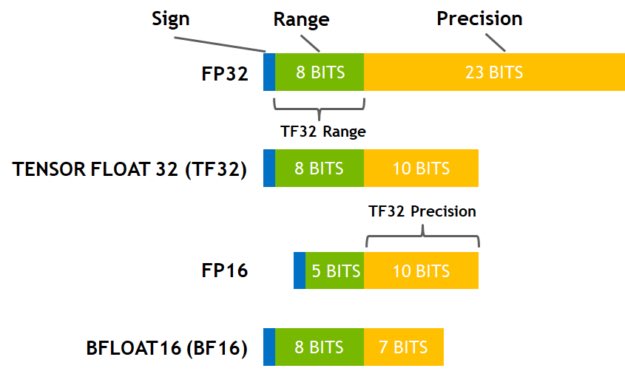
@tenderizzation It is bf19(8bit exponent and 10bit mantissa) and we are using it our custom accelerator on FPGA. It works perfectly so far.
English
0
0
1
290
Hasan
Hasan@hasanunlu9·
@__tinygrad__ We recently completed our hardware design on fpga and it runs gemma 3 1billion(16 tokens/s) with lower end ddr4 memory and it is much faster than nvidia jetson. Here is our logic utilization including ddr4 controller. However it is around 60k lines of rtl code.
Hasan tweet mediaHasan tweet media
English
0
0
2
531
the tiny corp
the tiny corp@__tinygrad__·
The Anthropic TPU deal solidifies it. There's two companies that can make training chips, NVIDIA and Google. Elon tried with Dojo. Amazon tried with Trainium. DeepSeek tried with Huawei. Countless startups are flailing with multiple tapeouts and no real adoption. The funny thing is, the TPU chip itself is very simple. The difference is all the software (XLA-TPU is the best deep learning compiler, too bad it's closed source). In 2 more years, tinygrad will be actually 1.0, with performance exceeding all other libraries. There was a lot of Dunning-Kruger on the way, but we maintain the underlying abstractions required for all deep learning style compute are very simple. At this point, the backend specific code is 1,000 lines. The Verilog for an accelerator should only be about 3,000. We'll build it on FPGAs, and then look for a partner to work with to tape it out. PS: We're still hard at work on the AMD MLPerf contract. AMD has made big strides on their mainline stack in the last 2 years. It's mirroring the NVIDIA stack, but I've come to respect this strategy more and AMD will soon be an uncontested third player in the training space.
English
58
77
1.6K
252.2K
Hasan
Hasan@hasanunlu9·
@cloneofsimo Not even imagenet — even simpler: I just want to see dot-product performance.
English
0
0
1
278
Simo Ryu
Simo Ryu@cloneofsimo·
Im confused about "10,000 more efficient" part. This means you can train stable-diffusion-3 like model with 20$~ ish amount of electricity. What stops them from building a model and demonstrating it, beyond *checks note* ... Fashion MNIST? Im genuinely curious whats stopping them from demonstrating something like imagenet-1k which should take less than a dollar of electricity (if my math is right) for 200k steps of training
Extropic@extropic

Hello Thermo World.

English
72
21
667
148.9K
Pavan Jayasinha
Pavan Jayasinha@pavanjayasinha·
@hasanunlu9 @0xMihirPatil Yes, the systolic array I implemented was output stationary, not weight stationary. Did I say otherwise in the thread?
English
1
0
0
162
Pavan Jayasinha
Pavan Jayasinha@pavanjayasinha·
I implemented an LLM end-to-end in hardware, and ran it on an FPGA. Zero Python. Zero CUDA. Just pure SysVerilog. All my progress + everything I learned from 200h of LLM chip design (demo at the end)👇
Pavan Jayasinha tweet media
English
90
274
2.7K
347K
Hasan
Hasan@hasanunlu9·
@0xMihirPatil @pavanjayasinha Since the matrix multiplications are large, they require a tiled approach. In this case, each tile should match the size of the systolic array. An output-stationary dataflow is best, because it avoids repeatedly relocating partial sums to and from SRAM, which is a big overhead.
English
1
0
3
107