Jinal Jhaveri

1.5K posts

Jinal Jhaveri banner
Jinal Jhaveri

Jinal Jhaveri

@jinal

Investor / Founder @mismoteam: Hire top global tech talent , @school_mint: Help schools Attract, Enroll & Retain students @EnableUsInfo: Digital Sales Rooms

San Francisco شامل ہوئے Mart 2008
922 فالونگ1.3K فالوورز
Jinal Jhaveri ری ٹویٹ کیا

Ankur Nagpal
Ankur Nagpal@ankurnagpal·
Super excited to launch our tax planning AI in beta today If you are a Carry customer who wants access, lmk and we can enable it for your account Upload your tax transcript and we check eligibility against 24 different tax saving strategies to find you money
Ankur Nagpal tweet media
English
7
2
27
5.2K
Jinal Jhaveri ری ٹویٹ کیا
Garry Tan
Garry Tan@garrytan·
This CA “billionaire” tax is an unrealized gains tax. A unicorn startup founder becomes a paper billionaire around $5B val. At YC we avg 2 to 4 per year (!) This will kill startups and innovation in California since a founder is illiquid while instantly on the hook for $100M
Teddy Schleifer@teddyschleifer

NEWS: Larry Page and Peter Thiel are making moves to leave California by the end of the year to avoid a possible billionaires tax that could hit them where it hurts. With @RMac18 + @hknightsf. nytimes.com/2025/12/26/tec…

English
668
708
8.5K
1.9M
Alex Smith
Alex Smith@ninja_maths·
Yes, exactly. ACT will follow the same format: An ACT fundamentals course, followed and supported by a specific test-prep course. @justinskycak has already made some solid inroads in helping us to map out a ACT Fundamentals course, so we can probably put a "broad strokes" course together quite quickly. Mapping out and building the missing middle and test-prep courses is more time consuming, but once we have the broad strokes fundamentals course in place we can start thinking carefully about that.
English
1
0
1
76
Alex Smith
Alex Smith@ninja_maths·
Apologies for the radio silence from me over the past few months. I've been insanely busy with little time for updates. But since it's my birthday today (yay me) and we just hit a few major milestones, I thought today would be a good time for an update. Over the past four months, our two biggest challenges have been: 1. Updating the SAT Fundamentals course to include all possible "missing middle" topics. 2. Creating our SAT Math Prep course, our first-ever test-prep course. I'm delighted to say that we've now added all missing middle topics to the Fundamentals course, and the Math Prep course is now ready. We're testing the Math Prep course with a handful of students first and making sure everything is in order before launching to the general public. It will be generally available very soon! The Fundamentals course is designed to provide students with all the foundational knowledge and skills they need for success on the exam. It is what I’d call a “regular” Math Academy course, complete with fully granular lessons and lots of scaffolding topics, all designed to develop mastery. The test-prep course contains only the types of questions you’ll likely see on the SAT exam itself. There are no lessons or scaffolding KPs, as all explicit instruction and scaffolding take place in the Fundamentals course. The test-prep course focuses on developing automaticity with the types of questions that often appear on the exam, giving students plenty of repetition and doubling down on areas where they need more practice. The difference between the two courses is similar to that between doing regular training as a professional boxer (mastering the fundamentals) vs. preparing for a contest against a specific opponent (test prep). Mastering the Fundamentals: Before going anywhere near a boxing ring, you need to master the fundamentals. Footwork, strength, endurance, conditioning, defence, a decent jab, and a good working knowledge of all the other punches. If you don't have all these, then you shouldn't be stepping into the ring, and you'll likely get your ass handed to you if you do! Fight Preparation: This is about getting ready for the specific opponent you plan to face. Every athlete has strengths and weaknesses. Have you studied your opponent and trained specifically to counter their strengths and capitalize on their weaknesses? Without specific knowledge of your opponent and the appropriate training to deal with them specifically, it's likely that, despite your solid fundamentals, you'll still fall short. Training prior to a contest needs to be tailored to your specific opponent. Once students have completed the Fundamentals course (i.e., they have all the foundations in place and they are rock-solid), they’ll qualify for the test-prep course. The fact that they're allowed to transition to the prep course means they're ready to start training for a specific opponent: the SAT exam itself. We will NOT allow students to transition to the Prep course until they have mastered the content in the Fundamentals course! Training for the specific test you plan to take is crucial for success. Raw subject knowledge is not enough, but you cannot be successful without it. Acquire the raw, fundamental skills first. Then, once those are all in place, you’re ready to start preparing for your opponent. The SAT Math Prep course itself consists of 284 topics. However, well-prepared students “should” place out of most of it when they sit the diagnostic assessment. What’s more, we were able to identify a ton of hierarchical structure in the test-prep questions, which I wrote about this a bit here: x.com/ninja_maths/st…. Since then, the knowledge graph for this course has grown considerably. In short, this means students can gain implicit practice on less-advanced questions by practicing more advanced ones, which should allow them to progress through the course and master all SAT-style questions we have extremely efficiently. The Missing Middle The "missing middle" refers to the gap between the knowledge acquired through a standard curriculum and the specific knowledge and skills needed to excel on certain tests, such as the SAT. In regular curricula, these missing middle topics are usually either (a) not covered at all, (b) glossed over, or (c) treated as "problem-solving" exercises that the majority of kids don't get around to even attempting, let alone mastering. Over the past 3-4 months, we've added over 120 of these missing middle topics to the Fundamentals curriculum. The results of this effort have looked extremely promising so far. There are too many new missing middle topics to cover, but just to give you a flavor, here's a handful we've recently added. Algebra & Advanced Algebra * Parametrizing Systems With Infinitely Many Solutions. Helping students to parametrize lines not just in the form (t, f(t)), but also (g(t), t) and (f(t),g(t)), as well as recognize valid parametrizations (quite advanced for this level). * Equating Polynomial Coefficients - Students are often required to deduce information about two equivalent polynomials by equating their coefficients. Some kids will understand what to do right away (i.e., they can deduce what to do without explicit instruction). But for the majority of kids, explicit instruction is needed, and this is a *vital* skill that requires automaticity as it required quite often. * Time-Shifting Exponential Models - Involves rewriting exponential models using different time units (avoiding common pitfalls) and solving related problems. * Vieta's Formulas - A wonderful, easy-to-understand (and even prove) concept that makes solving problems about sums and products of roots of polynomials an absolute breeze. * Reasoning about quadratic coefficients using various theorems (multiple topics). Some of the more challenging problems involve deducing a relationship between quadratic coefficients. We dedicated several topics to this. The idea is to train students to know which theorems to apply to a given situation. Larger Systems of Equations - Helping students reason about the number of solutions to a system containing three equations (most standard curricula stop at two equations only). * Working With Equivalent Forms of Exponential Functions. I wrote about this here: x.com/ninja_maths/st…. I'm also preparing another scaffolding topic to provide more context. * Extrema of Exponential Functions - Placing domain restrictions on transformed exponential functions, and using that to establish possible maximum and minimum values. * Factoring Binomial Expressions Containing Hidden Factors - When given a polynomial equation to solve, students will "by default" want to multiply two binomials whenever they see them, but this is often not very efficient. Factoring is often more efficient, so you need to train students to recognize situations where it is more appropriate, including when some factors are partially hidden. * Determining Unknown Parameters in Systems of Linear Equations - Occurs quite frequently on the SAT. Easy if you've mastered it, quite difficult if you haven't (and they tend to make the SAT questions quite tricky). * Solving Systems of Linear Equations by Identifying Structure - I wrote a bit about this here: x.com/ninja_maths/st… Geometry & Trigonometry * Areas of Inscribed Triangles - I wrote a post about that here: x.com/ninja_maths/st… * Constructing Functions Representing Properties of 2D and 3D Shapes (Multiple Topics) - These sound like they should be easy. But questions on the SAT are designed in such a way to mislead students who misread the question, which is easily done when you're under time pressure. It's less about recalling the various formulas for area, volume, etc., and more about correctly interpreting the relationships between the dimensions of a given shape. * Surface Areas of Combined Prisms - These often involve setting up and solving systems of nonlinear equations. Also, before you get to the hard problems, it's important to check students understand that when you glue two faces of a prism together, you lose the surface area from *two* faces (not one, which is a common mistake). Students must also correctly construct expressions for combined surface areas, both with concrete examples and with algebraic expressions. * Recognizing 30-60-90 Triangles - Cool scaffolding topic designed to help students immediately spot when a triangle is 30-60-90, an important skill. * Reasoning About Congruent and Similar Triangles (Multiple topics) - Using their knowledge of the various criteria to determine when you have sufficient information to prove congruence/similarity. Problem-Solving and Data Analysis * Optimizing Sums, Differences, Products, and Quotients - Actually one of my favorite missing middle topics. Given X = {x_1, x_2,..., x_n} and Y = {y_1, y_2, ..., y_m}, how does one optimize x + y, x - y, xy, and x/y, where x and y are elements of X and Y, respectively? It's rarely taught explicitly, and while the sum and product cases may seem obvious, the difference and quotient cases are less so (these are the ones that usually crop up, too). Getting this right is a vital skill in some SAT problems—you don't want students trying to figure this out on the fly; it needs to be *automatic!* The actual topic uses notation/phrasing in a more level-appropriate way than what I've done here, but the core essence is the same. * Bounding Statistical Metrics For Grouped Data - helping students evaluate expressions like min(Mean(X) - Median(Y)) given data presented in various forms, very much supported by the optimization topic above. * Interpreting Descriptions of Physical Phenomena, and Interpreting Rates of Change of Physical Phenomena - I could write an entire post about just these topics. Essentially, training students to extract useful information from a detailed description of some physical phenomena (e.g., magnetic flux density), write down appropriate formulas, check the units balance, and use them to solve problems, usually in some kind of non-trivial geometric setting. There's a lot more to discuss, but that'll probably do for now. For anyone who wants to know more about the SAT courses and the missing middle, please keep your eyes peeled for more episodes of the @_MathAcademy_ podcast (I'm planning to make an appearance to discuss all this, and more, very soon 🙂). Links in replies.
English
21
2
55
17.2K
Jinal Jhaveri
Jinal Jhaveri@jinal·
@ninja_maths @ninja_maths this is super exciting. Would this be the same Math Prep Course used for ACT Prep (when the ACT prep test course is available)?
English
2
0
1
75
Alex Smith
Alex Smith@ninja_maths·
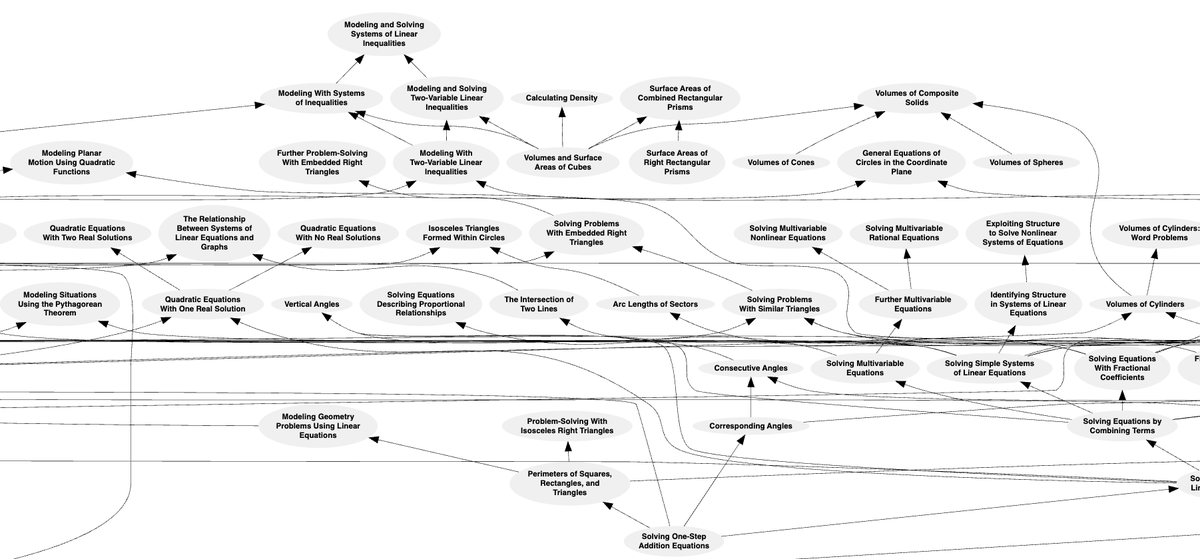
Here's a close-up of part of the KG for the Math Prep course. Lots of structure that we were able to exploit. Globally, it's quite flat. But since students should place out of most of it, most student activity should take place around the leaf nodes.
Alex Smith tweet mediaAlex Smith tweet media
English
1
0
11
1.1K
Jinal Jhaveri ری ٹویٹ کیا
Konstantin Vinogradov
Konstantin Vinogradov@vinogradovk·
Over five years ago, I started publishing the top trending open-source startups every quarter — the ROSS Index. It has become a handy tool for 60K+ developers, founders, and other OSS fans who have visited it to date. Today, I'm thrilled to make it even more useful, as we are open-sourcing all its data for more than 20 quarters on GitHub, in a convenient format. Explore our repo and star it to be notified about new index releases. And, of course, now is also the time to reveal the fresh top 20 startups by GitHub stars growth for Q3 2025 — one can find more details on them in the repo too!
Konstantin Vinogradov tweet media
English
2
3
11
3.2K
Jinal Jhaveri ری ٹویٹ کیا
Tim Suzman
Tim Suzman@TimSuzman·
Good luck on S25 Alumni Demo Day from all the YC alumni!
English
1
4
22
1.3K
Jinal Jhaveri ری ٹویٹ کیا
Sam Park
Sam Park@SamuelPark·
Introducing Cosmic 2.0 The best AI tool available for building and monetizing websites and web apps. Go from prompt -> first payment in minutes Comment “cosmic” for 24 hours of unlimited credits. (thread):
English
121
28
277
52.5K
Jinal Jhaveri ری ٹویٹ کیا
Joe Connor
Joe Connor@josephjconnor·
The federal tax credit scholarship provision has passed! This is the boldest federal policy in decades. It will channel billions in private dollars to support educational opportunity nationwide. A massive win for parents, school choice, and American values.
English
0
2
12
517
Jinal Jhaveri ری ٹویٹ کیا
Garry Tan
Garry Tan@garrytan·
We need to legalize math in California Today the anti-math education bureaucrats are trying to force the UC system to water down math standards to accept fake data science courses that don’t teach algebra We interviewed @minilek, CS division chair @ Berkeley to get the low down
English
77
191
1.4K
255.2K
Jinal Jhaveri ری ٹویٹ کیا
Gagan Biyani 🏛
Gagan Biyani 🏛@gaganbiyani·
How does Empower Oakland feel post-election? Cautiously optimistic. Mayor-elect Lee promised to unify Oakland. We love this message, and hope she brings in folks who didn't support her (such as Empower). We also like her 100-day plan. Much of it aligns with our agenda for Oakland. In general, one major thing we can help with is we believe Oakland should learn to do more with less. You can spend $1.7B and get very little (as we do now). Or you can spend $1.7B and get a lot. Spending money and raising money is not a win: the win is delivering results. We'll work hard to help Oakland get on track, and no matter what we will continue to fight for practical progressive governance in City Hall.
English
7
4
33
3.9K
Jinal Jhaveri ری ٹویٹ کیا
Michelle Tandler
Michelle Tandler@michelletandler·
I've been in San Francisco for a month and can confidently report that the city is *back on track*. The streets are clean. The tents are gone. I've seen just one pile of glass. SF's collapse was the direct result of Progressive leadership & policy. Now, we recover. 🤍🌁
English
151
69
2.2K
175.5K
Jinal Jhaveri ری ٹویٹ کیا
Loren Taylor
Loren Taylor@lorenmtaylor·
This campaign has been powered by you — through every moment, big and small. To everyone who volunteered, donated, shared your story, asked tough questions, and stood up for a better Oakland: thank you. We’re in the final hours. If you haven’t already, get your ballot in and remind your people to do the same. Let’s rise to meet this moment and build the Oakland we all believe in. #OaklandVotes #LorenForOakland
English
12
20
126
6.5K
Jinal Jhaveri ری ٹویٹ کیا
Michelle Tandler
Michelle Tandler@michelletandler·
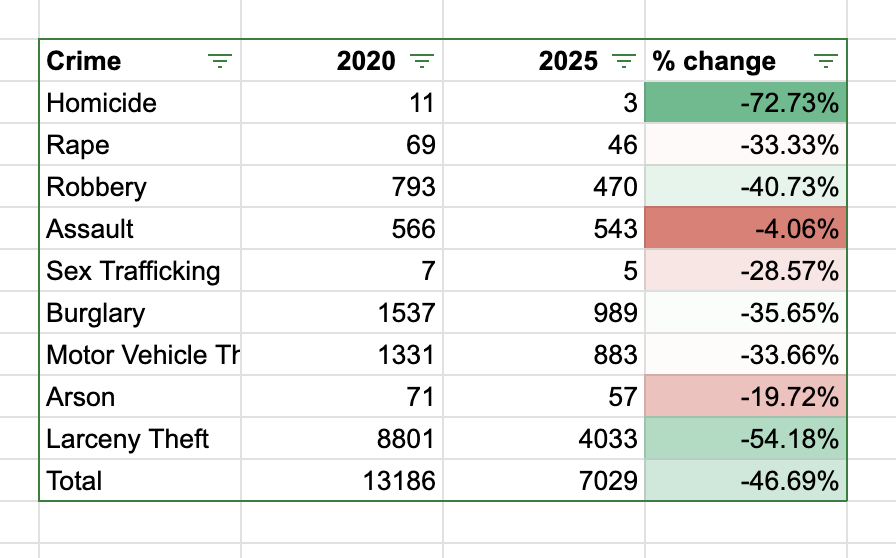
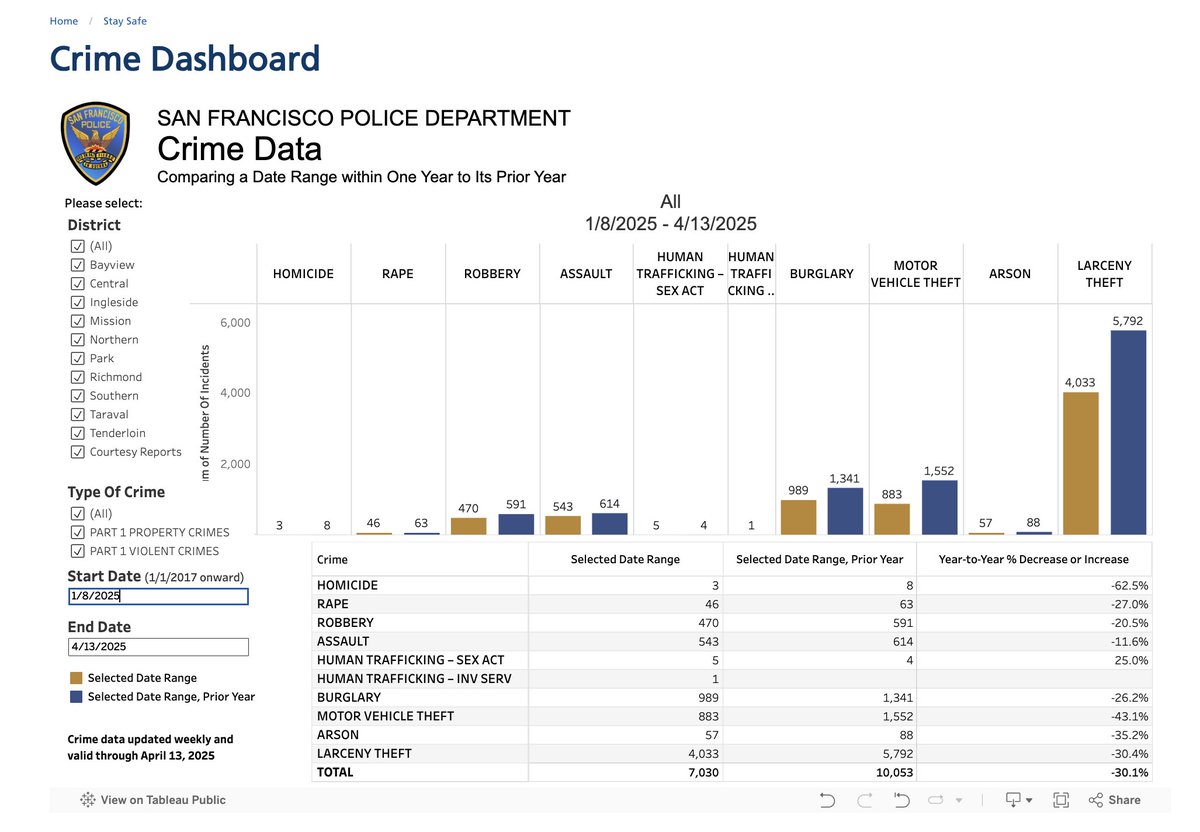
Crime is down 46% in San Francisco compared to 2020. In 2020, we had a Progressive DA and Board. Now we have Moderate leaders. The results are astonishing.
Michelle Tandler tweet mediaMichelle Tandler tweet mediaMichelle Tandler tweet media
English
102
159
2K
356.3K
Jinal Jhaveri ری ٹویٹ کیا
Gagan Biyani 🏛
Gagan Biyani 🏛@gaganbiyani·
I'm truly amazed at how much money, vitriol and hypocrisy is in Oakland politics. A group of special interests have spent $1M supporting two candidates, and they consistently say one thing and do the exact opposite... They decry their opponents as backed by billionaires, when they themselves are backed by Piedmont billionaires Quinn Delaney and Wayne Jordan. They say their opponents are fighting dirty, meanwhile they have spent more money on negative advertising than anyone else. They loudly complain that corporations are buying the election, but their candidate Barbara Lee is backed by PG&E and AirBnB. Unfortunately, in response to this, many on X and other platforms resort to unsavory name-calling and inappropriate behavior themselves. This just adds to the distrust and toxicity of Oakland politics. Empower Oakland is trying to walk a fine line. We believe in an Oakland where residents, labor leaders, politicians, and business owners work together to build us up instead of tearing us down. We also do not stand for this kind of campaigning, and so we call out these tactics when we see them. Sometimes that means going on the offensive; we'll try to do that with facts instead of vitriol. I sincerely hope that both sides see the backlash to these tactics and reconsider them in the future. We need a new direction in Oakland with a new group of leaders. If you haven't yet, please get out and vote for Loren Taylor. I know him personally and I am confident he is a different kind of leader than what we've had. And, if you live in District 2, vote for Charlene Wang and Harold Lowe.
English
7
11
99
10.7K