Max Otc
885 posts


Max Otc
@max_otc
Prediction market without insider trading - Founder


A lot of the founders in my DMs pitched me a on prediction markets. I think most of them are chasing the wrong opportunity… Prediction markets are now among the most competitive categories on earth. @Polymarket and @Kalshi are raising mind-boggling numbers, and traditional players like @RobinhoodApp are building their own products. The category has incumbents with massive liquidity, strong brands, and aggressive product roadmaps. For the startups building net new prediction markets, it’s worth asking: what is the unique edge? Some pitch adding new market formats as their wedge. I don’t know if this is defensible. Every incumbent is actively expanding into new formats. Look at what @Polymarket offered just a year ago compared to today. They ship new products by the week. If the incumbents can add your market type faster than you can build distribution, the advantage evaporates. Others argue that better tech is the wedge. Tech doesn’t appear to be a limiter on @Polymarket or @Kalshi. The platforms work. Users aren’t leaving because of a tech problem. In my opinion, the more interesting opportunity is packaging prediction markets into entirely new products for underserved customers. People who would never open a @Polymarket account but have a real need to express a view on some future outcome. An outdoor concert venue might want to go long on rain for Sunday night to hedge cancellation risk. A logistics company might want to take a position on port delays. These are prediction market use cases dressed up as risk management tools, sold through channels the incumbents might not touch. And you don’t have to reinvent the wheel. You don’t need to build the market, source the liquidity, or design the matching engine. You can plug into existing prediction market APIs and focus entirely on distribution and product. There’s a fair pushback about platform risk here. But @Polymarket is onchain and open, which makes this meaningfully less risky than building on a closed platform. I’m not saying a new prediction market will never break through. In many mature categories someone always finds a way. @HyperliquidX broke into perps, one of the most competitive verticals in crypto with many well-capitalized competitors. AI gave @CoreWeave an opening in cloud. But in each case there was a specific structural reason the new entrant won. Disclosure: We are @Polymarket investors. Take the above with a grain of salt




How Prediction Markets Like Kalshi and Polymarket Can Be Manipulated by Insiders — Without Breaking Laws 🧵1/5 This morning @SquawkCNBC had @GovChristie on the program to discuss federally regulating prediction markets. Prediction markets like Kalshi and Polymarket are touted as wisdom of crowds — accurate, efficient, and hard to manipulate. But insiders can legally sway outcomes and odds in subtle ways. No fraud needed. Let's break it down. #PredictionMarkets #Kalshi #Polymarket @mansourtarek_ @shayne_coplan

we have 20+ meetings set up with founders who cold dmed it has been awesome to see so many folks actively building cool things it's not too late to dm


Warning: Long post ahead Prediction markets are one of the most genuinely innovative financial tools of the last decade and the regulatory panic surrounding them reveals a fundamental confusion about responsibility. Nobody is demanding that knife manufacturers be held accountable every time someone gets stabbed. We don't sue Victorinox because a person made a bad decision. We don't regulate kitchen knives out of existence because a small minority misuses them. We hold the *individual* responsible for their actions as we should. So why do prediction markets get treated differently? When someone loses money on a prediction market, that is a decision *they made*. They assessed the odds, weighed the risk, and placed a position. That is called personal responsibility. Holding the platform accountable for every negative outcome is the same logical absurdity as holding a knife manufacturer liable for every stabbing. The tool is not the problem. The absence of individual accountability is. Now about the age argument. I'll grant this one freely: an 18+ minimum on prediction markets makes complete sense. But here's where it gets interesting. In virtually every democracy, 18 is also the age at which you are trusted to choose your country's government. You can vote on trillion-dollar fiscal policy. You can vote on war and peace. You can vote on the laws that govern every citizen. If society trusts you at 18 to make those decisions, decisions that affect *everyone* then why on earth would it not trust you to make a financial decision that affects only *yourself*? Every person who is eligible to vote should be eligible to use prediction markets, full stop. No additional restrictions. No paternalistic gatekeeping. If you're old enough to pull a lever that shapes national policy, you're old enough to take a position on an outcome with your own money. Prediction markets aggregate information, improve forecasting, and create price discovery in areas where traditional markets fall short. They are a genuine financial innovation, not a vice to be stamped out. Regulate fraud. Prosecute manipulation. Then get out of the way and let adults be adults.




Are we seeing BTC above $74k on April 18? This is an Order Book Market, iykyk 👀.


Most platforms, chains and apps die once their airdrops are completed. That's why some try to delay them, some add vesting, and others come up with crazy promises. But that doesn't change the fact that these days, the airdrop is usually the beginning of the end. Smart teams understand that



.@megaETH TGE in 2 weeks??? 7 fresh polymarket accounts bought 100k shares on Megaeth token launch by April 30. pumping the price from 9c to 53c in a matter of few days (profile links below)


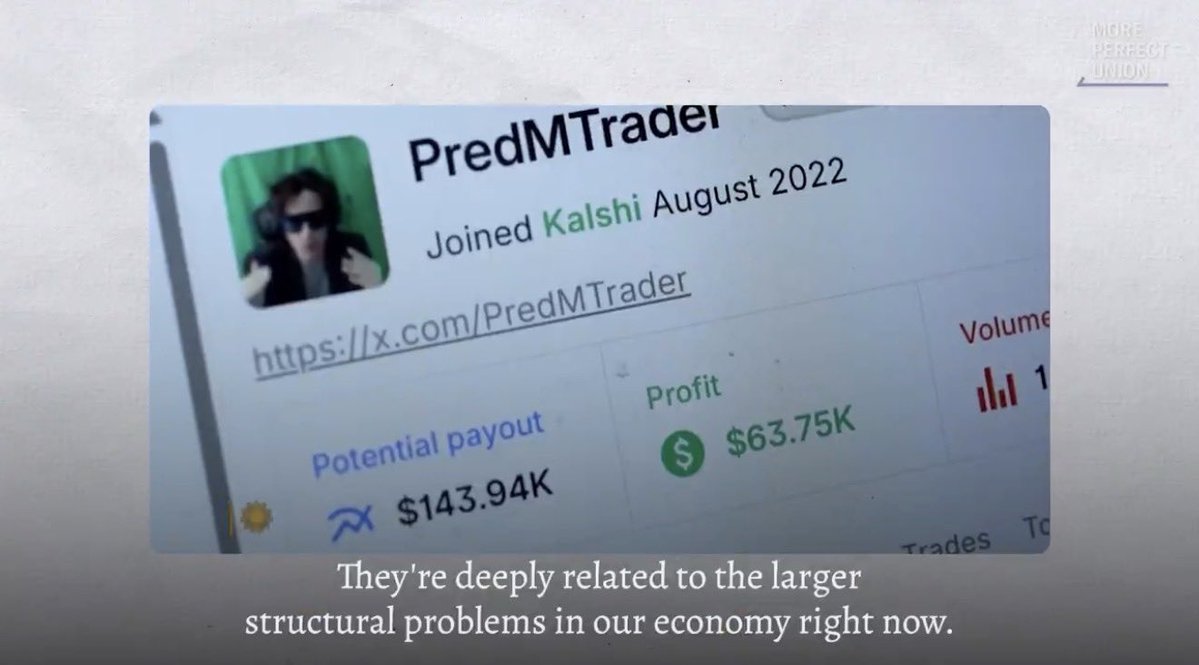
NEW: Prediction markets are scamming the working class. Polymarket and Kalshi claim they are "democratizing finance," but their business model enables a handful of elites to fleece their customers. On Polymarket just 0.04% of traders capture 70% of the profits.




Who Wins and Who Loses In Prediction Markets? I read a research article about who actually makes money on Polymarket. Dataset: 1.4M users, 70M trades, $20B volume. Here are the main points: > Top 1% of users capture 84% of all gains > 70.8% of users lose money > Market makers beat takers at 80 out of 99 price levels > Buying contracts below 10¢ is the #1 way to lose money (they are systematically overpriced) > Overtrading makes losses even worse