Pedro Rosón Fdez

1K posts

Pedro Rosón Fdez

Pedro Rosón Fdez

@prosonf

Senior Software Engineer at @FortrisHQ #Java #Springframework

Málaga (Spain) شامل ہوئے Temmuz 2013
685 فالونگ249 فالوورز
Pedro Rosón Fdez ری ٹویٹ کیا
Pablo Grueso
Pablo Grueso@PabloGrueso·
Tengo que sacar un momento para escribir un post de por qué esto es una barbaridad desde el punto de vista organizativo y de flujo de procesos. Básicamente, la unidad de gestión debería ser el caso, y organizar en torno a él al equipo. Lo importante es que el caso llegue cuanto antes a una resolución, y es justo lo contrario a lo que se consigue con un sistema diseñado para mantener a todos los funcionarios ocupados El coste del cambio de contexto es inasumible en un juzgado, por la propia naturaleza de los expedientes, y el conocimiento del asunto que adquieren los auxilios, LAJ, etc... por la mera tramitación hace que sea mucho más efectivo que se mantengan de principio a fin. La reforma Bolaños obvia lo que sabemos de procesos, organización y sobrecarga cognitiva de los humanos desde décadas. Si a alguien de verdad le importa busquen sobre Lean, one piece flow, Kanban, WIP limit, teoría de restricciones...
Elisa Beni@elisabeni

A hacer puñetas… Que tenga que salir una magistrada a explicarte el desastre que ha liado Bolaños…

Español
12
65
184
30.5K
Pedro Rosón Fdez ری ٹویٹ کیا
Taylor Pearson
Taylor Pearson@TaylorPearsonMe·
Eli Goldratt's book, The Goal, was famous for its (then unpopular argument) that keeping every machine running 24 hours a day, the metric most plant managers cared about, was actively making factories worse. I suspect we're seeing the same fallacy in how many people are using AI agents. Goldratt's point was that machine utilization isn't throughput. What you want from a manufacturing plants is making good widgets as cost-effectively as possible. It doesn't necessarily follow that running your machines all the times optimizes that. Picture a three-station assembly line. Stations 1 and 2 each crank out 200 widgets an hour. Station 3 can only handle 100. Running stations 1 and 2 around the clock doesn't ship more product. It just piles up half-finished widgets in front of station 3, ties up cash in inventory, and creates more work managing the pile. He developed the Theory of Constraints to point out that what matters is solving the bottleneck in the system, not increasing machine utilization. I suspect a lot of agent usage right now is the same fallacy at higher resolution. Running 20 Claude Code sessions in parallel can feel productive because something is always happening. But, if the bottleneck in your work is judgment about what's worth doing, more agents just generate more output for you to wade through. This is not to say there aren't workflows running 20 agents in parallel very effectively, I'm sure there are. And, I suspect there's a general retraining we all need to do around evolving historical workflows. But.... The constraint for most knowledge work is deciding what's worth executing and no one is task switching between 20 things at the same time effectively I don't think. I find I can run maybe 2 or 3 things in parallel with maybe 1 or 2 admin-y type things on the side and that is only if I'm very locked in.
English
21
65
475
41.4K
Pedro Rosón Fdez ری ٹویٹ کیا
Jaana Dogan ヤナ ドガン
Software engineering isn't going away because engineering is mostly about about picking the next big unsolved puzzle and solving it. Software engineers are some of the most versatile problem solvers.
English
18
62
645
28.1K
Pedro Rosón Fdez ری ٹویٹ کیا
Leo Rial
Leo Rial@LeoTelvia·
@antonello Ese caso me parece oro para cualquier empresa pequeña: no se trata solo de usar IA o escribir más rápido, sino de entender dónde compensa construir algo propio porque el criterio, el dato y el proceso ya son demasiado estratégicos para delegarlos fuera.
Español
1
1
1
507
Pedro Rosón Fdez ری ٹویٹ کیا
César Astudillo 🇪🇸✳️
César Astudillo 🇪🇸✳️@cesarastudillo·
Nota para mí mismo: Cuando @Recuenco dice "NETAPADEH" ("no es tan así pero algo de eso hay") parecería que se desliza a los terrenos supuestamente profanos del razonamiento informal, cuando en realidad el NETAPADEH es uno de los building blocks del pensamiento complejo. (...)
Español
6
7
66
12.8K
Pedro Rosón Fdez ری ٹویٹ کیا
Antonio Ortiz
Antonio Ortiz@antonello·
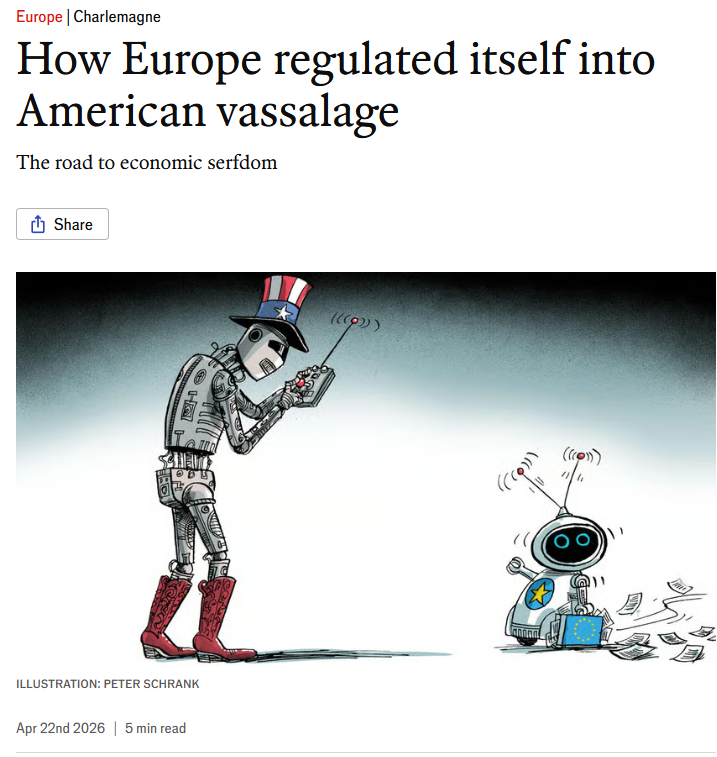
Este artículo de The Economist es brutal en su exposición de algo que vengo sosteniendo desde hace años: la sobrerregulación tecnológica europea eleva tanto la barrera de entrada (costes burocráticos, sanciones enormes) que sólo pueden afrontar empresas grandes. Es un golpe autoinflingido, que ha beneficiado a las estadounidenses y perjudicado a las europeas (que por nuestro mercado fragmentado tienden a ser más pequeñas) Cito del artículo: "Sí, las normas de la UE a menudo se aplicaban a las empresas estadounidenses, siempre que quisieran ofrecer sus productos en el bloque. Sin embargo, en la práctica, la regulación afectó más a las empresas europeas. Los costes de administrar normas complejas de protección de datos, por ejemplo, podían absorberse fácilmente para Google o OpenAI, gracias a sus ejércitos de personal de cumplimiento. No ocurre lo mismo con sus rivales europeos, que generalmente carecían de escala (en parte porque el mercado único fragmentado de la UE dificultaba su crecimiento más allá de su país de origen). Así, la UE generó barreras de entrada que a menudo terminaron protegiendo a los gigantes estadounidenses" Y sigo diciendo que con la inteligencia artificial hemos hecho lo mismo. Campeones de la regulación, incentivamos la concentración en grandes empresas que por músculo financiero, tamaño de mercado y mucho más capital de inversión resultan ser de EEUU. economist.com/europe/2026/04…
Antonio Ortiz tweet media
Español
21
141
326
21.9K
Loretta 🍺🎾🎸
Loretta 🍺🎾🎸@FPJ_Loretta·
Adivina adivinanza para no guitarristas: cuando tienes una guitarra eléctrica sonando en un amplificador distorsionado (sonido "rockero") y bajas el volumen en la guitarra, ¿qué creéis que le pasa al sonido, principalmente?
Español
4
0
0
1.6K
Pedro Rosón Fdez
Pedro Rosón Fdez@prosonf·
@antonello Me pregunto cómo será cuando lleguen a España, en cada país hay diferentes biases en la normativa. Aquí, en Málaga, hiperronda, dos carriles se escinden a la derecha y hay una señal de 40. Nadie la respeta, ¿qué pasará cuando estos coches bajen a 40 en medio de la autopista?
Español
1
0
0
137
Antonio Ortiz
Antonio Ortiz@antonello·
Me leo siempre los posts de Understanding AI sobre los informes de accidentes de robotaxis autónomos Waymo. El de esta edición sigue reflejando que sufren menos accidentes, Pero creo que es muy interesante la parte de cómo sonlos que sí tienen: Resulta que la mayoría de los accidentes con Waymo involucrado fueron causados por errores de conductores humanos. Más de la mitad (48 casos) ocurrieron cuando otro vehículo chocó contra un Waymo por detrás, muchos de ellos mientras el coche autónomo estaba detenido en un semáforo, una señal de alto o cediendo el paso a peatones. Otros 12 incidentes implicaron impactos desde otras direcciones contra un Waymo detenido, incluido un caso en el que un conductor chocó deliberadamente contra el vehículo en dos ocasiones (la rebelión contra las máquinas, supongo). Pero aquí está lo que destacaría: El incidente más grave ocurrió cuando un error de ruta llevó a un Waymo no autorizado a circular por una autopista. El vehículo se detuvo en el carril derecho y, aunque varios coches lo esquivaron sin problemas, un SUV intentó rodearlo y colisionó con una camioneta, la cual cayó más de 15 pies (casi 5 metros) desde un puente. Cuando los Waymo cometieron errores, estos fueron casi siempre por exceso de precaución, es decir, detenerse en lugares inapropiados o permanecer inmóviles demasiado tiempo. Y parece un patrón común al resto de coches autónomos o robotaxis. Nota sobre que los Waymo provocan menos accidentes: un 82% menos de accidentes con heridos, 83% menos que activan los airbags y 92% menos que lesionan a peatones. understandingai.org/p/human-driver…
Antonio Ortiz tweet media
Español
2
11
31
3.3K
Pedro Rosón Fdez ری ٹویٹ کیا
Dave W Plummer
Dave W Plummer@davepl1968·
I've been married for 35 years. With autism, no less. 40 years ago, when we met, I had no idea that I had autism, but I knew I was a little different. And I told her that in our relationship, she would have to go first. I have no "game". I don't flirt. I'm not wired for it. My entire reproductive plan was to just be nice and smart and "hang around" until someone "got me". And she did. And 40 years later, it remains true. I am constantly recalibrating my outward emotion and affection up or down to match what I perceive from others. Even if I -feel- more, I ratchet it down. And then when I receive affection or affirmation, it goes up. You might think that cowardly, or self-protective, and maybe it is. But with ASD, you don't have a "natural sense" of how the other person is magically feeling. You have to go by example. And it's very easy to overstep or overreach if you're not careful.
Dave W Plummer tweet media
Zweil@somethings_awry

As an autistic man, flirting and making the first move intentionally makes me feel like I'm engaging in harassment

English
101
59
2K
99.5K
Pedro Rosón Fdez
Pedro Rosón Fdez@prosonf·
@PabloGrueso 🤯 Le veo el sentido, y es bastante opuesto a lo que pensaba hace unos meses. Por eso me 🤯
Español
0
0
1
150
Pablo Grueso
Pablo Grueso@PabloGrueso·
Pensaba sobre esta conversación de abajo, y mi enfoque estratégico para España sería, por orden de prioridad: - Mediterráneo: nos une la cultura, la proximidad y geográficamente siempre seremos un enclave único, en la unión de dos continentes. - Hispanoamérica: nos une la cultura, el idioma, una historia común y formamos un espacio de cientos de millones de habitantes. La distancia es un problema menor con las comunicaciones, y nos da la ventaja de tener intereses en dos continentes. - Europa: no nos une ni la cultura, ni el idioma. No podemos crear una nación con el norte de Europa. Es un mercado muy potente, por lo que únicamente haría acuerdos comerciales que pongan en valor nuestras fortalezas, y acuerdos de defensa mutua tipo OTAN.
Pablo Grueso@PabloGrueso

Acabo de tener una reunión con el CEO de una compañía alemana y me he partido con esto: - ¿Estáis pensando expandiros a España? - Mis inversores no me dejan poner dinero al sur de Austria. Algún día nos convenceremos de que nos une más a Latinoamérica que a Centroeuropa.

Español
12
0
31
5.8K
Pedro Rosón Fdez ری ٹویٹ کیا
Javier G. Recuenco
Javier G. Recuenco@Recuenco·
Sobre agencia y hormesis, entre otras muchas cosas.
Jaynit@jaynitx

In 1942, the Japanese rounded up all Chinese men in Singapore. They were filtering out the healthy young ones to execute. Lee Kuan Yew was 18. A guard pointed at him and said: "Go to that lorry." He knew what that meant. The lorry went to the beaches. The beaches meant machine guns. He asked: "Can I collect my other things?" They said yes. He walked away, found his family's gardener, and hid in his quarters for two days. When they changed the screening inspectors, he tried again. This time, he got through. The ones sent to that lorry were taken to the beaches and shot. Somewhere between 50,000 and 100,000 didn't survive. 60 years later, he sat down at Harvard to explain how he built Singapore from a tiny island into one of the wealthiest nations on Earth: On what the war did to him: "We lived in happy, placid colonial Singapore in the 1920s and 30s. The British Empire would have lasted another thousand years, so we thought." Then the Japanese came. In less than one and a half months, the British collapsed. "Three and a half years of hell. Butchery. Brutality. Many didn't survive. I was fortunate. I did." "But it changed us." "What right did they have to do this to us? Why did the British let us down so badly?" When the war ended, Lee went to Cambridge to study law. But he was watching with different eyes. "Can they govern me better than I can govern myself? Because they scooted when the Japanese came in. And why shouldn't I be running the place?" On learning languages to lead: Lee was the best speaker in English. But only 20% of Singapore spoke English. The masses spoke Hokkien, Mandarin, and Malay. "So every day at lunchtime, instead of having lunch, I would sit down with a Hokkien teacher and laboriously and painfully learn to convert my Mandarin into Hokkien." "Had I not mastered that, the battle would be lost by default." His first speech in Hokkien, the kids laughed at him. "I said, please don't laugh. Help me. I'm trying to get you to understanding." By 6 months, he could get his ideas across. By 2 years, he was fluent. "Believe it or not, at the end of two years I could speak better than most of them." "That came respect." It showed two things: how determined he was, and how sincere. Here was a man doing all these other things and still learning their language just to talk to them. On fighting the Communists: The Communists had been organizing since 1923. The year Lee was born. "Here we were in the 1950s trying to beat them. And they are professionals at organization." They had elimination squads. Guerrillas in the jungle. Killer squads in the towns. Lee stood up and said no. "They denied that they were Communists. 'We're just left-wing socialists.' So I did a series of 12 broadcasts to set the scene. And I made it in three languages." English. Malay. Mandarin. 20 minutes each. "When I finished each broadcast, the director of the station couldn't see me. Went into the room and found me lying on the floor trying to recover my breath." "But it was a fight for survival. Life or death." On where trust comes from: "It's difficult to establish trust in times of calm. You just say, 'Well, it's an argument, therefore I'm a better guy than you.'" "But when the chips are down and you can get eliminated in a very unpleasant way and you show that you're prepared for it and you'll fight for them, it makes a difference." "Without that trust, we could not have built Singapore." On IQ vs EQ: Harvard asked him: would you prefer high IQ or high EQ in a leader? "IQ, you can get beautiful paper done. Complex formulas worked out. Elegant solutions." "But when you've got to get a team to work and put that formula into practice, you're dealing with human beings." "If you're not good at EQ, you can't sense that A doesn't get on with B, and you put them in the same team. It's no good." He rated his own EQ as 7 or 8 out of 10. His IQ as "maybe 120." But he had colleagues who could sense a person instantly. "He shook hands with the man and said, 'I recoiled when I felt his palm. Evil man.' And he was. How does he know? I don't know." "So I learned whenever I had to do interviews to choose people, I would get people who are very good at seeing through a candidate." On corruption: Singapore in the 1950s was full of deals, bribes, and organized crime. "When we took over, we decided that this was the critical factor. If we did not make it so that every dollar put in at the top reaches the ground as one dollar, we're not going to succeed." "We came in and made a symbolic act. We dressed in white shirts, white trousers, and said we will be what we represent." He put the anti-corruption bureau under his personal portfolio. "I gave the director the authority to investigate everybody and everything. All ministers. Including myself." One of his own colleagues took half a million in bribes. When the investigation started, he asked to see Lee. "I said, if I see you then I'll be a witness in court. So best not see me. Better see your lawyer." The man committed suicide. Left a note saying: "As an oriental gentleman who believes in honor, I have to pay the supreme price." "It's a heavy price. But it reminds every minister that there are no exceptions." On consistency: Lee had three journalists analyze 40 years of his speeches. He asked them: what was the dominant theme? All three said the same thing: consistency. "What I said at the beginning, throughout all that period, the theme stayed loud and clear." "That made it simple. Because you know where you stand with me. And you know what I want to do." On delivering results: "We deliver the homes, the schools, the jobs, the hospitals." "Today, 98% of our people own their own homes. The smallest would be about $100,000 US. The biggest about $300,000." "Once you own that amount of assets, you are not in favor of risking it with a crazy government. Your assets will go down in value." "But that was planned." Why? Because Singapore is small. Everyone does national service. If you're going to fight, you better be fighting for something you own. "So we give everybody a stake." On changing culture slowly: Lee wanted Singapore to speak English. But he couldn't force it. "Had I passed a law and said you will all learn English, we would have had mayhem. Riots." Instead, he let parents watch who got the best jobs. The jobs were already there, from the multinationals and banks. They all used English. "They watched and saw who got the best jobs. And they switched." It took 16 years. "I did not want to have said 16 years. Because in those 16 years I lost 20,000 Chinese graduates who had poor jobs. I wanted to make it shorter. I couldn't. I would have run into flack." On whether leadership can be taught: Lee quoted Isaac Singer, the Nobel Prize winner for Yiddish literature. Someone asked Singer: "Can you make a writer write great literature?" He paused. Then said: "If he has the writer in him, I will make him a good writer in a shorter time." Lee's version: "Can you make a leader of anybody? I don't think so." "He must have some of the ingredients. He must have that high energy level. He must have the ability to project himself, his ideas. He must have the desire, almost instinctively, to say 'let's do something better.' Of wanting to do something for his fellow men and not just for himself and his family." "You can't teach those things. He's either got it or he hasn't got it." "But if he's got that, then you can save him a lot of trouble." On sustaining yourself: Harvard asked how he managed despair over decades of leadership. "If your message is one of despair, then you should not be a leader. You must give people hope." "But there are moments when you feel very down. Either because you're physically down, or emotionally down, or because the world has turned adverse against you." "When you are in that condition, the first thing you do is get a good night's sleep. Then get a swim or chase a ball. Get the cobwebs out of your mind." "If you're not fit, you're going to make mistakes. Physically fit. You must stay physically and mentally fit." In his later years, he learned to meditate. "At the end of 20 minutes to half an hour, my pulse rate can go down from 100 to about 60. You can feel yourself subside. You still your mind. You empty your mind." "Then when you are rested, you resume quietly. You still got the same problems. Maybe you sleep on it. Come back. Look at it for a few days. Then decide." This 2 hour Harvard interview will teach you more about leadership than every business book you've read combined. Bookmark & give it 2 hours this weekend, no matter what.

Español
2
3
23
3.8K
Pedro Rosón Fdez ری ٹویٹ کیا
Captain Obvious™️
Captain Obvious™️@TheFungi669·
Just in: Tim Cook is stepping down as CEO of Apple. I wish Trump would also step down. Of course, I’m comparing apples to oranges.
English
536
4.5K
42.3K
777.5K
Pedro Rosón Fdez ری ٹویٹ کیا
Jon González
Jon González@Jongonzlz·
Si toleras que un representante público trate de humillar y ridiculizar a un chaval de 20 años en televisión y redes sociales, además mediante mentiras y falsedades, y que no solo rectifique o pida disculpas, sino que se pavonee, simplemente porque es de "los tuyos" y el otro es de "los de ellos", estás incentivando a los partidos a que seleccionen ese tipo de perfiles; estás contribuyendo a la decadencia de la política en España. Sí, tú.
Español
71
1.5K
5.8K
204.7K
Pedro Rosón Fdez ری ٹویٹ کیا
Jon González
Jon González@Jongonzlz·
Lo que estoy intentando que veáis todos hoy, también quienes sois sus votantes, si sois mínimamente honestos con vosotros mismos, es que la política y los medios se han convertido en un campo de batalla donde la verdad ha dejado de importar. En este contexto, ya nadie exige a los políticos la capacidad de buscarla o defenderla: basta con rascar un poco para que queden en evidencia. Lo mismo ocurre, como veis, con muchos de los supuestos "expertos" que aparecen en programas de infotainment. No solo no son capaces de rebatir los datos o los cálculos, sino que ni siquiera pueden reproducirlos. Hoy, lo único que importa es el relato. La verdad ha pasado a un segundo plano. Y eso está degradando el nivel del debate público hasta mínimos históricos en democracia.
Español
93
1.3K
4.1K
138.8K
Pedro Rosón Fdez ری ٹویٹ کیا
Jon González
Jon González@Jongonzlz·
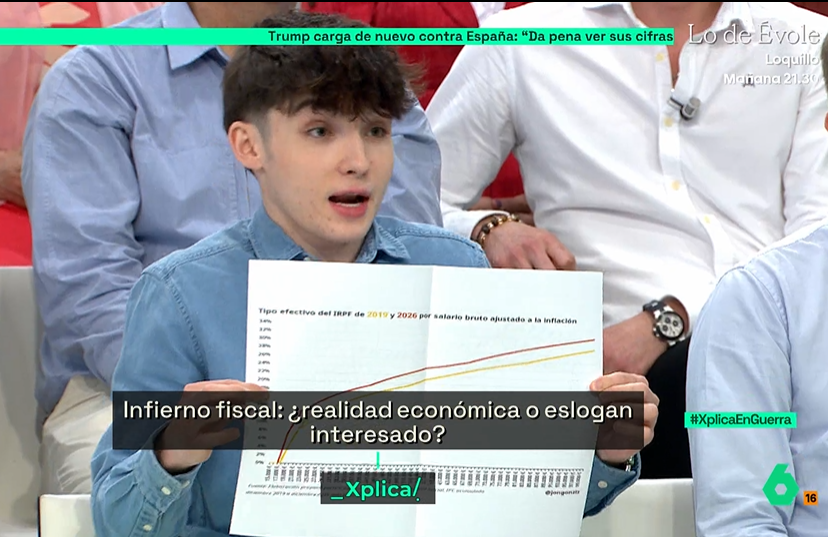
Ayer en @laSextaXplica varios de los 'expertos' como @JulenBollain, @AlbertoSotillos, @AfraBlanco, @jdiazgimenez, incluso el presentador @jjyelamo acusaron a @Jon_Echeverria_ de ofrecer datos 'inventados', 'bulos de la ultraderecha' cuando explicó que el salario medio neto real se ha reducido un 3,4%, que 18.000€ pagan más impuestos que su equivalente ajustado a la inflación en 2019, o que todas las rentas que hoy pagan IRPF, pagan más IRPF, ajustado a la inflación que con el último cambio en los cálculos que entró en vigor completamente en 2019. Como el autor de los cálculos soy yo y, por tanto, al que indirectamente han desacreditado es a mí, vuelvo a presentar los datos indicando todas las fuentes para que tomen una de las dos opciones: o rebaten los cálculos o rectifican, idealmente en el mismo medio, o al menos aquí en X. Los cálculos. 1⃣ Vamos a la Encuesta Trimestral de Coste Laboral en el INE (ine.es/jaxiT3/Datos.h…). A la serie desestacionalizada y ajustada por calendario. Tomamos el 'coste salarial total por trabajador' de los periodos 4T2018 y 4T2025 (últimos 7 años). 2⃣ Vamos al IPC General en el INE (ine.es/jaxiT3/Datos.h…). Comparamos el dato de 2018M12 y 2025M12. IPC acumulado del 23,2%. Lo utilizaremos para deflactar los importes nominales del salario. 3⃣ Calcular el salario neto en 2018 y 2025. Es muy sencillo, porque para 28.886€ y 23.157€ anuales, el cálculo es el mismo; no hay deflactación, no hay nuevas deducciones, no hay nada. Lo único que cambia es que el tipo de la cotización a la Seguridad Social ha pasado del 6,35% al 6,48%. Partimos del salario bruto, deducimos las cotizaciones sociales y la deducción general de 2.000€ (que son los mismos 2.000€ en 2018 y 2025) y tenemos nuestra base imponible. Aquí no aplican reducciones por rendimientos del trabajo ni en 2018 ni en 2025, así que es muy fácil. Aplicamos los tramos del IRPF teniendo en cuenta el mínimo personal y familiar de 5.550€ que es el mismo en 2018 y 2025. Así obtenemos el salario neto. Un 2,55% inferior ajustado a la inflación en 4T2025 que en 4T2018. No tiene más. Entre el 1T2018 y el 4T2025 supone el 3,4% que presenta Jon. Estoy abierto a cualquier consulta o aclaración de los detalles. En los siguientes tuits iré enlazando tuits donde se explican el resto de datos. Todos correctos. Por cierto, el gráfico que presenta Jon en la captura del vídeo se ha mostrado en el Congreso de los Diputados, así que no solo estáis acusándole a él de presentar datos falsos sin contrastar en un medio de televisión, sino a un diputado de mentir en el Congreso.
Jon González tweet media
Español
191
2.7K
6.8K
574.9K
Pedro Rosón Fdez ری ٹویٹ کیا
Amazing Physics
Amazing Physics@amazing_physics·
"Not flat, we checked" -- NASA
Amazing Physics tweet media
English
402
12.7K
122.7K
1.1M
Pedro Rosón Fdez ری ٹویٹ کیا
laura franch
laura franch@franch_laura·
Hoy te invito a descubrir (o redescubrir) la vibrante y luminosa obra de Álex de Marcos (Madrid, 1985). Un artista con una capacidad asombrosa para elegir paletas cromáticas y, sobre todo, emocionales. 👇🏻Abro hilo.
laura franch tweet medialaura franch tweet medialaura franch tweet medialaura franch tweet media
Español
9
73
472
11.1K
Pedro Rosón Fdez ری ٹویٹ کیا
Radical Living
Radical Living@RadicalFalk·
What 10 Years in Spain Does To You 🍗
English
238
1K
14.6K
1.8M