
Tarun
8.6K posts

Tarun
@tarunoneworld
https://t.co/eIo4FYYjjG
🌏 Pale blue dot شامل ہوئے Ağustos 2009
829 فالونگ151 فالوورز


Need headphones / earphones / earpods for my Dad.
He needs something on which he can listen to songs while he is on his morning walk and has his phone in his pocket.
Any recommendations?
He has a Redmi phone.
English
Tarun ری ٹویٹ کیا

The reason most people stay average is because that’s how normal distribution works 😭
Raj Shamani@rajshamani
The reason most people stay average is because average behaviour gets you social acceptance much earlier than exceptional behaviour gets you results.
English
Tarun ری ٹویٹ کیا

Interesting: a day after polling ends in West Bengal, ED chooses not to oppose regular bail to Vinesh Chandel, co-founder IPAC in an alleged money laundering case. Raat gayi, baat gayi?🙏
English
Tarun ری ٹویٹ کیا

@shantanugoel @ravihanda It's just a question of following the trail, getting to the bottom. Each account is supposed to be heavily KYC'ed and verified.
The follow thru investigation needs will from the top. Not sure while its lacking.
English

There isn't much that police does to go beyond first level connections in most cases. Even when they do I don't think there are enough convictions.
If they did, yeah they could curb it. A lot of scams even run out of proper office buildings but a lot of police is paid off/involved. In many cases, bank employees are involved.
English
I have a very basic question about cyber fraud - how does it actually work?
These are all transactions that happen in white money. Bank accounts need PAN, Aadhar, Mobile, address proof.
If the money is still in accounts, it can be frozen and refunded. They cannot withdraw lakhs and crores in a couple of days via ATMs because of cash withdrawal limits.
How is it such a big problem without any solution.
Vivek@Vivek_Investor
67 years old man lost his entire retirement fund to cybercrooks who assured him good returns from share trading. Don't know what to say 😌 Src: Times of India.
English
Tarun ری ٹویٹ کیا

Last 5 days of shoot:
>Boat ride in Bengal
>Temple visit in Kolkata
>Roadshow in Gangtok
>Football in Gangtok
>Temple visit in Varanasi
Who is actually running this country?
English
@BharatJaiin They don't have what amount? He mentioned the upper limit, you understand that right?
English

Most don't have this amount to invest as well.
Then do you consider succession laws, taxation, fema, forex conversion etc and complicate it further 🤔
Neil Borate@ActusDei
Most Indians don't know they can legally invest $250,000 abroad every year. Here's everything you need to know about global investing — costs, taxes, platforms, and estate tax. A thread 🧵
English
Tarun ری ٹویٹ کیا

I travelled through Great Nicobar today.
These are the most extraordinary forests I have ever seen in my life. Trees older than memory. Forests that took generations to grow.
The people on this island are equally beautiful - both the adivasi communities and the settlers - but they are being robbed of what is rightfully theirs.
The government calls what it is doing here a “Project.” What I have seen is not a project. It is millions of trees marked for the axe. It is 160 square kilometres of rainforest condemned to die. It is communities that have been ignored while their homes have been snatched away.
This is not development. This is destruction dressed in development’s language.
So I will say it plainly, and I will keep saying it: what is being done in Great Nicobar is one of the biggest scams and gravest crimes against this country’s natural and tribal heritage in our lifetime.
It must be stopped. And it can be stopped - if Indians choose to see what I have seen.
English

@BasuNivesh @ravihanda @ActusDei Diversification is a fundamentally strong principle of investing. And that's what @ActusDei is promoting. Rightly so. International diversification is important. What is your problem with it?
English

@ravihanda @ActusDei I am never deadly against global investing. But deadly against the idea of global investing is the ONLY way to create wealth (for their own business module or for the sake of Paapi Peth)..
English
Beware of such souls before BLINDLY following for your investment. They can go to any extent to defend their business module. One such classic example is this defense. For such souls, INVESTMENT = GLOBAL INVESTMENT. Not because of you, but because of their own business.
English
Tarun ری ٹویٹ کیا
Too much democracy: "Gujarat chief minister Bhupendra Patel, speaking at a public event after the recent withdrawals in local body elections, reportedly said the aim should be a situation where no one even files a nomination against the ruling party".

English
@spaultweet @NKapoor2020 @TheClubJunto @AjuGeorge7 It's not an either/or. Feel free to question the government. That's exactly what the original post did, and must be echoed by every citizen. It affects us all.
English

@tarunoneworld @NKapoor2020 @TheClubJunto @AjuGeorge7 Of course people will ask questions because it is easier to question corporations than politicians.
Let’s talk about R&D budget of government. What about Indian military? Why did the govt reduce tax incentives for R&D.
What the govt doing to keep scholars in the country?
English

Bernstein: India’s Ambitions are Hollow Without R&D Investments
1. No nation in history became a developed economy with R&D @ 0.65% of GDP
2. Labor Arbitrage Economy: Demand broken as wages stagnate for 10 yrs. You raise wages, you can’t compete. AI dents it further.
INSIGHTS:
R&D Intensity (% of GDP)
2000s
Korea: 3.12%
Taiwan: 2.7%
China: 1.32%
India: 0.82%
2010s
Korea: 4.29%
Taiwan: 3.3%
China: 2.11%
India: 0.75%
2020-25
Korea: 5.21%
Taiwan: 4.0%
China: 2.8%
India: 0.65%
Widening Innovation Gap: China’s GDP is 5X of India. Its R&D budget is 4X in % of GDP. So, in dollar terms, China is 5x4 = 20X of India’s R&D every year.
Labourers vs. Innovators
a. India’s Top 10 Companies: Combined R&D Expense 2025 (Thinking in Quarters): Below $1B
b. China Companies R&D Expense 2025 (Thinking in Decades): BYD $8B; Huawei $14B; Xiaomi $5B
c. Korea: In 1970s, private to government R&D share was 20:80. In 1990s, the ratio became 80:20. Korean government forced private sector to invest in R&D, reject short-termism, and massively incentivized firms with export credits and R&D tax credits.
d. Taiwan: In 1980s, the government funded research labs for semiconductors. The “seed” was sown by the government; the “scale” was led by private sector. Today a single company TSMC controls 70% world market share in semiconductor pure-play, driven by AI demand.
e. China: In 1980s, India and China had similar R&D investments. China realized that technology was their only guarantee of national survival. The government and private sector formed a combined “war machine” to become the “IP owner” and not just the “world’s factory” for tech goods.
India’s Scarcity Mindset
a. While Korean and Chinese companies operate in a culture that rewards global innovation, Indian companies operate in a culture that rewards bowing down before bureaucrats and ministers.
b. To grow in India, you don’t need to build world-beating products. You just need to operate in those areas of the domestic economy where government policy favours Indians over foreign businesses.
c. Think of a student whose father owns the school, and no other students are allowed to sit in the exam. What will be his capability? While other countries demand global dominance as a point of national pride, Tata, Reliance, and Adani cannot even make a candy that sells in the world market.
d. Curse of Cheap Labor: Indian IT companies realized that when you can make 20% margin by selling cheap labor, why build a semiconductor factory that requires $20 billion CapEx? They kept distributing lakhs of crores in dividends (mainly to promoters) while the world invested in AI and chips.
e. The GCC Paradox: India now has over 50% of the world's Global Capability Centers (GCCs). From Google to Walmart to Mercedes, the world’s best tech innovation and research is happening in India, but the Intellectual Property (IP) belongs to other countries. So, we remain only “cheap labour” for others.
Low Wages; Broken Consumption
a. Labour arbitrage economies enjoy GDP growth till wages keep rising. But wage growth stalls when other poor economies like Bangladesh or Philippines catch up with lower wages. That’s when their dream of becoming a “developed economy” gets a reality check.
b. From 2015 to 2025, real wages in India have stagnated. Rural wages have seen a negligible CAGR of 0.1%, and entry-level IT salaries have famously remained stuck at ₹3.5 LPA. China’s real wages (inflation-adjusted wages) have grown at 8 to 9% CAGR during the same period.
c. Indian companies continue to operate in low-complexity, me-too product/service segments where low wages are a competitive advantage. But now AI is the new emerging threat to IT sector and GCCs.
Endpiece
In absence of an urgency to shift from Labour Arbitrage to Innovation Premium, India risks falling into the Middle Income Trap. India’s demographic dividend is ending by 2040. Without investing patient capital in R&D, India will squander its opportunity to achieve a developed nation status by 2047.
@arabicatrader
English
Tarun ری ٹویٹ کیا

@NKapoor2020 @TheClubJunto @AjuGeorge7 Every shareholder is a stakeholder. So is every employee. The IT Sector is a key to India's progress. People will ask questions. Why do you have a problem?
English

@tarunoneworld @TheClubJunto @AjuGeorge7 I am not defending anything.
It’s free market. Sell your stake & move on(if you have any in these companies).
Or buy enough of the company & run it the way you want it(once you own it).
How a company operates its business is not a matter of broader public debate.
English
Tarun ری ٹویٹ کیا
@NKapoor2020 @TheClubJunto @AjuGeorge7 Every Tom Dick and Harry will question them soon enough when they sink investor's money and employees jobs. Your defence is pathetic

English
@TheClubJunto @AjuGeorge7 They will figure it out where to invest their surplus.
What I still find amusing is the kind of ‘why don’t they..’ questioning that every Tom Dick & Harry does about IT companies.
As if they owe an explanation to anyone(other than their investors).
English
Tarun ری ٹویٹ کیا

15th April : BJP sends ED at Ashok Mittal’s residence.
24th April : Ashok Mittal Quits AAP along with Raghav Chaddha, and joins BJP.
Welcome to new India, everything is now so blatant that they don’t even have shame anymore.

English

Have a list of 1M+ founders and CEOs
Verified emails, phone numbers, etc.
Sourced from various private databases
Like + comment 'List' and I'll dm it to you
English
Tarun ری ٹویٹ کیا

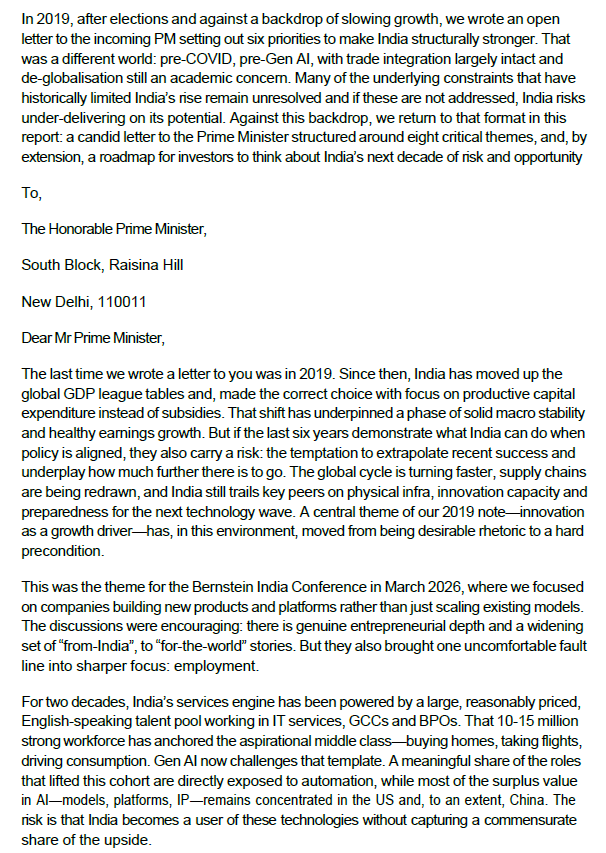
Bernstein just wrote an open letter to India's Prime Minister — and it is asking some hard questions. (23rd April India Strategy note) 👇
1/ The employment question is existential, not cyclical - India's 10–15 million strong IT/BPO workforce — the backbone of the aspirational middle class — is directly in Gen AI's crosshairs. Manufacturing can't absorb the slack at current trajectory. The real question: does the next growth leg create engineers and product builders, or mostly drivers and delivery staff?
2/ Agriculture is stuck in a 1970s policy loop 42–45% of the workforce. 15–16% of GDP. - Below 1-hectare average holdings. Monsoon-dependent farming. Loan waivers instead of reform. The farm laws rollback made things harder, not less necessary. Rs 3–4 trillion in annual input subsidies need to shift toward post-procurement income transfers — and cold storage/logistics investment is not optional anymore.
3/ India risks becoming a permanent AI consumer, not a creator - Data centers are not a strategy. India doesn't own a single frontier AI model. If Indian data keeps training US and Chinese models while domestic capability goes unbuilt, the IT services sector hollows out with nothing to replace it. Bernstein's ask: fund domestic foundation models, build compute capacity, and push global AI companies to list in India — sharing value with the public.
4/ Manufacturing ambition keeps outrunning manufacturing depth - PLI created momentum, but the share of manufacturing in GDP is still stuck at 16–17%. Even in EVs, battery cells — 30–40% of cost — are largely imported from China. The pattern of late entry into industries after global supply chains are already formed needs to break. The next bet must be placed before the race is lost — automation, robotics, advanced materials, AI-integrated manufacturing.
5/ Cash transfer schemes are quietly crowding out capex - Women-only cash transfers across a dozen-plus states now total Rs 1.7–2.5 trillion annually — roughly 0.5% of GDP — and rising. In some states, these schemes absorb 2–3% of GSDP, squeezing infrastructure budgets. Bernstein isn't saying scrap them — targeted support has a role. But election-synchronised, unconditional, permanent transfers risk locking India into a low-productivity equilibrium where taxes fund today's consumption instead of tomorrow's capabilities.
6/ R&D spend of 0.6–0.7% of GDP is not a serious number for a country with semiconductor ambitions Merit-diluting reservation policies are hollowing out research institutions. Without fixing the talent pipeline and funding base, aspirations in AI, deep tech and semiconductors remain exactly that — aspirations.
Bernstein's closing line: "India does not lack capital, talent, or ambition. What it requires now is a sharper willingness to take difficult decisions early, rather than defer them. The window to act is still open, but it is narrowing."
#nifty #india #stockmarket #investing
--------------------------------
Informational only. Not investment advice. Investments subject to market risk. | GoIndia Advisors LLP | SEBI Registered Research Analyst | Reg. No. INH000020040 | SEBI (RA) Regulations, 2014.
For Serious Investors → goindiastocks.com
Follow us for more insights.
English
@ravihanda @anmolm_ Everyone should avoid excess sugar, no? Irrespective of whether you're trying to lose weight or not
English
@anmolm_ Btw - you aren't fat. Why are you not drinking regular coke?
English