Vamsi Krishna B

14.9K posts

Vamsi Krishna B

Vamsi Krishna B

@vkbdev

Interested in Startups, Data, DevOps and Programming

شامل ہوئے Mart 2009
1.8K فالونگ1.3K فالوورز
Vamsi Krishna B ری ٹویٹ کیا
Mohandas Pai
Mohandas Pai@TVMohandasPai·
Minister @nitin_gadkari needs your attention
Normal Guy@Normal_2610

India pays a premium for the privilege of not learning anything :) Every Indian car Tata, Mahindra, Maruti, all of them has a tiny computer inside called an ECU (Engine Control Unit) This computer decides everything - how much fuel to inject, when to shift gears, how brakes work, how the battery behaves in an EV. Think of it as the car's brain. India makes zero of these brains for passenger cars. All of them come from foreign companies, mainly Bosch (Germany). If you don't control the brain, you don't really control the car. Indian OEMs can't even add a simple valve to their own engine without asking Bosch for permission. They can't change a single line of code. They are selling cars with someone else engineering inside. This isn't really about technology being too hard. It's a business model designed to keep you dependent. Three layers lock you in :) First, every new car programme needs Bosch to do setup work (Rs 10-30 crore). Second, you pay full price for software Bosch already developed for Volkswagen so Bosch gets paid twice for the same work. Third and this is the killer every time you want to change anything in the software, even something tiny, it costs around $500,000. So Indian OEMs simply stop trying to innovate. They accept whatever Bosch gives them. The calibration trap means tuning the car's brain for Indian conditions, how should the engine behave in Ladakh cold vs Chennai heat? Indian OEMs outsource even this to AVL in Austria. AVL reuses work they already did for European cars, charges India full price, and transfers zero knowledge. So Indian engineers never even learn how their own cars work from the inside. What Korea did is Hyundai faced the exact same situation in 1987. They set up Kefico as a joint venture with Bosch, learned everything from the inside, and by 2015 they owned the full technology themselves. The sequence was simple - first learn calibration (tuning) → then write your own software → then build your own hardware. It's a ladder. India never climbed the first rung. Why India didn't do this - It's not a talent problem Indian engineers design ECUs at Bosch offices worldwide. It's a combination of things like Indian OEMs won't fund Indian startups to develop alternatives. They demand that Indian suppliers first prove themselves in Europe before getting a chance at home (while European companies protect their own). Middle managers won't risk their careers backing a Pune startup when they can safely pick Bosch. India spends 0.64% of GDP on R&D vs Korea's 4.9%. Private sector funds only 36% of India's R&D, in Korea it's 79%. SEDEMAC - the one exception - One Indian company (IIT Bombay founders, Pune-based) actually makes ECUs for two-wheelers and generators. They have real IP, real patents, millions of units shipped. But even they couldn't break into passenger cars. Tata Motors is literally in the same city and doesn't use them. EVs are simpler to control than petrol/diesel engines. This should have been India's fresh start. Instead, Mahindra's new EV platform has Bosch (Germany), Valeo (France), BYD (China), Mobileye (Israel), Continental (Germany) - zero Indian ECUs. The dependency just migrated from ICE to EV with different foreign names. swarajyamag.com/technology/the…
English
25
114
432
53.3K
Vamsi Krishna B ری ٹویٹ کیا
Pavanasoonu 🇮🇳
Pavanasoonu 🇮🇳@Pavanasoonu·
How many friends here are based in Bangalore? I am interested in starting a free Jyotish monthly meet. No astrology knowledge required. Venue - Lal Bagh on Sundays. More details shortly. Repost this for more visibility. Those keen to join can email to admin@jyotishkatti.com #Bangalore #Bengaluru
Pavanasoonu 🇮🇳 tweet media
English
47
123
401
120.4K
Vamsi Krishna B
Vamsi Krishna B@vkbdev·
@vydrifter88 @amargov The article goes into detail; one needs to read it in its entirety. However, it would carry more weight if the author cited sources, especially engineers who work there (even if anonymous).
English
1
0
0
196
Vishal yadav
Vishal yadav@vydrifter88·
@amargov @amargov Have you considered an actual engineer while creating this? Mhawk is a home grown engine.
English
4
0
3
1.3K
Amar Govindarajan
Amar Govindarajan@amargov·
India has been making cars since the 1950s but the motor industry has not invested adequately to have the design skills & competency sufficiently in house. Selling cars for 6-7 decades and yet not entirely self-reliant when it comes to engines.
Amar Govindarajan tweet media
English
68
373
1.6K
52.1K
Vamsi Krishna B
Vamsi Krishna B@vkbdev·
@a_srinidhi @vvaayu Never seen a couple till now who has fallen asleep in their own wedding that too when performing the rituals ( Saptapadi , etc ) Also this practice is predominantly practiced in andhra states where day temperatures can be extreme .
English
0
0
1
101
Vamsi Krishna B
Vamsi Krishna B@vkbdev·
@a_srinidhi @vvaayu Friends and relatives can enjoy the reception. For the main ritual, only the core family truly matters. Midnight muhurthas preserve the sacred ritual without spectacle. The priest leads, not the crowd. Focus stays on the sacred ritual not the display.
English
1
0
1
110
ಶ್ರೀನಿಧಿ Śrīnidhi
@vvaayu But I feel marriage is very important part of one life. Why to do in night where there is practice of doing it in day (in Karnataka it is always daytime ). Everyone will be sleepy /tired. Rather than giving importance to wedding, people come and enjoy Bharat /reception only
English
2
0
5
764
Vamsi Krishna B
Vamsi Krishna B@vkbdev·
@homam108 @25_shivansh Namaste Gurugaru. Is it feasible to use Ephemeris published by the Positional Astronomy Centre, Kolkata as an alternative to Swiss Ephemeris? Is Swiss preferred primarily because it’s embeddable as a database in applications, or does it offer superior astronomical accuracy?
English
0
0
0
235
PVR Narasimha Rao
PVR Narasimha Rao@homam108·
Namaste, please stop making statements about what JHora internally does, without confirming with its author (me). Browsing through some of your interactions with @25_shivansh, I'm afraid you're badly confused. 😢 Kali yuga start date is widely accepted as 17/18 Feb 3102 BCE (per proleptic Julian calendar. It is 22/23 January 3102 BCE per proleptic Gregorian calendar). Yes, it is astronomical year -3101 (in continuous counting), but that corresponds to 3102 BCE and not 3101 BCE. Please don't start new controversies just because you misunderstood something and are tied in knots of confusion. BTW, notating 1 BC/BCE as year 0, 2 BC/BCE as year -1 etc is not my invention, but a standard convention (for having a single number without suffix strings). BTW, in both Drik & Surya Siddhanta modes, JHora uses the respective epochs and computes delta_t from it accurately, to find planetary positions for the intended moment. In Drik siddhanta mode, JHora's planetary calculation engine is Swiss Ephemeris 2.02.01, which replicates the precision of NASA's JPL DE431. All planetary calculations take as input "JD" (Julian days - a double precision floating point number that measures the delta between the moment (date & time) of interest and noon Universal Time on January 1, 4713 BCE (proleptic Julian calendar). In Surya Siddhanta mode, JHora's planetary calculation engine uses an interpretation based on Makaranda Sarini (tables composed by Makaranda in 1478-79 CE). All planetary calculations take as input "ahargana" (a double precision floating point number that measures the delta between the moment (date & time) of interest and the beginning of Kali yuga, in local mean time). All linear/nonlinear translations between different ways to represent time, are done within JHora by the internal equations of time. Bottomline is this: User feeds dates/times in either [proleptic] Julian/Gregorian calendar (there is a combobox to select that, when entering birthdata) and JHora displays output (dasa start/end dates/times, annual chart dates/times etc) in the same calendar. However, a continuous double precision floating point number is used internally for representing a moment in time, w.r.t. the relevant epoch. Also JHora allows users to select between sidereal and tropical solar years for various computations such as dasas, annual charts etc. * * * You talked in a previous tweet about "Vedic" astronomy vs "western" astronomy. As Shivansh aptly replied, "Truth does not become Western or Vedic. It is either consistent with observation or it is not." In any case, there are only one set of planets that any model tries to capture! 😃 BTW, "western" is the wrong adjective here - it should be "modern" instead. Modern observations (e.g. JPL DE431) are accurate and can be extrapolated backwards to 5400 BCE, with a precision that is within a handful of arc-seconds (arc-second = 1/3600 of a degree and degree = 1/30 of a rasi)! Some people like to instead use Surya Siddhanta (you said you use it and gave screenshots of JHora Surya Siddhanta mode). But that's not logical. Let me put siddhantas in perspective: (1) IF Surya Siddhanta was a sacred/sacrosanct theory and "absolute" truth, why are there other siddhantas? Varahamihira's "Pancha Siddhantika", for example, refers to Surya, Romaka, Paulisha, Vasishtha and Paitamaha Siddhantas (and there are many more, such as Soma, Brahma, Maha etc Siddhantas). If one of them gave the "absolute" and "perfect" formulas, why were others even composed by rishis or referred to by Varahamihira? (2) Some point out that Surya Siddhanta is "revealed" by Surya himself. But who made that claim? Who was it revealed to? It was Mayaasura. It's a teaching shared with the world by an Asura. In comparison, some other siddhantas came from rishis. (3) This is the most logical explanation for the existence of many siddhantas with different formulas: Ancient rishis and yogis could accurately measure planetary positions. But other people needed the ability to extrapolate those discrete observations made at specific dates/times, to other dates/times. So rishis came up with simplified formulas (curve fitting!) - those formulas fit their observations well and were reasonably accurate when extrapolated. (4) Different siddhantas were composed in different eras and gave different sets of formulas to curve fit different sets of discrete sets of measurements made in those eras. But, as large time pass, errors in the formulas increase (in all siddhantas). (5) Some Siddhantas cleverly embedded some parameters (beejas) in the formulas. They had specific values in the text, but were expected to be "tuned" (beeja samskara) in future eras, based on fresh accurate observations made then!! They'd match observations of that era closer then and extrapolations in the era would be more accurate. (6) But many astrologers following Surya Siddhanta use the ancient formulas with original parameter values or those with parameters finetuned a few centureis back. Obviously, their compuations will be inaccurate w.r.t. actual observations (e.g. made by ISRO or NASA). (7) If you (or others) are using Surya Siddhanta module of my freeware "Jagannatha Hora" (JHora), it uses Makaranda's tables that were finetuned based on fresh observations by Indian astronomer Makaranda, around 1480 CE. Using those formulas for 3000 BCE timeframe is illogical - too much error! Even in 2026, you'll notice a noticeable amount of error between actual observations and those formulaic computations (with a time gap of just 540 years or so)! (8) One may be struck bu the fact that one gets 8/9 planets (except Rahu) near Pisces end or Aries start in JHora, on 18 Feb 3102 BCE (using proleptic Julian calendar), if Surya Siddhanta and Surya Siddhanta ayanamsa are selected? Well, that's by design! Surya Siddhanta formulas assume the MEAN positions of all these 8 planets at 0Ar0 at the epoch (Kali yuga start mentioned above). TRUE positions will be within a few degrees from mean positions of course! Essentially, these formulas just used preset positions at epoch. But there is no guarantee that those are accurate or based on a measurement. The only guarantee is that the error in the era for which parameters were tuned based on fresh observations would be pretty low, the way the formulas are structured (assuming the parameter tuning was done well, using accurate measurements). * * * One last word: Those who followed me in late 1990s and early 2000s know that I used to engage in MANY intellectual debates on a few yahoogroups. I have realized over time that most people are egoistic and not interested in truth - they just want to convince others of their incomplete/imperfect understanding. So, over the last decade and half, I've been interested more in questioning the completeness of my own understanding of various things, finding truth for myself and perfecting my own understanding, rather than convincing others (which I concluded I cannot - and also need not - do, though I may share my conclusions with the world at the right time, without getting into useless debates). So you don't see me entertaining any debates these days. Bottomline: I have no interest in a long debate on this. May those who see merit in this benefit and may those who find this nonsensical ignore me. 🙏🕉️🙏
Jayasree Saranathan@jayasartn

Vedic astrology and epigraphy  uses straightforward subtraction. In contrast, astronomical reckonings use Tropical Gregorian or Julian calender whose duration is different from Vedic sidereal year.  Astrology software including Jhora use Vedic sidereal year aligning with the traditional subtraction method and give the corresponding Gregorian civil years, not the tropical Gregorian year whose duration varies from the sidereal year.  So 3101 BCE remains as a corresponding Gregorian year and not an astronomical year you use in astronomy simulator. The overwhelming epigraphic evidence from stone and copper-plate records favors 3101 BCE. This date is what traditional panchangas, temple records and historical grants upheld for centuries.In short: Inscriptions don't lie—3101 BCE is the date rooted in real, repeated ancient records. ** Several pramanas in epigraphy, panchangas, Jyothisha and Siddhantas for 3101 BCE. But where is the pramana for 3102 BCE or 3067 BCE? Your guru has not given any shastric, epigraphic, siddhantic, punanic, Ithihasic or Jyothisha pramana for 3067 BCE.

English
46
98
587
88.2K
Ramesh Chivukula
Ramesh Chivukula@cram1960·
@homam108 @25_shivansh Namaskarams. Yes you may avoid wasting your precious time in unnecessary debates .May God bless you abundantly and continue to guide you in your humongous Sadhana and sharing Ancient Wisdom with ordinary folks like us.
English
2
1
11
2.4K
Vamsi Krishna B
Vamsi Krishna B@vkbdev·
Software salaries are heavily skewed. FAANG engineers earning 60L–1Cr+ will pull the mean up. That does not mean the average engineer earns 33L. If the real average were 33L, The median would be around 25L+. That would mean more than half the engineers in Bengaluru earn 25+.
omkaar@codexomkaar

Average salary of software engineers in Indian cities in 2025 Bengaluru - 33.65 LPA Hyderabad - 30.26 LPA Delhi NCR - 21.38 LPA Pune - 19.54 LPA Mumbai - 18.42 LPA Chennai - 18.29 LPA Kolkata - 9.15 LPA Ahmedabad - 8.97 LPA

English
1
0
1
152
Adithya
Adithya@adithya·
RATHA-SAPTAMI (25th Jan 2026) AND BHEESHMASHTAMI (26th Jan 2026) ANUSHTANA VIDHANAM AS PER SANATANA DHARMA SHASTRA Namaskaram Dharma Shastra says Ratha Saptami is a day which can wipe away sins committed by a person in his past 7 births (Sapta Janma) if you follow the simple procedure recommended by our ancient Vedic Rishis. Let’s first understand what is Ratha Saptami? You know that with the Sun entering Makara Rashi, Uttarayana i.e. day time for Gods in heaven has begun, which has happened in January 2026. On 25th Jan 2026, Surya Bhagawan (Sun God) who rides in his chariot drawn by 7 horses, will turn towards the north-eastern direction in the northern hemisphere. This celestial event happens only once a year on Ratha Saptami day when the Sun is most powerful. If we follow and perform the rituals mentioned in Shastras on this day, we will get the punya (merit) of performing rituals of Surya Grahana (Solar eclipse) and on this day Lord Surya shines equivalent to the power of 1 crore Sun - Surya grahana tulya Ratha Saptami and Kotibhaskara says Dharma Shastra. This day is also called as Surya Jayanti (birthday of Lord Surya) or Arogya Saptami (Health Saptami) because if you worship Lord Surya on this day you will be relieved from your diseases and sins (papas). As you know, heat and water can remove dirt. Imagine a greasy vessel you are finding difficult to clean, if you heat it with water the grease loosens. Similarly on this day, when you have a bath with mantras addressed to Surya, these mantras will burn your sins which you have accumulated like grease in your body, and the water will wipe you clean externally. The sins you have committed in your last 7 births are said to be destroyed by this early morning bath as per our Shastras. So what do you have to do on 25th Jan 2026 ? 1. Get up early in the morning before sunrise. Finish your early morning activities like brushing your teeth, going to toilet, etc. 2. Wear a clean dhoti and an Angavastra/Uttareya (uparna) for men. Sari for women. Children small dhoti/towel. You need to have bath with these clothes on, but before that…. 3. You need to get 7 Arka leaves per person, who wants to perform this Snana Anushtana. Arka is called Aakh ke patte in Hindi, Rui in Marathi, Erukkam elai in Tamil, Jilledu in Telugu, Aakonda in Bengali, Neela Erukku in Malayalam. This leaves are offered to Hanuman as mala too on Saturdays. Photo of Arka leaves attached in the FB post link (VEDA Ghosham). Please note that if these leaves are plucked fresh, they release a milky white sap (liquid), which should not go in your eyes or mouth, else it will cause irritation. If you buy these leaves one day earlier, then no sap will come, so it is safe. But caution to be used if any sap seen in the end of leaves then it should not go into eyes or mouth. If you don’t get Arka leaves, then you can use 7 Badari leaves. Badari is called Ber ke patte in Hindi, Bor che paan in Marathi, borehannu in kannada, Lanta in Malayalam, Regi in telugu, illandai elai in Tamil, Vadar in Bengali 4. You should keep 7 Arka leaves or 7 Badari leaves or both together, on top of your head and chant the “Ratha Saptami Snana Mantras” (see the photos in the link) and have a bath. These are set of 3 slokas only and simple to chant. As the water flows from these leaves on your head through your body, it purifies you and the mantras you chant at this time wipes away sins of your last 7 births. Arka is another name for Surya, so on this day these leaves get the power and energy of Surya. Once you finish chanting these mantras you can allow the leaves to fall on the floor or in case of river you can allow it to float away then finish your bath. The Snana Mantras (Mantras to be chanted during bath) is attached with this post, in photos below FB post 5. This bath has to be performed between early morning - 72 minutes before Sunrise in your city on 25th Jan 2026 Contd...
Adithya tweet media
English
4
29
208
9.8K
Veda Ghosham
Veda Ghosham@VedaGhosham·
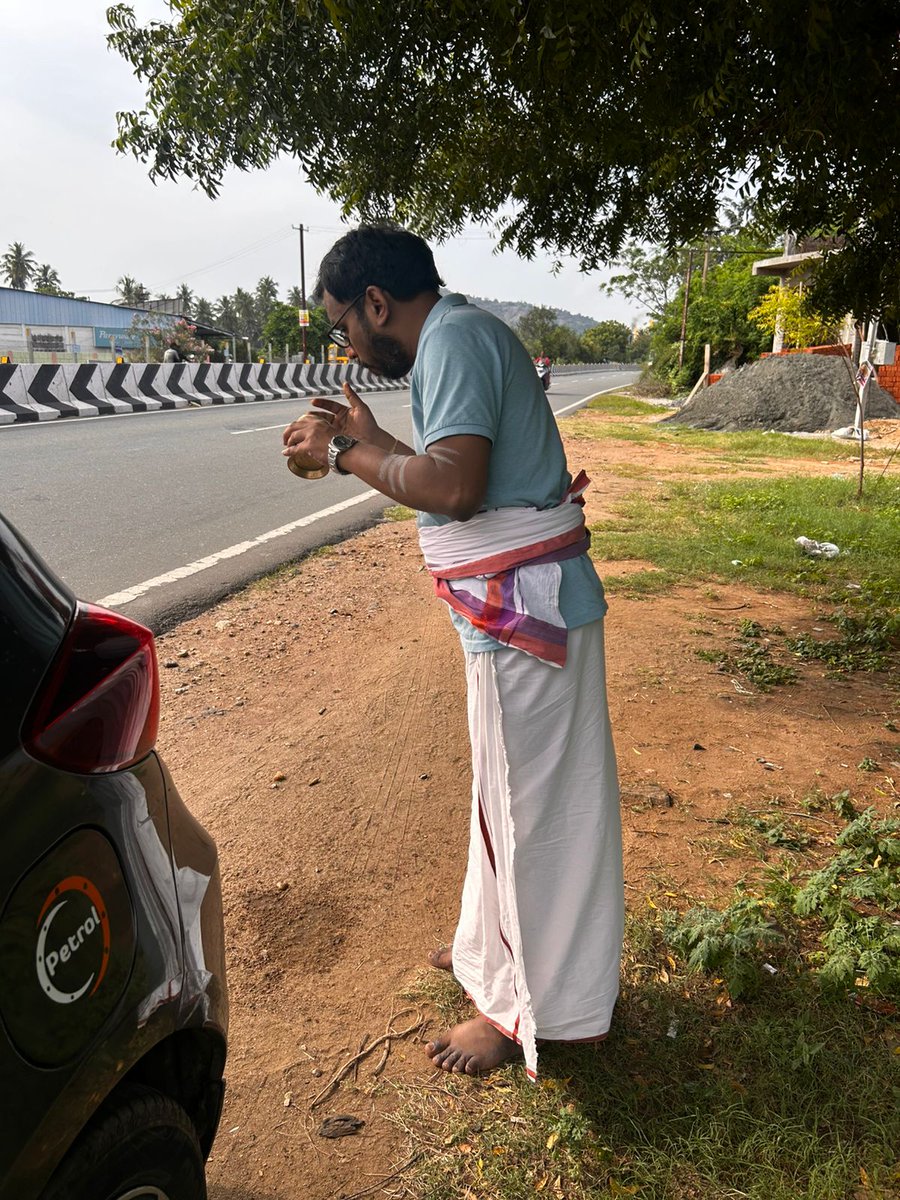
🔥A follower Veda Ghosham social media pages Sri Shreekrishna Kumar stopping by road side to perform Sandhyavandanam. He is highly motivated by our posts and doesn't miss Nityakarma even when he travels. His Sandhya kit is always a part of his travel 🧳 bag #VedaGhosham #Nityakarma #Sandhyavandanam
Veda Ghosham tweet mediaVeda Ghosham tweet mediaVeda Ghosham tweet media
English
6
21
148
4.5K
Nilesh Trivedi
Nilesh Trivedi@nileshtrivedi·
Introducing @QwikBuild, our AI coding agent: - Can be used on messaging apps like WhatsApp and RCS. Build on the go. - Understands multi-modal inputs like Voice notes, images and docs - even in languages other than English - Does not require technical knowledge. It's an autonomous agent, not a co-pilot. - Builds ready-to-use webapps with fully implemented features like: - Auth and role-based access control, - Database and file storage, - AI features inside your app such as text-to-image, image-to-image, file-to-json, voice-to-text etc, - Inbound and outbound comms, - Scheduled background tasks, - Admin/Content management so you can modify your landing pages quickly, - CRM features like Lead capture, - Soon: Payments and E-commerce - You get a ready-to-use and ready-to-share website within minutes. You can easily map a custom domain as well. - And continue to manage the business with the same AI assistant. It feels like code is neither a blocker or a moat for online businesses now. Power to the idea-person! 😁 Do give it a try. There's a waitlist but I'll bump you up if you're a mutual.
QwikBuild@QwikBuild

Introducing - QwikBuild - Idea to App in 7 min. It's like having a Tech Team in your pocket!

English
32
21
106
19.4K
original-thought
original-thought@orgnlthghts·
@wesbos nice! are you running anything custom to parse the bundled/transpired code?
English
1
0
0
159
Wes Bos
Wes Bos@wesbos·
Apple just launched a web version of the App Store and it's build on Svelte!
Wes Bos tweet media
English
110
182
4.2K
337K
naren.io
naren.io@nareni0·
Does anyone know any platform/devops engineers who doesn’t keep uttering “Kubernetes” either every 5 minutes or when asked how to host a CRUD web app? Someone with first principles thinking and knows architecture fundamentals?
English
8
3
16
2.9K
Vamsi Krishna B ری ٹویٹ کیا
FFmpeg
FFmpeg@FFmpeg·
We would like to thank @Nithin0dha for the $100k donation to FFmpeg (pending)! While this does not solve the funding problems behind FFmpeg and Open Source in general, it's a step forward to a sustainable future for Open Source Software.
FFmpeg tweet media
English
111
335
7.1K
1.2M
Vamsi Krishna B
Vamsi Krishna B@vkbdev·
@ArunBee Gurugaru, I just realized that we share the same intiperu.
English
1
0
1
575
Arunn Bhagavathula చి లిపి
I was compelled to “change” my name from B Arun to Bhagavatula Arun due to a requirement from the IEPF. It all began when I discovered 100 shares of a major company that I had purchased in the early ’90s and completely forgotten about. The share certificates carried the name B Arun while my Aadhaar and PAN which were obtained much later mention the expanded form Bhagavatula Arun. The IEPF refused to accept that both names referred to the same person and their rules require that we change the name officially leaving me with no choice but to initiate an official name change and have it published in the Official Gazette. That tedious process is still ongoing even after a full year and hopefully it will be published in the next month in the Gazette whereupon I need to lodge a large set of documents with KFin Tech and after they give me an entitlement letter from the company I again need to upload another large set of documents in IEPF portal and then wait indefinitely for the shares to be credited to my demat account. Some people told me that IEPF takes anything between 3 months to 2 years after we upload the documents. I'm not unduly worried as that particular share is presently being traded at few thousands and I expect it to go up by at least a thousand or two by the time I get hold of my shares😎 All is well if it ends up well!!!
Muthukrishnan Dhandapani@dmuthuk

I've officially changed my name from D.Muthukrishnan to Muthukrishnan Dhandapani. Basically, I've expanded the initials. I've done this for the entire family and all official records have been updated. Twitter is the last place now I'm updating. This concept of initial instead of last name is unique to this part of the country. With everything getting digitalised and small mismatches in names becoming big issues, decided to follow the convention of first name as my name and last name as that of my father. For my son too, I've done similarly. My wife chose to keep her last name as mine, that of spouse. Everything got completed only yesterday. So updating the same now in my public profile.

English
9
3
56
27.8K