Willy Roque Barboza, MD

2.6K posts

Willy Roque Barboza, MD banner
Willy Roque Barboza, MD

Willy Roque Barboza, MD

@wroqueMD

PCCM physician-scientist | Drug Development | tweets are my own.

شامل ہوئے Mayıs 2019
2.1K فالونگ1.4K فالوورز
Willy Roque Barboza, MD ری ٹویٹ کیا
Vega Shah
Vega Shah@dr_alphalyrae·
Introducing La-Proteina, a generative AI model that creates complete atomistic protein structures together with their amino acid sequences, scalable upto 800 residues. Built by @NVIDIA Research, in collaboration with @UniofOxford and @Mila_Quebec La-Proteina addresses a key challenge in protein design by generating both backbone and side-chain atoms in a single unified process. It uses a hybrid architecture that models alpha-carbon coordinates while encoding sequence and side-chain details in latent vectors for every residue. @DidiKieran @karsten_kreis @tomasgeffner @ArashVahdat
English
11
82
398
47K
Willy Roque Barboza, MD ری ٹویٹ کیا
Maria Ermolaeva
Maria Ermolaeva@MariaErmolaev13·
Study shows that senescent cells literally sugar-coat themselves to avoid recognition and clearance by the immune system. nature.com/articles/s4358…
English
3
89
378
26K
Willy Roque Barboza, MD ری ٹویٹ کیا
Martin Picard
Martin Picard@MitoPsychoBio·
If we look at thousands of proteins (i.e., signals) in the human blood, the protein most associated with chronic physical and mental illnesses is the **same protein** as the top marker for mitochondrial diseases: GDF15 When mitochondria cannot flux energy properly, the cell makes and secretes GDF15 in the blood to alert other cells Some highlight by Cynthia Liu in our group: - GDF15 is the top predictor for most diseases - GDF15 associated with diabetes is among the most significant protein-prevalent disease associations Based on p-value, GDF15 was most significantly associated with disease. - “GDF15 was associated with the most diseases, containing 205 prevalent and 397 incident diseases, generally acting as a risk factor except for three incident diseases (respiratory diseases affecting the interstitium, disorders of magnesium metabolism, and peripheral artery disease).” - “GDF15, similar to its high ranking with protein-disease pleiotropy, ranked second for protein-trait associations, boasting a substantial 428 associations.”Significant associations with many lipid metabolite markers. - Mental disorders like anxiety disorders, depression, and mood disorders, along with mental health-related traits, also exhibited substantial proteomic signatures including elevated GDF15 - “The fluid intelligence score and various types of dementia shared significant proteins such as NEFL and GDF15 (Figure 2G)” - “GDF15, the protein with pleiotropic effects, was causally associated with several autoimmune diseases, including ulcerative colitis and rheumatoid arthritis (Figure 6B).” Data from >53,000 people in the UK Biobank Full paper here: cell.com/cell/fulltext/… Resource to explore your favorite protein or disease/trait of interest: proteome-phenome-atlas.com
Martin Picard tweet media
English
32
324
1.3K
136.6K
Willy Roque Barboza, MD ری ٹویٹ کیا
Pulmonary Cell News
Pulmonary Cell News@pulmonary_news·
Using a specific TRβ agonist, sobetirome, @HenanUniversity scientists demonstrated that Rβ activation confered AT2-to-AT1 cell differentiation and anti-fibrosis during lung repair via KLF2 and CEBPA. go.nature.com/4gSzzYN
Pulmonary Cell News tweet media
English
0
2
8
527
Willy Roque Barboza, MD ری ٹویٹ کیا
Evan Weber
Evan Weber@EvanWeberPhD·
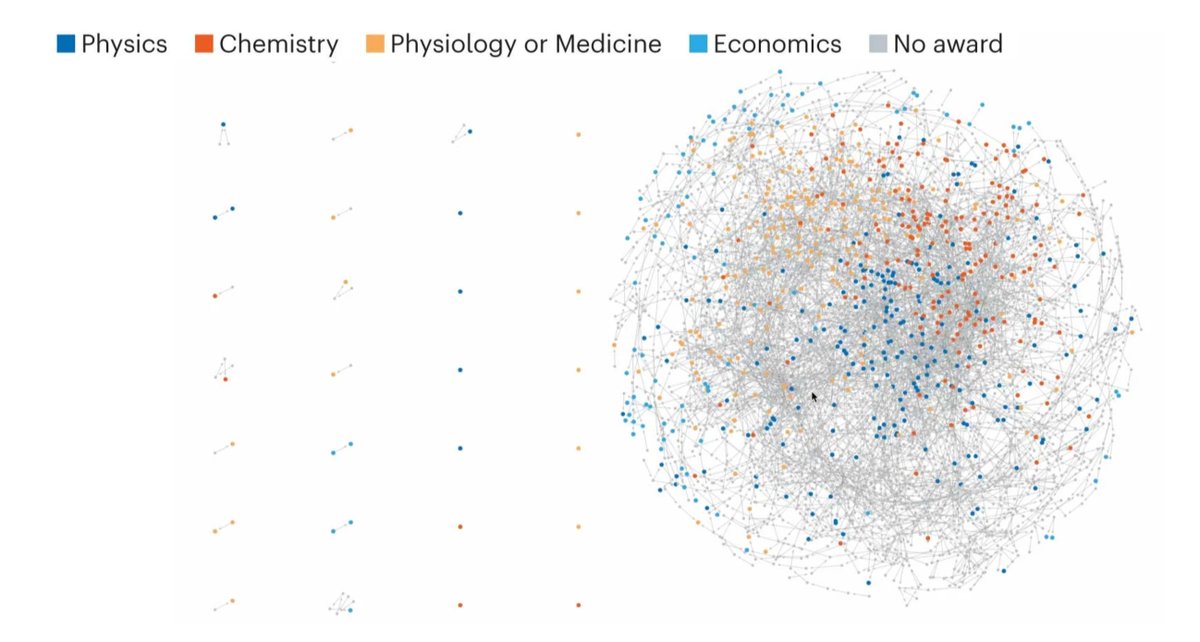
An absolutely bonkers stat from this Nature article on Nobel Prize winners. "702 out of 736 researchers who have won science and economics prizes up to 2023 are part of the same academic family" nature.com/immersive/d415…
Evan Weber tweet media
English
166
711
4.5K
754.4K
Willy Roque Barboza, MD ری ٹویٹ کیا
Marinka Zitnik
Marinka Zitnik@marinkazitnik·
Excited to share TxGNN, a model that identifies potential therapies from existing medicines for thousands of diseases. Trained across 17,080 diseases, TxGNN predicts drug candidates for conditions with limited or no treatment options, including rare diseases @NatureMedicine paper: nature.com/articles/s4159… Globally, there are over 7,000 rare and undiagnosed diseases, yet only 5 to 7 percent have treatments, leaving the majority untreated or undertreated. Even for more common diseases, new drugs could offer alternatives with fewer side effects or replace drugs that are ineffective for certain patients TxGNN generates new insights on its own in the form of multi-hop interpretable rationales, applies them to diseases it was not trained for, and offers explanations for its predictions Human evaluation showed that TxGNN's predictions perform well across multiple axes of performance Many of TxGNN's predictions align with off-label prescriptions used in a large healthcare system Many thanks to a fantastic research team @KexinHuang5 @payal_chandak @WangQianwenToo @_toolazyto_ @AkhilVaidMD @jure @girish_nadkarni @BenGlicksberg @HarvardDBMI @harvardmed @KempnerInst @harvard_data @broadinstitute @cziscience @harvardmed News and Gazette: hms.harvard.edu/news/researche… Thanks @EkaterinaPeshev
Marinka Zitnik tweet media
English
9
109
377
40.5K
Willy Roque Barboza, MD ری ٹویٹ کیا
Journal of Clinical Investigation
Journal of Clinical Investigation@jclinicalinvest·
Granulomas guide researchers to an FDA-approved drug for sarcoidosis. Sati et al. identify type 1 innate lymphoid cells as a biomarker for sarcoidosis and find plerixafor-treated mice develop fewer lung granulomas. @realthomasleung @PennMedicine
English
0
2
4
2.5K
Willy Roque Barboza, MD ری ٹویٹ کیا
NM Pulmonary and Thoracic Surgery
Luisa Morales-Nebreda, MD (@luismnMD), discusses a recent study she led to explain longer times on ventilators for patients with #pneumonia caused by #COVID19. The study explored T-cells in lungs and how they behave differently in patients with SARS-CoV-2 pneumonia compared to pneumonia caused by other respiratory pathogens. #google_vignette" target="_blank" rel="nofollow noopener">medicalxpress.com/news/2024-09-c…
NM Pulmonary and Thoracic Surgery tweet media
English
0
4
7
910
Willy Roque Barboza, MD ری ٹویٹ کیا
Saez-Rodriguez Group
Saez-Rodriguez Group@saezlab·
📣 The much-revised manuscript of LIANA+, our all-in-one solution to study cell-cell communication from single-cell, spatial, and multi-omics technologies, is now published in @NatureCellBio nature.com/articles/s4155…
Saez-Rodriguez Group tweet media
English
3
80
240
29.7K
Willy Roque Barboza, MD ری ٹویٹ کیا
Pulmonary Cell News
Pulmonary Cell News@pulmonary_news·
Amphiregulin (AREG) expression was elevated in intermediate #alveolar stem cells of mouse fibrotic lungs and idiopathic pulmonary fibrosis patients. An AREG-neutralizing antibody efficiently blocked lung #fibrosis development. 🛡️ @CellStemCell | bit.ly/3YLdW5Z
Pulmonary Cell News tweet media
English
0
2
3
366
Willy Roque Barboza, MD ری ٹویٹ کیا
Nathan Baugh
Nathan Baugh@nathanbaugh27·
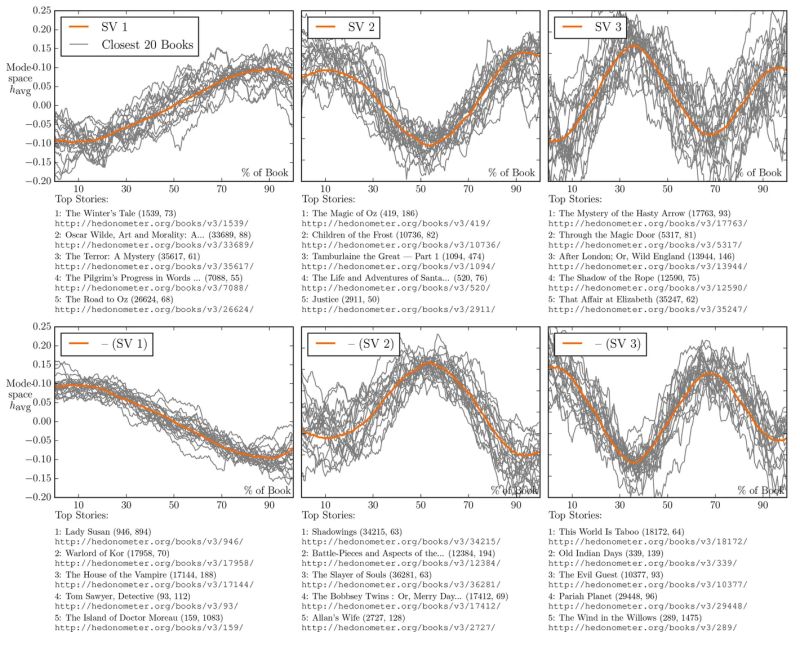
In 2016, researchers at the University of Adelaide tested Kurt Vonnegut's theory that, "There’s no reason why the simple shapes of stories can’t be fed into computers." They took the emotional arcs of 1300+ novels from Project Gutenberg, turned that into data, used modern tech to analyze the emotional arcs, and then identified 6 patterns seen over and over again in western storytelling. Here they are: 1. Rags to Riches (rise) Your classic underdog tale. A humble, hardworking peasant climbs the mountain to pull the sword from the stone. • Rocky • King Arthur • The Pursuit of Happiness 2. Riches to Rags (fall) Maybe the saddest story of them all. A journey from the highest of highs to the lowest of lows. • King Lear • Citizen Kane • Scarlet Letter 3. Man in a Hole (fall then rise) A character’s doing fine, gets herself into a huge problem, but figures out how to overcome it. They often end up better than they started. “You see this story again and again,” Vonnegut says. “People love it, and it is not copyrighted.” • The Martian • The Hunger Games • Shawshank Redemption 4. Icarus (rise then fall) The hero goes on a meteoric rise up New York (or some other) society, calls everyone “old sport,” and throws the wildest parties in town. Then reality sets in, and he realizes he’s too close to the sun. • Macbeth • Great Gatsby • Death of a Salesman 5. Cinderella (rise then fall then rise) I’ll leave this description to Vonnegut: “We’re gonna start way down here. Worse than that, who is so low? It’s a little girl… the shoe fits, and she achieves off-scale happiness.” • Red Rising • Slumdog Millionaire • The Count of Monte Cristo This is my personal favorite. 6. Oedipus (fall then rise then fall) Up until the ~70% mark of the story it looks like things are sunshine and rainbows. Walter White goes from high school teacher to king of the drug lords, if you will. Then all goes wrong. The original fall is often not their doing while the final fall is. • Hamlet • Gone Girl • Breaking Bad My 3 takeaways: 1. Rags to Riches, Oedipus, and Cinderella rank as the three most popular with consumers. AKA, those books sold the most copies. 2. When you think through a story, give it an emotional shape. Literally draw it. X axis: Time Y axis: Ill fortune to good fortune You might be surprised how much it helps you craft your plot (I was shocked). 3. Vonnegut was a damn genius.
Nathan Baugh tweet media
English
90
871
5.4K
737K
Willy Roque Barboza, MD ری ٹویٹ کیا
Vega Shah
Vega Shah@dr_alphalyrae·
The @NVIDIAHealth team just made 2 foundation models available as inference microservices. DiffDock, a predictive model for how drug candidates bind with target proteins. And MolMIM for controlled generation of small molecules bit.ly/4fxU3oQ
English
1
23
111
11K