20th Century Boxing: Icons, Memories & More

8.2K posts

20th Century Boxing: Icons, Memories & More banner
20th Century Boxing: Icons, Memories & More

20th Century Boxing: Icons, Memories & More

@20thCentBoxIMM

Brief glimpses into fights, and fighters, of the 20th century; the great, the near great, the very good, the journeymen, the opponents and much more.

Tham gia Nisan 2025
249 Đang theo dõi361 Người theo dõi
20th Century Boxing: Icons, Memories & More
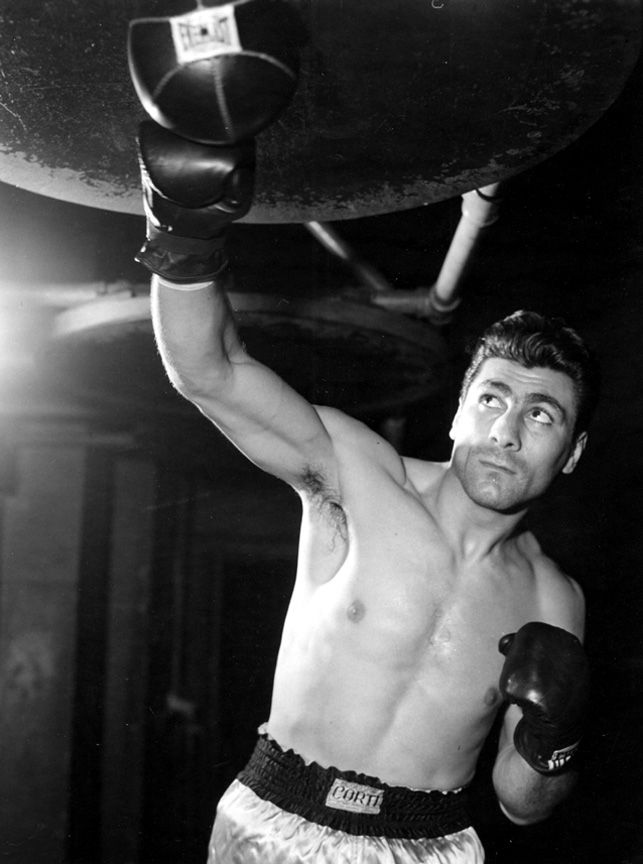
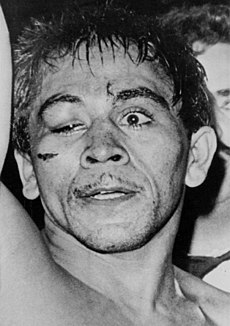
Jack Chase (pictured) loses his California State Middleweight Title to Archie Moore via 15-round unanimous decision on May 8, 1943 at Lane Field in San Diego, California. Chase had won the CA State Middleweight Title from Eddie Booker five months earlier. Chase-Booker had also been the first scheduled 15-round fight in California since 1914. After being banned, fifteen-round fights were again legalized in California in November of 1942. The AP reported that Chase began to tire in the 13th round and Moore's strong late rally secured him the decision. Chase would regain the title from Moore with a 15-round UD in August at the San Francisco Civic Auditorium. Moore would win a 10-round decision over Chase in November of 1943 and the pair would fight to a 10-round draw in 1946. The "Ole Mongoose" would score a 9th round KO of Chase in their final (6th) meeting, in March of 1947, at the Olympic Auditorium in Los Angeles. Moore had won a 10-round UD in their first bout, in 1942, at San Diego Coliseum. ---------------------------------------------------------- By any means of measure, Jack Chase should have been afforded the opportunity to fight for a world title during his career, but we can't rewrite history be it good or bad. Born Isaiah James Chase in Sherman, Texas, he was an African-American middleweight, who boxed in the 1930s and 1940s. He was born in Texas and fought mainly on the west coast of the United States. He boxed under the name ‘Young Joe Lewis’ (sometimes billed as 'Young Joe Louis' as well) for the first part of his career, before changing to Jack Chase in 1942. His official fight count stands at 117 (81-24-12 with 31 KO's), but it is believed he competed in at least an additional 40 plus fights prior to 1936, during which time his full record is unknown. Chase is included in the set remembered as ‘Murderers’ Row’, a term used by Budd Schulberg to describe those boxers of the era who were so feared that they were avoided by title holders and so were unable to ever secure a title shot. Jack Chase was ranked 2nd in the world at middleweight yet never received a title shot. Chase had several run ins with the law during his life, including serving jail time in Colorado on a few occasions, and was arrested for shooting fellow boxer Aaron Wade in California (We have gone over that Wade story previously here and will again in more detail in the future). From Charley Burley dot com: Another of the solid West Coast fighters campaigning throughout the 1930s and 40s Jack Chase appeared to have something of the devil about him. Starting out as a teenager fighting in the tough mining town of Walsenburg, Colorado he is reported to have stretched out an unbeaten run of some sixty plus fights before losing to South African Eddie Pierce. With close to half of his victories coming via the short route this Rocky Mountain socker proved that he could box as well as punch and by 1937 Young Joe Louis, as he was calling himself, was rated in the top ten in the country by the Ring magazine. Unfortunately for him a seemingly unstoppable march towards higher honours and greater recognition came to an screeching halt when the young fighter found himself caught up in a ‘situation’ and ended up paying his debt to society in a Colorado prison cell. Further misfortune befell him upon his return to ring action in 1941 when opponent Roy (Jack) Gillespie died as a result of a knockout blow. After one more fight in the Rocky Mountain region Young Joe Louis took himself and his eighty-something record to California where he became Jack Chase. During the 40s the professional fight game on the West Coast could boast some of the best fighters in the United States – if not the world and the new arrival soon found himself trading leather with Archie Moore, Eddie Booker, Lloyd Marshall, Tiger Wade and Charley Burley. A veritable ‘Who’s Who’ of 1940s black fistiana. Chase quickly established himself and won the California State Middleweight title by defeating Eddie Booker over fifteen rounds. He then lost and re-won the title in two bouts with the inimitable Archie Moore. Two successful defences against Lloyd Marshall were notched up before Jack ran into the great Charley Burley. Chase was stopped twice by the Pittsburgh great in two title fights and lost an earlier encounter on points. Chase beat some of the top names in the game at the time, but two guys he just couldn’t beat were the aforementioned Burley and the sadly neglected Holman Williams who topped Jack on four separate occasions. Early in 1944, a shooting incident involving fellow middleweight ‘Tiger’ Wade had him in the news for reasons other than fighting — although Wade recovered sufficiently to continue with his career. Jack put some more hurt on Wade a few months later when he knocked him out in ten rounds. After losing his state middleweight title to Charley Burley, Chase won the state light heavyweight crown in a match with Watson Jones over fifteen rounds. After 1944 however, the number of bouts and the number of victories began to dwindle; losses to Archie Moore and the solid ‘Oakland’ Billy Smith finished him as a top-flight attraction. What is noticeable about the record of Jack Chase is the absence of practically all of the big-name white fighters at middleweight and even light heavyweight. As with the rest of the black fighters around during the same period, fighting among themselves was the only way for these long-forgotten boxing stars to make a living. (P.S. Some moron on a Pacquiao thread on X yesterday replied to me that if Chase was that good he'd have fought for a title. In his opinion that meant Chase 'sucked'. That kind of (boxing) illiteracy, and stupidity, is what we're committed to either changing, or avoiding, here every day.)
20th Century Boxing: Icons, Memories & More tweet media
English
0
1
3
47
20th Century Boxing: Icons, Memories & More
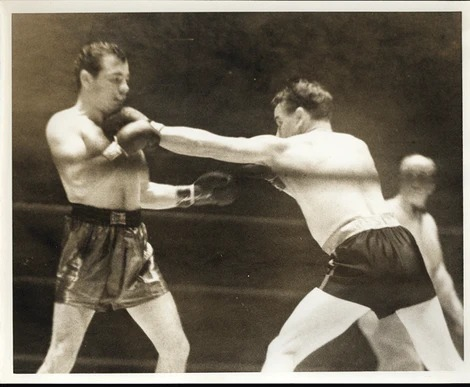
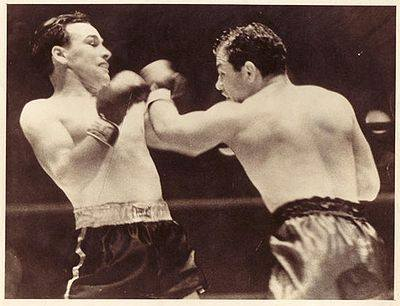
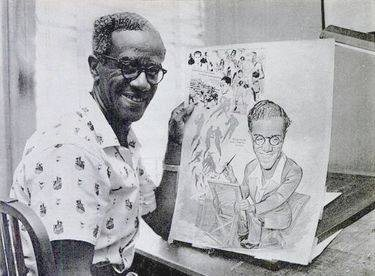
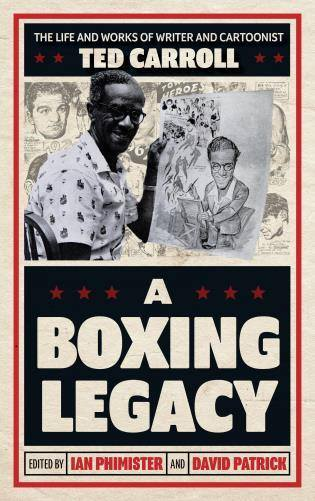
Tony Canzoneri wins a 10-round unanimous decision over Jimmy McLarnin, on May 8, 1936, at Madison Square Garden. (McLarnin is in the trunks with the white band around the waist.) This bout was proclaimed by eventual IBHOF Inductee Ted Carroll (pictured) as the greatest fight that he ever witnessed during his 50-year career. (Source: The Ring magazine, April 1973). From boxrec once again: Theodore (Ted) Carroll (1904-1973) is considered one of the greatest American artists of the 20th Century, notably as a master boxing cartoonist. His drawings and prose appeared on almost a monthly basis in The Ring, virtually from the magazine’s inception until his death -- almost 50 years. He became the sole cartoonist for The Ring in 1935. An African-American himself, his series on the history of black boxers for The Ring was a product of his meticulous research. Born July 6, 1904 in New York to Jesse and Elizabeth, Carroll was raised in Greenwich Village and the Greenwich Settlement. He was graduated from the High School of Commerce in New York, and applied for entry into the Art Students League. He was turned down. Carroll was also an accomplished athlete, excelling in basketball. He did some basketball coaching and is credited with starting Frank McGuire on his way to a successful coaching career. Carroll entered the United States Army and was discharged four years later as a First Lieutenant. Carroll worked for the Brooklyn Daily Times from 1928-1933, and the Brooklyn Daily Eagle 1933-1937. "He was rich in knowledge of the old writers, a strong admirer of Dr. Samuel Johnson and Boswell, of Goldsmith, Dickens, Faulkner and Wolfe.... Carroll picked Ray Robinson as the greatest boxer, pound for pound. He saw Willie Pep as the most clever. He picked Joe DiMaggio as the No. 1 ballplayer. His football favorite was Ken Strong, of NYU and the New York Giants. His basketball heroes were Bob Pettit and Bob Cousy. His favorite fight manager was Jimmy Bronson." The greatest fight he ever saw was Tony Canzoneri vs. Jimmy McLarnin (1st meeting). Known for his ubiquitous bow-ties, Carroll never married, spending his last years in a small apartment on Edgecomb Street, Harlem, New York. In the last year of his career Carroll created paintings of horse racing, which were displayed at New York’s Aqueduct Track. "I miss the guy terribly," said Harry Markson, of Madison Square Garden. "He was a rare man, a great artist." "If my career, such as it is, can help make this a better country for all, it will have been well spent." Ted Carroll. Some of you may recall the artwork of his that I had posted previously entitled "The Great Featherweights". I have many of his drawings in the archives so you'll see them on here as well.
20th Century Boxing: Icons, Memories & More tweet media20th Century Boxing: Icons, Memories & More tweet media20th Century Boxing: Icons, Memories & More tweet media20th Century Boxing: Icons, Memories & More tweet media
English
0
0
6
45
20th Century Boxing: Icons, Memories & More
Obie Walker (left) and George Cook weigh in for their bout, on May 8, 1935, in White City, London, UK. Walker will prevail via 10-round points decision. Though short (5'9") for a heavyweight, Obie "Bearcat" Walker was quick on his feet, could take a punch, and was a strong puncher. He went 97-19-7 with 64 KOs, many of those losses coming very late in his career. From boxrec: Obie Walker was a much-avoided heavyweight contender of the 1930s. In his sports column in the July 5 1938 Atlanta Georgian, Ed Danforth wrote: Walker became the toast of Paris. He knocked cold every topnotcher he met on the continent. Max Schmeling shrewdly dodged him, the best of the Englishmen too, sidestepped the squatty brown man who carried lighting bolts in both fists. Competent critics say he could have knocked out Schmeling, Joe Louis and Jim Braddock in one night within the space of 10 rounds. While this seems to be an overstatement--despite having his best run in Europe he still lost there to Jack London, Larry Gains and Gustave Limousin (a highly disputed decision)--Walker was certainly a good fighter: he was fleet of foot, had a strong punch and was the possessor of a solid chin. Highlights of his career include wins over Tony Galento, Leroy Haynes, Elmer Ray and George Godfrey; the last being for the so-called World Colored Heavyweight Title. ---------------------------------------------------------- 43-50-10 with only 11 KO wins, the 5'9" George Cook, out of Australia, would have quite the career for a fighter with a losing record. From boxrec: George Cook was born in the now defunct town of Cobbora (near Dubbo), New South Wales, Australia, on 23rd January 1898. He stood at only 5’ 9” tall, had a reach of 73 ½”, and weighed around 190 pounds. Due to his lack of height, Cook tended to prefer infighting. His career started in 1916 with a 15 round points loss to Jim Tracey. During a globe trotting career which lasted until 1938, he fought in all corners of the world including Australia, France, England, Germany, Argentina, South Africa, Sweden, U.S.A, Italy, Ireland, New Zealand, Canada and Wales, and that was before the aeroplane shrunk the globe. He fought some very good fighters throughout his career, including Georges Carpentier (L KO4), Tom Heeney (W 15), Jack Sharkey (L 10), Primo Carnera (L KO2 & L KO4), Johnny Risko (WF 5), Paolino Uzcudun (W 15 & W 10), Young Stribling (L10, L10, L KO8 & ND 10) and Walter Neusel (L 12). He also unsuccessfully challenged for the British Empire title 4 times against Joe Beckett (LF 6), Phil Scott (LF 17), Larry Gains (L 15) and Jack Petersen (L 15). He did however win the Australian heavyweight title in 1926 with a 20 round points win over American Tiger Jack Payne who had only held the title for a record 8 days. Cook relinquished the title when he sailed overseas again. He eventually retired in 1938 after a loss to Jack London (L KO2). George Cook certainly had one of the most interesting careers of all Australian boxers. Cook died in England in 1943 aged 45 years old.
20th Century Boxing: Icons, Memories & More tweet media
English
0
0
1
31
20th Century Boxing: Icons, Memories & More
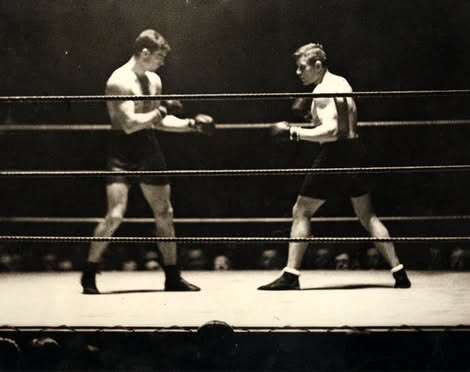
Young Stribling drops Hans Schonrath twice in the 2nd round on May 8, 1930, at The Royal Albert Hall in Kensington, London, UK, and scores a 2nd round TKO win. It's quite a difference in experience as Stribling wins in his 261st profesional boxing macth while Schonrath suffers his 3rd loss in his 14th pro fight. Hans Schonrath (right in the pic) had represented Germany in the 1928 Olympic Games without medaling. 37-37-13 with 18 KO's as a pro, he was 10-0-1 early in his career after a points win over Jose Santa (We have covered him here - type his name in the 20thCB:IM&M search box on FB to read posts on this BIG heavyweight). He'd also lose a decision to Larry Gains and be stopped by both Obie Walker and George Godfrey. Schonrath would be a casualty of the second World War, as he drowned when the SS General von Steuben, a hospital ship he served on, was sunk near Pilla, Germany (now Baltiysk, Russia), during World War II. He was 42 years old.
20th Century Boxing: Icons, Memories & More tweet media
English
0
0
1
31
20th Century Boxing: Icons, Memories & More
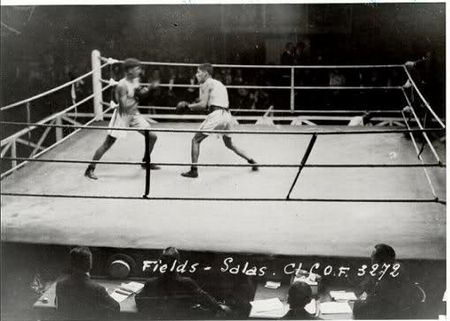
In his third pro fight Jackie Fields (left) wins a 10-round points decision over Joe Salas (right) on May 8, 1925 at Legion Stadium in Hollywood, California. The LA Times reported that Fields 'gave a masterful performance.' Joe Salas had been the Silver Medalist at the 1924 Paris Olympic Games in the Featherweight (126 pound) class. He had lost in the final to teammate Jackie Fields. Salas had also won the National AAU Featherweight Championship in 1924. He went 30-8-4 (3 KO's) as a pro. This was Salas' 4th pro fight. Fields would go on to have a fantastic career himself going 72-9-2 with 31 KO wins from 1925-33. Here's his boxrec bio: Jackie Fields spent his early years living in a Jewish neighborhood of Chicago. He later said: "Being in the ghetto, you had to fight." When his father contracted tuberculosis, the family moved to Los Angeles, where he was introduced to boxing at the Los Angeles Athletic Club around 1921. (Legend has it that Fields took his ring name from either a Chicago department store, or in honor of an obscure fighter named Marty Fields.) By 1924 Fields had competed in the pre-Olympic AAU Nationals. Despite a broken hand, he reached the semifinals and a place on the Olympic team as an alternate. His team-mate included future Flyweight World Champion and fellow L.A.A.C. member Fidel LaBarba. On the boat ride to the 1924 Summer Olympics, Fields defeated two other Olympic candidates to make the team. He was only 16-years-old when he captured the Olympic Featherweight boxing championshipl, the youngest athlete ever to win an Olympic boxing crown. When he got home from the Olympics, however, his mother spanked him for stepping into the ring. (His Olympic triumph was made into a 1939 movie called 'The Crowd Roars'.) Fields turned professional in 1925 and quickly moved up the ranks, defeating Mushy Callahan, Sergeant Sammy Baker, Vince Dundee, and Jack Zivic. He then defeated Young Jack Thompson for the National Boxing Association Welterweight Championship in March 1929 via a 10-round decision. In July 1929, Fields faced defending champion Joe Dundee for the Undisputed World Welterweight Title, and won the match after Dundee fouled him with a 2nd-round low blow. Fields totally dominated the abbreviated fight. He floored Dundee once in the first round and four more times in the first part of round 2. After the fifth knockdown in that round, "Pal Joey" crawled across the ring on his hands and knees until he got right in front of Fields and sucker punched him in the groin. Fields nailed the issue succinctly: "That bum and his buddies had bet money on the fight." Dundee knew he was a goner and he also knew if the fight ended on a foul, all bets were off. In May 1930, Fields lost the title to Jack Thompson in a 15-round fight. Fields retired after that fight, but returned to the ring two years later fighting for the Welterweight World Title against Lou Brouillard, who had won it from Thompson. Fields regained it, winning in 10 rounds, in January 1932. In 1932, he was involved in a car accident from which he suffered a detached retina and lost sight in one eye, although he did not tell anyone about it at the time. In February 1933, Fields lost the title in a 10-round decision to Young Corbett III in San Francisco. The referee, Jack Kennedy, admitted to Jackie's manager Jack Kearns after the fight in the dressing room: "I made a mistake," and told him he had raised the wrong hand. Kearns hit Kennedy, sending him sprawling to the floor and knocking him out. Fields fought only one bout after his loss to Corbett, because his eye injury had become too troublesome. Jackie Fields died in 1987 at the age of 79.
20th Century Boxing: Icons, Memories & More tweet media
English
0
0
0
25
20th Century Boxing: Icons, Memories & More
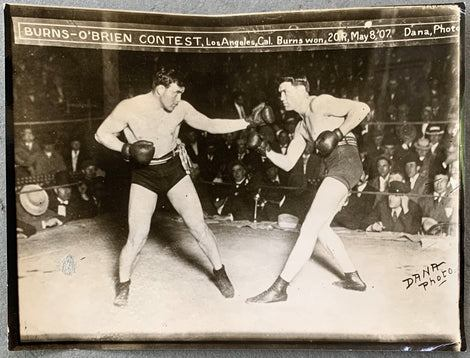
Heavyweight Champion Tommy Burns (left) and Jack O'Brien (right) meet for the third time on May 8, 1907, at the Naud Junction Pavilion in Los Angeles, California, this meeting being their second heavyweight title match. Burns will win a 20-round points decision in his 5th title defense. The first Burns-O'Brien fight took place on October 7, 1904, with O'Brien winning by a six-round newspaper decision. The second Burns-O'Brien bout took place on November 28, 1906. Burns, the defending World Heavyweight Champion, retained the title when the bout ended in a twenty-round draw. However, most of the people in attendance thought Burns had won the fight. The day after their third fight, the San Francisco Call reported: "Rugged Tommy Burns out fought Jack O'Brien for the full twenty rounds in their fight before the Pacific Athletic club tonight and was given a well merited decision after the final round by Referee Charles Eyton. From the start it was apparent to the spectators that it takes two to make a fight. O'Brien had to avail himself of every inch of the ring to be able to stall off the determined rushes of his opponent and save himself the ignominy of having a knockout charged against him at this late day in his career as a boxer. Whatever the reason, he made an unexpectedly poor showing both in stamina and hitting power and in judgment of distance. Apparently trained to the hour, from outward appearances, he seemed uncertain of his fighting powers from start to finish and was loth to put himself to the test of the sharp competition which was expected of a man of the caliber of Burns. One round was almost identical with another, Burns being always the aggressor, while O'Brien was kept on the run. Whenever O'Brien showed a willingness to mix matters, and this was at Intervals few and far between. Burns at once commenced to punish him severely. Contrary to all expectations, O'Brien was badly cut up during the progress of the fight, and at its close he was far from the gay young blade that he usually is when on parade. Burns did not show a mark as the result of the conflict. Both of O'Brien's eyes were badly cut, while his nose, which had been damaged in his last fight with Burns, also came in for a severe bombardment. The injury to his eyes would have had the effect of impairing his judgment of distance, but he used so few of his opportunities in this respect that it could hardly be called a handicap to him. A buzz of comment went about the big pavilion in which the fight was held when Referee Eyton, upon stepping into the ring, made the announcement. 'For good and sufficient reasons I declare off all bets on this contest.' Later he explained that he had done this because the betting looked bad. The odds ruled almost throughout the betting at 5 to 4, with O'Brien favorite. Some betting was done at 5 to 3, with O'Brien favorite, and as this probably did not appeal to McCarey's sense of what the odds should have been he decided to prevent the semblance of scandal in the club. The reason for installing O'Brien as the public choice was that it was believed that he had not been in condition to do himself justice In his previous fight with Burns, and that at this time he would score a decisive victory. The outcome showed that Burns' remarkable fighting spirit is too much for O'Brien at the present time, after the drain which has been made upon his vitality in the twelve years he has been in active service in the ring. The crowd, while large, fell below the expectations of the promoters. The $30,000 purse for which the men were supposed to be battling vanished into thin air and other arrangements for compensation of the fighters were made at the last moment. There was a delay before the men entered the ring and this was caused by a conference between the fighters and the management, which resulted in a new adjustment of the division of the purse. O'Brien originally was to have received $10,000 as his share, while Burns took a gamble on the size of the house and was to have been paid on a percentage basis. As there was only about $20,000 in the house there was a final adjustment of the compensation before the fighters appeared." Two days after the fight, the San Francisco Call would add more reporting: "An ugly scandal has developed over the Burns-O'Brien fight, and O'Brien, who has been held up before the public as a model both in and out of the ring, has had his reputation for honestly sadly besmirched. In addition, he must bear the ignominy of being called a craven coward. The expose came after the calling off of the bets on the fight by Referee Eyton last night, and Burns was the man to give the facts to the public. Burns told how O'Brien had visited him at his home in this city last November with the proposition that they have a return match and that O'Brien be declared the winner. Burns was so eager for a return match and at the same time «o certain that be could never get O'Brien into the ring for a square fight, he said, that he agreed to lose to O'Brien, intending to go on and win once he had the Philadelphia in front of him." Burns and O'Brien had some bad blood between them and, after this bout both of them, along with promoter Tom Mccarey, would spill their guts. From boxrec: Tommy Burns: "They say Jack O'Brien is smart. Well, they'll say Tommy Burns is smarter now. I always knew that this fellow was the greatest faker in the business. Last December he came to my house twice on Adams street for the purpose of framing up a deal whereby he could retain his fame. He wanted me to lay down and offered me the winner's end of the purse. I wouldn't stand for it at first, but I agreed when I found out that it was the only way to get him in the ring. The last time he left my home it was with the understanding that I was to go out in the eleventh round. He gave me this line of talk: 'I know I haven't a chance in the world to beat you, Tommy, and have everything to lose. It won't hurt you so much to be defeated and it will me. I would be down and out.' I decided then and there that the chance had come to expose this man to the world and resolved to do so." Promoter Tom McCarey: "O'Brien came to me in my office a few hours before the Mellody-Sullivan battle. . . . He submitted a proposition relative to Burns 'laying down.' I absolutely refused to consider it, but O'Brien persisted and suggested that I see Burns and feel him out on the subject. I met Burns at the ringside and Burns admitted that he had already agreed to 'lay down' in the eleventh round, at the same time asserting his intention of double crossing O'Brien. When I saw that Burns really meant to fight I agreed and it was planned to declare all bets off at the last minute and then clang the gong before O'Brien had a chance to make any sort of a break." Philadelphia Jack O'Brien: "On the night of the Mellody-Sullivan fight I came in and met McCarey at his office. McCarey said: 'Well, I am the best friend you have, Jack.' I asked him what he meant and he told me that Burns would flip a coin to see which one of us would lay down, or that he thought Burns would go out if he received a little on the side. I asked him how much and he said he thought $2500 would be bait. I agreed that McCarey should see Burns. Another meeting resulted and McCarey brought news that Burns would lay down for $3500. It was then agreed that I was to receive 30 per cent of the gross receipts and pay Burn the $3500. . . . According to the first set of articles we were to fight straight rules. That was when Burns was to go out in the eleventh round. Later it was decided to break clean and I was to receive a decision with Burns going slow. . . . They double crossed me at the last. When I saw the jig was up I decided that there was nothing left to do but make a bluff. I merely tried to stay the limit." ---------------------------------------------------------- Philadelphia Jack O'Brien, born Joseph Francis Anthony Hagen, was the chief second to Jack Dempsey at the 1926 Jack Dempsey vs. Gene Tunney (1st meeting) bout in Philadelphia. His bio states that O'Brien was agile, quick and limber, a two-handed puncher who landed often but not a particularly hard hitter. His best punches were a left jab and a hard overhand right, and he was a good defensive fighter who blocked punches well and counterpunched accurately. Despite the apparent shenanigans surrounding this bout, O'Brien was a highly regarded boxer in his era. 92-6-13 with 55 KO wins; he had decision wins over Marvin Hart, Joe Choynski and Burns, a stoppage win over Bob Fitzsimmons for the Light Heavyweight Championship in 1905, draws with Burns, Stanley Ketchel and Jack Johnson, decision losses to Burns and Bob Fitzsimmons, and a TKO loss to Sam Langford. Rather than defending the light heavyweight title after stopping Fitzsimmons, O'Brien instead abandoned it in order to fight at heavyweight. According to the San Francisco Call's report on that fight, O'Brien had done enough damage to Fitzsimmons body that the Middleweight and Heavyweight Champion began vomiting in his corner after the 13th round and had to retire. Nat Fleischer, founder and editor of The Ring Magazine, would rank O'Brien as the #2 All-Time Light Heavyweight, and famed boxing promoter Charley Rose ranked him as the #3 All-Time Light Heavyweight. Post-boxing, Hagan/O'Brien managed a gym on the seventh and top floors of the Rosemont building at 1658 Broadway, New York City, in the late 1920s/early 1930s. Legendary World Middleweight Champion Harry Greb, "The Pittsburgh Windmill", trained at O'Brien's gym and the only existing films of Greb in action are of workouts and sparring with O'Brien. Philadelphia Jack O'Brien died on November 12, 1942 at the age of 64. O'Brien was inducted into the Ring Magazine Hall of Fame in 1968, the World Boxing Hall of Fame in 1987, and the International Boxing Hall of Fame in 1994
20th Century Boxing: Icons, Memories & More tweet media
English
0
0
4
63
Rep. Malcolm Kenyatta
Rep. Malcolm Kenyatta@malcolmkenyatta·
What Republicans are doing in Tennessee today and across the country is a stain on our nation’s soul. This Supreme Court will be remembered as the most corrupt in history.
English
5.4K
3.8K
15.1K
236.9K
Eva.
Eva.@Bunny_ngl·
I need a dog name that sounds like it comes from a wealthy family!
English
17.4K
565
16K
3M
Vinny’s Corner
Vinny’s Corner@VinnysCorner1·
Roberto Duran vs Manny Pacquaio 🥊 Who wins this mythical matchup at LIGHTWEIGHT⁉️
Vinny’s Corner tweet media
English
123
15
100
7.8K
AlphaFox
AlphaFox@alphafox·
Nothing says I'm poor like pretending to look rich.
English
2.3K
1K
18.6K
1.2M
20th Century Boxing: Icons, Memories & More
Pacquiao got starched in 1996 in his 12th pro fight by a guy who finished with a 15-8-6 pro record, Rustico Torrecampo, who was 11-4-5 at the time. Name another guy, on anybody's top-ten P4P list that got KO'd by a guy as he neared his prime, with that bad a record? I love pacquaio but he doesn't belong in the top-ten of any serious P4P list.
English
1
0
0
37
stokedsports
stokedsports@stokedsport·
Is Manny Pacquiao top 3 greatest boxers of all time? 🤔🥊
stokedsports tweet media
English
42
6
52
7.3K
𝐁𝐢𝐠 𝐍𝐨𝐧𝐬𝐨🏂
The story of George Stinney The youngest person ever sentenced to Death. Only 14 years old and was accused of killing 2 white girls. He was sentenced and killed in the electric chair. 70yrs later in 2014, he was proven innocent. His last words were : “Johnny, I didn’t do it, i didn’t do it,Why would they kill me for something I didn’t do”💔
𝐁𝐢𝐠 𝐍𝐨𝐧𝐬𝐨🏂 tweet media𝐁𝐢𝐠 𝐍𝐨𝐧𝐬𝐨🏂 tweet media
Como_Jason🇮🇹@Como_Jason07

What’s the saddest racism experience or story you’ve ever heard? 😔

English
1.3K
11.7K
55.8K
4M
OrsonPrattPartyMachine
OrsonPrattPartyMachine@OrsonPratt65·
@20thCentBoxIMM Never held the title but IMO Charles is the greatest 175er ever to live. Three wins over Archie Moore, including a KO, and basically fought/beat everyone.
English
1
0
2
18
20th Century Boxing: Icons, Memories & More
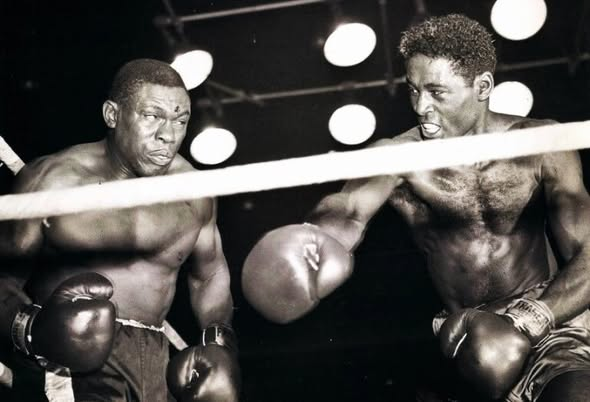
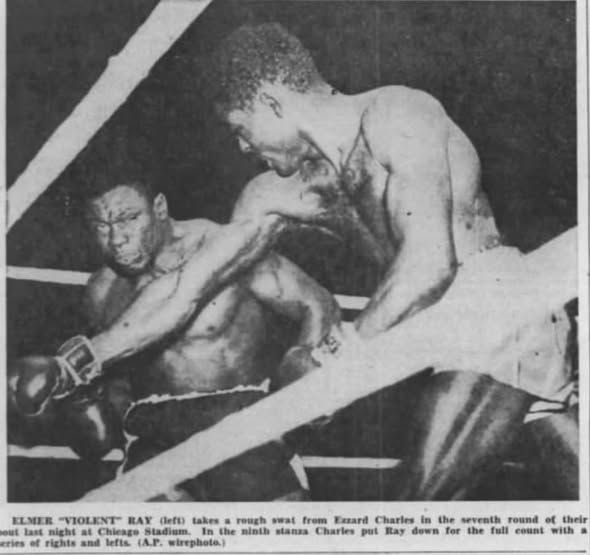
Ezzard Charles (right, in both pics) KO's Elmer "Violent" Ray in the 9th round at Chicago Stadium on May 7, 1948. Ray came into this fight the 2nd ranked heavyweight in the world. United Press would report: "Hammer-fisted Ezzard Charles racked up a knockout over Elmer Ray today and called for a shot at light heavyweight champion Gus Lesnevich. The fast moving Charles hanged the aging Ray right out of heavyweight boxing with a left hook at 2:43 of the 9th stanza." Chicago Promoter Irving Schoenwald would wire Gus Lesnevich a $50,000 offer to defend his Light Heavyweight Title against Charles in an outdoor show in Chicago for that summer but that never happened. Charles would eventually defend the Heavyweight Championship against Lesnevich, in August of 1949, scoring a 7th round RTD win at Yankee Stadium. Ezzard Charles started 1948 off with an 8th-round KO of Archie moore in Cleveland and would go onto decision Jimmy Bivins in September at Griffith Stadium. Finishing the year with an 11th round TKO of Joe Baksi, it was evident that Charles would now seek the Heavyweight Title. ---------------------------------------------------------- Elmer "Violent" Ray went 15-0 in 1946 with 14 KO's,14-0 with 14 KO's in 1945, 15-0 with 15 KO's in 1944, and hadn't lost a fight since August of 1943 (a decision to Turkey Thompson), in the midst of a 50-fight win streak. All without getting a title shot. He'd finally lose, a decision, to Jersey Joe Walcott in March of 1947. 96-23-11 with 69 KO's, Elmer "Violent" Ray was the #1-ranked heavyweight contender by early 1947. He lost that ranking and a potential title fight with Joe Louis, when he was defeated by Jersey Joe Walcott on March 1st of 1947. Ray would subsequently go on to defeat future champion Ezzard Charles on a split decision, before Charles knocked him out in the 9th round on May 7, 1948, in a rematch, ending his title hopes for good. Ray would split two fights with Charles, go 1-2 against Walcott, and have wins over Lee Savold (KO2) and Obie Walker (Two decisions) as well. In 2003, Elmer Ray made the Ring Magazine's list of 100 greatest punchers of all-time at # 44. ---------------------------------------------------------- There's a tendency, sadly, particularly by the more historically illiterate and ignorant boxing fans, for many to look at Ezzard Charles' career record and dismiss him when speaking about the best pound-for-pound fighters in the history of the sport. Ezzard Charles was in the midst of one of the most sensational runs in boxing history, he had lost only one fight since December of 1944 - a decision to Elmer "Violent" Ray which he'd later avenge with this 9th round KO - right to the Heavyweight Title and would not lose again until July of 1951. In that seven and a half year span; Charles beat Archie Moore three times, Llloyd Marshall twice, Oakland Billy Smith twice, Jimmy Bivins twice, Jersey Joe Walcott twice, Elmer Ray, Gus Lesnevich, Joey Maxim and Joe Louis. Keep in mind that Charles also won UD's over the great, and in his prime, Charley Burley in both of their meetings in 1942. Charles took their first fight on three days notice, as well, dropping burley in round four and almost knocking him out in the final round. At the time that Charles lost his title to Walcott his record stood at 71-5-1, his only losses to future Middleweight Champion Ken Overlin (UD10), a split decision to Kid Tunero (one of the best Cuban fighters to never win a world title), a UD to the great Jimmy Bivins, a 9th round TKO loss to the great Lloyd Marshall, and that decision to Elmer Ray. One of the most underrated great boxers in the sport's history, Charles wasn't afforded the opportunity to fight for a world title until his 68th pro fight, already nine years into his career. Ezzard Charles is an All-Time, Top-Ten, Pound-for-Pound boxer.
20th Century Boxing: Icons, Memories & More tweet media20th Century Boxing: Icons, Memories & More tweet media
English
2
2
15
532
stokedsports
stokedsports@stokedsport·
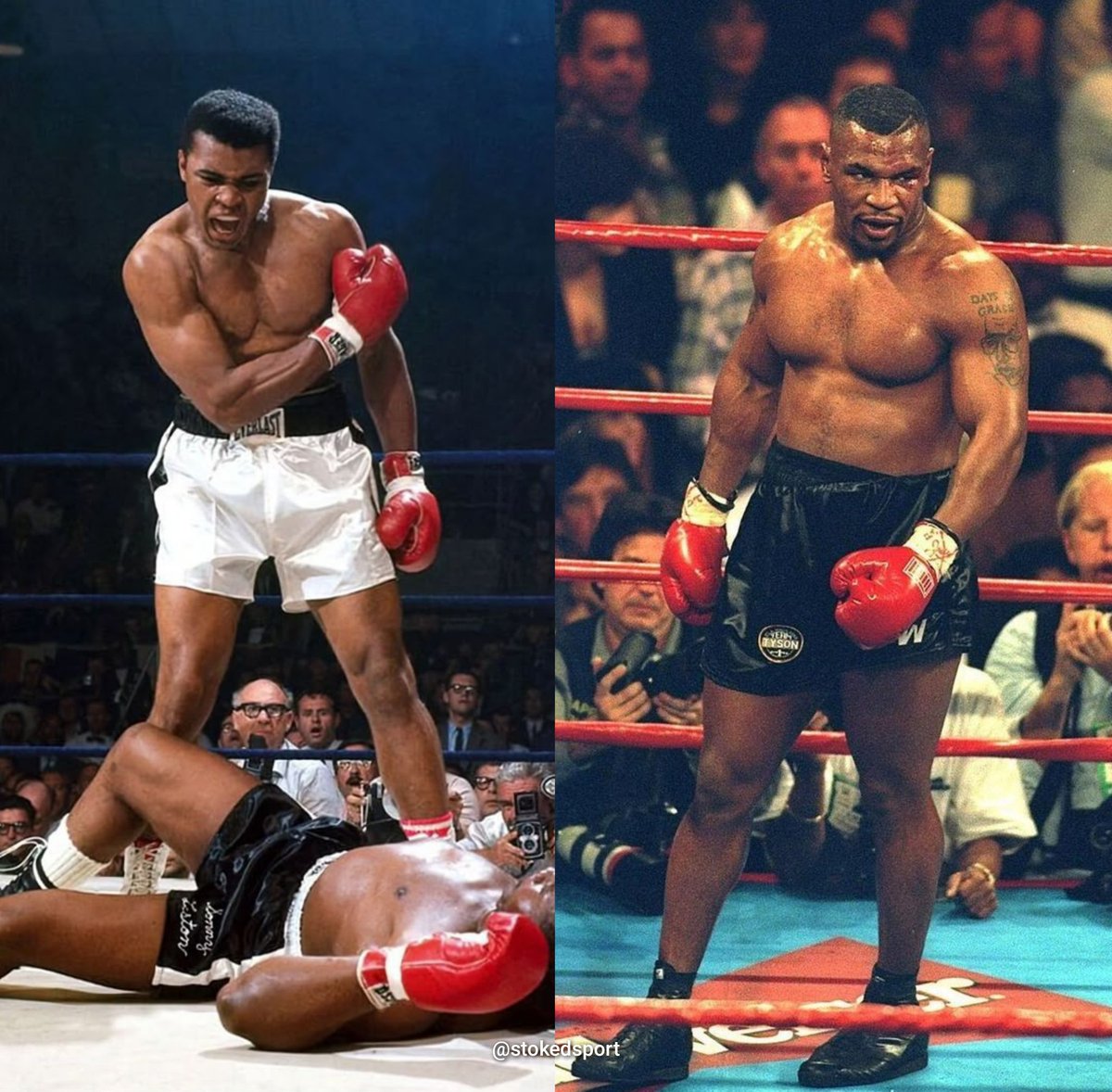
Unpopular opinion Mike Tyson had more influence in boxing than Muhammad Ali.
stokedsports tweet media
English
29
7
28
2.1K
20th Century Boxing: Icons, Memories & More
20th Century Boxing: Icons, Memories & More. Proud to bring a ventury of boxing history to the historically and knowledgeably illiterate of the boxing world 24/7/365. (Also on FB and Instagram. Expanding soon to other social media venues.)
20th Century Boxing: Icons, Memories & More tweet media20th Century Boxing: Icons, Memories & More tweet media20th Century Boxing: Icons, Memories & More tweet media20th Century Boxing: Icons, Memories & More tweet media
English
0
0
1
51